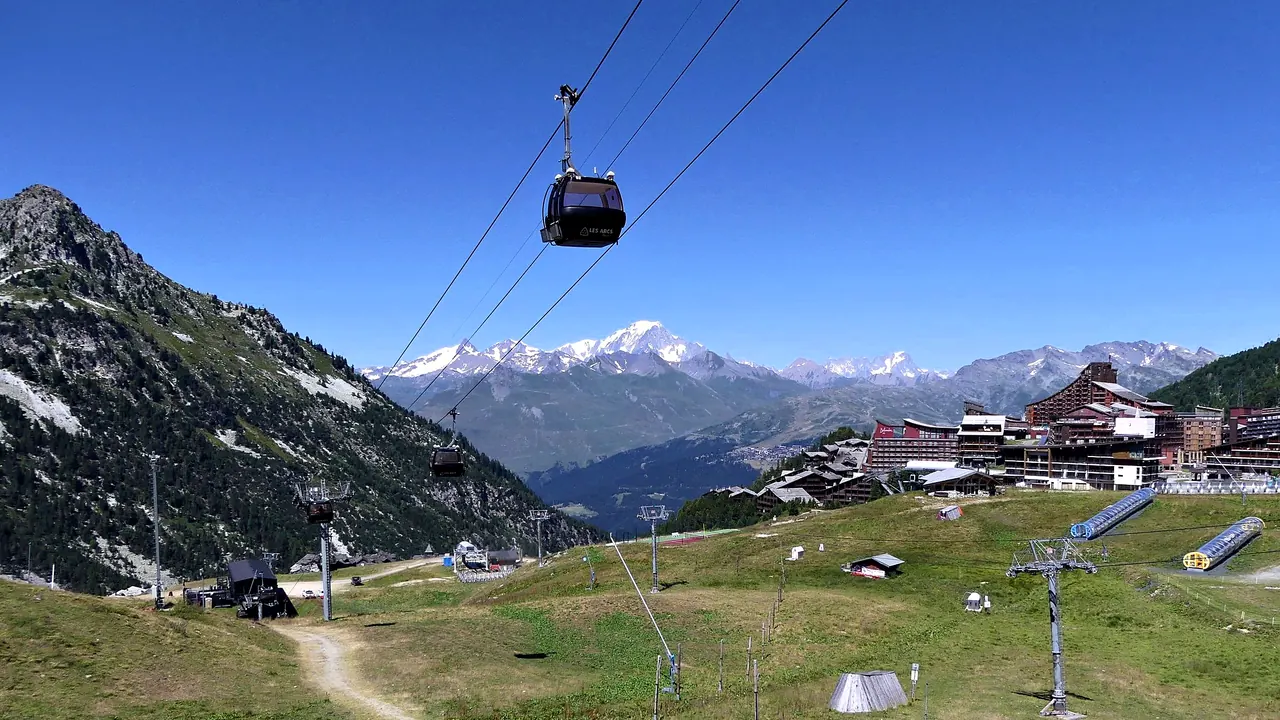
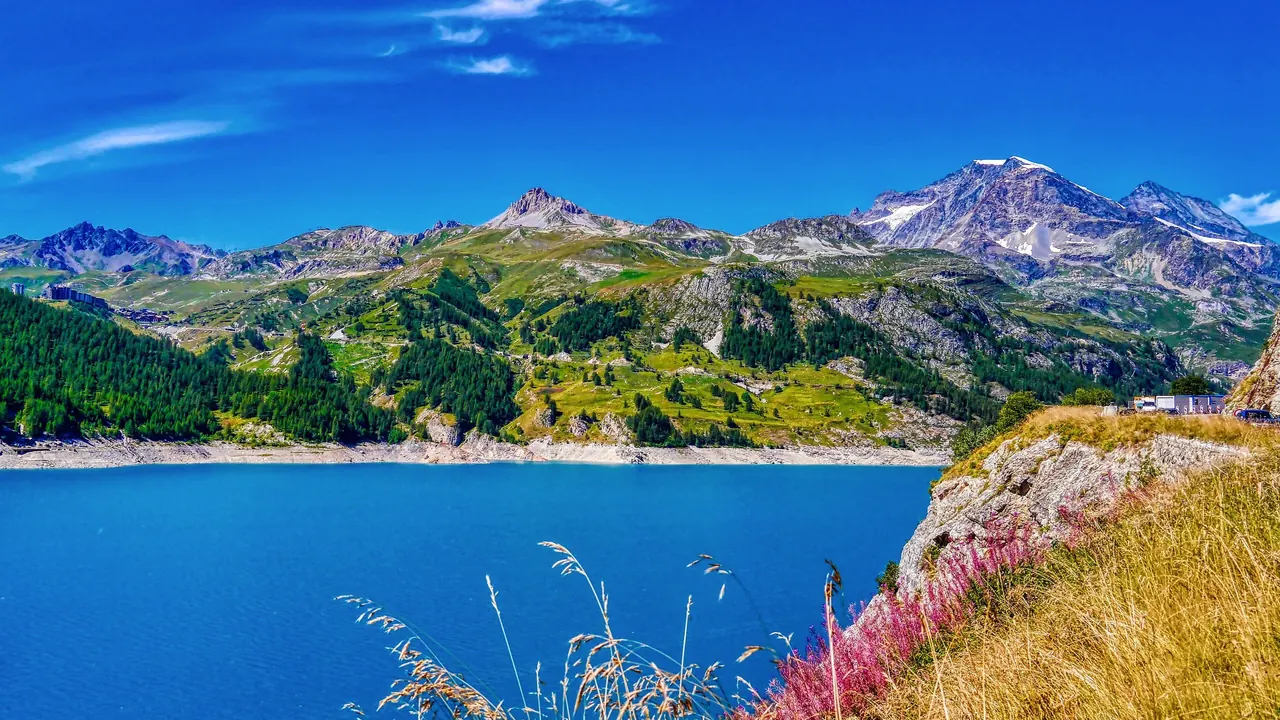
Photos: Les Arcs by Florian Pépellin, CC BY-SA 4.0, cropped; Tignes by Zairon, CC BY-SA 4.0, cropped.
Les Arcs or Tignes?
Our verdict in twelve categories, each scored against the same fixed benchmark cities, and the climate month by month, so you can choose for your trip.
Choose Les Arcs for
- day trips
- families
- live music and the arts
Les Arcs is the better pick for families and for anyone who would rather arrive by train than by car. Its car-free villages were planned around children's ski weeks, the funicular from Bourg-Saint-Maurice puts the valley a few minutes away, and Charlotte Perriand's architecture and the July chamber music festival give it more to notice beyond the pistes.
Choose Tignes for
- nightlife
- beaches
- wellness
Tignes suits groups of young skiers who want the evenings to run as hard as the days. Val Claret and Le Lac keep the bars and small clubs going well past midnight, the Grande Motte glacier stretches the season into autumn, and in summer the lake gives the village a shore to sit by and a cold swim.
Scoreboard
Twelve categories on one fixed scale from 0 to 100. The shaded stretch is the gap between the two.
Your match
Pick a travel style or drag the sliders, and both match scores follow your weighting.
Wins on day trips and families with your weighting.
Wins on nightlife and beaches with your weighting.
What matters to you?
Category by category
What the scores mean for a trip.
Beaches & swimming
Neither resort is somewhere to swim, but Les Arcs offers less. You get the heated pools in residences and the small leisure lakes down in the valley, and a real lake swim means a drive of about two hours to Annecy or Lac du Bourget.
Tignes at least has water at its centre. In July and August a supervised bathing area with a small sandy shore opens on the lake below Tignes Le Lac, though the snowmelt water is cold enough to make it a quick plunge. The indoor lagoon pool and slides at the aquatic centre beside it are a dependable fallback in any weather.
Food & drink
At the table the two are hard to tell apart: fondue, raclette, tartiflette and croziflette built on Beaufort, with long terrace lunches on the slopes. Les Arcs adds old farm buildings turned into mountain huts, and its best local produce is sold at the Beaufort cooperative and the markets down in Bourg-Saint-Maurice.
In Tignes the good cheese, charcuterie and Savoie wines are sold in delicatessens right in the villages. Its everyday choice leans more towards burgers and pizza for the ski crowd, and few kitchens stay open between seasons.
Culture & sights
Les Arcs has the stronger case, and it lies in the resort itself. Arc 1600 and Arc 1800, shaped by Charlotte Perriand, carry France's label for remarkable twentieth-century architecture and reward anyone curious about modernist design. Baroque chapels and stone hamlets lie further down the Tarentaise.
Tignes has a story more than sights. The old village was drowned by the Chevril dam in 1952, and the giant mural on the dam wall recalls it. Apart from that there are functional apartment blocks and a few small chapels in Les Brévières and Les Boisses.
Nightlife
Tignes is the clear choice for late nights. Après-ski moves from the mountain terraces into the bars of Val Claret and Tignes Le Lac, where seasonal workers and young British, Scandinavian and French groups dance in ski boots until the small clubs shut well after midnight.
Les Arcs has a good après hour at the foot of the slopes in Arc 1800 and Arc 2000, with DJs and table-dancing, and Arc 1800 has a late bar or two and a small club. With so many families in apartments, though, most evenings are over soon after dinner.
Nature & outdoors
Both are first-rate mountain bases beside the Vanoise National Park, and the difference is in the shape of the terrain. Les Arcs links with La Plagne by a double-decker cable car to form Paradiski, and its long runs drop from the Aiguille Rouge all the way down to the valley floor. In summer there is rafting on the Isère, a bike park and via ferrata.
Tignes sits higher, around its lake at 2,100m, and links with Val d'Isère. The Grande Motte glacier above it makes the snow more reliable and the season longer, and in summer the trails lead to alpine lakes.
Day trips
Les Arcs is much better placed for days out. It sits right above Bourg-Saint-Maurice, so the Beaufortain cheese villages, the Tarentaise chapels and the old towns of Chambéry and Annecy are all within a two-hour drive. When the Little St Bernard Pass is open in summer, Aosta and the Courmayeur side of Mont Blanc are within reach too.
Tignes lies at the head of a long valley, and every outing starts with the slow road down. Val d'Isère is a short bus ride away, and with a car you can visit the medieval hill village of Conflans and the village of Beaufort. In practice, though, most visitors stay up in the mountains.
Good for families
Les Arcs was designed for this. Its villages are largely free of traffic, and there are kindergartens and themed fun slopes. Sledging, snow play areas and ice skating fill the afternoons, and in summer there are lakeside play areas and mountain-bike lessons.
Tignes also handles a family ski week well, with ski-in, ski-out apartments, beginner areas beside Le Lac and Val Claret, and the aquatic centre for white-out days. Its greater height tires toddlers more, and families who want quiet nights are better off in the lower hamlets.
Getting around
Les Arcs is easier to reach. A funicular climbs from the main-line station in Bourg-Saint-Maurice to Arc 1600 in a few minutes, so a whole stay can be done without a car. Once you are there, the villages are spread out along a winding road, and you depend on shuttles that slow down in snow.
Tignes is the other way round. It is about forty minutes from the station by bus or taxi, but its villages sit close together and are linked by free shuttles and lifts, so in winter many guests ski from door to door.
Shopping & style
Shopping is purely practical in both: ski hire, outdoor gear and supermarkets for self-caterers. In Les Arcs the best things to take home, Beaufort and génépi liqueur, are mostly found down in Bourg-Saint-Maurice. Tignes sells its cheeses, cured sausages and mountain honey in delicatessens in the villages themselves.
Affordability
Both are expensive for a winter week, with lift passes, hire, lessons and lunches on the slopes, and costs peak in the French school vacation weeks. In Les Arcs, the main ways to save are cooking in your apartment and booking January or late March.
In Tignes, the long season leaves cheaper weeks at either end, and summer brings free or low-cost activities around the lake. Eating out stays at resort prices there all year.
Live music & performing arts
Les Arcs has the one real cultural event of the two. Its summer classical music festival, held since the 1970s, fills the halls and chapels with chamber concerts and a music academy for a few weeks in July. In Tignes, live music means après-ski bands, DJs on the terraces and the odd free outdoor concert, with no programme beyond that.
Wellness & relaxation
The two are fairly evenly matched, with saunas, steam rooms and pools for tired legs. In Les Arcs these are mostly inside the residences and hotels, and Brides-les-Bains and Salins-les-Thermes are about an hour away for real thermal waters. Its quiet summer paths suit a slow stay.
Tignes has a public spa in the aquatic centre by the lake, with hammam and massage open to anyone. Its winter evenings are noisier, but the lakeside is peaceful in summer.
When should you go?
Pick your month. The climate figures are measured averages, not a forecast.
Les Arcs in July
Tignes in July
Daytime high, °C
Rainfall in the month, mm
Where the figures come from
Les Arcs's temperatures are measured 43 km from the centre, at Grand St. Bernard / Grand Saint Bernard.
Les Arcs's station stands 199 m above the city centre, so the centre is likely a little warmer than the figures say.
Les Arcs has no rain gauge within 25 km of the centre, so its rainfall comes from a gridded climate dataset read at the destination rather than from a gauge further away.
Tignes has no weather station within reach, so its figures come from a gridded climate model rather than a measured record, and read a broad area rather than one spot.
Temperature and rainfall are climate normals, averaged over the years shown. Les Arcs: 1991-2020 normals, Grand St. Bernard / Grand Saint Bernard (43.4 km from centre). Tignes: 2001-2020 normals, NASA POWER reanalysis grid, no weather station within 90 km.
Both resorts sit below freezing from December to February, so winter is about snow, not strolling. The two part ways in summer. Les Arcs, at the height of its measured data, stays cool even in July and August at around 12°C, while Tignes reaches about 18°C, warm enough for walking in shirtsleeves and for a brief dip in the lake. Neither ever gets warm enough for a proper beach day.
Les Arcs is also the wetter of the two all year, with its heaviest rain in November at around 193mm, though July is its sunniest month and spring brings long, bright days for late-season skiing. Tignes gets about half that rain in most months, so its summer hiking weather tends to be drier and more reliable. Late spring and late autumn are the quiet in-between seasons in both.
Which traveller are you?
On a family trip with young children, Les Arcs is the better choice. Its villages are largely car-free, with kindergartens, gentle beginner slopes, sledging and skating close to the apartments, and the whole resort was laid out with family ski weeks in mind.
For a food and nightlife trip, choose Tignes. The cheese-heavy menus are much the same in both resorts, but the evenings are not. Tignes keeps its après-ski bars and small clubs in Val Claret and Le Lac loud well after midnight, while Les Arcs mostly goes to bed early.
For skiers who want to get on snow early or late in the year, Tignes has what Les Arcs lacks. The Grande Motte glacier opens its season in autumn and keeps some summer skiing going, high above a resort whose winter pistes are among the most snow-sure in the Alps.
Before you go
| Measure | Les Arcs | Tignes |
|---|---|---|
| Official language | French | French |
| Currency | Euro (EUR) | Euro (EUR) |
| Sockets | CE230 V, 50 Hz | CE230 V, 50 Hz |
| Driving side | Right | Right |
| Time zone | UTC+1, UTC+2 in summer | UTC+1, UTC+2 in summer |
| Emergency number | 112 | 112 |
| Elevation | 2,273 m | 1,440 m |
| Main airport | Geneva International Airport (GVA)92 km from centre150 non-stop destinations | Geneva International Airport (GVA)105 km from centre150 non-stop destinations |
| Public holidays this year | 11 days | 11 days |
By the numbers
| Measure | Les Arcs | Tignes |
|---|---|---|
| Population | - | 1,919 |
| People per km² | - | 24 |
| Museums within 10 km | 0 | 0 |
| UNESCO World Heritage sites within 50 km | 0 | 0 |
Where else could you go?
Every comparison below shares a destination with this one, so you can follow Les Arcs or Tignes somewhere new.
- Val d'Isèrevs Tignes
- La Rosièrevs Les Arcs
- La Plagnevs Les Arcs
- La Rosièrevs Tignes
- La Plagnevs Tignes
- Val d'Isèrevs Les Arcs