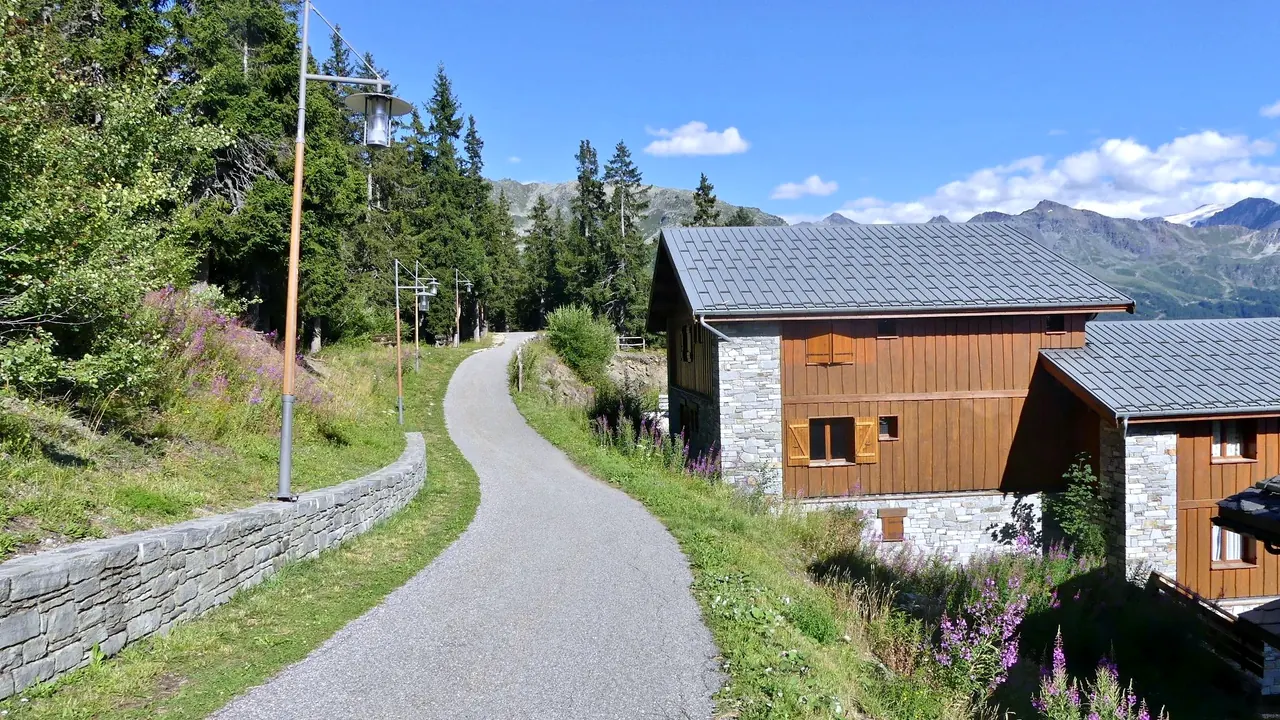
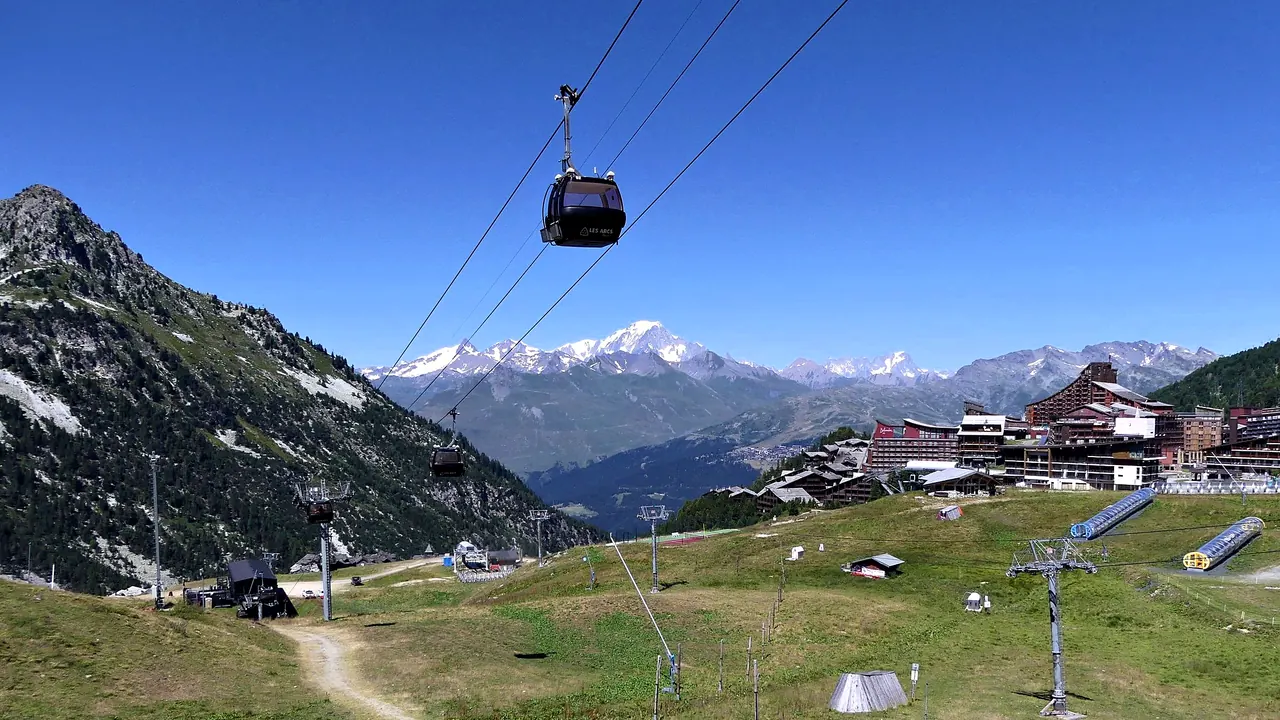
Photos: La Rosière by Florian Pépellin, CC BY-SA 4.0, cropped; Les Arcs by Florian Pépellin, CC BY-SA 4.0, cropped.
La Rosière or Les Arcs?
Our verdict in twelve categories, each scored against the same fixed benchmark cities, and the climate month by month, so you can choose for your trip.
Choose La Rosière for
- prices
- wellness
La Rosière is the smaller and quieter of the two. It suits skiers who like a sunny, south-facing slope and the chance to ski over the border to La Thuile for an Italian lunch, and it suits people who want evenings to end early in a chalet. It costs a little less, which helps self-catering groups and couples who care more about the mountain than what happens after the lifts close.
Choose Les Arcs for
- getting around
- live music and the arts
- families
Les Arcs is the better pick if you want a bigger, more complete resort. Through Paradiski you get far more skiing, there is more to do after skiing, the Perriand architecture is worth seeing in its own right, and a funicular brings you up from the train station. Families on a ski week, and anyone arriving by train, will find it easier to manage, as long as they can pay for it.
Scoreboard
Twelve categories on one fixed scale from 0 to 100. The shaded stretch is the gap between the two.
Your match
Pick a travel style or drag the sliders, and both match scores follow your weighting.
Wins on prices and wellness with your weighting.
Wins on getting around and live music and the arts with your weighting.
What matters to you?
Category by category
What the scores mean for a trip.
Beaches & swimming
Neither resort is anywhere near the sea, and swimming means a heated pool in your residence or hotel. In summer La Rosière has cold Alpine lakes further down the valley. From Les Arcs, a proper lake swim means a drive of about two hours to Annecy or Lac du Bourget.
Food & drink
The basic menu is the same in both: tartiflette, raclette, fondue and Beaufort, eaten in slope-side huts with long views. Les Arcs offers a little more range, with a few kitchens cooking refined alpine dishes and pizzerias and crêperies in each village.
La Rosière's choice is smaller and the menus repeat. Its compensation is unusual: you can ski over the border and have pasta, polenta and a proper espresso on the Italian side at lunch.
Culture & sights
Neither is a place for sightseeing, but Les Arcs has more to look at. Charlotte Perriand's stepped buildings at Arc 1600 and Arc 1800 are recognised modernist architecture and attract design enthusiasts on their own account.
La Rosière is a pleasant chalet resort with no real heritage of its own. Its most interesting history lies up on the Little St Bernard Pass in summer, at the Iron Age stone circle and the old hospice. Both resorts share the baroque churches of the Tarentaise villages below.
Nightlife
Les Arcs is livelier after the lifts close. Terrace bars at the foot of the slopes have DJs and table-dancing, and Arc 1800 keeps a late bar or two and a small club going. Even so, many guests are families, and most nights end early.
La Rosière is quieter still. A few bars fill for après-ski, one or two stay open later in peak weeks, and the resort is in bed soon after dinner. If you want to party, neither suits you well, but Les Arcs comes closer.
Nature & outdoors
Both are excellent mountain bases, and the difference is in the kind of terrain. La Rosière's area runs over the Little St Bernard Pass to La Thuile, so you ski in two countries. It has sunny south-facing runs, tree-lined pistes and heli-skiing from the Italian side, with views across to the Vanoise glaciers.
Les Arcs is bigger. Paradiski links it to La Plagne, and long descents run from the Aiguille Rouge at over 3,200m down to the valley. In summer it also has more organised activity: a bike park, via ferrata, and rafting on the Isère, alongside the ibex and marmots of the Vanoise.
Day trips
The day trips are much the same from both: Bourg-Saint-Maurice, the Beaufortain cheese villages, and Aosta's Roman remains and Courmayeur once the pass opens in summer. La Rosière sits right at the foot of that pass, so Italy feels like its natural outing. From Les Arcs, the big-name neighbours Val d'Isère and Tignes are the obvious winter alternatives to driving two hours to Annecy or Chambéry.
Good for families
Both resorts aim at families, but Les Arcs was planned for them from the start. Its villages are largely car-free and you can ski from the door. Ski schools take the youngest children, with kindergartens and themed fun slopes, and ice skating and pools fill the time off skis.
La Rosière offers central nursery slopes, ski-in, ski-out lodging and a village small enough for older children to wander, plus dog-sled outings. It has less to fall back on when the weather turns, though. Neither has any zoo or theme park.
Getting around
Les Arcs is unusually easy to reach without a car. A funicular climbs in a few minutes from the train station in Bourg-Saint-Maurice to Arc 1600, and free shuttles link the villages. The villages are spread far apart along the road, though, so you can't walk between them.
From the same station, La Rosière is about half an hour by bus up a winding road. Once there, you rely on pistes, lifts and a shuttle between its hillside quarters, and walking between them can be steep and icy. For trips beyond the resort, a car helps in both places.
Shopping & style
Shopping in both is practical: ski hire, outdoor gear, small supermarkets and local cheese. Les Arcs has a few more shops spread across its several villages, and génépi joins Beaufort as the souvenir to take home. La Rosière has a couple of food and gift shops. In both cases Bourg-Saint-Maurice is better for local produce.
Affordability
A winter week is expensive in either place, but La Rosière costs a little less. It is noticeably cheaper than the glamorous resorts nearby, and its chalets and apartments make self-catering easy.
Les Arcs costs more, partly because the pass covers the huge Paradiski area. Its mostly self-catering apartments help, and so do quieter weeks in January or late March. Summer is far cheaper in both.
Live music & performing arts
La Rosière has no performance life beyond the occasional band in a bar. Les Arcs has one real draw: a classical music festival running since the 1970s, which fills its halls and chapels with chamber concerts and a music academy for a few weeks in July. For the rest of the year, both offer only après-ski music.
Wellness & relaxation
Both resorts rely on the pools, saunas and spas in hotels and residences. The difference is in the pace and in where you go for proper bathing. La Rosière is restful all year, with chalets among the larches and early evenings, and in summer the historic baths of Pré-Saint-Didier are an easy trip over the pass.
Les Arcs is busier in ski week and only slows down in summer and the shoulder weeks. If you want to take the waters, the old spa towns of Brides-les-Bains and Salins-les-Thermes are about an hour down the valley.
When should you go?
Pick your month. The climate figures are measured averages, not a forecast.
La Rosière in July
Les Arcs in July
Daytime high, °C
Rainfall in the month, mm
Where the figures come from
La Rosière has no weather station within reach, so its figures come from a gridded climate model rather than a measured record, and read a broad area rather than one spot.
Les Arcs's temperatures are measured 43 km from the centre, at Grand St. Bernard / Grand Saint Bernard.
Les Arcs's station stands 199 m above the city centre, so the centre is likely a little warmer than the figures say.
Les Arcs has no rain gauge within 25 km of the centre, so its rainfall comes from a gridded climate dataset read at the destination rather than from a gauge further away.
Temperature and rainfall are climate normals, averaged over the years shown. La Rosière: 2001-2020 normals, NASA POWER reanalysis grid, no weather station within 90 km. Les Arcs: 1991-2020 normals, Grand St. Bernard / Grand Saint Bernard (43.4 km from centre).
Both are winter resorts first, with daytime highs below freezing from December to February in each. They part ways in spring. By April La Rosière is clearly above freezing at around 6°C, so spring has properly arrived on its sunny slopes. Les Arcs is still at 0°C and feels wintry through the month. In high summer La Rosière reaches about 18°C, comfortable for hiking and biking on the high pastures. Les Arcs peaks at around 12°C, so you need a jacket on the trails even in July.
Les Arcs is also wetter in every month, with the most rain and snow in November at about 193mm. Its sunshine is best from June to August and almost disappears in December, when the days are short and dim. La Rosière's drier, warmer summer makes it the gentler choice from June to September. Both are at their least inviting in November, between the seasons.
Which traveller are you?
On a family trip with children, La Rosière suits older children who are happy to roam a small, quiet village. Les Arcs is easier with toddlers, and in summer its lakeside play areas and mountain-bike lessons give children more to do than hikes and picnics.
On a tight budget, La Rosière is the better bet. You give up the sheer size of Paradiski, but you still ski in two countries, and with so few bars there is little to spend on after dark. Les Arcs costs more, although the train and funicular mean you can do without a hire car.
For a food and nightlife trip, Les Arcs is the one to pick. In La Rosière the best meal is often lunch over the border, and the evenings soon run out. Les Arcs has several villages to choose from, so a week can bring a different dinner and a different night out each evening.
Before you go
| Measure | La Rosière | Les Arcs |
|---|---|---|
| Official language | French | French |
| Currency | Euro (EUR) | Euro (EUR) |
| Sockets | CE230 V, 50 Hz | CE230 V, 50 Hz |
| Driving side | Right | Right |
| Time zone | UTC+1, UTC+2 in summer | UTC+1, UTC+2 in summer |
| Emergency number | 112 | 112 |
| Elevation | 1,844 m | 2,273 m |
| Main airport | Geneva International Airport (GVA)89 km from centre150 non-stop destinations | Geneva International Airport (GVA)92 km from centre150 non-stop destinations |
| Public holidays this year | 11 days | 11 days |
By the numbers
| Measure | La Rosière | Les Arcs |
|---|---|---|
| Museums within 10 km | 0 | 0 |
| UNESCO World Heritage sites within 50 km | 0 | 0 |
Where else could you go?
Every comparison below shares a destination with this one, so you can follow La Rosière or Les Arcs somewhere new.
- La Plagnevs Les Arcs
- Tignesvs Les Arcs
- Tignesvs La Rosière
- La Plagnevs La Rosière
- Val d'Isèrevs Les Arcs
- Courchevelvs Les Arcs