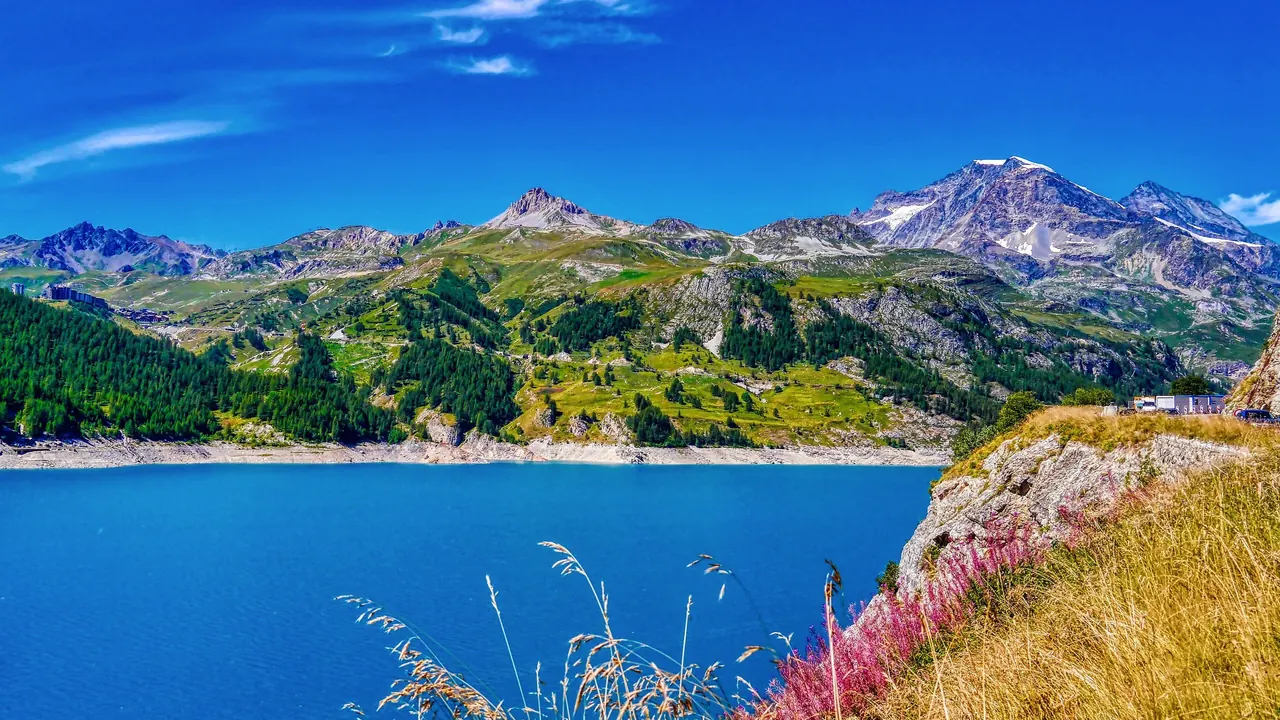
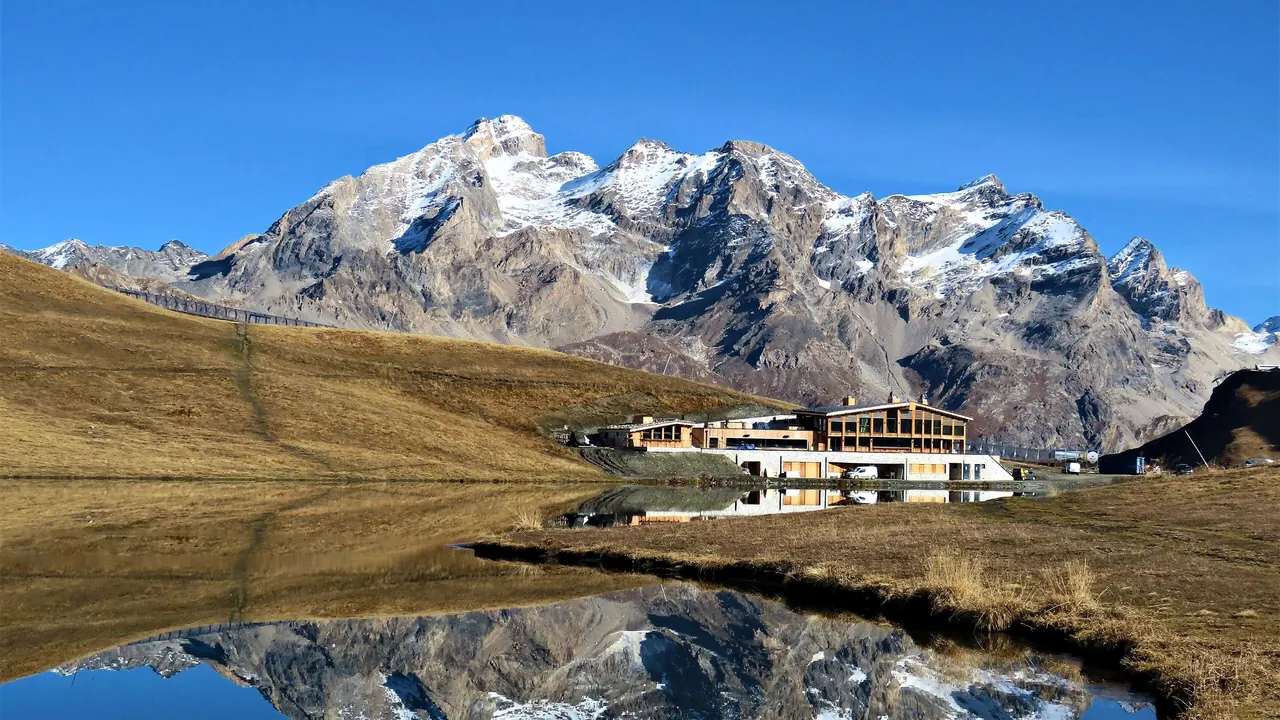
Photos: Tignes by Zairon, CC BY-SA 4.0, cropped; Val d'Isère by Rémih, CC BY-SA 4.0, cropped.
Tignes or Val d'Isère?
Our verdict in twelve categories, each scored against the same fixed benchmark cities, and the climate month by month, so you can choose for your trip.
Choose Tignes for
- beaches
- prices
- families
Tignes is the better pick for skiers watching their spending and for families who want everything close at hand. Its self-catering apartments, ski-in, ski-out lodging and beginner slopes beside the villages keep a week simple and cheaper. The lake gives it a summer side too, with a bathing area, pedalos and an aquatic centre for bad-weather days. You give up charm in return, because the villages are functional blocks built at altitude in the 1960s and 1970s.
Choose Val d'Isère for
- food and drink
- getting around
- shopping
Choose Val d'Isère if you want the same ski area with an older village around it and better food at night. It has a stone church, old lanes and larch-wood hamlets up the valley, and some of the most celebrated tables in the French Alps. The village runs along a single valley floor, so you can walk to dinner. All of this costs a good deal more, and the evenings are tuned to a wealthier chalet crowd.
Scoreboard
Twelve categories on one fixed scale from 0 to 100. The shaded stretch is the gap between the two.
Your match
Pick a travel style or drag the sliders, and both match scores follow your weighting.
Too close to call, level with your weighting
Wins on beaches and prices with your weighting.
Wins on food and drink and getting around with your weighting.
What matters to you?
Category by category
What the scores mean for a trip.
Beaches & swimming
Tignes has a modest advantage because its lake is right there. In July and August a supervised bathing area with a small sandy shore opens below Tignes Le Lac, and the aquatic centre next to it has a lagoon pool and slides all year. The water is snowmelt, though, so a swim is short and cold.
In Val d'Isère the same lake is over the ridge, and swimming mostly means the indoor pool at the village sports centre. Neither resort is a place for beach days.
Food & drink
Both cook from the same Savoyard repertoire of fondue, raclette and tartiflette, with Beaufort in nearly everything. Val d'Isère pulls clearly ahead in the evening. A handful of its kitchens are among the most celebrated in the French Alps, and its wine bars pour good Savoie whites.
In Tignes, Le Lac and Val Claret lean towards pizzerias, burger places and crêperies, with only a few kitchens trying a modern Alpine menu. Menus repeat from one restaurant to the next. In both resorts, the delicatessen cheese is the thing to remember.
Culture & sights
Neither resort is a sightseeing destination, but their histories are very different. The story of Tignes is the old village drowned by the Chevril dam in 1952, recalled by the giant mural on the dam wall. The resort that replaced it is made of functional apartment blocks.
Val d'Isère kept more of its past: the Baroque altarpiece of Saint-Bernard-de-Menthon, a few old lanes and the stone hamlets of Le Fornet and Le Joseray. Ski fans can also stand beneath the Bellevarde face, where the 1992 Olympic downhill was raced.
Nightlife
In winter both resorts go out equally hard, so the difference is in where the nights happen and who is out. In Tignes the nights are split between the bars of Val Claret and Le Lac, with small clubs and a young crowd of beer drinkers and seasonal workers. The lower hamlets stay quiet.
Val d'Isère's après-ski is famous for dancing on tables in the party restaurants on the slopes. Later the crowd moves into one compact village with a couple of basement clubs, and well-off chalet guests mix in with the workers. Both go quiet in summer and close between the seasons.
Nature & outdoors
The lifts link the two resorts into one ski area, so the mountains are effectively shared. What differs is the doorstep. Tignes looks onto its lake and the Grande Motte glacier, which starts the ski season early in autumn and keeps some summer skiing going.
Val d'Isère has the steep Face de Bellevarde, the Pissaillas glacier and ski touring routes. In summer, cyclists ride from the village up the Col de l'Iseran, at 2,764m. Both open onto the Vanoise National Park for summer hiking among ibex and marmots.
Day trips
Both sit at the head of the same long valley, so outings are few and similar: Bourg-Saint-Maurice at the bottom, and in summer Aosta over the Little St Bernard Pass. Tignes has Val d'Isère's old centre a short bus ride away and Conflans and Beaufort further down by car.
When the Col de l'Iseran is open, Val d'Isère has Bonneval-sur-Arc, a well-preserved stone village, less than an hour over the pass.
Good for families
Both work for a family that skis, but Tignes is slightly easier with small children. Its beginner areas sit right beside Le Lac and Val Claret, and many apartments are ski-in, ski-out. On days without skiing, the aquatic centre and the summer lake with its pedalos give children more to do. It does sit higher, which can tire the very young.
Val d'Isère offers fenced snow gardens, ski schools in several languages and childcare built into many chalet stays. Away from the snow it mostly has an ice rink, sledging and a climbing wall, so non-skiing parents may find the week long.
Getting around
Val d'Isère is easier to get around once you arrive. It is one village strung along the valley floor from La Daille to Le Fornet, with free shuttles along its length and lifts leaving from several points, so walking to dinner is normal.
Tignes is a scatter of separate villages at different levels, linked by shuttles and lifts, and the paths between them can be icy and uphill. Tignes is a little closer to the railway at Bourg-Saint-Maurice, though, and for both resorts anything beyond the valley needs a car.
Shopping & style
Shopping in both resorts means ski kit and cheese. Val d'Isère has more choice, with boot-fitting specialists and a few upmarket mountain-wear boutiques for the chalet crowd. Tignes is more about hire shops and supermarkets for self-caterers. Either way, Beaufort, charcuterie and Savoie wine from the delicatessens are the best things to take home.
Affordability
Tignes is the cheaper of the two, although it is still not a bargain. Lift passes, lessons and slope-side lunches add up, but the large stock of self-catering apartments and the cheaper early and late-season weeks give you ways to save. Summer around the lake is easier still.
Val d'Isère is among the most expensive places in the Alps for a winter week. Chalets, hotels, mountain lunches and village drinks are all priced for a well-off international crowd. Summer softens the cost but does not make it cheap.
Live music & performing arts
Neither resort has a theatre, concert hall or regular programme, and the live music is much the same. Tignes has bands and DJs on terraces plus the occasional free outdoor concert during resort events. Val d'Isère has cover bands in the après-ski bars and open-air events in the village. For anything more, you have to drive a long way down the valley.
Wellness & relaxation
Both are about equally restful, but the spas are set up differently. In Tignes, anyone can use the spa at the lakeside aquatic centre, which has a hammam and massage. Real thermal waters are at Brides-les-Bains, about an hour down the valley.
In Val d'Isère, wellness mostly belongs to the upmarket hotels and catered chalets, each with its own pool and treatment rooms. Everyone else uses the public spa area at the sports centre. Both are calmest in early summer and September.
When should you go?
Pick your month. The climate figures are measured averages, not a forecast.
Tignes in July
Val d'Isère in July
Daytime high, °C
Rainfall in the month, mm
Where the figures come from
Tignes has no weather station within reach, so its figures come from a gridded climate model rather than a measured record, and read a broad area rather than one spot.
Val d'Isère has no weather station within reach, so its figures come from a gridded climate model rather than a measured record, and read a broad area rather than one spot.
Temperature and rainfall are climate normals, averaged over the years shown. Tignes: 2001-2020 normals, NASA POWER reanalysis grid, no weather station within 90 km. Val d'Isère: 2001-2020 normals, NASA POWER reanalysis grid, no weather station within 90 km.
The two resorts share a high valley and the same climate, so the choice is about the trip, not the timing. Daytime highs stay below freezing from December to February, around -4°C in January, which is ideal for snow and too cold to linger outdoors. March and April are still wintry on the upper slopes but milder in the sun.
Summer is short. July and August reach about 18°C, which is pleasant for hiking and cycling but too cool for lazy swimming. May is the wettest month at about 103mm, and June and November are also damp. The months between the seasons are cool, grey and best avoided. For skiing, aim for midwinter to early spring. For walking, go in July, August or a crisp September at about 13°C.
Which traveller are you?
On a trip on a tight budget, Tignes is the more forgiving choice. Self-catering apartments make up much of the resort, and the free lakeside activities help in summer. Val d'Isère is priced for a well-off chalet crowd almost everywhere.
On a family trip with children, Tignes has the edge. Nursery slopes sit right by the villages, ski-in, ski-out apartments save carrying gear, and the aquatic centre with slides saves a white-out day. Val d'Isère answers with snow gardens and childcare included in many chalet stays.
For a food and nightlife trip, Val d'Isère is the better bet. Its celebrated kitchens and Savoie wine bars give the evenings more to them than the pizzerias and fondue of Tignes. Both resorts have lively après-ski, but Val d'Isère's dancing in the party restaurants on the slopes is the more famous.
Before you go
| Measure | Tignes | Val d'Isère |
|---|---|---|
| Official language | French | French |
| Currency | Euro (EUR) | Euro (EUR) |
| Sockets | CE230 V, 50 Hz | CE230 V, 50 Hz |
| Driving side | Right | Right |
| Time zone | UTC+1, UTC+2 in summer | UTC+1, UTC+2 in summer |
| Emergency number | 112 | 112 |
| Elevation | 1,440 m | 1,785 m |
| Main airport | Geneva International Airport (GVA)105 km from centre150 non-stop destinations | Geneva International Airport (GVA)111 km from centre150 non-stop destinations |
| Public holidays this year | 11 days | 11 days |
By the numbers
| Measure | Tignes | Val d'Isère |
|---|---|---|
| Population | 1,919 | 1,567 |
| People per km² | 24 | 17 |
| Museums within 10 km | 0 | 0 |
| UNESCO World Heritage sites within 50 km | 0 | 0 |
Where else could you go?
Every comparison below shares a destination with this one, so you can follow Tignes or Val d'Isère somewhere new.
- Les Arcsvs Tignes
- La Rosièrevs Tignes
- La Plagnevs Tignes
- Les Arcsvs Val d'Isère
- Val Cenisvs Val d'Isère
- Val Cenisvs Tignes