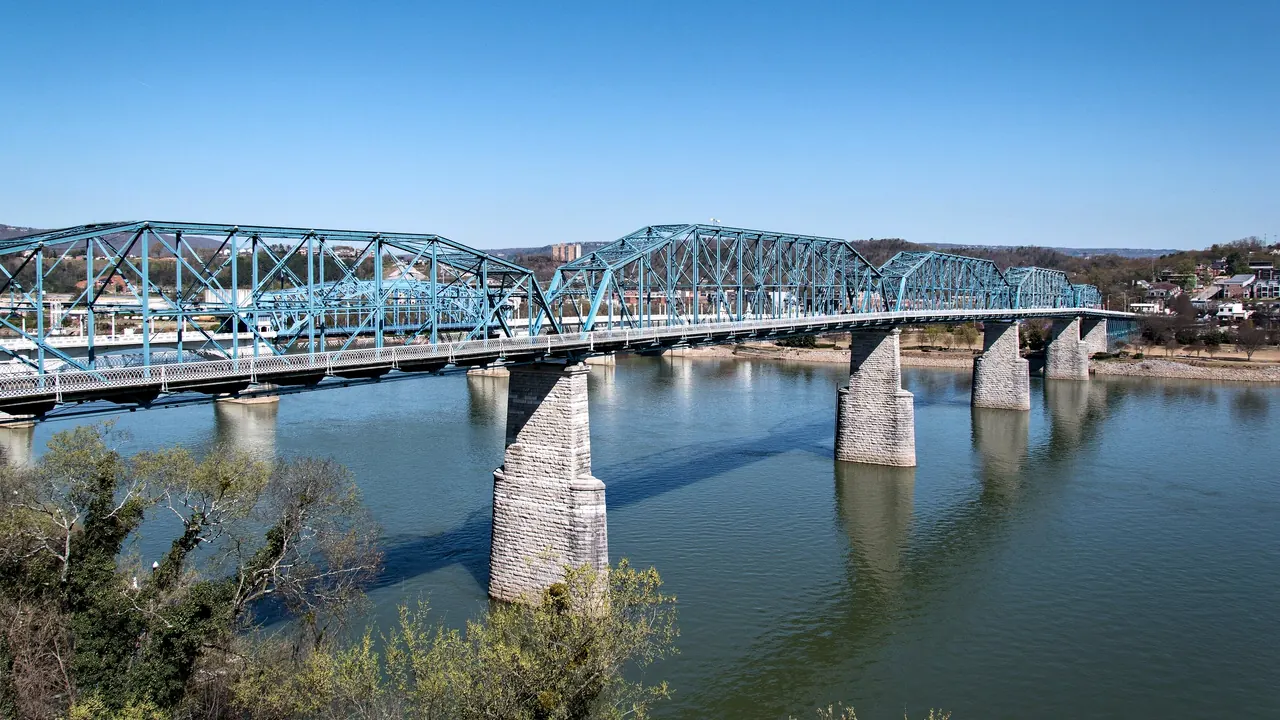

Photos: Chattanooga by Ɱ, CC BY-SA 4.0, cropped; Nashville by Warren LeMay, CC BY-SA 2.0, cropped.
Chattanooga or Nashville?
Our verdict in twelve categories, each scored against the same fixed benchmark cities, and the climate month by month, so you can choose for your trip.
Choose Chattanooga for
- nature and the outdoors
- families
- prices
Chattanooga is the pick for travellers who want to spend their days outside: climbing the sandstone bluffs, hiking above the Tennessee River Gorge or rafting the Ocoee, then coming back to a quiet evening by the river. It is also easier with children, because the aquarium and the Lookout Mountain attractions sit close together, and it costs a little less.
Choose Nashville for
- live music and the arts
- nightlife
- food and drink
Nashville belongs to people who travel for music and a night out. The Opry, the Ryman, the songwriter rooms and the honky-tonks of Lower Broadway give it an evening life Chattanooga cannot come close to. Hot chicken and the kitchens of East Nashville also make it the better place to eat. Expect to pay more and to spend less time on trails.
Scoreboard
Twelve categories on one fixed scale from 0 to 100. The shaded stretch is the gap between the two.
Your match
Pick a travel style or drag the sliders, and both match scores follow your weighting.
Wins on nature and the outdoors and families with your weighting.
Wins on live music and the arts and nightlife with your weighting.
What matters to you?
Category by category
What the scores mean for a trip.
Beaches & swimming
Neither city is a beach destination. Both are far inland, and swimming means a lake in summer. Chattanooga adds cool creek swimming holes up on the plateau and small swimming areas at Chickamauga Lake and Harrison Bay, while Nashville's Percy Priest and Old Hickory lakes are more for a day on a pontoon boat than a long swim.
Food & drink
Both cities cook the same Southern food, meat-and-three plates, barbecue, biscuits and fried chicken, but Nashville takes it further. Hot chicken gives it a dish of its own, and East Nashville, Germantown and the Gulch have more chef-driven kitchens. Nolensville Pike adds Kurdish, Mexican and Vietnamese cooking, which Chattanooga largely lacks.
Chattanooga eats well for a few days. Its best restaurants and breweries are around the Southside and Main Street, and the North Shore does brunch. Once you step away from Southern food, though, the choice narrows quickly.
Culture & sights
Nashville has more to see, and most of it is about music: the Country Music Hall of Fame, the National Museum of African American Music and a daytime tour of the Ryman. Add the Parthenon replica in Centennial Park, the Frist in its Art Deco post office and the Hermitage, and you have several full days.
Chattanooga's story is war and railways. The 1863 battlefields at Point Park and Missionary Ridge, the old Terminal Station and the Hunter Museum on its river bluff fill two or three good days. The Walnut Street Bridge is the landmark, and you will cross it more than once.
Nightlife
Going out is where Nashville pulls far ahead. Lower Broadway is several blocks of honky-tonks with a band on every floor, open to the street and busy into the small hours. East Nashville and Midtown are there for something calmer.
In Chattanooga an evening out means brewery tables, cocktail bars and the short strip of bars on Station Street, and most places wind down well before Nashville gets going. It suits a beer and a long talk on a patio, not a big night.
Nature & outdoors
Chattanooga is built into its landscape in a way Nashville is not. The Tennessee River cuts through the ridges of the Cumberland Plateau right at the city, so you can climb the sandstone bluffs, hang glide off Lookout Mountain, paddle the river gorge or ride the mountain-bike trails in Prentice Cooper without going far. The Ocoee whitewater and Cloudland Canyon are about an hour out.
Nashville's outdoors is gentler: deer and owls at Radnor Lake, forest walks in the Warner Parks, an easy paddle on the Harpeth and cycling on the Natchez Trace Parkway. It makes a pleasant morning, but there is no real climbing or whitewater.
Day trips
The two cities have about as much within a day's reach, and both can visit the Jack Daniel's distillery at Lynchburg. The difference is in what lies closest. Nashville's best outings are short: Franklin's preserved Main Street and battlefields are half an hour south, and Leiper's Fork and Stones River are nearby.
From Chattanooga, the most interesting trips are longer drives to bigger places: Atlanta or Nashville for a full day, Knoxville, or the Space and Rocket Center at Huntsville. Chickamauga battlefield is the easy short trip. Both cities need a car for all of these.
Good for families
Chattanooga keeps a family trip at a manageable size. Coolidge Park on the North Shore has a restored carousel and splash fountains for hot afternoons, there is a small zoo, and Lake Winnepesaukah, just over the Georgia line, is an old-fashioned amusement park rather than a giant theme park. The city is small and relaxed enough that children rarely feel overwhelmed. Summer heat and the drives between sights still need some planning.
Nashville has strong attractions of its own: the zoo at Grassmere, the planetarium and hands-on exhibits of the Adventure Science Center, and the Lane Motor Museum's odd collection of cars. They are in different parts of a spread-out city, though, so a day with children means a lot of time in the car. The Parthenon in Centennial Park and a summer water park by Percy Priest Lake help fill the gaps.
Getting around
Getting around feels much the same in both: a small centre you can walk, then a spread-out city built for the car. Chattanooga's free electric downtown shuttle and the Walnut Street Bridge to the North Shore make its core slightly easier, though the mountains and trails still need a car.
In Nashville, Broadway, the Ryman and the Gulch are a short walk from each other. The Opry, the Hermitage and East Nashville are each a drive apart, though, and rush-hour traffic on the interstates and party vehicles downtown slow things down.
Shopping & style
Shopping in Nashville has a clear character: boot and hat stores along Lower Broadway, new and vintage guitars, letterpress concert posters, and independent boutiques and record shops in 12 South and East Nashville.
Chattanooga is quieter, with converted railway warehouses at Warehouse Row and small boutiques and galleries along Frazier Avenue. Its one real strength is outdoor gear, which makes sense in a city people visit to climb and paddle.
Affordability
Chattanooga is the cheaper of the two, though it is moderate rather than a bargain. Hotels and casual meals cost less than in the big cities, and the trails, parks, riverfront walks and downtown shuttle are free. The aquarium, the Lookout Mountain attractions and a hire car with fuel still add up, especially for a family.
Nashville's downtown hotels are expensive, above all at weekends when groups fill them, and ride-hailing across such a spread-out city adds up. One thing helps: the honky-tonks on Broadway charge no cover. Staying midweek or outside downtown and eating at hot chicken counters and meat-and-three cafeterias also make a real difference.
Live music & performing arts
Here Nashville is in a different league. You could fill every evening of a trip with the Grand Ole Opry several nights a week, touring acts under the Ryman's famous acoustics, songwriter nights in small rooms, bluegrass near the Gulch and the symphony at the Schermerhorn.
Chattanooga has the gilded 1920s Tivoli Theatre, a small symphony and opera company and some country and bluegrass bands in Southside bars. That is enough for an evening or two, and music lovers based there often make a separate trip to Nashville.
Wellness & relaxation
Neither city has a spa or bathing tradition, so the choice comes down to pace. Chattanooga is the calmer place to slow down, a small city where an afternoon on the riverfront or a porch in Bluff View feels unhurried.
Nashville's downtown runs on noise and late nights. To rest there you need to go to the leafy streets of Belmont or Hillsboro, or to the hotel and day spas in the wealthier neighbourhoods.
When should you go?
Pick your month. The climate figures are measured averages, not a forecast.
Chattanooga in July
Nashville in July
Daytime high, °C
Rainfall in the month, mm
Temperature and rainfall are climate normals, averaged over the years shown. Chattanooga: 1991-2020 (sunshine 1981-2010) normals, Lovell Field (6.3 km from centre). Nashville: 1991-2020 (sunshine 1981-2010) normals, Nashville Airport (9.6 km from centre).
The two cities share almost the same climate, since they sit about two hours apart in the same corner of Tennessee. Both are hot and humid from June to August, with afternoons around 32°C that make long walks or hard hikes tiring. The lakes are warm enough for a swim from June to September. Spring, through April and May, and autumn, from late September into October, are the best months in both: warm, but without the heat.
Winters are cool and grey rather than harsh, and Chattanooga is a couple of degrees milder. It is also the wetter of the two in winter, with more than 120mm in most months from November to March. In return it gets noticeably more sunshine from late spring through summer, nearly 300 hours in May against about 240 in Nashville.
Which traveller are you?
For an outdoors trip, Chattanooga is the clear choice. Lookout, Signal and Raccoon mountains rise straight above town, and the sandstone bluffs draw climbers from across the East. The Ocoee whitewater and Cloudland Canyon are about an hour away. Nashville's lakes and greenways are gentle by comparison.
On a food and nightlife trip, Nashville wins easily. Hot chicken, meat-and-three cafeterias and the chef-led kitchens of East Nashville fill the days, and the honky-tonks on Lower Broadway have bands playing until the small hours. Chattanooga's breweries and patios are pleasant but quiet early.
On a family trip with children, Chattanooga is easier. The Tennessee Aquarium and the Creative Discovery Museum are a few blocks apart downtown, and the Incline Railway, Ruby Falls and Rock City are made for children. Nashville's zoo is good, but its downtown belongs to adults drinking late.
Before you go
| Measure | Chattanooga | Nashville |
|---|---|---|
| Currency | US Dollar (USD) | US Dollar (USD) |
| Sockets | AB120 V, 60 Hz | AB120 V, 60 Hz |
| Driving side | Right | Right |
| Time zone | UTC-5, UTC-4 in summer | UTC-6, UTC-5 in summer |
| Emergency number | 911 | 911 |
| Elevation | 206 m | 182 m |
| Main airport | Chattanooga Metropolitan Airport (Lovell Field) (CHA)6 km from centre15 non-stop destinations | Nashville International Airport (BNA)10 km from centre122 non-stop destinations |
| Public holidays this year | 13 days | 13 days |
By the numbers
| Measure | Chattanooga | Nashville |
|---|---|---|
| City population | 181,099 | 689,447 |
| People per km² | 484 | 506 |
| Museums within 10 km | 7 | 12 |
| UNESCO World Heritage sites within 50 km | 0 | 0 |
Where else could you go?
Every comparison below shares a destination with this one, so you can follow Chattanooga or Nashville somewhere new.
- Atlantavs Chattanooga
- Pigeon Forgevs Chattanooga
- Gatlinburgvs Chattanooga
- Louisvillevs Nashville
- Ashevillevs Chattanooga
- Pigeon Forgevs Nashville