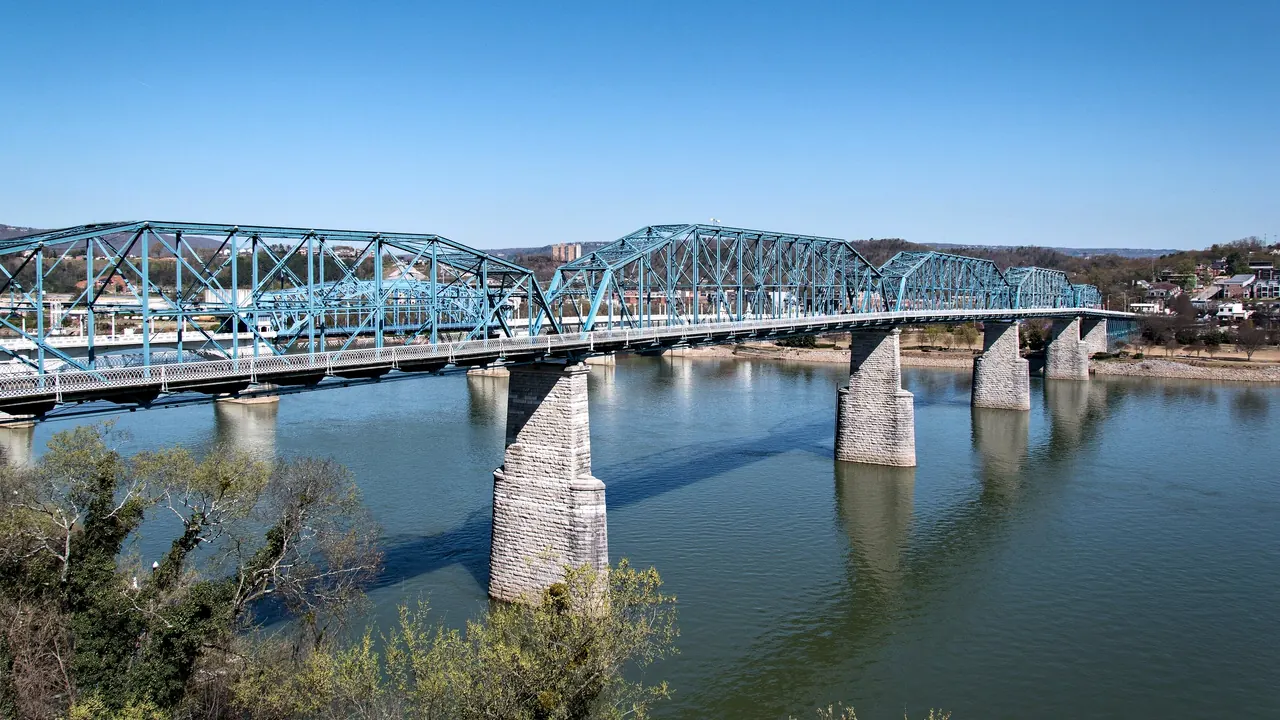
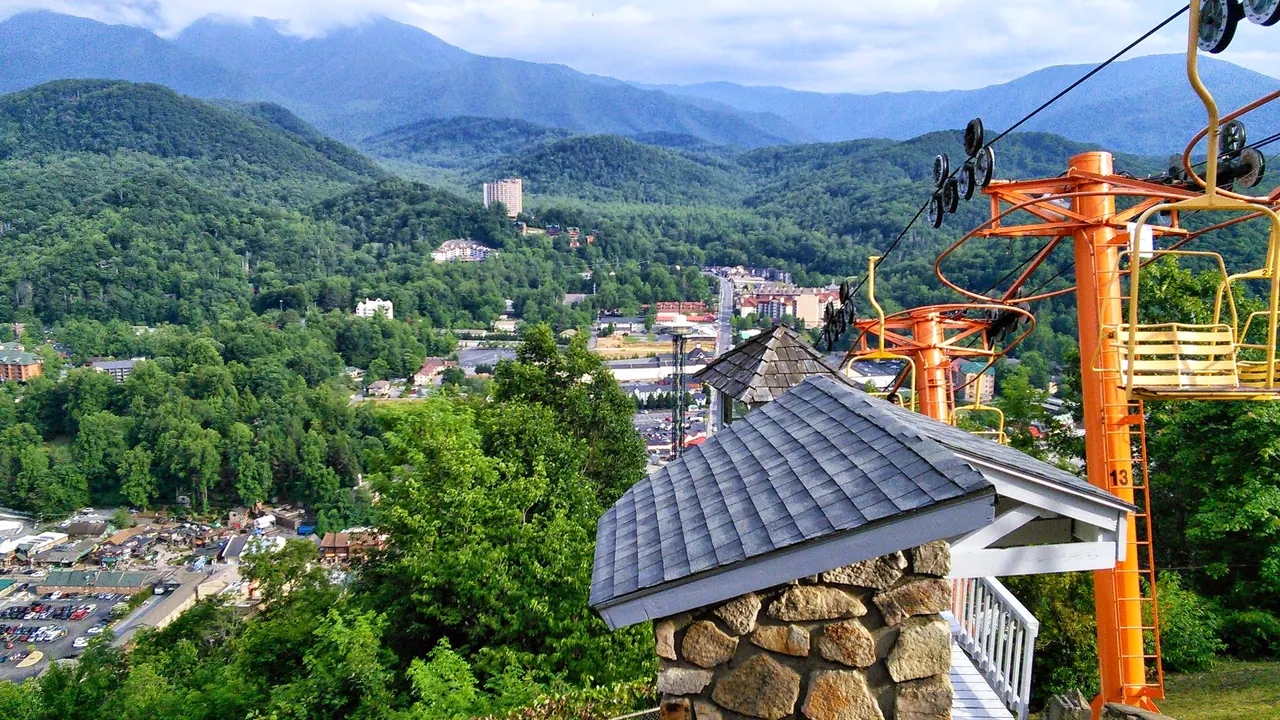
Photos: Chattanooga by Ɱ, CC BY-SA 4.0, cropped; Gatlinburg by Evan Nichols, CC BY 3.0, cropped.
Chattanooga or Gatlinburg?
Our verdict in twelve categories, each scored against the same fixed benchmark cities, and the climate month by month, so you can choose for your trip.
Choose Chattanooga for
- culture and sights
- food and drink
- nightlife
Chattanooga is the better choice for a rounded trip where the outdoors shares the days with a real town. Climbing, hiking and paddling start on the ridges above the river. The evenings bring Civil War sites, the Hunter Museum, Southern cooking on the Southside and a brewery or music bar afterwards, all in a centre you can walk.
Choose Gatlinburg for
- families
- nature and the outdoors
- wellness
Families, and anyone who wants the Smokies themselves, should lean towards Gatlinburg. The national park begins where the Parkway ends, with bears, waterfall walks and Clingmans Dome. The town is laid out for children, from the aquarium and alpine coasters to Dollywood nearby. Evenings are quiet and the food is plain, and the best rest comes on a cabin deck above the trees.
Scoreboard
Twelve categories on one fixed scale from 0 to 100. The shaded stretch is the gap between the two.
Your match
Pick a travel style or drag the sliders, and both match scores follow your weighting.
Wins on culture and sights and food and drink with your weighting.
Wins on families and nature and the outdoors with your weighting.
What matters to you?
Category by category
What the scores mean for a trip.
Beaches & swimming
Neither has a beach, but Chattanooga's lake water makes the friendlier swim. Chickamauga Lake and Harrison Bay State Park have designated swimming areas that are warm from June to September, and there are cool swimming holes on the plateau above town.
Gatlinburg's water is mountain river, cold even in July and fast after rain. Tubing on the Little River near Townsend is the fun here, and for a proper lake swim Douglas Lake is about forty minutes away.
Food & drink
Chattanooga eats noticeably better. Its Southern cooking runs from meat-and-three plates to smoked brisket and catfish. The Southside and Main Street have the chef-led restaurants and breweries, and the North Shore does brunch. The range is narrow, but you have real choices.
Gatlinburg's Parkway is built to feed crowds: pancake breakfasts, barbecue, fudge and moonshine tastings. Good Appalachian dishes such as trout, country ham and stack cake exist, but you have to look for them, and keen eaters drive to Knoxville.
Culture & sights
Chattanooga has the history and the museums. The Civil War battlefields on Lookout Mountain and Missionary Ridge, the old Terminal Station, the Hunter Museum on its bluff and the Walnut Street Bridge give you two or three solid days.
Gatlinburg has almost none of this in town, where the landmarks are an observation tower and mountaintop amusements. Its heritage lies in the working studios of the Great Smoky Arts and Crafts Community and in the mountain cabins, mills and churches of Cades Cove and the Roaring Fork, which you drive out to in the park.
Nightlife
Neither town is built for a late night, but Chattanooga gives you somewhere to go after dinner. Going out here centres on craft beer and cocktails, and the bars sit close enough together downtown that you can try two or three in an evening and find people your own age doing the same. It suits couples and groups of friends in their twenties and thirties who want a few drinks and some company after a day climbing or paddling, not a club.
In Gatlinburg, drinking is more something to sample than a night out: small glasses of fruit-flavoured moonshine at a tasting counter, perhaps a beer on a brewery terrace, then back up the hill. The evening is planned around families and couples, so anyone hoping to dance or stay out late will find almost nothing. For travellers who just want to unwind after the trails, though, that quiet is part of the appeal.
Nature & outdoors
Both are serious outdoor bases, and Gatlinburg has the edge because it opens straight into the Great Smoky Mountains National Park. Deep hardwood forest, waterfall walks, the Alum Cave climb up Mount LeConte, Clingmans Dome at close to 2,025m and frequent bear sightings make it the bigger wilderness, though roads clog at weekends and in October.
Chattanooga's outdoors is more about sport than wilderness. You get rock climbing on the sandstone bluffs, hang gliding from Lookout Mountain, paddling in the Tennessee River Gorge and Ocoee whitewater within an hour.
Day trips
The two have about as many outings as each other, but of different kinds. From Chattanooga the pull is cities: Nashville and Atlanta are each about two hours away, and Huntsville's Space and Rocket Center is closer, so long drives are part of the deal.
From Gatlinburg the trips lean towards the mountains. You can cross Newfound Gap to Cherokee and its museum, go on to Asheville and the Biltmore Estate, or drop down to quiet Townsend, with Knoxville about an hour away.
Good for families
Gatlinburg is the more complete family destination. The Parkway is one long run of attractions for children, Dollywood is a short drive away, and the park adds easy waterfall walks, creek wading and junior ranger badges. The cost is traffic and queues in high season.
Chattanooga is gentler and smaller. The Tennessee Aquarium and the Creative Discovery Museum are close together downtown, Lookout Mountain has the Incline Railway and Ruby Falls, and Coolidge Park has a carousel and splash fountains.
Getting around
In both towns you can walk only a small core and need a car beyond it. Chattanooga's walkable centre is wider, joining the riverfront, the Southside and the North Shore across the Walnut Street Bridge, and a free shuttle runs through downtown. In Gatlinburg the walkable part is the Parkway strip, with a trolley out to Pigeon Forge, but most visitors stay in hillside cabins and drive park roads that jam in October.
Shopping & style
Shopping is a sideline in both, though of different kinds. Chattanooga's best is on Frazier Avenue, with boutiques and outdoor-gear shops, and in the converted warehouses of Warehouse Row, with a large mall on the edge of town.
Gatlinburg's Parkway is mostly souvenirs and candy kitchens. The Arts and Crafts Community loop, though, sells quilts, pottery and brooms straight from the makers' studios, and Pigeon Forge has the outlet malls.
Affordability
Chattanooga costs a steady amount rather than a lot. Hotels and casual meals are cheaper than in the big American cities, and the trails, riverfront walks and downtown shuttle are free. Against that, the aquarium and Lookout Mountain charge full admission, and tips and a hire car add up.
Gatlinburg works out a little cheaper, mostly because of how people stay there. A large cabin shared by a group or an extended family, or an older motel midweek or in winter, keeps the bill down, and the national park costs little to enjoy. The savings disappear on the Parkway attractions and at Dollywood, and rates jump in October and over Thanksgiving, Christmas and New Year.
Live music & performing arts
Chattanooga can give you a proper evening at the theatre: the gilded 1920s Tivoli Theatre, a symphony and opera company with a regular season, and bluegrass and Americana bands in Southside bars. Gatlinburg's entertainment is mountain music in tasting rooms and on the street, with dinner shows and gospel revues in Pigeon Forge and more at Dollywood, but there is no orchestra or serious theatre.
Wellness & relaxation
Neither has spas worth travelling for, so the difference lies in how you stay. Gatlinburg's secluded hillside cabins, with a hot tub on the deck and mist on the ridges, make it the better place to switch off, as long as you stay above the noisy Parkway.
Chattanooga's calm is that of a small, quiet city: an unhurried afternoon on the riverfront or a porch in Bluff View, in a place where most visitors come to be active.
When should you go?
Pick your month. The climate figures are measured averages, not a forecast.
Chattanooga in July
Gatlinburg in July
Daytime high, °C
Rainfall in the month, mm
Where the figures come from
Gatlinburg's temperatures are measured 45 km from the centre, at McGhee Tyson Airport.
Gatlinburg has no rain gauge within 25 km of the centre, so its rainfall comes from a gridded climate dataset read at the city rather than from a gauge further away.
Temperature and rainfall are climate normals, averaged over the years shown. Chattanooga: 1991-2020 (sunshine 1981-2010) normals, Lovell Field (6.3 km from centre). Gatlinburg: 1991-2020 (sunshine 1981-2010) normals, McGhee Tyson Airport (44.9 km from centre).
The two share a humid Southern climate and are at their best at the same times. Spring and autumn suit both: April and October bring mild days that are ideal for hiking, and October is the driest month in each, with Gatlinburg falling to 69mm. From June to August afternoons reach 31°C to 32°C with heavy humidity and long sunny days. That is fine for a lake or river swim but hard work on a trail or a city walk at midday.
In both places rain falls right through the year. Chattanooga is wettest from December to March, at around 130mm a month, while Gatlinburg's wettest month is July, when summer storms build over the mountains. Winters are cool rather than harsh. Gatlinburg runs a couple of degrees colder and gets less sun, which suits a cabin more than a day of sightseeing.
Which traveller are you?
For a culture and arts trip, Chattanooga is the clear pick. Point Park and Missionary Ridge tell the story of 1863, the Hunter Museum fills an afternoon and the Tivoli stages concerts. Gatlinburg's heritage is mostly craft studios and cabins in the park.
On a food and nightlife trip, Chattanooga again comes out ahead. Chef-led kitchens, barbecue and craft breweries on the Southside, with Station Street for a drink, make for several good evenings. Gatlinburg offers pancake houses, fudge and moonshine tastings, and the strip empties early.
On a family trip with children, Gatlinburg is made for it. The Parkway's aquarium, coasters and chairlift parks, Dollywood nearby and easy waterfall walks with bears to spot keep children busy. Chattanooga's aquarium and Lookout Mountain make a calmer, smaller alternative.
Before you go
| Measure | Chattanooga | Gatlinburg |
|---|---|---|
| Currency | US Dollar (USD) | US Dollar (USD) |
| Sockets | AB120 V, 60 Hz | AB120 V, 60 Hz |
| Driving side | Right | Right |
| Time zone | UTC-5, UTC-4 in summer | UTC-5, UTC-4 in summer |
| Emergency number | 911 | 911 |
| Elevation | 206 m | 393 m |
| Main airport | Chattanooga Metropolitan Airport (Lovell Field) (CHA)6 km from centre15 non-stop destinations | McGhee Tyson Airport (TYS)46 km from centre34 non-stop destinations |
| Public holidays this year | 13 days | 13 days |
By the numbers
| Measure | Chattanooga | Gatlinburg |
|---|---|---|
| City population | 181,099 | 3,577 |
| People per km² | 484 | 133 |
| Museums within 10 km | 7 | 4 |
| UNESCO World Heritage sites within 50 km | 0 | 1 |
Where else could you go?
Every comparison below shares a destination with this one, so you can follow Chattanooga or Gatlinburg somewhere new.
- Pigeon Forgevs Gatlinburg
- Ashevillevs Gatlinburg
- Atlantavs Chattanooga
- Pigeon Forgevs Chattanooga
- Nashvillevs Chattanooga
- Atlantavs Gatlinburg