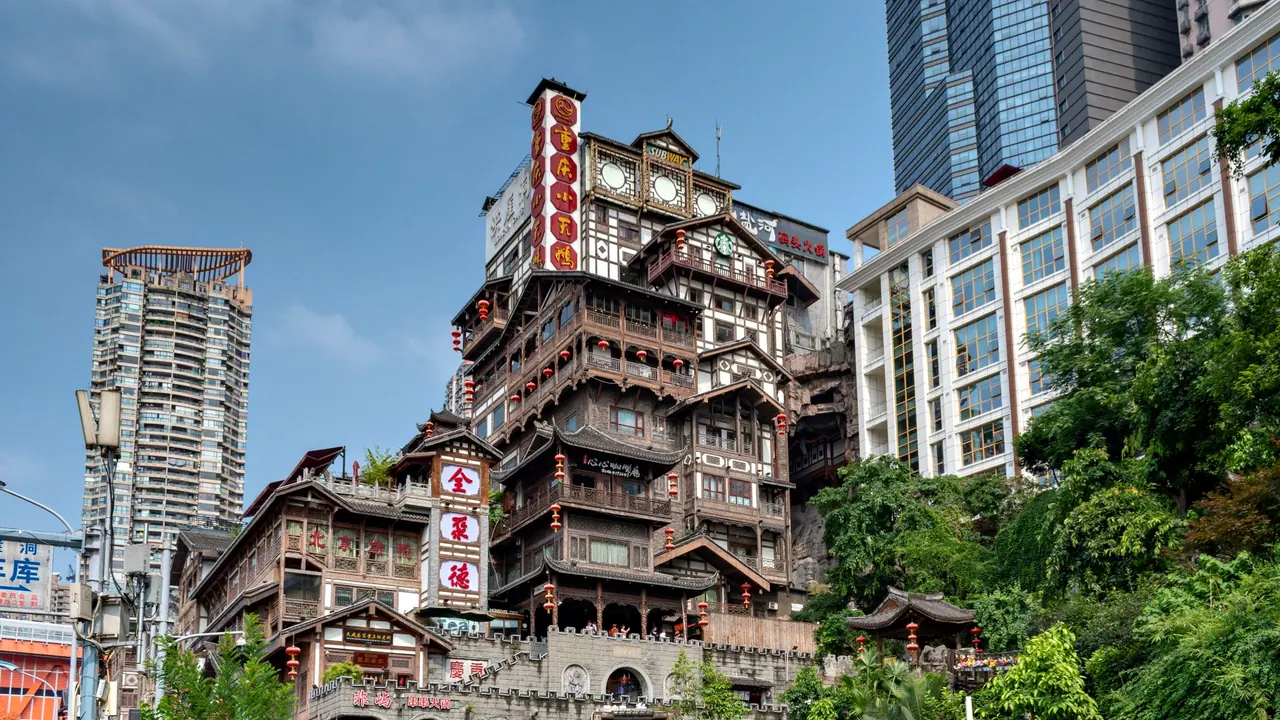
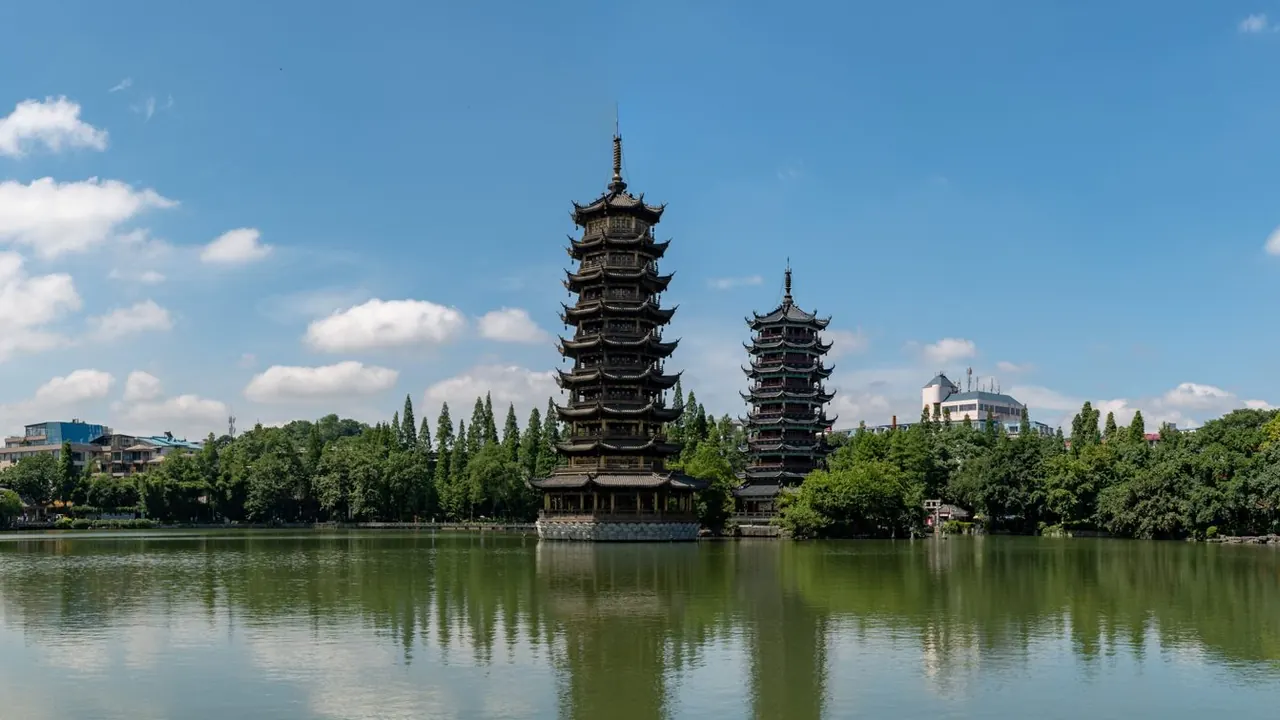
Photos: Chongqing by xiquinhosilva, CC BY 2.0, cropped; Guilin by xiquinhosilva, CC BY 2.0, cropped.
Chongqing or Guilin?
Our verdict in twelve categories, each scored against the same fixed benchmark cities, and the climate month by month, so you can choose for your trip.
Choose Chongqing for
- food and drink
- nightlife
- shopping
Chongqing suits travellers who want a big Chinese city at full volume. Hotpot, noodle breakfasts and skewers are the main reason to go, and the evenings run late. Towers climb the ridges above two rivers, and a monorail and cable cars carry you through it all. Chengdu and the Dazu carvings are within easy reach. It is the better choice for eaters, night owls and anyone who finds dense, vertical cities exciting rather than tiring.
Choose Guilin for
- nature and the outdoors
- beaches
Guilin is a trip for scenery more than for city life. The karst peaks along the Li River, bamboo rafting on the Yulong, cycling lanes around Yangshuo and the Longji rice terraces are what you go for, and the town itself is a pleasant base rather than the main event. Choose it if you want slow days outdoors and quiet nights in a guesthouse among the rice fields, and you are happy to give up much of the food and nightlife.
Scoreboard
Twelve categories on one fixed scale from 0 to 100. The shaded stretch is the gap between the two.
Your match
Pick a travel style or drag the sliders, and both match scores follow your weighting.
Wins on food and drink and nightlife with your weighting.
Wins on nature and the outdoors and beaches with your weighting.
What matters to you?
Category by category
What the scores mean for a trip.
Beaches & swimming
Both cities sit far inland, so neither is a place for a beach trip. The real difference is how you cool off. Around Yangshuo, the Yulong and Li rivers have calm, shallow stretches for wading or a dip from a bamboo raft. In Chongqing the Yangtze and Jialing are fast, muddy working rivers, so swimming means a hotel pool or one of the hot-spring resorts.
Food & drink
Food is the biggest gap between the two, and it favours Chongqing heavily. This is the home of hotpot, with its numbing beef-tallow broth. The day starts with fiery xiaomian noodles and carries on through spicy chicken, grilled fish and chuanchuan skewers, much of it served late into the night. If you can't handle chilli you will need a split pot, but the range and energy are on a different level.
Guilin's cooking is good but narrow. You eat mifen rice noodles at breakfast counters, river snails, stuffed vegetables and Yangshuo's beer fish, and after a few days you have covered most of it. Many restaurants near the sights cater to tour groups, so you will eat better by seeking out the noodle shops locals use.
Culture & sights
Chongqing gives more to look at and more history to explore. The city itself is the spectacle: towers on ridges, a monorail running through buildings, and Hongyadong's stilt houses lit up above the Jialing. Behind that are the Three Gorges Museum, the Huguang Guild Hall and the sites from its time as China's wartime capital, including the Stilwell Museum.
Guilin's sights are mostly nature turned into parks, such as Elephant Trunk Hill, Reed Flute Cave and the Sun and Moon Pagodas on Shan Lake. Its one major historic site is the Ming-era Jingjiang Princes' City. It is pleasant, but a day or two covers it.
Nightlife
Chongqing is the place for a real night out. Evenings start with the lit skyline from the riverbanks or the cable car, carry on into hotpot past 2am, and end in the glossy table-service clubs of Jiujie or a craft-beer bar near Jiefangbei.
Guilin's evenings are gentler: a walk around the lit-up lakes, skewers on Zhengyang Street and a beer. For anything later you need Yangshuo's West Street, which is loud and touristy.
Nature & outdoors
Guilin is the stronger choice here, and its landscape is famous across China. Limestone peaks line the Li River all the way to Yangshuo, rafts drift down the Yulong, and lanes between the peaks are made for cycling. The rock is a major climbing destination, and the Longji terraces cover whole mountainsides to the north.
Chongqing has good green escapes of its own. Nanshan's forest paths look across at the skyline, and Jinyun Mountain makes a half-day outing. Its finest karst, at Wulong, takes a long day, though. Summer heat and the haze that settles in the valleys limit outdoor time more than in Guilin.
Day trips
Chongqing has the broader choice of trips out. Chengdu, with its teahouses and panda base, is about an hour away by high-speed train. The Buddhist cliff carvings at Dazu are among China's finest, and the Diaoyu Fortress and stilt-house towns like Zhongshan add history.
Guilin's outings blur into its scenery. Yangshuo works better as a second base than as a day trip. Xingping and Daxu show old riverside life, and the ancient Lingqu Canal and the Zhuang and Yao villages at Longji round out a shorter list.
Good for families
Chongqing has more for children to do. They can see giant pandas at the zoo, spend time at the science museum on the Jiangbei riverfront and visit the theme parks on the edge of the city. Even a ride on the cable car over the Yangtze, or on a monorail that passes through a building, makes an outing. The cost is the terrain. Stairs and steep lanes are everywhere, so a pushchair is more hindrance than help, and with so much chilli in the food you will be asking for mild versions at most meals.
Guilin is easier on small legs. The centre is flat and walkable, older children can cycle the level lanes around Yangshuo, and rafting on the Yulong is gentle enough for most ages. Once you have done the caves and the river, though, there is little left, and nothing like Chongqing's pandas or theme parks to fill a spare day. Both cities are hot and sticky in July and August, and Guilin also has very heavy rain in late spring and early summer. English is scarce, so arranging transport and tickets before you arrive saves parents a lot of strain.
Getting around
Chongqing is easier to get around, thanks to a huge metro and monorail network with English signs. Its difficulty is vertical: a short distance on the map can mean dozens of flights of stairs or a lift down many floors, and map apps often lose you between levels.
Guilin has no metro, and its buses are signed mostly in Chinese. The centre around the Two Rivers and Four Lakes is compact and flat enough to walk, which helps. Reaching the countryside means a train to Yangshuo, a cruise or a car with a driver.
Shopping & style
Chongqing is the better city for shopping. The pedestrian streets around Jiefangbei and the Guanyinqiao malls carry international and luxury brands in quantity, though much of it is what any large Chinese city sells. Guilin has little beyond souvenir lanes and night-market stalls. What it does have is local: chilli sauce, osmanthus tea and sweets, Sanhua rice liquor, and Zhuang and Yao brocade from the villages.
Affordability
Both cities are very cheap day to day, so the difference lies in where the money goes. In Chongqing, meals, the metro and even upscale hotels cost little, and the extras are Yangtze cruises, cable cars and paid viewpoints. In Guilin, noodles, taxis and countryside guesthouses are just as easy on the budget. What adds up is entry to the sights, since the cruise, the caves and most hill parks all charge.
Live music & performing arts
Neither city is a reason to travel for the stage, but Chongqing has more variety. You can see Sichuan opera's face-changing and fire-spitting acts in teahouse theatres. The glass Grand Theatre on the Jiangbei waterfront hosts touring ballet and concerts, and the city has its own symphony orchestra.
Guilin's offer is mainly shows staged for visitors. The standout is Impression Liu Sanjie, staged on the Li River at Yangshuo with the peaks lit behind it, and there are acrobatics and the odd Gui opera in town. Concerts and theatre are essentially absent.
Wellness & relaxation
Chongqing has a real bathing culture. Its hot-spring resorts at Beiwenquan, Nanwenquan and Dongquan have outdoor pools in wooded valleys, and cheap foot-massage parlours stay open late after hotpot. The city itself is steep, noisy and humid, so rest means heading out to the edges.
Guilin has no bathing tradition of its own, and its nearest springs, at Longsheng, are about two hours away. Its form of rest is quieter. A guesthouse outside Yangshuo among the rice fields gives you slow days of cycling and tea, though with fewer ways to be pampered.
When should you go?
Pick your month. The climate figures are measured averages, not a forecast.
Chongqing in July
Guilin in July
Daytime high, °C
Rainfall in the month, mm
Temperature and rainfall are climate normals, averaged over the years shown. Chongqing: 1991-2020 normals, Chongqing (10.2 km from centre). Guilin: 1991-2020 normals, Guilin (7.6 km from centre).
Spring and autumn are the best times for both cities, but for different reasons. Chongqing is at its best in April, May and again in September and October, when it is warm enough to walk the stairs and riverbanks without the full summer heat. July and August reach 34°C with heavy humidity. These are its sunniest months, but they are hard work on foot. Winter is mild and fairly dry, but it is also very grey, with only a handful of sunshine hours in December and January.
Guilin's year turns on the rain. Late spring is very wet, with June bringing around 442mm, more than double Chongqing's wettest month. Mist often hangs over the peaks then, and river trips can be washed out. From September to November the rain eases off while the days stay warm, and this is the best season for the Li River, cycling and the golden terraces. Winters are a little milder than Chongqing's but damper. Neither city has beach weather in any useful sense.
Which traveller are you?
For a food and nightlife trip, Chongqing is the clear pick. Hotpot halls, xiaomian stalls and skewer kitchens keep cooking past midnight, and the riverside promenades and the Jiujie clubs in Jiangbei carry the night on. Guilin offers rice noodles and a lakeside beer.
On an outdoors trip, Guilin wins. The Li River cruise, rafting on the Yulong, flat cycling lanes between the peaks, world-known sport climbing at Yangshuo and the Longji terraces all lie close at hand. Chongqing's best landscapes, like Wulong, take a long day out.
On a shopping trip, Chongqing has far more to offer. The malls around Jiefangbei and Guanyinqiao carry international and luxury brands, and hotpot base and Sichuan pepper make easy gifts. Guilin's shopping is souvenir lanes, with osmanthus tea and minority embroidery as the best finds.
Before you go
| Measure | Chongqing | Guilin |
|---|---|---|
| Official language | Putonghua | Putonghua |
| Currency | Yuan Renminbi (CNY) | Yuan Renminbi (CNY) |
| Sockets | ACI220 V, 50 Hz | ACI220 V, 50 Hz |
| Driving side | Right | Right |
| Time zone | UTC+8 | UTC+8 |
| Emergency number | Police 110, ambulance 120, fire 119 | Police 110, ambulance 120, fire 119 |
| Elevation | 237 m | 153 m |
| Main airport | Chongqing Jiangbei International Airport (CKG)19 km from centre167 non-stop destinations | Guilin Liangjiang International Airport (KWL)25 km from centre43 non-stop destinations |
| Public holidays this year | 6 days | 6 days |
By the numbers
| Measure | Chongqing | Guilin |
|---|---|---|
| City population | 32,054,159 | 4,931,137 |
| Museums within 10 km | 7 | 1 |
| UNESCO World Heritage sites within 50 km | 0 | 1 |
Where else could you go?
Every comparison below shares a destination with this one, so you can follow Chongqing or Guilin somewhere new.
- Yangshuovs Guilin
- Chengduvs Chongqing
- Zhangjiajievs Chongqing
- Guangzhouvs Guilin
- Zhangjiajievs Guilin
- Macauvs Guilin