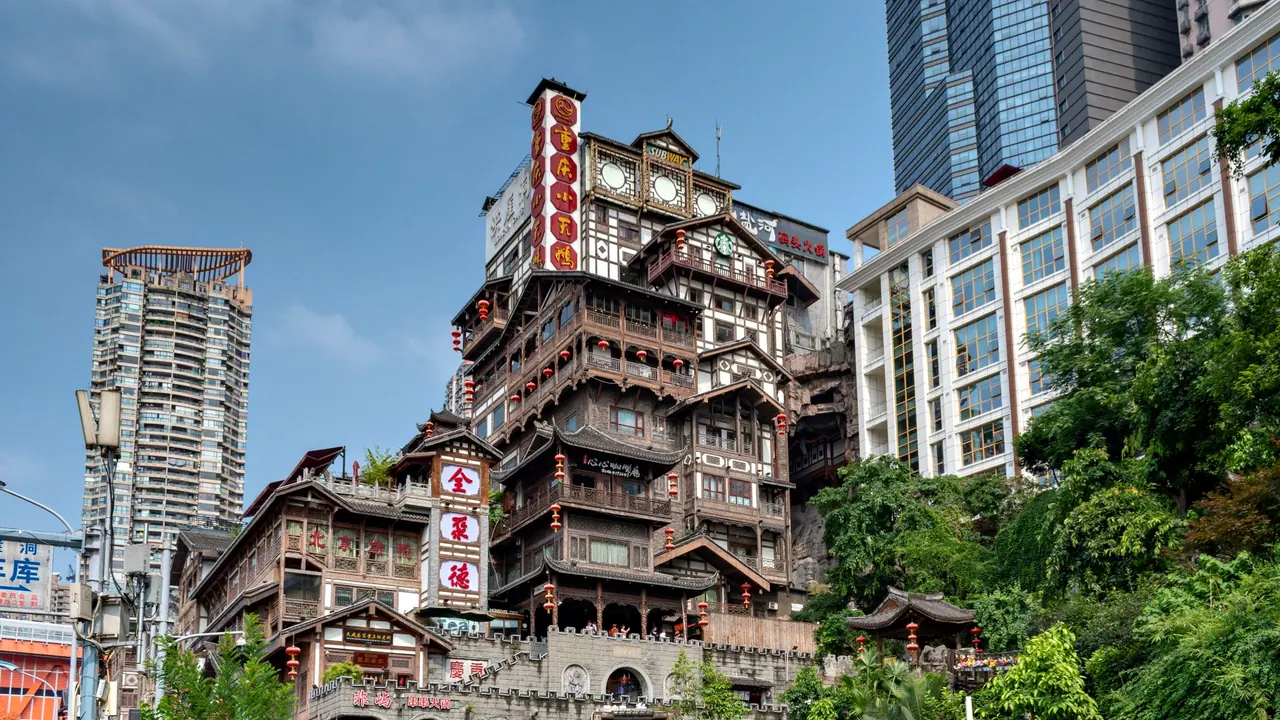
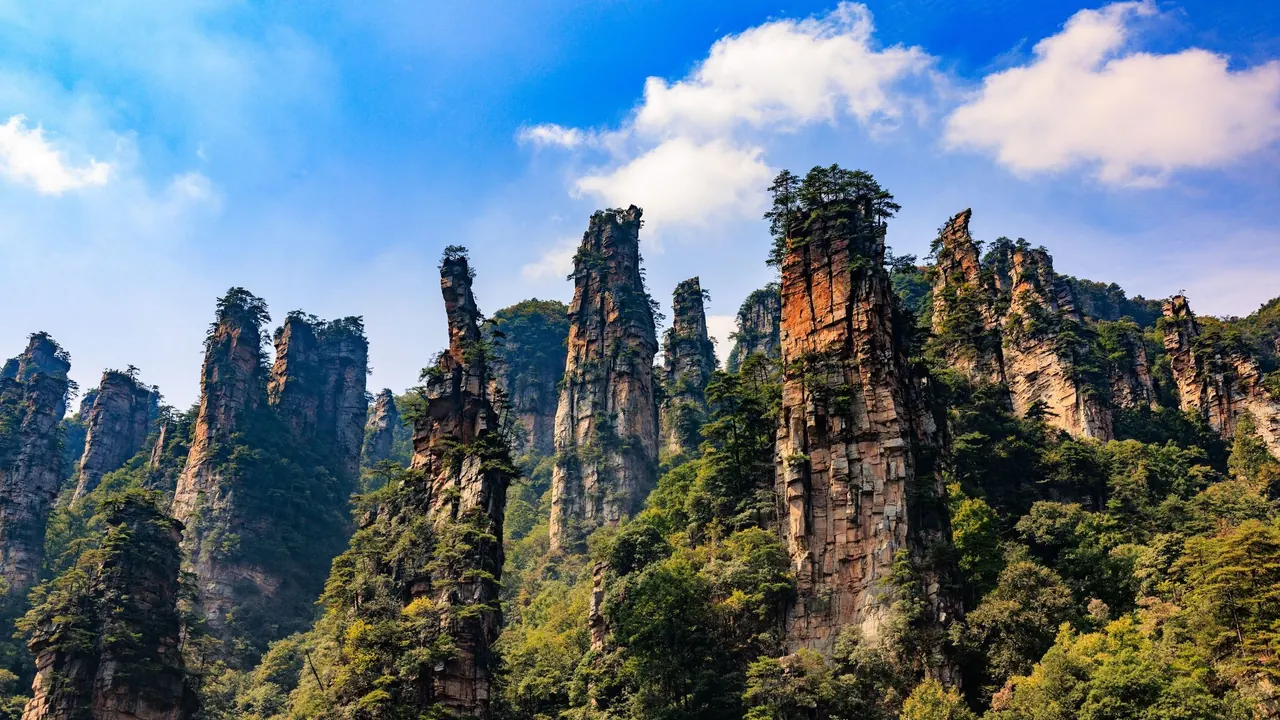
Photos: Chongqing by xiquinhosilva, CC BY 2.0, cropped; Zhangjiajie by David Tran, Pexels License.
Chongqing or Zhangjiajie?
Our verdict in twelve categories, each scored against the same fixed benchmark cities, and the climate month by month, so you can choose for your trip.
Choose Chongqing for
- nightlife
- food and drink
- shopping
Chongqing suits travellers who want a big city on its own terms. Hotpot halls and noodle stalls stay busy past midnight, towers rise in stacks on the ridges above two rivers, and the monorail runs through buildings. A large rail network makes all of it easy to reach. It also makes a good base: Chengdu and the Dazu carvings are both within a day, and there are hot-spring resorts on the edge of the city for recovering from the heat and the stairs.
Choose Zhangjiajie for
- nature and the outdoors
Choose Zhangjiajie if the landscape is the whole point of the trip. The sandstone pillars of Wulingyuan and the cliff paths of Tianmen Mountain are some of the most striking scenery in China, and Chongqing's hills and karst cannot match them. In return you give up most of what a city offers. Evenings are short, the food is simpler, the town's sights fill half a day and getting between the parks takes planning. It rewards walkers and photographers who are happy to be up at dawn.
Scoreboard
Twelve categories on one fixed scale from 0 to 100. The shaded stretch is the gap between the two.
Your match
Pick a travel style or drag the sliders, and both match scores follow your weighting.
Wins on nightlife and food and drink with your weighting.
Wins on nature and the outdoors with your weighting.
What matters to you?
Category by category
What the scores mean for a trip.
Beaches & swimming
Neither city is anywhere near a coast, and neither has a beach or a river safe to swim in, so on this count they are level. The difference is how you cool off. In Chongqing it is hotel pools, hot-spring resorts and the odd wading spot on the river shore. In Zhangjiajie it is summer rafting through the gorges, while Baofeng Lake is for boat rides rather than swimming.
Food & drink
Chongqing is a destination for eating in its own right. It is the home city of hotpot, cooked in everything from pavement stalls to vast halls. Mornings start with fiery xiaomian noodles, and the riverside and hillside districts are full of small kitchens selling spicy chicken, grilled fish and skewers until well after midnight.
Zhangjiajie's western Hunan cooking is good but narrower. The best of it is sanxiaguo stew, smoky cured pork, pickled chillies and mountain mushrooms, washed down with strong rice wine. The good eating is in the city's evening food streets, because the menus around the Wulingyuan gates are built for tour groups. Both places are hard going if you avoid chilli, though Chongqing's split pots make it easier to manage.
Culture & sights
For sightseeing, Chongqing gives you far more to fill the days. The city itself is the show: Hongyadong's stilt houses on the cliff, the peninsula lit up at night and monorails running through hillsides. Add the Three Gorges Museum, the Huguang Guild Hall, Luohan Temple and the wartime sites such as the Stilwell Museum, and that fills two or three days.
Zhangjiajie's town offers the quiet Ming-era Puguang Temple, a Tujia folk-customs park and a few rebuilt streets, which take about half a day. Its heritage lies in the Tujia villages and old towns further out.
Nightlife
Chongqing runs late. Evenings start with the river views and the cable car, move on to hotpot past 2am, and end in the glossy table-service clubs of Jiujie in Jiangbei or one of the scattered craft-beer bars. Expect to be out among locals rather than other tourists.
Zhangjiajie keeps hiking hours. Most people are in bed early for a dawn start in the park, so the riverside bars, karaoke parlours and night-food streets are for a beer after dinner, and Wulingyuan goes quiet even sooner.
Nature & outdoors
Zhangjiajie is the one people travel across China to see. Thousands of sandstone pillars, many over 200m tall, rise out of the forest at Yuanjiajie and Tianzi Mountain, with macaques along the Golden Whip Stream. Tianmen Mountain's cable car climbs straight from the town centre to cliff walkways and the great Heaven's Gate arch, and the Grand Canyon, Yellow Dragon Cave and rafting rivers lie beyond. The paths are paved and crowded at peak times, so go early.
Chongqing's outdoors are pleasant rather than spectacular. Nanshan's forest paths and skyline lookouts are just across the Yangtze, Jinyun and Gele mountains make half-day walks, and the natural bridges of Wulong and the Three Gorges cruises are its bigger draws.
Day trips
Chongqing has the wider range. Chengdu, with its teahouses and panda base, is about an hour away by high-speed train. The Dazu cliff carvings, made between the 9th and 13th centuries, are about two hours by road, and the Diaoyu Fortress recalls a Song garrison's long stand against the Mongols. Quieter stilt-house towns such as Zhongshan, Songji and Laitan fill out the list.
Zhangjiajie has fewer outings, but its best one is excellent. Fenghuang's walled riverside town on the Tuo is worth an overnight stay, and Furong Town's waterfall cliff and the UNESCO-listed Tujia ruins at Laosicheng complete a short list.
Good for families
With children, Chongqing is the easier pick. There are giant pandas at the zoo, a large science museum on the Jiangbei waterfront and theme parks on the edge of the city, and the river cable car and the monorail through buildings are treats in themselves. Its layered streets and stairs are hard with a pushchair, though.
Zhangjiajie thrills older children with its glass walkways, cliff-face lift and macaques, but almost nothing there is made for them. Long queues and steep steps wear out small children, so short days built around the cable cars work best.
Getting around
In Chongqing, the metro and monorail reach almost everywhere, with English signs and announcements, and cable cars, escalators and lifts deal with the slopes. The challenge is vertical. Street, bridge and building levels rarely line up, and map apps often lose track of where you are.
Zhangjiajie is spread out instead. The main forest park is about 30km from the city, the other sights are scattered beyond it, and the park's shuttle buses have mostly Chinese signs and long queues. Many visitors hire a driver and split their stay between Wulingyuan and the town.
Shopping & style
Chongqing offers large-scale city shopping. Malls and department stores crowd the pedestrian streets around Jiefangbei and Guanyinqiao, though they stock much the same as any large Chinese city. Packs of hotpot base and Sichuan pepper make the most local souvenir.
Zhangjiajie has little beyond stalls near the park gates. The things worth buying there are Tujia xilankapu brocade, some Miao silver, tea and smoked mountain produce.
Affordability
Both are cheap places to stay, eat and get around, so the difference lies in where the money goes. In Chongqing a full day of food and city sights costs little, and only extras such as Yangtze cruises, cable cars and paid viewpoints add up.
In Zhangjiajie the separately ticketed forest park, Tianmen cable car, glass bridges and lifts become the biggest cost of the trip. Rooms near the park gates also cost more during Golden Week and the Chinese New Year travel season.
Live music & performing arts
Chongqing has a modest but genuine stage. Sichuan opera's face-changing and fire-spitting routines are performed in teahouse theatres, and the glass Grand Theatre on the Jiangbei waterfront hosts ballet, touring productions and the city's own symphony orchestra.
Zhangjiajie offers large staged spectacles instead, retelling Tujia and Miao folklore. The open-air show beneath Tianmen's cliffs is the most memorable of them, but there is no local theatre or music scene beyond these shows.
Wellness & relaxation
Chongqing gives you real ways to rest. Hot springs that have been used for centuries feed outdoor pools in wooded valleys at Beiwenquan and Nanwenquan, and cheap reflexology parlours stay open late. The city itself is noisy and steep, so you have to make time for rest.
Zhangjiajie's days are built around stone steps and crowds. Recovery there means a foot massage after the trails, a hotel spa or a drive to the countryside springs, and the calmest moments are early mornings in the lower valleys.
When should you go?
Pick your month. The climate figures are measured averages, not a forecast.
Chongqing in July
Zhangjiajie in July
Daytime high, °C
Rainfall in the month, mm
Where the figures come from
Zhangjiajie has no weather station within reach, so its figures come from a gridded climate model rather than a measured record, and read a broad area rather than the city itself.
Temperature and rainfall are climate normals, averaged over the years shown. Chongqing: 1991-2020 normals, Chongqing (10.2 km from centre). Zhangjiajie: 2001-2020 normals, NASA POWER reanalysis grid, no weather station within 90 km.
Both cities are at their best in spring and autumn, roughly April and late September to October. Chongqing's summer is the harder one, with July and August highs around 34°C, heavy humidity and a wet June. That makes long days on its stairs and ridges tiring. Zhangjiajie stays a few degrees cooler in summer, reaching about 30°C in July, which is still warm for thousands of stone steps. Neither city has a sea, so warm months only mean sweatier walking.
Zhangjiajie is the wetter of the two all year. Its May and June rains reach about 229mm, against Chongqing's peak of 211mm in June. In April and October, though, both are mild and much drier than in early summer. Winter is cold and grey in both. Zhangjiajie drops to around 7°C in January and its peaks sometimes see snow. Chongqing is a little milder but very dull, with only a handful of sunshine hours a month from November to February.
Which traveller are you?
On a food and nightlife trip, pick Chongqing. Eating is the main event there, and dinners run on into bars and clubs well after midnight. Zhangjiajie's cooking is worth trying, but its evenings end early, with the town up at dawn.
For an outdoors trip, choose Zhangjiajie. Chongqing manages half-day walks on Nanshan and a long day out to Wulong's natural bridges. Zhangjiajie's pillar forest and Tianmen's cliff paths can fill several days, with rafting and the Grand Canyon in reserve.
On a relaxing and wellness trip, choose Chongqing. A soak in the thermal pools at Beiwenquan, below Jinyun Mountain, fills a half-day, and locals often finish a hotpot night with a foot massage. Zhangjiajie's long days on stone steps leave little room to unwind.
Before you go
| Measure | Chongqing | Zhangjiajie |
|---|---|---|
| Official language | Putonghua | Putonghua |
| Currency | Yuan Renminbi (CNY) | Yuan Renminbi (CNY) |
| Sockets | ACI220 V, 50 Hz | ACI220 V, 50 Hz |
| Driving side | Right | Right |
| Time zone | UTC+8 | UTC+8 |
| Emergency number | Police 110, ambulance 120, fire 119 | Police 110, ambulance 120, fire 119 |
| Elevation | 237 m | 170 m |
| Main airport | Chongqing Jiangbei International Airport (CKG)19 km from centre167 non-stop destinations | Zhangjiajie Hehua International Airport (DYG)5 km from centre31 non-stop destinations |
| Public holidays this year | 6 days | 6 days |
By the numbers
| Measure | Chongqing | Zhangjiajie |
|---|---|---|
| City population | 32,054,159 | 1,517,027 |
| People per km² | - | 159 |
| Museums within 10 km | 7 | 0 |
| UNESCO World Heritage sites within 50 km | 0 | 1 |
Where else could you go?
Every comparison below shares a destination with this one, so you can follow Chongqing or Zhangjiajie somewhere new.
- Chengduvs Chongqing
- Guilinvs Zhangjiajie
- Yangshuovs Zhangjiajie
- Xi'anvs Chongqing
- Xi'anvs Zhangjiajie
- Guilinvs Chongqing