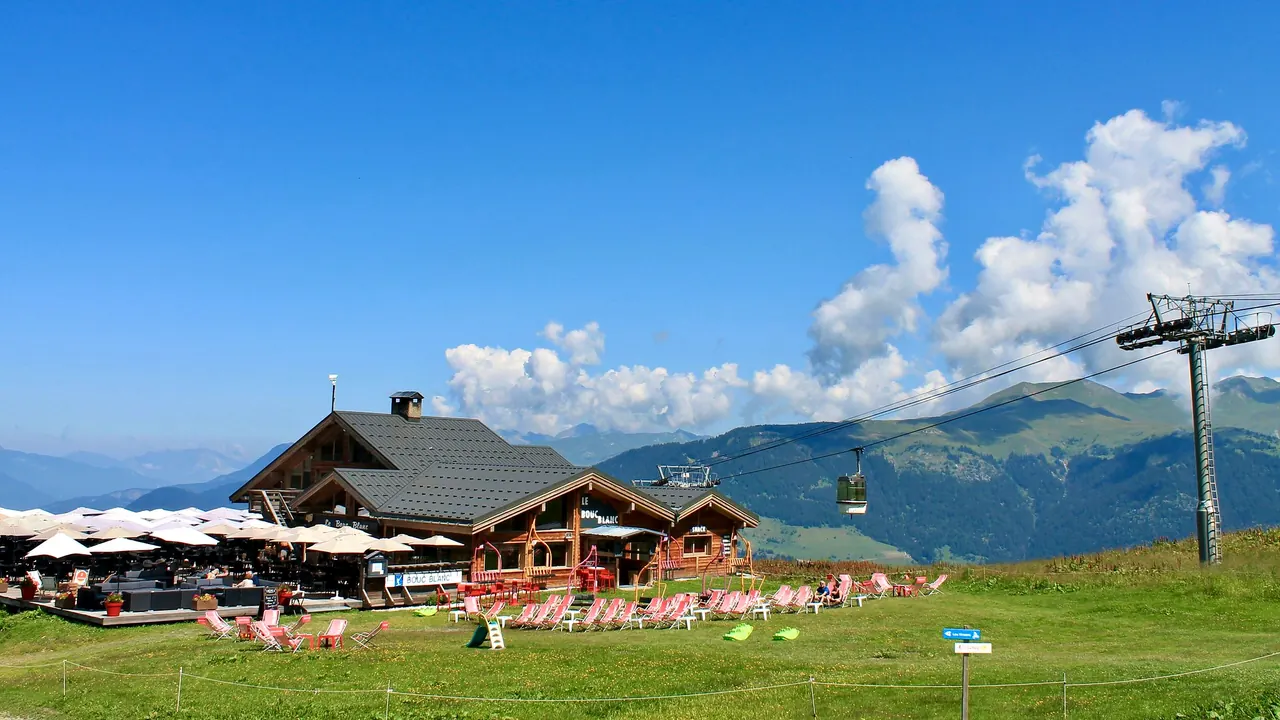
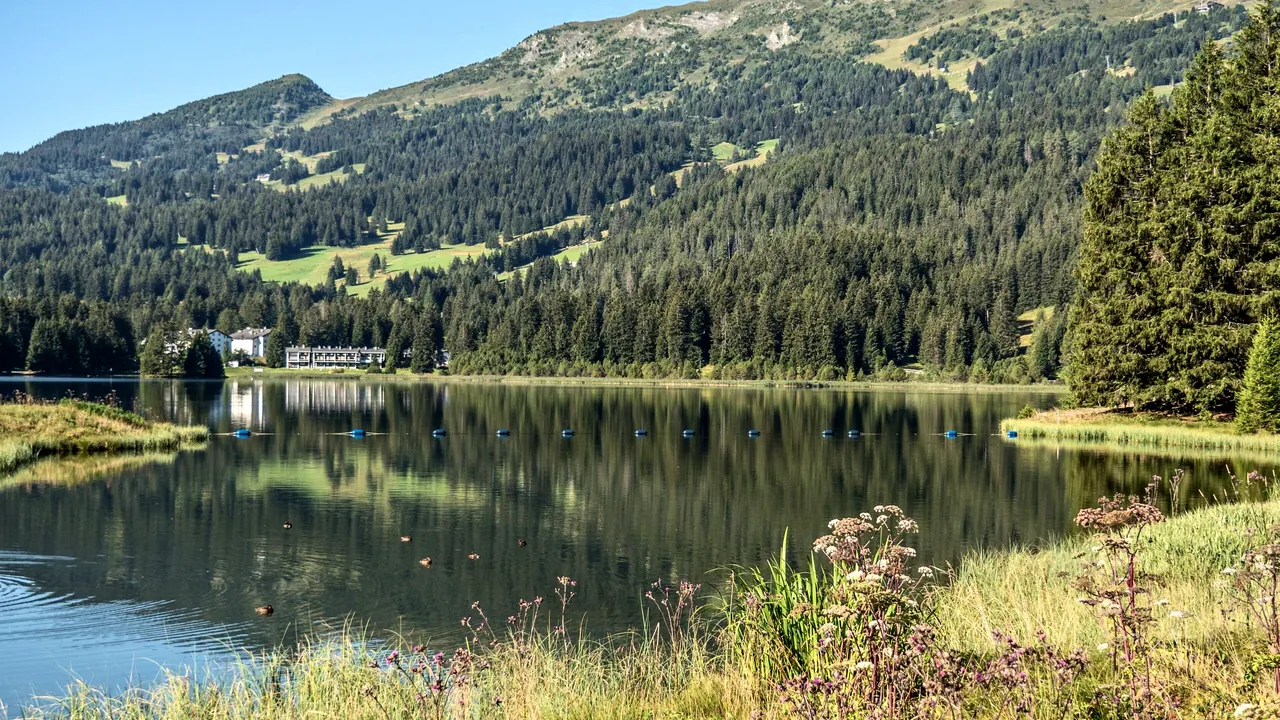
Photos: Courchevel by B. Brassoud, CC BY-SA 4.0, cropped; Lenzerheide by Jag9889, CC BY-SA 4.0, cropped.
Courchevel or Lenzerheide?
Our verdict in twelve categories, each scored against the same fixed benchmark cities, and the climate month by month, so you can choose for your trip.
Choose Courchevel for
- food and drink
- shopping
- nightlife
Courchevel is the pick for a winter ski week where the evenings count as much as the pistes. It has the vast linked terrain of Les 3 Vallées, and Courchevel 1850 adds starred dining rooms, long lunches on sunny terraces, late clubs, luxury boutiques and palace spas. It suits travellers with a very large budget who are happy to stay on the mountain all week.
Choose Lenzerheide for
- day trips
- beaches
- getting around
Lenzerheide is for people who spend the day outdoors and keep their evenings quiet. It makes the better summer base, with a lake you can actually swim in and one of the Alps' leading bike parks. It is also easier to reach and to leave. The PostBus from Chur links it to the Swiss railways, and Chur, the Albula line and the wine villages around Maienfeld all make proper day trips.
Scoreboard
Twelve categories on one fixed scale from 0 to 100. The shaded stretch is the gap between the two.
Your match
Pick a travel style or drag the sliders, and both match scores follow your weighting.
Wins on food and drink and shopping with your weighting.
Wins on day trips and beaches with your weighting.
What matters to you?
Category by category
What the scores mean for a trip.
Beaches & swimming
Neither resort is near the sea, but Lenzerheide does the summer swim better. The Heidsee lies at the foot of the village, with a lido, a grassy shore and clear water that is fine for a cool dip in July and August. Courchevel's nearest equivalent is the small Lac de la Rosière above Moriond, which is more for paddling and sunbathing on the grass, so most swimming there happens indoors at the aquatic centre or in a hotel pool.
Food & drink
Courchevel eats at a level few mountain resorts reach. The palace hotels of 1850 hold a cluster of Michelin-starred kitchens, and lunch on the slopes means grilled meats, seafood and serious wine lists on sunny terraces, with fondue and tartiflette for everyday meals.
Lenzerheide is plainer: capuns, pizokel and barley soup in hotel dining rooms and mountain huts, a couple of more ambitious hotel kitchens, and Bündner Herrschaft wines worth trying. Both are dear and thin out between seasons, but only Courchevel is worth choosing for its food.
Culture & sights
Both are resorts built around the mountains, and neither has much to see. Courchevel has the 1992 Olympic ski jumps at Le Praz and the modernist chalets of 1850. Lenzerheide has small village churches and Romansh place names. The real difference is access: Lenzerheide has a cathedral town half an hour down the valley, while from Courchevel any serious history starts with the long drive off the mountain.
Nightlife
Courchevel 1850 has a winter night scene with a reputation of its own. It starts with après-ski on slope-side terraces, moves to hotel bars and ends in a few glamorous clubs that run on champagne into the early hours. The choice is narrow and costly, but for many visitors it is part of the reason to come.
Lenzerheide's version is louder at lift-closing time and smaller later on, with a couple of village bars and one small club busy on peak weekends. In summer both go quiet, and in Lenzerheide a summer evening usually ends with a drink on a terrace.
Nature & outdoors
Both are first-rate mountain bases, and each is best at something different. Courchevel sits inside Les 3 Vallées, so skiers can cover some 600km of linked pistes, from tree-lined runs down to Le Praz to the steep couloirs off the Saulire. In summer the Vanoise National Park, with its glaciers and ibex, starts right at the edge of the resort.
Lenzerheide's ski area links over to Arosa, and it adds cross-country trails round the Heidsee, a biathlon arena and a cable car to the Rothorn summit for high-alpine views. In summer, its bike park, which hosts international races, and its long singletrack make it the stronger choice for mountain bikers.
Day trips
Lenzerheide is far better placed for days out. Chur is half an hour away by PostBus, and the UNESCO-listed Albula line climbs over its viaducts towards St Moritz. Maienfeld, the Bündner Herrschaft wine villages and Vaduz in Liechtenstein are all easy outings.
From Courchevel, every trip begins with the winding descent to Moûtiers. Conflans and Beaufort are about an hour away, Chambéry and Annecy further still, which is why most visitors on a ski week stay put.
Good for families
Both work well for families learning to ski, with gentle sunny nursery slopes and large children's ski schools. Courchevel adds free beginner lifts at Moriond and Village and an aquatic centre with slides for a day off, but families tend to stay below 1850, which is built around adult luxury.
Lenzerheide is better for children in summer, with pedalos and playgrounds by the lake, summer toboggan runs, rope parks and easy bike trails. In both, a wet day means improvising, though in Lenzerheide the PostBus makes Chur an easy rainy-day escape.
Getting around
Lenzerheide is the easier of the two to get to. The PostBus from Chur station connects it to the Swiss rail network in about half an hour, and a car is not needed. Courchevel means a train to Moûtiers and then about 25km of hairpin bends, with snow chains in winter.
Once you arrive, Courchevel is the more compact resort, with a free shuttle between the villages, a gondola up to 1850 and many ski-in, ski-out chalets. Lenzerheide stretches for several kilometres along the valley road, so you will rely on local buses beyond the centre.
Shopping & style
Courchevel is the only one of the two where shopping can fill an afternoon, and only in winter. The short stretch of fashion houses, jewellers and watchmakers in 1850 opens with the lifts and shuts when the season ends, and after that the lower villages offer little beyond everyday needs. Savoyard cheese, charcuterie and carved wooden pieces are the more modest things to take home.
Lenzerheide's shops are mainly there to equip a mountain stay, with outdoor clothing next to the rental counters. A few village boutiques are good for a short browse between outings, and the best souvenirs are the ones you can eat: Graubünden sausage, mountain cheese and a whole Engadine nut tart from the delis. Come here to buy a good waterproof, not to go shopping for its own sake.
Affordability
Neither suits a tight budget, and both are among the most expensive places in the Alps. Courchevel 1850 is priced for the very wealthy, although Le Praz, Courchevel Village and La Tania are a little gentler. Lenzerheide is expensive throughout in the Swiss way, softened slightly in summer and by a guest card that covers local buses. In both, self-catering is the main way to save.
Live music & performing arts
Neither has a theatre, a concert hall or a regular programme. In both, live music usually means a band at an après-ski bar. Courchevel adds occasional concerts and seasonal events. Lenzerheide has open-air music around its big summer sporting events, and Chur is close enough for a proper evening out.
Wellness & relaxation
Courchevel has the more lavish spas. The palace hotels have pools under timber roofs, hammams and post-ski treatments, many of them open to non-residents, and the public aquatic centre has a more affordable spa with mountain views.
Lenzerheide's larger hotels have solid spas, and the quiet evenings are restful in themselves. For thermal water, though, you have to drive about an hour to Bad Ragaz, or further to the stone baths at Vals.
When should you go?
Pick your month. The climate figures are measured averages, not a forecast.
Courchevel in July
Lenzerheide in July
Daytime high, °C
Rainfall in the month, mm
Where the figures come from
Courchevel has no weather station within reach, so its figures come from a gridded climate model rather than a measured record, and read a broad area rather than one spot.
Lenzerheide's temperatures are measured 33 km from the centre, at Samedan.
Lenzerheide's station stands 234 m above the city centre, so the centre is likely a little warmer than the figures say.
Lenzerheide has no rain gauge within 25 km of the centre, so its rainfall comes from a gridded climate dataset read at the destination rather than from a gauge further away.
Temperature and rainfall are climate normals, averaged over the years shown. Courchevel: 2001-2020 normals, NASA POWER reanalysis grid, no weather station within 90 km. Lenzerheide: 2015-2025 (rainfall 1991-2020) normals, Samedan (32.9 km from centre).
Courchevel is the colder of the two. Daytime highs stay below freezing from December to February, around -4°C in January, which keeps the snow reliable but makes the streets of 1850 icy. Summer is short and fresh, peaking at about 18°C in July. Rain is spread fairly evenly through the year, and May is the wettest month at about 103mm.
Lenzerheide runs a couple of degrees milder all year, with January hovering around freezing and July reaching about 20°C, which is warm enough for a brisk swim in the Heidsee in July and August. The trade-off is a much wetter summer. From May to October rainfall is far higher than in Courchevel, peaking at about 164mm in August, so pack waterproofs for hikes and bike rides. For snow, both are at their best from December to March. For summer walking, Courchevel's drier months have the edge.
Which traveller are you?
For a food and nightlife trip, Courchevel is the clear winner in winter. It has Michelin-starred dinners in the palace hotels, long terrace lunches between runs, and late clubs where the champagne flows. Lenzerheide offers hearty Graubünden cooking and a smaller après-ski that ends earlier.
On a shopping trip, Courchevel is the only real choice, and only during the ski season. That is when its top village fills with luxury fashion, jewellery and watch boutiques beside first-class ski shops. Lenzerheide covers hire gear and delis, so serious shoppers go down to Chur.
On an outdoors trip, the season decides. Skiers who want to cover the most ground should pick Courchevel, which sits inside the world's largest linked ski area. In summer, Lenzerheide is the better base, with its race-standard bike park, flowing singletrack and a lake warm enough to swim in.
Before you go
| Measure | Courchevel | Lenzerheide |
|---|---|---|
| Official language | French | French, German, Italian, Romansh |
| Currency | Euro (EUR) | Swiss Franc (CHF) |
| Sockets | CE230 V, 50 Hz | CJ230 V, 50 Hz |
| Driving side | Right | Right |
| Time zone | UTC+1, UTC+2 in summer | UTC+1, UTC+2 in summer |
| Emergency number | 112 | 112 |
| Elevation | 1,757 m | 1,473 m |
| Main airport | Geneva International Airport (GVA)100 km from centre150 non-stop destinations | Zürich Airport (ZRH)112 km from centre226 non-stop destinations |
| Public holidays this year | 11 days | 9 days |
By the numbers
| Measure | Courchevel | Lenzerheide |
|---|---|---|
| Population | - | 2,641 |
| Museums within 10 km | 0 | 1 |
| UNESCO World Heritage sites within 50 km | 0 | 1 |
Where else could you go?
Every comparison below shares a destination with this one, so you can follow Courchevel or Lenzerheide somewhere new.
- Méribelvs Courchevel
- Arosavs Lenzerheide
- La Plagnevs Courchevel
- Les Menuiresvs Courchevel
- Val Thorensvs Courchevel
- Tignesvs Courchevel