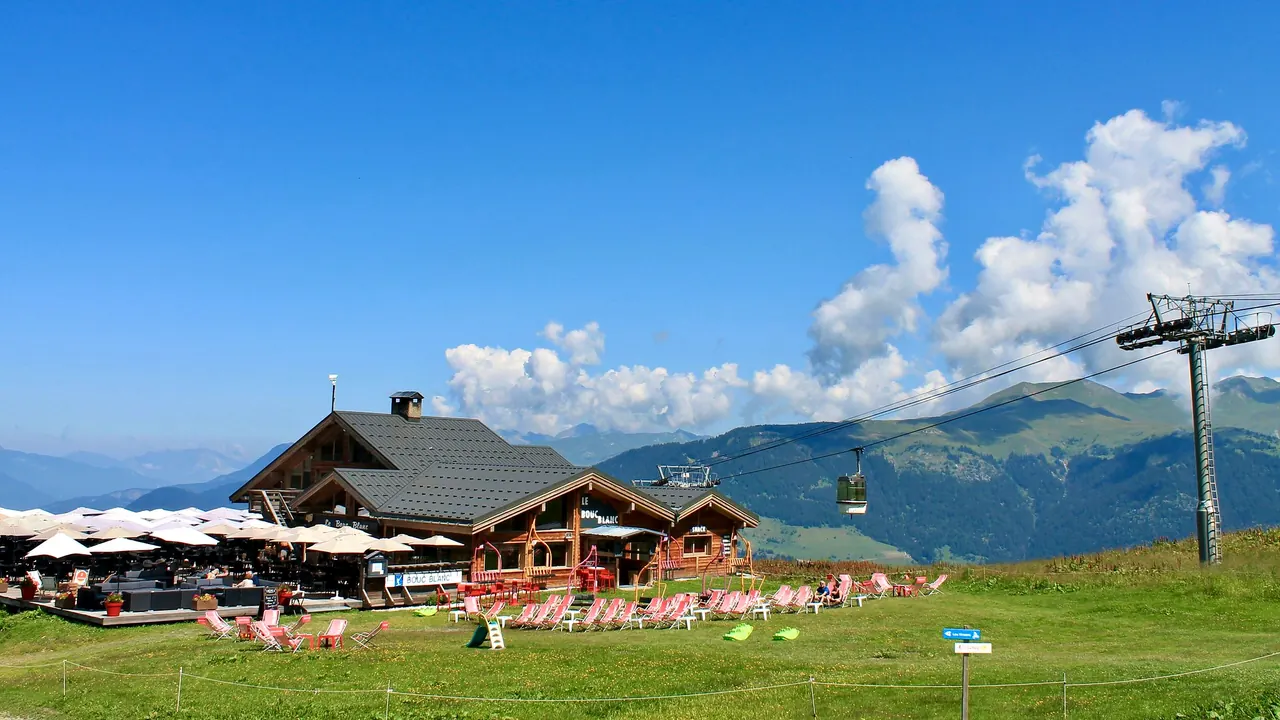
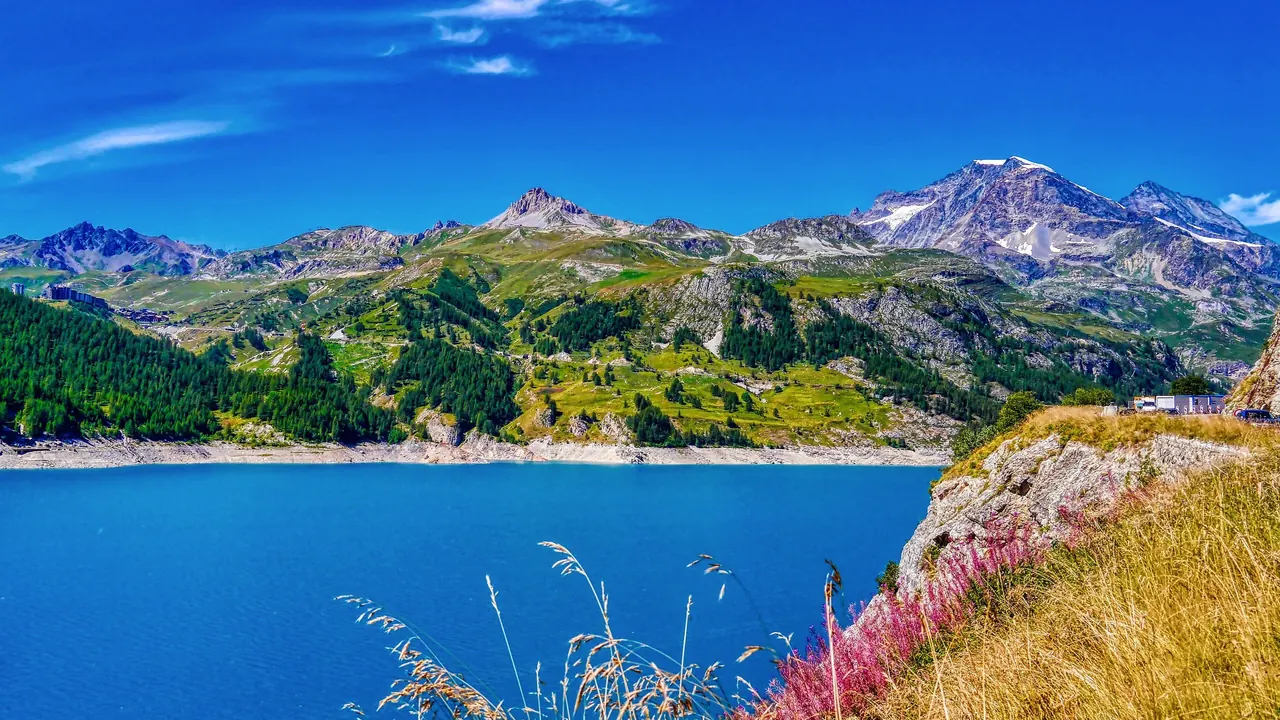
Photos: Courchevel by B. Brassoud, CC BY-SA 4.0, cropped; Tignes by Zairon, CC BY-SA 4.0, cropped.
Courchevel or Tignes?
Our verdict in twelve categories, each scored against the same fixed benchmark cities, and the climate month by month, so you can choose for your trip.
Choose Courchevel for
- food and drink
- shopping
- wellness
Courchevel suits skiers who want the polish of the Alps and can pay for it. It plugs into Les 3 Vallées, a bigger linked ski area than Tignes shares with Val d'Isère, and around the skiing it adds Michelin-starred dinners, long terrace lunches, lavish hotel spas and a street of luxury boutiques in 1850. Parents of first-time skiers will also find its lower villages the gentler place to start.
Choose Tignes for
- prices
- beaches
- nightlife
Tignes is the choice for people who care most about the snow and less about the extras. Its height and the Grande Motte glacier stretch the season from autumn into early summer, the off-piste is big, and the nights are louder and younger. It is still a dear resort, but a self-catering week here costs far less than anything Courchevel offers.
Scoreboard
Twelve categories on one fixed scale from 0 to 100. The shaded stretch is the gap between the two.
Your match
Pick a travel style or drag the sliders, and both match scores follow your weighting.
Wins on food and drink and shopping with your weighting.
Wins on prices and beaches with your weighting.
What matters to you?
Category by category
What the scores mean for a trip.
Beaches & swimming
Neither resort is for beach days. In Courchevel, swimming means a paddle and a sunbathe on the grass at the little Lac de la Rosière above Moriond, or else the indoor pools of the aquatic centre in Courchevel Village or a hotel.
Tignes does better in summer. In July and August a supervised bathing area opens on the Lac de Tignes, with a small sandy shore and bracing snowmelt water. For warmer swimming, the aquatic centre right beside it has a lagoon pool and slides.
Food & drink
Courchevel eats on another level. The palace hotels of 1850 hold a cluster of Michelin-starred kitchens among the best in France, and slope-side lunches run to seafood and serious wine lists. Nearly all of it is aimed at wealthy visitors, though, and there is little casual eating.
Tignes sticks to resort staples: fondue, tartiflette and croziflette, pizzerias and crêperies in Le Lac and Val Claret, and only a handful of more ambitious modern Alpine kitchens. Both share the Savoyard cheese table, Beaufort above all, and in both much of the dining closes between seasons.
Culture & sights
Neither resort is a place for sightseeing, as both were built for skiing, but the little heritage they have tells different stories. Courchevel's is sporting and architectural: the Olympic ski jumps at Le Praz, built for the Albertville Winter Games, and the modernist chalets of 1850.
Tignes has a sadder tale. Its old village in the valley was drowned under the Chevril dam's reservoir, and the resort was rebuilt higher up in functional apartment blocks. The story is told at the dam, where a giant mural covers the wall.
Nightlife
Both resorts go out hard in winter and fall quiet in summer, but the evenings feel very different. Courchevel 1850 means après-ski on the terraces, then hotel bars and a few glamorous late clubs with champagne and big tables, a short list for people with money to spend.
Tignes is younger and rowdier. Skiers and seasonal workers from Britain, Scandinavia and France fill the bars of Val Claret and Le Lac with beer, shots and dancing in ski boots until the small clubs close. Families in either resort can stay in the lower villages, away from the noise.
Nature & outdoors
Both are among the great ski destinations of the Alps, and both open onto the Vanoise National Park for summer walks among ibex and marmots. Courchevel's strength is reach. It sits inside Les 3 Vallées, the largest linked ski area in the world, with beautifully groomed runs that range from wooded slopes above Le Praz to the couloirs off the Saulire.
Tignes answers with altitude. At about 2,100m, below the Grande Motte glacier, its pistes are snow-sure. With Val d'Isère it forms one of the largest ski areas in the Alps, with big off-piste terrain and a season that begins in autumn.
Day trips
Neither resort is a good base for excursions, but Courchevel is a little better placed. Once you are down at Moûtiers, Conflans and Beaufort are about an hour away and Chambéry with its dukes' castle a little further. Lakeside Annecy is within two hours, and the Baroque churches of the Tarentaise are closer still.
Tignes sits at the head of a longer valley, so the same outings mean more driving. The easiest trip is to neighbouring Val d'Isère and its older centre. In summer the Little St Bernard Pass opens a route to Roman Aosta in Italy, about two hours away.
Good for families
Both work for a family ski week, with big ski schools and an aquatic centre with slides for a day off the snow, but Courchevel has the edge. The beginner slopes at Moriond and Courchevel Village are gentle, sunny and served by free lifts on quiet pistes, though 1850 itself is aimed at adults.
Tignes puts its nursery areas right beside Le Lac and Val Claret and has plenty of ski-in, ski-out apartments, and in summer the lake adds pedalos. The drawbacks are the cold and the altitude, which can tire very young children.
Getting around
Inside the resorts the two work the same way. Free shuttle buses link the villages, many places to stay are ski-in, ski-out, and each village centre is walkable, though steep and icy. Courchevel adds a gondola from Le Praz and Courchevel Village up to 1850, and even a small altiport for private planes and helicopters.
Getting there differs only in detail. Courchevel's station is Moûtiers, about 25km below up a road of hairpin bends. Tignes is reached from Bourg-Saint-Maurice, about forty minutes away by bus or taxi, and anywhere beyond its valley needs a car or a transfer.
Shopping & style
Courchevel 1850 is the only one of the two where shopping is part of the stay. In winter a short street of luxury fashion houses, jewellers and watchmakers opens beside excellent ski shops. Tignes is purely practical, with gear hire, sportswear and supermarkets for self-caterers. In both, the best thing to take home is Savoyard cheese and charcuterie.
Affordability
Both are expensive, but Courchevel is in a different league. It is priced for the very wealthy in 1850, and Le Praz, Courchevel Village and La Tania are still high, even in self-catering apartments.
Tignes is costly in the peak school vacation weeks. Even so, its many self-catering apartments, cheaper weeks early and late in the season and lower summer lodging put a stay within reach of more people. Eating out costs resort prices in both.
Live music & performing arts
Neither has a theatre, a concert hall or a regular programme. In both, live music means bands in après-ski bars and occasional concerts at seasonal events. Tignes also has DJs on mountain terraces and free outdoor concerts during its winter and summer events.
Wellness & relaxation
Courchevel is the more pampering place to unwind. Its luxury hotel spas are among the most lavish in the mountains, with timber-roofed pools, hammams and treatments that non-residents can often book, and the aquatic centre in Courchevel Village adds a public spa with outdoor views. For real thermal waters, the spa town of Brides-les-Bains lies in the valley just below, within easier reach of Courchevel than of Tignes.
Tignes sticks to the basics: saunas, steam rooms, hot tubs, and a hammam and massage at the lakeside aquatic centre. Winter weeks there run at an energetic pace, so anyone after real calm will find it in summer, by the quiet lake.
When should you go?
Pick your month. The climate figures are measured averages, not a forecast.
Courchevel in July
Tignes in July
Daytime high, °C
Rainfall in the month, mm
Where the figures come from
Courchevel has no weather station within reach, so its figures come from a gridded climate model rather than a measured record, and read a broad area rather than one spot.
Tignes has no weather station within reach, so its figures come from a gridded climate model rather than a measured record, and read a broad area rather than one spot.
Temperature and rainfall are climate normals, averaged over the years shown. Courchevel: 2001-2020 normals, NASA POWER reanalysis grid, no weather station within 90 km. Tignes: 2001-2020 normals, NASA POWER reanalysis grid, no weather station within 90 km.
The two resorts share the same climate, so choosing a month comes down to what each one does with it. From December to March daytime highs stay around or below freezing, about -4°C in January, and this is the heart of the ski season in both. April brings softer spring snow as afternoons reach 6°C. May is the wettest month at 103mm. Along with November, it falls in the quiet spell between seasons, when much of both resorts closes.
Summer is short and mild. Highs of 16°C to 18°C from June to August are good for hiking and biking but never beach weather, and rain falls through every month of the year. Tignes stretches the calendar at both ends: its glacier opens the winter season in autumn and keeps a little skiing going into early summer. In Courchevel, skiing depends on the midwinter snow.
Which traveller are you?
On a family trip with young children, Courchevel is where parents can book with least worry. The lower villages make an easy, calm base for a first week on skis. Tignes works for families too, but suits older, hardier children better than toddlers.
For a trip on a tight budget, neither resort is cheap, but only Tignes is worth pricing up. A group that shares an apartment, cooks in and avoids the school vacation weeks can make it work. In Courchevel even the plainest stay remains a luxury.
For skiers who want snow outside midwinter, Tignes is the one to book. Its high pistes hold good snow in the cheaper weeks at either end of the season. In early summer a morning on the glacier can end with an afternoon hike to an alpine lake, while Courchevel's slopes are by then only for walking and biking.
Before you go
| Measure | Courchevel | Tignes |
|---|---|---|
| Official language | French | French |
| Currency | Euro (EUR) | Euro (EUR) |
| Sockets | CE230 V, 50 Hz | CE230 V, 50 Hz |
| Driving side | Right | Right |
| Time zone | UTC+1, UTC+2 in summer | UTC+1, UTC+2 in summer |
| Emergency number | 112 | 112 |
| Elevation | 1,757 m | 1,440 m |
| Main airport | Geneva International Airport (GVA)100 km from centre150 non-stop destinations | Geneva International Airport (GVA)105 km from centre150 non-stop destinations |
| Public holidays this year | 11 days | 11 days |
By the numbers
| Measure | Courchevel | Tignes |
|---|---|---|
| Population | - | 1,919 |
| People per km² | - | 24 |
| Museums within 10 km | 0 | 0 |
| UNESCO World Heritage sites within 50 km | 0 | 0 |
Where else could you go?
Every comparison below shares a destination with this one, so you can follow Courchevel or Tignes somewhere new.
- Méribelvs Courchevel
- Val d'Isèrevs Tignes
- La Plagnevs Courchevel
- Les Menuiresvs Courchevel
- Val Thorensvs Courchevel
- Les Arcsvs Tignes