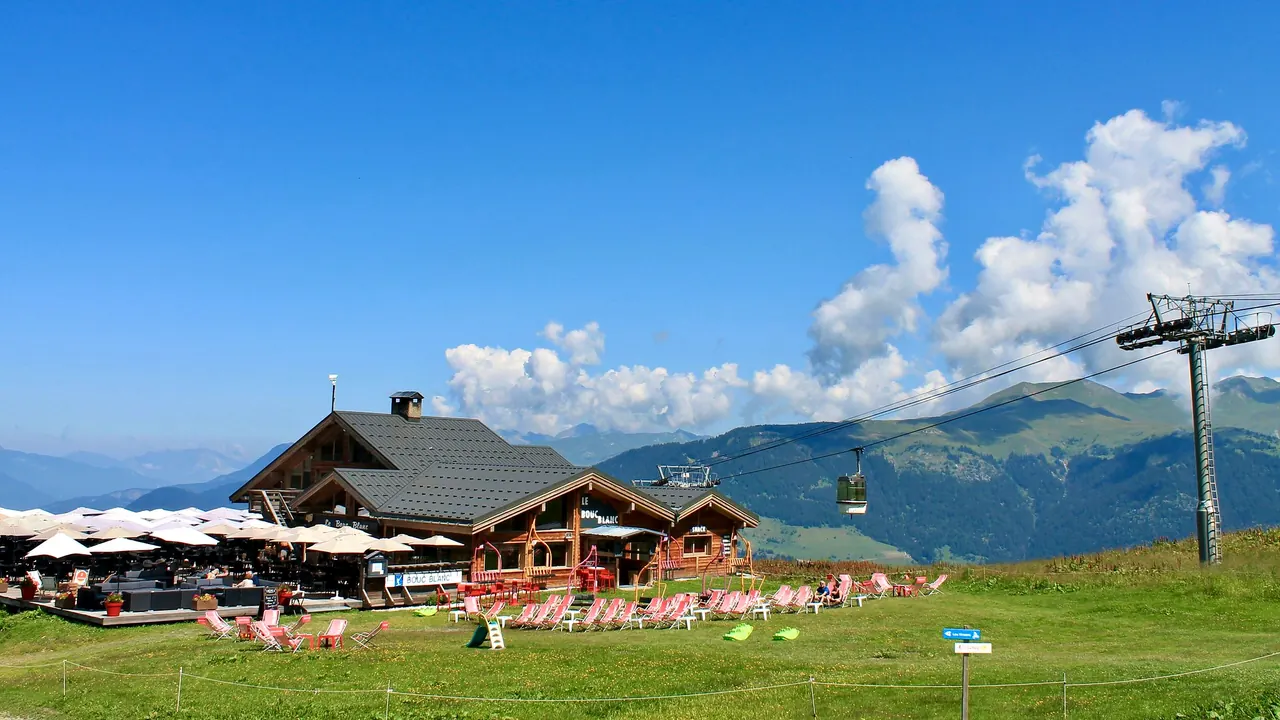
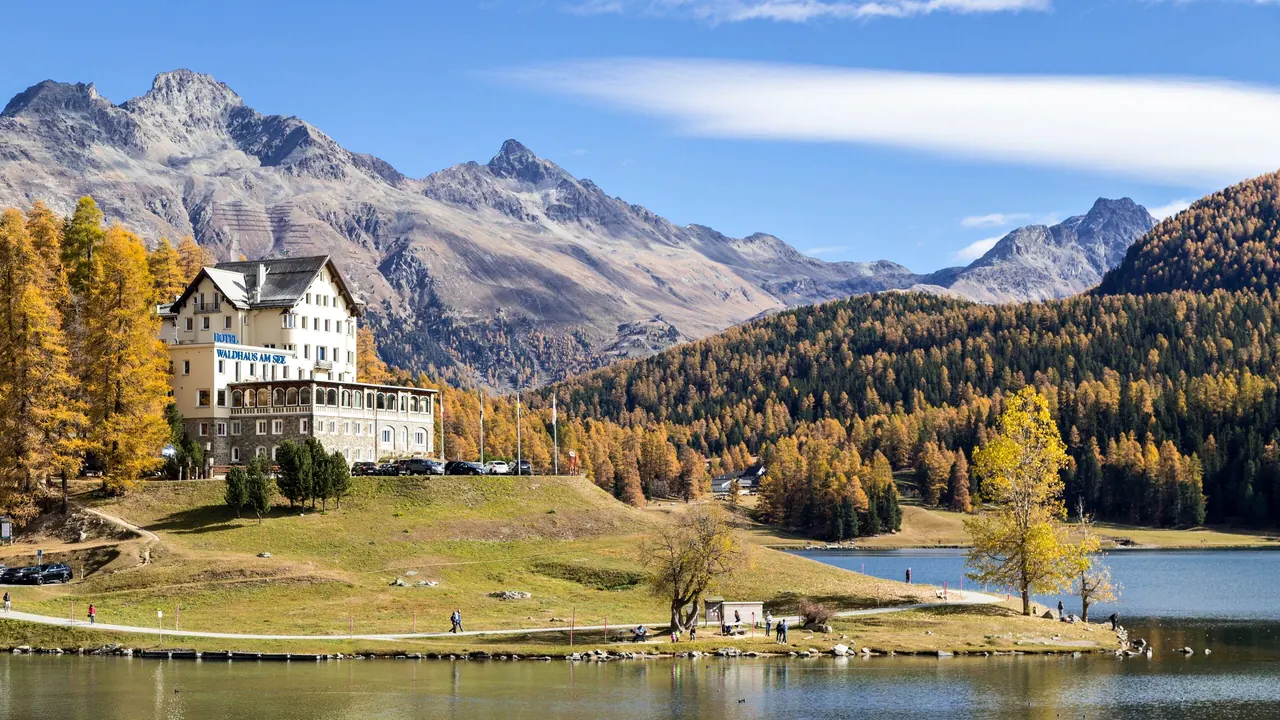
Photos: Courchevel by B. Brassoud, CC BY-SA 4.0, cropped; St. Moritz by JoachimKohler-HB, CC BY-SA 4.0, cropped.
Courchevel or St. Moritz?
Our verdict in twelve categories, each scored against the same fixed benchmark cities, and the climate month by month, so you can choose for your trip.
Choose Courchevel for
- food and drink
- families
- nightlife
Courchevel suits the dedicated downhill skier who wants as much terrain as possible from one door, since the 3 Vallées is the largest linked ski area in the world. It also suits families with children learning to ski, who get gentle slopes and big ski schools in the lower villages. Add the stronger dining and later nights, and a winter group with money to spend will find more going on here.
Choose St. Moritz for
- getting around
- live music and the arts
- day trips
For a stay about the mountains in a wider sense, St. Moritz is the better pick. The Engadine offers cross-country skiing, events on the frozen lakes, summer glacier walks and kitesurfing, and you can arrive by train and never need a car. The Segantini Museum, the festival concerts and the Bernina line to Italy reward travellers who want more than the pistes.
Scoreboard
Twelve categories on one fixed scale from 0 to 100. The shaded stretch is the gap between the two.
Your match
Pick a travel style or drag the sliders, and both match scores follow your weighting.
Too close to call, 2 points apart
Wins on food and drink and families with your weighting.
Wins on getting around and live music and the arts with your weighting.
What matters to you?
Category by category
What the scores mean for a trip.
Beaches & swimming
Neither resort is a place to swim, so the difference is only where you would dip a toe in summer. In Courchevel that means the little Lac de la Rosière above Moriond, which is cold but has grass to lie on, or the indoor pools and slides of the aquatic centre in Courchevel Village.
St. Moritz has the forest lake of Lej da Staz, which reaches about 20°C at best for a few weeks. Lake St. Moritz and Silvaplana belong to windsurfers in wetsuits. In both resorts, serious swimmers end up in a hotel pool.
Food & drink
Courchevel has more top restaurants. The palace hotels of 1850 hold a cluster of Michelin-starred kitchens, some of the most celebrated in France, and a slope-side lunch of grilled meat, seafood and fine wine is part of the ski day. Fondue, tartiflette and Beaufort cover the simpler end.
St. Moritz also eats well at the top, with long terrace lunches on Corviglia and Muottas Muragl, but it has fewer top kitchens. Its strength is regional cooking: capuns, pizzoccheri, air-dried beef and Engadine nut tart from the old confectioners. In both resorts, cheap casual food is hard to find and many kitchens close out of season.
Culture & sights
Neither is a sightseeing destination, but St. Moritz gives a curious visitor more for an afternoon off the snow. There is the Segantini Museum with its great Alpine triptych, the painted farmhouse rooms of the Engadin Museum and the leaning tower above the village. Its history as the birthplace of Alpine winter tourism and host of two Winter Olympics adds to that.
Courchevel was built after the war and offers the 1992 ski jumps at Le Praz, the modernist chalets of 1850 and a few chapels in the old hamlets, and very little beyond.
Nightlife
In both resorts nightlife only happens in winter and is about champagne and money, but Courchevel's nights run later and offer more choice. In 1850, après-ski on the terraces leads on to hotel bars and a handful of glamorous clubs that go on into the early hours. The lower villages add pubs for seasonnaires.
St. Moritz is grander and more restrained: hotel bars full of fur coats between Christmas and early March, and a couple of exclusive clubs where you need an introduction. Outside high season both go quiet, St. Moritz by about eleven.
Nature & outdoors
Both are among the great Alpine landscapes, and the difference is in kind. Courchevel is about downhill skiing on a vast scale. The linked Trois Vallées lets you ski to Méribel and Val Thorens and back in a day across some 600km of pistes, from tree-lined runs down to Le Praz to steep couloirs off the Saulire, with the glaciers and ibex of the Vanoise National Park for summer hiking.
St. Moritz has a wider, more varied valley, with a chain of lakes beneath high glaciated peaks and some of the best cross-country trails in the Alps. There is horse racing on the frozen lakes, the glacier walk to Morteratsch and kitesurfing on Silvaplana. For sheer downhill distance choose Courchevel, and for a mix of sports across the seasons choose St. Moritz.
Day trips
St. Moritz is the better base for days out, largely thanks to the railway. The UNESCO-listed Bernina line runs over the pass to Poschiavo and Tirano in Italy. Nietzsche's house in Sils Maria, the sgraffito villages of the Lower Engadine and Soglio over the Maloja Pass are all easy to reach by train or bus.
From Courchevel every outing starts with the hairpin descent to Moûtiers. After that, Conflans, Beaufort, Chambéry and Annecy lie one to two hours away. They are worthwhile towns, but most visitors on a ski week never make the trip.
Good for families
Courchevel is the more family-minded resort. Moriond and Courchevel Village have sunny beginner slopes, free beginner lifts and large children's ski programmes with snow gardens. The slides at the aquatic centre fill a rest day, and only 1850 itself is built around adult luxury.
St. Moritz is safe and easy, with nursery slopes on Corviglia, sledging and skating on natural ice. But it feels adult throughout, and families with young children often stay in the quieter villages along the valley instead.
Getting around
St. Moritz is much easier to reach and to use without a car. The Rhaetian Railway pulls into the lakeside station, and trains and buses link the whole Upper Engadine from Maloja to Zuoz. The only effort is the climb from Bad up to Dorf, and escalators help with that.
Courchevel works well once you are there, with free shuttles between the villages, a gondola up from Le Praz and plenty of ski-in, ski-out lodging. The catch is the arrival. It is a long climb up hairpin bends from Moûtiers station, some 25km below, and in winter you need snow chains.
Shopping & style
For shopping the two are much alike. Each has a short, very luxurious strip of fashion, watch and jewellery houses that opens for the winter crowd, with good ski shops alongside and little else. The local extras differ: Savoyard cheese, charcuterie and wooden crafts in Courchevel, and Engadine woodwork, linen, nut tart and furriers around Via Serlas in St. Moritz.
Affordability
Choosing one over the other saves you nothing, because both are among the most expensive resorts anywhere. The ways to soften the cost differ. In Courchevel that means staying lower down in Le Praz, Courchevel Village or La Tania and self-catering, while in St. Moritz it means coming in summer, picking a hotel that includes lifts and transport, or staying in a simpler guesthouse elsewhere in the valley.
Live music & performing arts
St. Moritz has the better calendar, though only in season. A long-running summer jazz festival, the Engadin Festival's chamber concerts in churches and hotel halls, and a winter classical series give music lovers dates to plan around.
Courchevel has no theatre or concert hall either, and little beyond occasional concerts and bands during après-ski.
Wellness & relaxation
Both resorts do wellness through lavish hotel spas that non-residents can book, and both have a public option with saunas for everyone else. The difference is heritage. St. Moritz began as a spa town, still offers mineral-water and peat treatments in Bad, and has the thermal baths of Scuol a train ride away.
Courchevel has no thermal tradition, and its spas are designed to ease tired legs after a day on the slopes. In both, the calm comes in summer and the quieter weeks rather than in high winter.
When should you go?
Pick your month. The climate figures are measured averages, not a forecast.
Courchevel in July
St. Moritz in July
Daytime high, °C
Rainfall in the month, mm
Where the figures come from
Courchevel has no weather station within reach, so its figures come from a gridded climate model rather than a measured record, and read a broad area rather than one spot.
St. Moritz has no rain gauge within 25 km of the centre, so its rainfall comes from a gridded climate dataset read at the destination rather than from a gauge further away.
Temperature and rainfall are climate normals, averaged over the years shown. Courchevel: 2001-2020 normals, NASA POWER reanalysis grid, no weather station within 90 km. St. Moritz: 2015-2025 (rainfall 1991-2020) normals, Samedan (5.5 km from centre).
These are winter resorts first, and neither is ever warm enough for a beach vacation. Courchevel is the colder of the two, with daytime highs around -4°C in January and a hard Alpine cold from December to February. Its rain and snow are spread fairly evenly through the year, and May is the wettest month. Summer is short, with highs near 18°C in July and August, which is pleasant for hiking.
St. Moritz is a little milder, around -1°C in January, and winter is its drier season, with February the driest month of all. In summer the pattern reverses. July highs reach about 20°C, good for walking, but June to November is noticeably wetter, with August bringing around 111mm.
Which traveller are you?
On a family trip with young children, Courchevel is the stronger choice. Sunny beginner slopes at Moriond and Courchevel Village, large ski-school programmes with snow gardens and the aquatic centre for a day off suit children better than St. Moritz's grand-hotel tone.
On a culture and arts trip, St. Moritz gives you more, though on a small scale. The Segantini Museum, the Engadin Museum, the summer jazz and Engadin Festival concerts, and the Bernina railway down to Italian villages fill days that Courchevel cannot.
For a food and nightlife trip, Courchevel wins in winter. The Michelin-starred kitchens of 1850 run deeper, lunch on the slopes is an occasion, and the clubs keep going into the early hours, while St. Moritz is more restrained and exclusive.
Before you go
| Measure | Courchevel | St. Moritz |
|---|---|---|
| Official language | French | French, German, Italian, Romansh |
| Currency | Euro (EUR) | Swiss Franc (CHF) |
| Sockets | CE230 V, 50 Hz | CJ230 V, 50 Hz |
| Driving side | Right | Right |
| Time zone | UTC+1, UTC+2 in summer | UTC+1, UTC+2 in summer |
| Emergency number | 112 | 112 |
| Elevation | 1,757 m | 1,822 m |
| Main airport | Geneva International Airport (GVA)100 km from centre150 non-stop destinations | Zürich Airport (ZRH)145 km from centre226 non-stop destinations |
| Public holidays this year | 11 days | 9 days |
By the numbers
| Measure | Courchevel | St. Moritz |
|---|---|---|
| Population | - | 5,027 |
| People per km² | - | 175 |
| Museums within 10 km | 0 | 7 |
| UNESCO World Heritage sites within 50 km | 0 | 2 |
Where else could you go?
Every comparison below shares a destination with this one, so you can follow Courchevel or St. Moritz somewhere new.
- Méribelvs Courchevel
- La Plagnevs Courchevel
- Les Menuiresvs Courchevel
- Val Thorensvs Courchevel
- Tignesvs Courchevel
- Les Arcsvs Courchevel