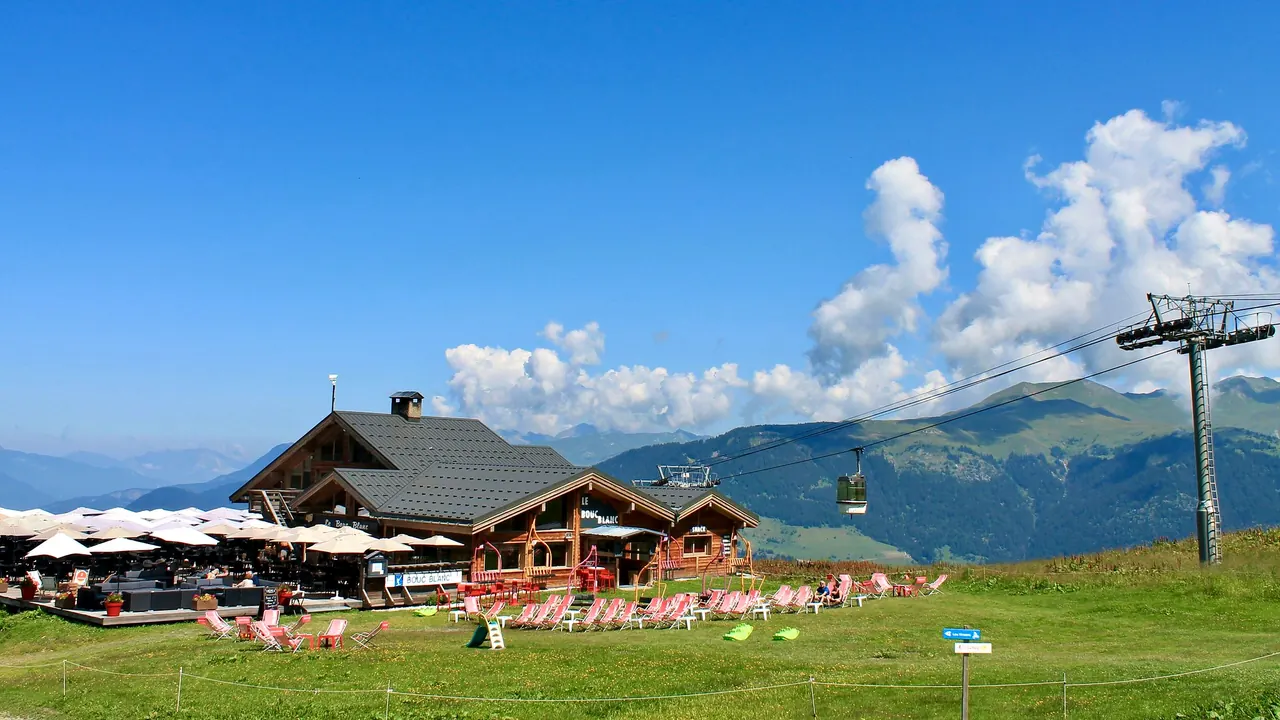
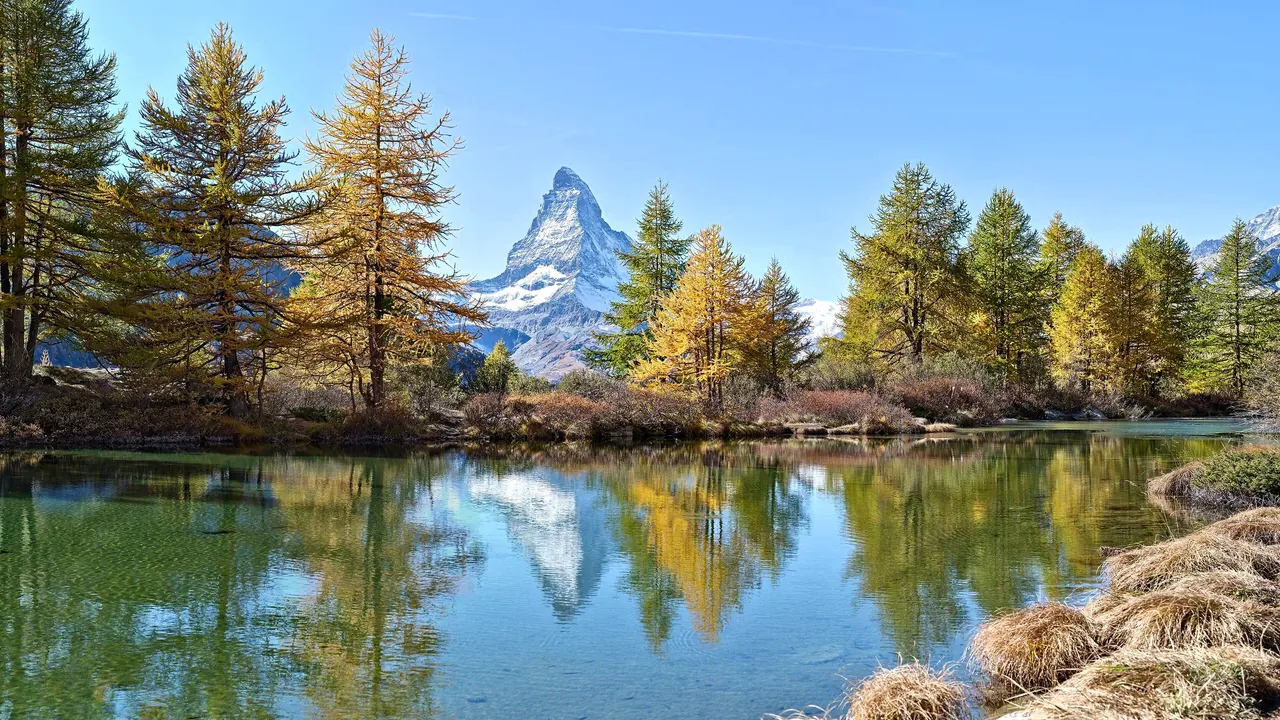
Photos: Courchevel by B. Brassoud, CC BY-SA 4.0, cropped; Zermatt by Roy Egloff, CC BY-SA 4.0, cropped.
Courchevel or Zermatt?
Our verdict in twelve categories, each scored against the same fixed benchmark cities, and the climate month by month, so you can choose for your trip.
Choose Courchevel for
- food and drink
- families
- shopping
Courchevel suits a ski week where the table and the evening matter as much as the pistes. Its Michelin-starred kitchens and long terrace lunches, the champagne clubs of 1850 and the short row of luxury boutiques give it more to do off the snow. The gentle beginner slopes at Moriond and Courchevel Village, with large children's ski schools and free beginner lifts, also make it the easier choice for a family learning to ski together.
Choose Zermatt for
- getting around
- culture and sights
- live music and the arts
Zermatt is for travellers who want the mountain itself to be the whole point. The Matterhorn stands over a car-free village, lifts climb to the glacier, and some pistes stay open into summer. You arrive by train and then walk everywhere, which is simpler than the hairpin road up to Courchevel. It also has a little more substance beyond the slopes, with a mountaineering museum, an old quarter of larch-wood barns and two music festivals in the calendar.
Scoreboard
Twelve categories on one fixed scale from 0 to 100. The shaded stretch is the gap between the two.
Your match
Pick a travel style or drag the sliders, and both match scores follow your weighting.
Too close to call, 2 points apart
Wins on food and drink and families with your weighting.
Wins on getting around and culture and sights with your weighting.
What matters to you?
Category by category
What the scores mean for a trip.
Beaches & swimming
Neither resort is a place for a beach. In summer Courchevel at least has the small Lac de la Rosière above Moriond, where you can lie on the grass and paddle in cold water, and the public aquatic centre in Courchevel Village has proper pools. Zermatt's tarns are for photographing the Matterhorn rather than swimming in, so there the only option is a hotel pool.
Food & drink
Courchevel has the more serious food scene. The palace hotels of 1850 hold some of the most celebrated kitchens in France, and lunch on the slopes is an occasion, with grilled meats, seafood and long wine lists on sunny terraces. Savoyard fondue, tartiflette and Beaufort cheese fill out the rest.
Zermatt's appeal is quieter and lies on the mountain: chalet restaurants in the hamlets of Findeln, Furi and Zum See, which you reach on skis or on foot, with Valais raclette, air-dried beef and glasses of Petite Arvine or Cornalin. There are fewer ambitious kitchens in the village itself, and in both places cheap eating is hard to find.
Culture & sights
Zermatt has the more interesting past, though neither resort is really a sightseeing trip. The underground Matterhorn Museum tells the story of the first ascent in 1865 and the deaths on the way down. Climbers who died on the surrounding peaks are buried beside the parish church, and the dark larch-wood granaries of the Hinterdorf show the farming village that was there before the hotels. The Gornergrat cog railway, which has been running since the nineteenth century, is worth riding for its own sake.
Courchevel was built for skiing after the war, so there is far less to see: the Olympic ski jumps at Le Praz, left from the Albertville Games, the modernist chalets of 1850 and a few chapels in the older hamlets.
Nightlife
Courchevel has the bigger night out in winter, and the more exclusive one. Evenings in 1850 move from terrace drinks at the foot of the pistes to hotel bars and a handful of late clubs where a large bill is part of the occasion. That suits a group out to celebrate more than someone hoping to drift between different kinds of bar. The pubs for seasonal workers in the lower villages are the relaxed alternative.
Zermatt is less polished and more good-humoured. Its best moment comes in the late afternoon, when skiers stop still in their boots at the bars on the last runs into the village. Only a few places on the main street carry on late, mostly at weekends. In summer the walkers and climbers who fill the village tend to turn in early, so evenings there are about dinner.
Nature & outdoors
Both are among the finest mountain settings in the Alps, but they differ in kind. Courchevel is the place to cover a lot of ground on skis. It lies inside Les 3 Vallées, so in a day you can ski over to Méribel and Val Thorens and back on some 600km of pistes, from tree-lined runs down to Le Praz to steep couloirs off the Saulire. In summer the Vanoise National Park, with its lakes, glaciers and ibex, starts right beside the resort.
Zermatt's strengths are altitude and scenery. A ring of glaciated summits surrounds the village, the Gorner Glacier lies below the Gornergrat, and the lifts climb higher than almost anywhere else in Europe, with skiing that crosses into Italy. It has the fuller summer of the two, with long marked trails past mountain lakes, the suspension bridge on the Europaweg and the final stage of the Haute Route.
Day trips
Neither resort is a good base for exploring further afield, and most visitors on either trip stay in the mountains. From Courchevel every outing starts with the winding road down to Moûtiers. Beyond it lie medieval Conflans, the cheese town of Beaufort, the dukes' castle at Chambéry and, at the far end of a long day, the lake at Annecy.
From Zermatt you go down by narrow-gauge train instead. That makes Sion an easy outing, with its two castle hills and old town set among the Valais vineyards, and Brig with the Stockalper Palace is closer still. Saas-Fee and the high vineyards of Visperterminen make good mountain alternatives.
Good for families
Courchevel is the stronger choice for a family ski week. The lower villages have gentle, sunny beginner slopes, free beginner lifts and snow gardens for the very young, and the aquatic centre with slides gives children an afternoon away from the snow.
Zermatt's car-free streets are its main advantage for parents, with no traffic and short walks between hotel, ski school and the Sunnegga nursery slopes. The downsides are rainy days that are hard to fill and high viewpoints too cold and too high in altitude for small children.
Getting around
Zermatt is far easier to get to and around. Trains connect smoothly with the Swiss rail network, ordinary cars stay below at Täsch, and the compact village, the cog railway and the underground funicular to Sunnegga are all within walking distance. Small electric taxis cover the outlying lifts.
Courchevel works well once you are there, with a free shuttle between the villages, plenty of ski-in, ski-out chalets and a gondola up to 1850. Getting there is the hard part: a climb of about 25km on hairpin bends from the station at Moûtiers, and in winter you need snow chains if you drive.
Shopping & style
Courchevel has the grander shopping, with a short stretch of luxury fashion houses, jewellers and watchmakers in 1850 during the winter, plus Savoyard cheese and wooden crafts. Zermatt's single main street is mostly Swiss watches, cowbells, chocolate and souvenirs shaped like the Matterhorn. Both resorts have excellent ski and mountaineering shops, which is the most useful thing to buy in either.
Affordability
There is nothing to choose between them: both are among the most expensive places in the Alps, and neither works on a tight budget. The ways to save are different, though. In Courchevel, staying in Le Praz, Courchevel Village or La Tania instead of 1850 helps a little, while Zermatt visitors can sleep down the valley in Täsch and live on supermarket picnics.
Live music & performing arts
Zermatt has a real if short season of live music. Zermatt Unplugged brings acoustic sets by well-known singers to tents and mountain stages in spring, and a late-summer chamber music festival puts classical players in the village church. Courchevel has nothing comparable, only occasional concerts and bands in the après-ski bars, so evenings there are about dinner and the clubs.
Wellness & relaxation
Both resorts handle relaxation in the same way, through hotel spas rather than thermal baths, but they feel different. Courchevel's palace spas are among the most lavish in the mountains, many take bookings from non-residents, and the public aquatic centre in Courchevel Village adds a cheaper sauna and steam area with views.
Zermatt has fewer spas open to day visitors. What it adds is the quiet of a car-free village with clean air, and real thermal bathing in the spa towns further down the Valais valley.
When should you go?
Pick your month. The climate figures are measured averages, not a forecast.
Courchevel in July
Zermatt in July
Daytime high, °C
Rainfall in the month, mm
Where the figures come from
Courchevel has no weather station within reach, so its figures come from a gridded climate model rather than a measured record, and read a broad area rather than one spot.
Zermatt has no weather station within reach, so its figures come from a gridded climate model rather than a measured record, and read a broad area rather than one spot.
Temperature and rainfall are climate normals, averaged over the years shown. Courchevel: 2001-2020 normals, NASA POWER reanalysis grid, no weather station within 90 km. Zermatt: 1991-2020 normals, TerraClimate 4 km grid at the town, no weather station within 90 km.
Both resorts are below freezing from December to February, and for most visitors winter is the main season. In summer neither gets warm enough for a beach, but both suit walking from June to September. Courchevel is the milder of the two in high summer, reaching about 18°C in July against about 14°C in Zermatt, so its meadows feel more like summer and Zermatt's higher trails stay cool.
Rain falls through the whole year in both. In Courchevel May is the wettest month, at around 103mm, which makes late spring a poor time to come. Zermatt's wettest month by far is November, at about 130mm, so the gap between autumn walking and the ski season is the time to avoid there. September is a good compromise in either resort, still mild enough for hiking and drier than the months on each side of it.
Which traveller are you?
On a family trip with children, Courchevel is the better choice, but stay in Courchevel Village or Moriond rather than 1850, which is built around adult luxury. Come in the ski season too, because once the lifts stop very little is laid on for children.
For a food and nightlife trip, Courchevel wins, but only in winter. Out of season most kitchens close and going out barely exists. Plan for big spending at every meal, since casual eating is rare. Zermatt's evenings are cheaper only by Alpine standards.
On an outdoors trip outside the ski season, Zermatt gives you more. Its lifts take walkers straight up to high trails, and guides take clients up the big peaks. Book your guide early and spend a few days walking first to adjust to the altitude.
Before you go
| Measure | Courchevel | Zermatt |
|---|---|---|
| Official language | French | French, German, Italian, Romansh |
| Currency | Euro (EUR) | Swiss Franc (CHF) |
| Sockets | CE230 V, 50 Hz | CJ230 V, 50 Hz |
| Driving side | Right | Right |
| Time zone | UTC+1, UTC+2 in summer | UTC+1, UTC+2 in summer |
| Emergency number | 112 | 112 |
| Elevation | 1,757 m | 1,624 m |
| Main airport | Geneva International Airport (GVA)100 km from centre150 non-stop destinations | Geneva International Airport (GVA)128 km from centre150 non-stop destinations |
| Public holidays this year | 11 days | 9 days |
By the numbers
| Measure | Courchevel | Zermatt |
|---|---|---|
| Population | - | 6,023 |
| People per km² | - | 25 |
| Museums within 10 km | 0 | 2 |
| UNESCO World Heritage sites within 50 km | 0 | 2 |
Where else could you go?
Every comparison below shares a destination with this one, so you can follow Courchevel or Zermatt somewhere new.
- Méribelvs Courchevel
- La Plagnevs Courchevel
- Les Menuiresvs Courchevel
- Val Thorensvs Courchevel
- Saas-Feevs Zermatt
- Tignesvs Courchevel