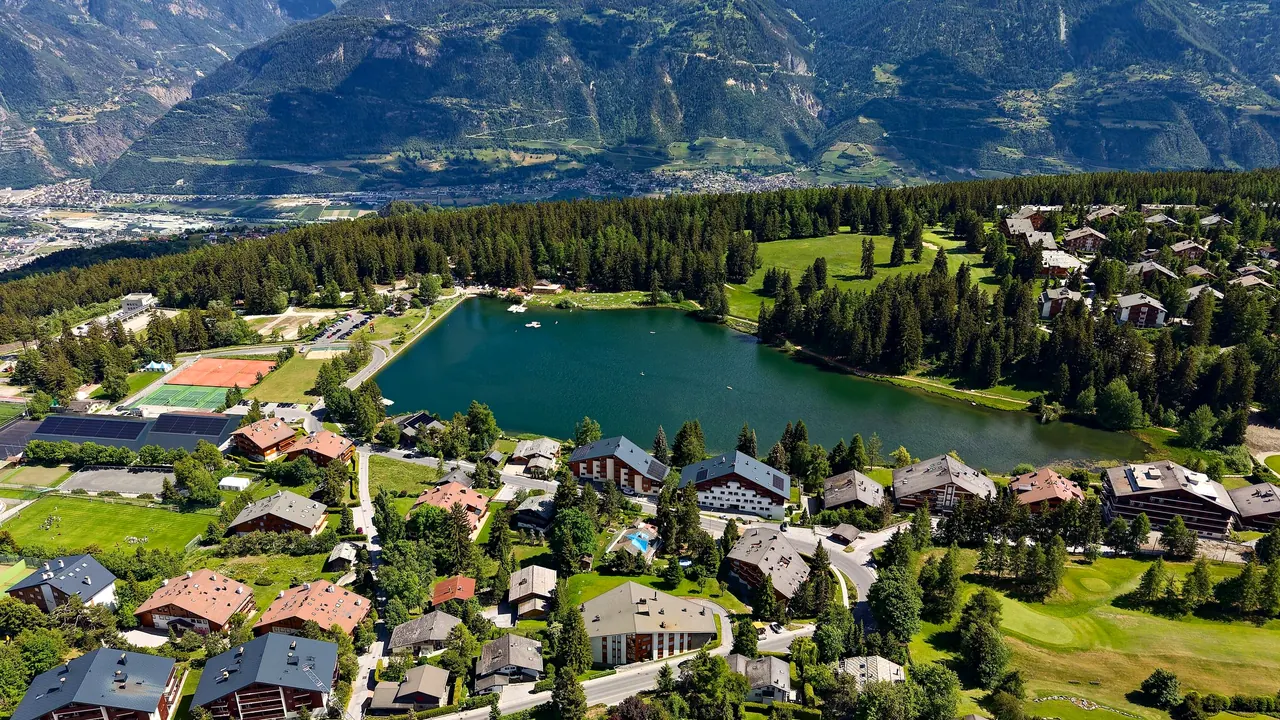
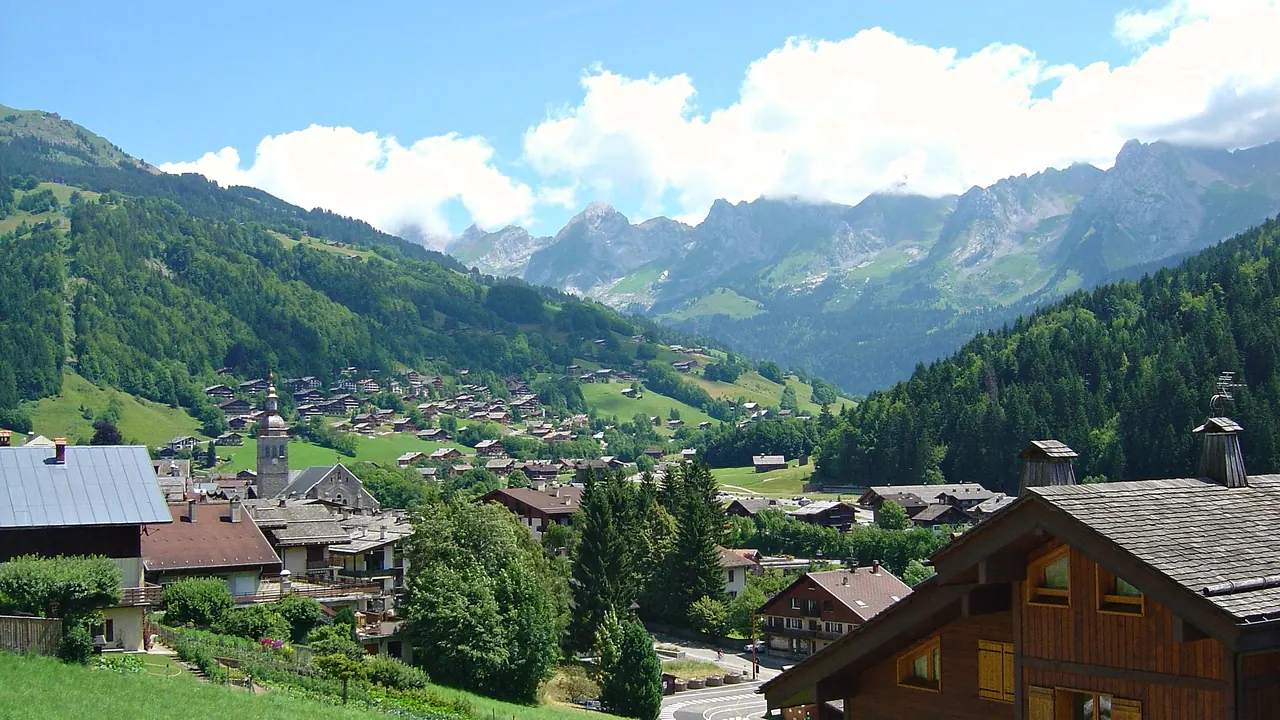
Photos: Crans-Montana by Daniel Reust, CC BY-SA 4.0, cropped; Le Grand-Bornand by Anthospace, CC BY-SA 3.0, cropped.
Crans-Montana or Le Grand-Bornand?
Our verdict in twelve categories, each scored against the same fixed benchmark cities, and the climate month by month, so you can choose for your trip.
Choose Crans-Montana for
- shopping
- getting around
- nightlife
Crans-Montana suits travellers who want a high, polished resort and can pay for it. Its ski area climbs to a glacier, the funicular and Swiss railway make a car unnecessary, and evenings bring hotel bars, gastronomic dinners and designer boutiques that a farming valley does not have. It works best for couples and groups who want comfort, views across the Valais and a bit of glamour after a day outdoors.
Choose Le Grand-Bornand for
- prices
- beaches
- families
Families, and anyone watching their spending, will get more from Le Grand-Bornand. This is a Savoyard cheese village built around children, with gentle slopes, farm visits and a summer festival for young audiences, and self-catering keeps costs well below the Swiss plateau. Lake Annecy is close enough for summer swimming. The price of that is a car for most outings and very quiet nights.
Scoreboard
Twelve categories on one fixed scale from 0 to 100. The shaded stretch is the gap between the two.
Your match
Pick a travel style or drag the sliders, and both match scores follow your weighting.
Too close to call, 1 point apart
Wins on shopping and getting around with your weighting.
Wins on prices and beaches with your weighting.
What matters to you?
Category by category
What the scores mean for a trip.
Beaches & swimming
Neither is a beach destination, but Le Grand-Bornand has proper swimming within reach. Lake Annecy is about 40 minutes away, with clear water reaching the low 20s°C and small beaches at Talloires, Menthon-Saint-Bernard and Sevrier. It makes a real summer outing, though you need a car to get there.
Crans-Montana only has its small plateau lakes. Lac Moubra and Lac Grenon are pleasant for a picnic and a quick dip in July and August, and nothing more.
Food & drink
Crans-Montana has the wider and more ambitious table. Raclette and fondue come with wines from the vineyards just below, Cornalin and Fendant among them, and the wealthy winter crowd keeps several serious gastronomic restaurants going. The weak spot is the everyday middle, which is thin.
Le Grand-Bornand is narrower but more rooted. It is the home of Reblochon, so farm cheese and the weekly market are the highlights, but restaurant menus rarely go beyond tartiflette and croziflette, and a special dinner usually means driving to Annecy.
Culture & sights
Both are thin on sights, so plan to go elsewhere for culture either way. The difference is in character. Le Grand-Bornand has a rural fabric worth an afternoon, with its onion-domed baroque church, old farm chalets and a farmhouse heritage house on cheesemaking. Crans-Montana is a twentieth-century resort of chalets and period hotels, and its history is found in the castles of Sion and the Rhône valley below.
Nightlife
Crans-Montana has an actual night scene, small and expensive though it is. Après-ski on terraces by the lifts moves on to hotel bars and piano lounges, and at weekends a couple of clubs stay open late, busiest over Christmas and February.
Le Grand-Bornand has a few après-ski bars in the village and at Chinaillon, and that is it. The family crowd goes to bed early, and a proper night out means the drive to Annecy.
Nature & outdoors
Both are excellent mountain bases, and what differs is the kind of mountain. Crans-Montana is high-alpine. Lifts reach the Plaine Morte glacier at around 3,000m, the pistes are broad and sunny, and the views stretch from the Matterhorn to Mont Blanc. In summer the bisse paths and golf are its signatures.
Le Grand-Bornand is mid-mountain country under the limestone wall of the Aravis, with peaks around 2,500m, pasture and wooded runs, and La Clusaz close by. Summer brings Tour de France climbs like the Col de la Colombière and sailing on Lake Annecy.
Day trips
The choice of outings is about equal, but you reach them differently. From Crans-Montana everything runs by funicular and train along the Rhône valley to Sion's hilltop castles, Martigny, Saint-Maurice abbey, and further on to Chillon and the Lavaux terraces.
Le Grand-Bornand depends on the car, but its best trip is closer and better: Annecy's canals and lakeside castle are about 40 minutes away, and Geneva is about an hour.
Good for families
Le Grand-Bornand is designed for children in a way Crans-Montana is not. It has snow gardens and beginner slopes at both village and Chinaillon, sledging, farm visits and river play, and the long-running Au Bonheur des Mômes festival each August. The whole place is compact.
Crans-Montana works well for families who ski or hike, with good ski-school children's areas and pedalos on the plateau lakes. Its spread-out layout makes daily life with toddlers more work.
Getting around
Crans-Montana is much easier without a car. The funicular from Sierre links straight into Swiss mainline trains, and free shuttles cover the long hillside between Crans, Montana and the lift bases, even if the distances between them mean you need a bus.
Le Grand-Bornand's centre is smaller and walkable, and winter shuttles reach Chinaillon. Beyond the valley, though, there is no railway and few buses, so trailheads, the lake and day trips all assume a car, and snowy passes can be slow.
Shopping & style
Crans has an unusual cluster of luxury for a mountain village: Swiss watchmakers, jewellers, cashmere and designer ski wear, along with delicatessens selling Valais wine and dried meats. Le Grand-Bornand's shops are practical gear and food shops, and its weekly market of cheese and crafts is the one real draw. Serious shopping there means Annecy.
Affordability
This is where the two differ most. Crans-Montana is expensive at every turn, from lodging and lift passes to a simple terrace lunch, and coming off-season or cooking for yourself only softens it a little.
Le Grand-Bornand is still an Alpine resort with costly school-vacation weeks, but it is more modest than the big high-altitude names. Self-catering is the usual way to stay, and summer or quieter January and March weeks bring costs down noticeably.
Live music & performing arts
Both rely on festival weeks rather than a season. In Crans-Montana that means Caprices, electronic music on the slopes in spring, and a summer series of chamber and classical concerts in churches and halls. Le Grand-Bornand's moment is the August children's festival, when street theatre, circus and puppetry fill the village. Pick your dates according to which of these appeals.
Wellness & relaxation
Crans-Montana has the stronger restful offer. The plateau began as a sanatorium retreat, several large hotels have full spas open to non-residents, and the hot pools of Leukerbad are under an hour away.
Le Grand-Bornand offers hotel saunas and hot tubs that are fine after skiing, but its real appeal is slow, quiet days with cow bells and wooden balconies, especially in early summer.
When should you go?
Pick your month. The climate figures are measured averages, not a forecast.
Crans-Montana in July
Le Grand-Bornand in July
Daytime high, °C
Rainfall in the month, mm
Where the figures come from
Crans-Montana has no weather station within reach, so its figures come from a gridded climate model rather than a measured record, and read a broad area rather than one spot.
Le Grand-Bornand's temperatures are measured 45 km from the centre, at Bourg-St-Maurice.
Le Grand-Bornand has no rain gauge within 25 km of the centre, so its rainfall comes from a gridded climate dataset read at the destination rather than from a gauge further away.
Temperature and rainfall are climate normals, averaged over the years shown. Crans-Montana: 2001-2020 normals, NASA POWER reanalysis grid, no weather station within 90 km. Le Grand-Bornand: 1999-2020 (rainfall 1991-2020) normals, Bourg-St-Maurice (44.7 km from centre).
Crans-Montana is the colder of the two all year, as you would expect on its high terrace. Winter days stay below freezing from December to February, which keeps the snow reliable, and even July and August only reach about 18°C. That makes summer comfortable for hiking and golf but only just warm enough for the plateau lakes. The rainiest stretch is May to August, at around 130mm a month, so expect afternoon showers in the hiking season. September is often the most settled month for walking.
Le Grand-Bornand is far milder in the figures, with summer highs around 27°C in July. That is warm enough for an afternoon at Lake Annecy, and the shoulder months of May and September are pleasant for hiking. Its wet season is the opposite of Crans-Montana's: rainfall peaks in late autumn and winter, up to 144mm in December, which falls as snow higher up, while summer is the drier half of the year.
Which traveller are you?
On a family trip with young children, Le Grand-Bornand is the easier choice. Crans-Montana's comforts, from designer boutiques to piano lounges, are aimed at adults and priced for them. Le Grand-Bornand is small, safe and calm, with ski schools by the village and pastures just above it.
For a trip on a tight budget, the gap is wide. Crans-Montana is among Europe's costliest places to stay, and even a plain terrace lunch adds up. In Le Grand-Bornand, renting an apartment and buying cheese straight from the farms keeps spending modest, especially in summer or quieter January weeks.
For a food and nightlife trip, Crans-Montana has more to offer. Gastronomic hotel restaurants and Valais wines such as Petite Arvine lead on to terrace après-ski, piano bars and a couple of late clubs. In Le Grand-Bornand, evenings end early after tartiflette.
Before you go
| Measure | Crans-Montana | Le Grand-Bornand |
|---|---|---|
| Official language | French, German, Italian, Romansh | French |
| Currency | Swiss Franc (CHF) | Euro (EUR) |
| Sockets | CJ230 V, 50 Hz | CE230 V, 50 Hz |
| Driving side | Right | Right |
| Time zone | UTC+1, UTC+2 in summer | UTC+1, UTC+2 in summer |
| Emergency number | 112 | 112 |
| Elevation | 1,495 m | 892 m |
| Main airport | Geneva International Airport (GVA)106 km from centre150 non-stop destinations | Geneva International Airport (GVA)41 km from centre150 non-stop destinations |
| Public holidays this year | 9 days | 11 days |
By the numbers
| Measure | Crans-Montana | Le Grand-Bornand |
|---|---|---|
| Population | 10,447 | 2,050 |
| People per km² | 175 | 33 |
| Museums within 10 km | 3 | 1 |
| UNESCO World Heritage sites within 50 km | 1 | 2 |
Where else could you go?
Every comparison below shares a destination with this one, so you can follow Crans-Montana or Le Grand-Bornand somewhere new.
- La Clusazvs Le Grand-Bornand
- Leukerbadvs Crans-Montana
- Megèvevs Le Grand-Bornand
- Adelbodenvs Crans-Montana
- Flainevs Le Grand-Bornand
- Saint-Gervais-les-Bainsvs Le Grand-Bornand