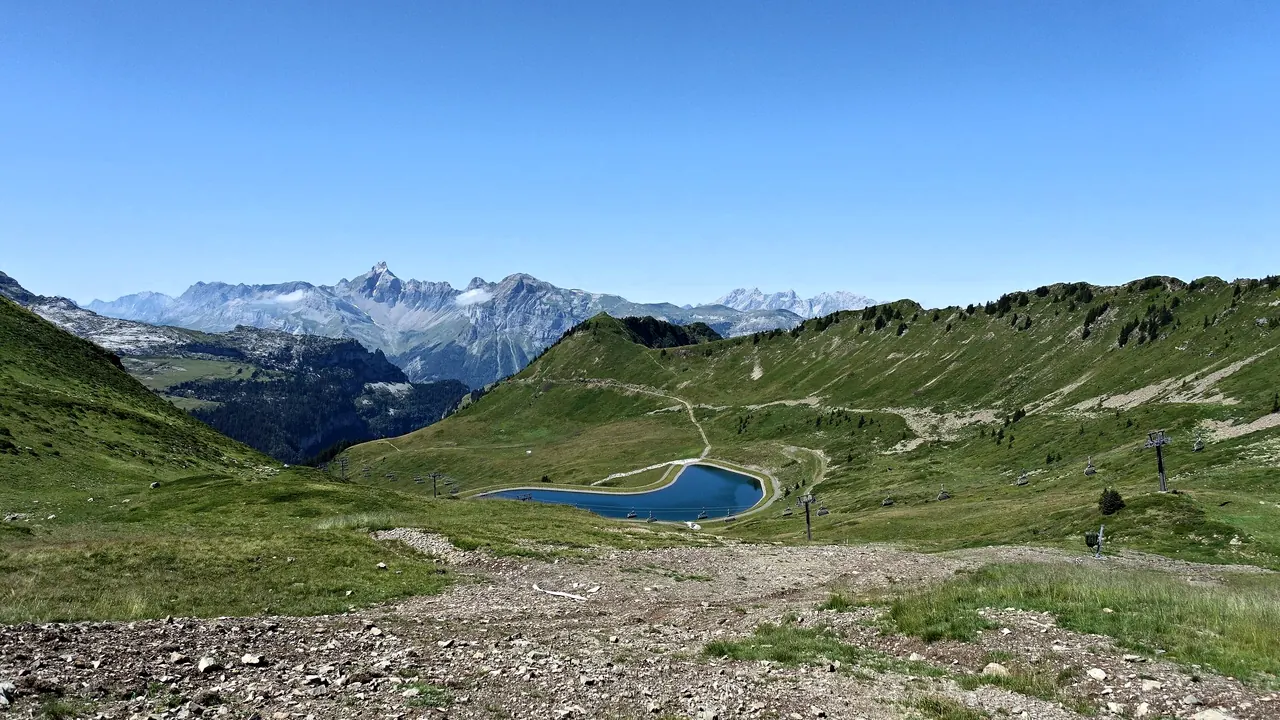
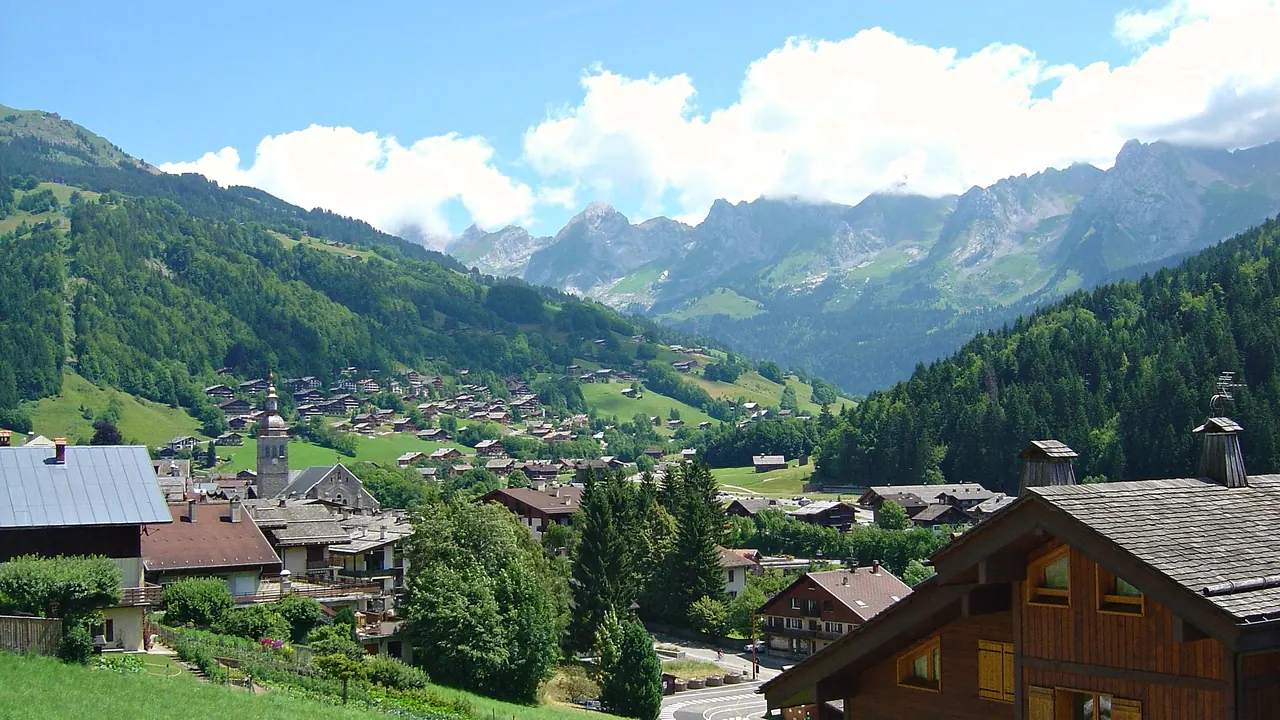
Photos: Flaine by Guilhem Vellut, CC BY 2.0, cropped; Le Grand-Bornand by Anthospace, CC BY-SA 3.0, cropped.
Flaine or Le Grand-Bornand?
Our verdict in twelve categories, each scored against the same fixed benchmark cities, and the climate month by month, so you can choose for your trip.
Choose Flaine for
- getting around
- culture and sights
- nightlife
Flaine is for skiers who want everything on the snow: a car-free resort where you can ski from the door into one of the biggest linked areas in the French Alps, with high, north-facing slopes that hold their snow and good off-piste. It also suits anyone curious about architecture, since Breuer's modernist resort and its monumental art are unlike any other ski station. Once you arrive the car can stay parked all week.
Choose Le Grand-Bornand for
- beaches
- live music and the arts
- wellness
Le Grand-Bornand makes more sense for families, summer visitors and anyone watching the budget. It is a working village in Reblochon country rather than a purpose-built resort, with farms, a weekly market and an August children's festival. Lake Annecy is close enough for regular swims and outings, and the summer hiking, cycling and paragliding give it a second season that Flaine cannot match.
Scoreboard
Twelve categories on one fixed scale from 0 to 100. The shaded stretch is the gap between the two.
Your match
Pick a travel style or drag the sliders, and both match scores follow your weighting.
Wins on getting around and culture and sights with your weighting.
Wins on beaches and live music and the arts with your weighting.
What matters to you?
Category by category
What the scores mean for a trip.
Beaches & swimming
Flaine is about as far from a swim as an Alpine resort can be. The small lake below the resort is for walking around, not bathing, and Lake Geneva or Lake Annecy means a long drive down the valley, so in summer most people use a residence pool.
Le Grand-Bornand is a mountain village too, but Lake Annecy is only about 40 minutes away through Thônes. Its clear water and the small beaches and pontoons at Talloires, Menthon-Saint-Bernard and Sevrier make a swim an easy afternoon out in July and August.
Food & drink
Both serve the same Savoyard food: fondue, raclette, tartiflette and croziflette. In Flaine you eat it mostly on sunny slope-side terraces at lunch, or cook it yourself in an apartment with cheese from the resort shops, and the choice shrinks once the ski season ends.
Le Grand-Bornand has the edge in where the food comes from. This is Reblochon country, so you can buy cheese straight from farms around the valley, eat in farm auberges and shop at the weekly market. For more refined cooking, people from both resorts drive to Annecy.
Culture & sights
Flaine has the more interesting sights, almost entirely because of its design. Marcel Breuer planned the whole resort as a single modernist scheme, with concrete blocks stepped along the rock and a building cantilevered over the cliff. Works by Picasso, Dubuffet and Vasarely stand among the buildings. Seeing it all takes an hour or two, but it rewards anyone who cares about architecture.
Le Grand-Bornand's heritage is rural: the baroque church with its onion-domed tower, old farm chalets with deep roofs, and a farmhouse museum about cheese-making. It makes a pleasant afternoon's walk, but there is less to see.
Nightlife
Neither resort is for a big night out, and the evenings feel much the same. In Flaine the après-ski crowd gathers in a few bars around the Forum, and one or two put on a DJ at weekends. In Le Grand-Bornand the bars are split between the village and Chinaillon and it is even quieter in summer, but Annecy's bars are much closer if you want a proper night out.
Nature & outdoors
Both are excellent mountain bases, but for different seasons. Flaine is the high-snow choice. Its north-facing limestone bowl keeps snow well, the lifts reach the Grandes Platières with a view of Mont Blanc, and the Grand Massif pistes run all the way down to Samoëns, Morillon and Sixt. There is serious off-piste and ski touring, and in summer the Désert de Platé's fissured karst, though that season is short.
Le Grand-Bornand starts from a lived-in valley under the Aravis wall. It mixes pasture and woodland skiing with cross-country trails and the La Clusaz area next door. In summer it is the stronger of the two, with hikes to high chalets, road climbs such as the Col de la Colombière and sailing on Lake Annecy.
Day trips
The two offer similar days out, mostly around Haute-Savoie, but they point in different directions. From Flaine, Geneva and Chamonix are each about an hour away and stone-built Samoëns is close by. Every outing begins with the long, winding descent to the Arve valley, though, and in winter that can be slow.
Le Grand-Bornand's great advantage is Annecy, about 40 minutes away, which leaves time for the castle at Menthon and lakeside Talloires on the same day. Chambéry and Yvoire are further away, and Thônes makes an easy half-day. You need a car from either resort.
Good for families
Flaine works well for a winter ski week with children. The centre is car-free, apartments are close to the snow and the nursery slopes and ski schools are right by the lodgings. Outside the snow there is little for children, though, and the cold at the top and the drive up can wear small ones out.
Le Grand-Bornand is the better all-round choice because it keeps children busy in summer too. They can watch Reblochon being made on farms, walk up to the pastures and play in the river. August brings a week-long children's festival of circus, puppets and street theatre, and Lake Annecy's beaches are close.
Getting around
Flaine is the easier place to be without a car once you are there. The resort is compact and car-free, its three parts are linked by lifts and a shuttle bus, and much of the accommodation is ski-in ski-out. Getting there means a transfer from Geneva airport or a drive up from the station at Cluses.
Le Grand-Bornand's centre is easy to walk, and free winter shuttles connect it to Chinaillon and the lifts. Outside the ski season and beyond the valley there is no railway and there are few buses, so summer trailheads, the lake and day trips all need a car.
Shopping & style
Le Grand-Bornand's weekly market and its few clothing shops give it a slight edge, though nobody picks either resort for shopping. In Flaine the shops in the Forum exist for the ski week: gear hire, small supermarkets, delis with local cheese and charcuterie, and a few souvenir counters.
In Le Grand-Bornand the market morning is worth planning around, with Reblochon, sausages and local honey alongside some crafts. For anything more, people from Le Grand-Bornand go down to Annecy, while from Flaine they head for Annecy or Geneva.
Affordability
Flaine is the costlier week. The lift pass, ski hire and lessons cost the most, terrace lunches add to the bill, and only a self-catering apartment really keeps spending down. Summer there is far cheaper, but the season is short.
Le Grand-Bornand is also an Alpine resort with expensive school vacation weeks. Overall it is more modest, though, and the quieter weeks of January and March, along with a long summer season, give you more ways to keep costs down.
Live music & performing arts
In Flaine, performance amounts to little more than live music at après-ski and the odd show in winter. There is no theatre or regular programme, so an evening of music or theatre means a trip to Annecy or Geneva.
Le Grand-Bornand has Au Bonheur des Mômes, a children's festival held every August for decades. For a week, circus, puppetry, music and street theatre fill the village. Outside that week it is mostly occasional concerts in the church.
Wellness & relaxation
Neither resort has a spa tradition. In Flaine, wellness means what comes with a ski week: pools, saunas and steam rooms in the bigger residences and hotels, which are good for tired legs but little more. The calm comes from the design, a car-free bowl of concrete and rock where the evenings end early. For a proper thermal soak you have to drive down to the old spa towns around Évian.
Le Grand-Bornand is the gentler place to slow down. Its hotels and chalet residences have the same kind of saunas and hot tubs, so the difference is the setting: a farming valley of pastures and old timber chalets rather than a purpose-built station. Outside the school vacation weeks, and especially in June, there is very little to do but sit back, and that is the point.
When should you go?
Pick your month. The climate figures are measured averages, not a forecast.
Flaine in July
Le Grand-Bornand in July
Daytime high, °C
Rainfall in the month, mm
Where the figures come from
Flaine has no weather station within reach, so its figures come from a gridded climate model rather than a measured record, and read a broad area rather than one spot.
Le Grand-Bornand's temperatures are measured 45 km from the centre, at Bourg-St-Maurice.
Le Grand-Bornand has no rain gauge within 25 km of the centre, so its rainfall comes from a gridded climate dataset read at the destination rather than from a gauge further away.
Temperature and rainfall are climate normals, averaged over the years shown. Flaine: 2001-2020 normals, NASA POWER reanalysis grid, no weather station within 90 km. Le Grand-Bornand: 1999-2020 (rainfall 1991-2020) normals, Bourg-St-Maurice (44.7 km from centre).
Flaine is a winter place first. Daytime highs stay below freezing from December to February, around -2°C in midwinter, which is what keeps its snow in good condition but makes the top of the lifts bitterly cold. Summer is short and cool, with highs of about 18°C in July and August. That is good weather for hiking, but too cool to think of swimming outdoors. Rain and snow are spread fairly evenly through the year, with no clearly dry month.
The figures for Le Grand-Bornand are much milder. Highs reach about 27°C in July, warm enough for afternoons at Lake Annecy in July and August, and spring and early autumn are pleasant for walking. Winters are wetter there, building to about 144mm in December, while late summer is the driest stretch. For summer hiking and lake days Le Grand-Bornand has the longer, warmer season. For cold, reliable snow Flaine is the safer bet.
Which traveller are you?
On a family trip with children, Le Grand-Bornand is the better choice. It has beginner slopes and snow gardens in winter, farm visits, river play and the August children's festival in summer, and Lake Annecy's beaches are close enough for a day out.
On an outdoors trip, it depends on the season. Flaine wins for skiing, with high north-facing snow, the huge Grand Massif and good off-piste. In summer, Le Grand-Bornand's Aravis trails, cycling passes and lake paddling give it a longer, fuller season.
On a trip on a tight budget, Le Grand-Bornand is easier on the wallet. Both are self-catering ski resorts, but winter costs in Flaine are higher. Le Grand-Bornand also has quiet January and March weeks and a cheaper summer with free things to do.
Before you go
| Measure | Flaine | Le Grand-Bornand |
|---|---|---|
| Official language | French | French |
| Currency | Euro (EUR) | Euro (EUR) |
| Sockets | CE230 V, 50 Hz | CE230 V, 50 Hz |
| Driving side | Right | Right |
| Time zone | UTC+1, UTC+2 in summer | UTC+1, UTC+2 in summer |
| Emergency number | 112 | 112 |
| Elevation | 1,600 m | 892 m |
| Main airport | Geneva International Airport (GVA)52 km from centre150 non-stop destinations | Geneva International Airport (GVA)41 km from centre150 non-stop destinations |
| Public holidays this year | 11 days | 11 days |
By the numbers
| Measure | Flaine | Le Grand-Bornand |
|---|---|---|
| Population | - | 2,050 |
| People per km² | - | 33 |
| Museums within 10 km | 0 | 1 |
| UNESCO World Heritage sites within 50 km | 2 | 2 |
Where else could you go?
Every comparison below shares a destination with this one, so you can follow Flaine or Le Grand-Bornand somewhere new.
- La Clusazvs Le Grand-Bornand
- Samoënsvs Flaine
- Saint-Gervais-les-Bainsvs Flaine
- Chamonixvs Flaine
- Les Getsvs Flaine
- Megèvevs Le Grand-Bornand