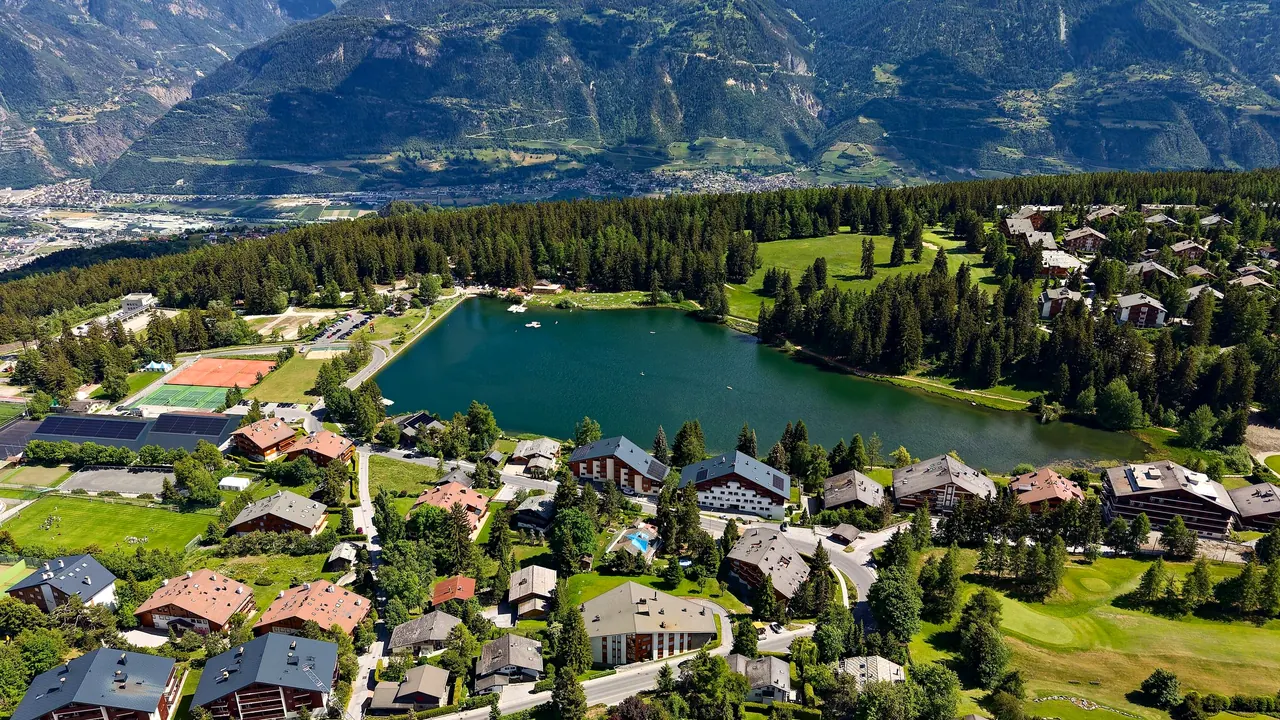
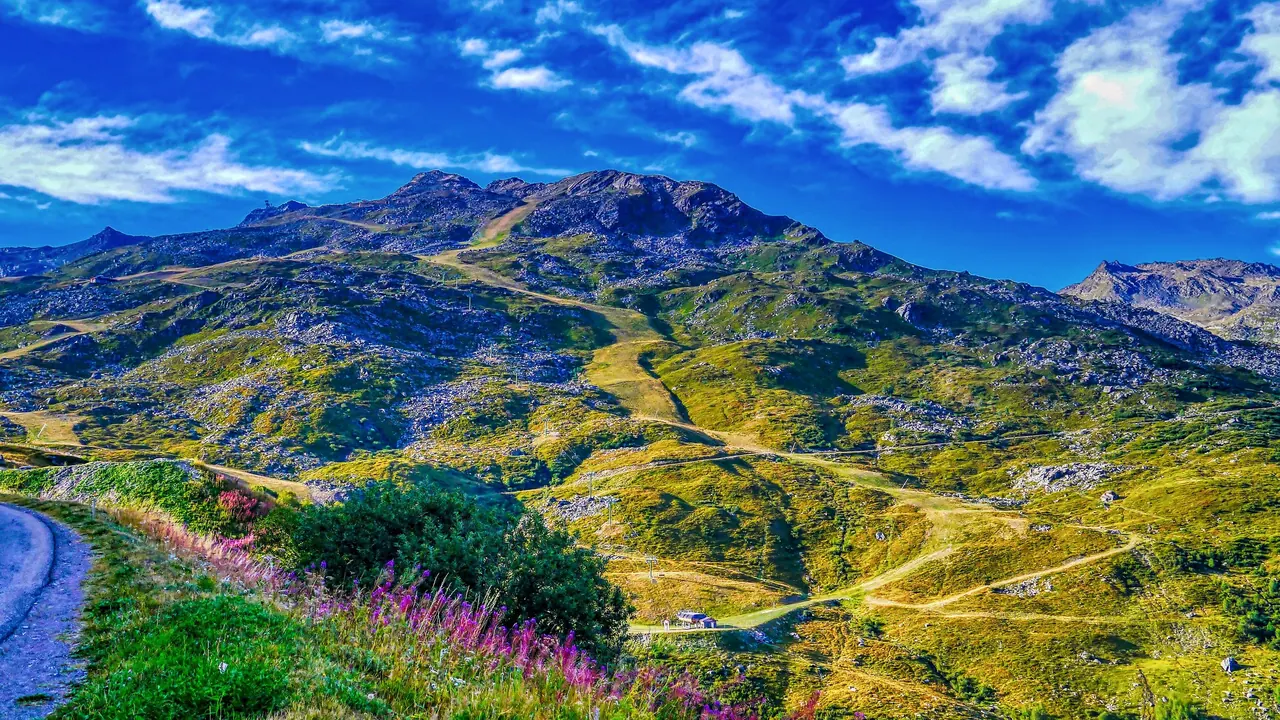
Photos: Crans-Montana by Daniel Reust, CC BY-SA 4.0, cropped; Val Thorens by Zairon, CC BY-SA 4.0, cropped.
Crans-Montana or Val Thorens?
Our verdict in twelve categories, each scored against the same fixed benchmark cities, and the climate month by month, so you can choose for your trip.
Choose Crans-Montana for
- day trips
- shopping
- wellness
Crans-Montana suits travellers who want a mountain stay with more than one string to it. In winter there is sunny skiing for intermediates. In summer there are bisse walks, golf and lazy afternoons by the lakes, and in any season there are hotel spas, smart boutiques and easy train trips down to Sion's castles and the Lake Geneva shore. It is calm and polished and good for families, and it costs accordingly.
Choose Val Thorens for
- nightlife
- prices
- food and drink
For a week that is all about snow and late nights, Val Thorens is the stronger pick. Its altitude makes the skiing reliable from late November into May, the Three Valleys give a huge linked area to explore, and the après-ski suits a young crowd. Groups who share an apartment and cook will find it easier on the wallet, though there is little to do beyond the slopes and the bars.
Scoreboard
Twelve categories on one fixed scale from 0 to 100. The shaded stretch is the gap between the two.
Your match
Pick a travel style or drag the sliders, and both match scores follow your weighting.
Wins on day trips and shopping with your weighting.
Wins on nightlife and prices with your weighting.
What matters to you?
Category by category
What the scores mean for a trip.
Beaches & swimming
Neither is a swimming destination, but Crans-Montana at least has somewhere to swim outdoors. In July and August, Lac Moubra and Lac Grenon on the plateau warm up enough to bathe in, with lawns, pontoons and picnicking families. It makes a pleasant afternoon.
Val Thorens has nothing like it. Its lakes sit above the treeline and stay glacier-cold all summer, so a swim means the sports centre pool or a hotel pool.
Food & drink
Both kitchens run on melted cheese, and both resorts keep a few ambitious hotel restaurants going for a special night out. The difference is in what comes with the cheese. Crans-Montana sits above the Valais vineyards, so a raclette comes with a Petite Arvine or Cornalin grown a short way down the slope, alongside dried meat and rye bread.
Val Thorens cooks Savoyard: tartiflette, diots sausages and Beaufort, and its best meal is often the long lunch at a slope-side hut. Below that, menus of cheese, pizza and burgers repeat across a week, and many groups simply cook in their apartments.
Culture & sights
Neither resort has sights to fill a day, and both send visitors down to the valley for old towns and churches. What little history they have differs. Crans-Montana grew out of early twentieth-century sanatoriums and grand hotels, and a few period buildings and small chapels still show it, while Val Thorens was built from scratch as a ski station in the 1970s and its only landmarks are the mountains.
Nightlife
Val Thorens is the place for a night out. Après-ski starts with dancing on the mountain terraces as the lifts close, then moves into the village bars and ends in clubs that stay open until the early hours, with a young crowd of students and groups of friends. A week can feel repetitive in one small village, but in winter the energy is real.
Crans-Montana goes out in a quieter key: terrace drinks near the lifts, hotel bars and piano lounges, and a couple of late clubs at weekends for an older, well-dressed crowd. It is busiest over the festive weeks and February, and in summer an evening out usually means a drink after golf.
Nature & outdoors
Mountains are the whole point of both, but they are very different mountains. Crans-Montana is a sunny, south-facing balcony among larch forest, looking across to a line of peaks from the Matterhorn to Mont Blanc. Its pistes are broad and mostly suit intermediates, and in summer it adds the level bisse paths, paragliding and some spectacular golf.
Val Thorens sits at about 2,300m among bare rock, snowfields and glacier, with no trees at all. For a skier it opens the whole Three Valleys, with off-piste and a snow-sure season from late November into May. Its summer is shorter and starker, though trails reach high lakes and the edge of the Vanoise national park, home to marmots and ibex.
Day trips
Crans-Montana is far better placed for outings. The funicular drops to Sierre and the Rhône valley railway, which brings Sion's hilltop castles of Valère and Tourbillon, the wine villages around Salgesch and Roman Martigny within easy reach. Montreux, the Château de Chillon and the Lavaux terraces are about an hour and a half away by train.
From Val Thorens, leaving means a long hairpin road down to Moûtiers. Conflans above Albertville makes a pleasant afternoon, but Annecy and Chambéry are around two hours by car each way, and most visitors never go. Méribel and Courchevel can be reached on skis, but that is a ski day rather than an excursion.
Good for families
Crans-Montana is the gentler choice with children. In winter it has broad, sunny beginner slopes and dedicated children's ski areas. In summer there are plateau lakes with playgrounds and pedalos, and bisse paths flat enough for small legs, all in a calm, safe resort. The catch is a village spread across a hillside, so a base near the shuttle and the lifts matters with toddlers.
Val Thorens works well for skiing families on the practical side, with a car-free centre, lodging close to the slopes, children's clubs, a long toboggan run and a pool. But at that altitude it is often very cold and windy, small children may sleep badly, and the party crowd sets much of the tone.
Getting around
Once you are there, both resorts work without a car and run free shuttle buses, but they are built in opposite ways. Crans-Montana is easy to reach: a funicular climbs from Swiss mainline trains at Sierre in about twelve minutes. On the plateau, though, Crans, Montana and the lift bases are strung along several kilometres of hillside, so crossing the resort usually means a bus.
Val Thorens is the reverse. The village is compact and largely car-free, and many beds are ski-in, ski-out, but getting there takes about an hour by bus or taxi up the hairpins from Moûtiers station. Drivers leave their cars in car parks at the edge of the resort.
Shopping & style
Crans is the only one of the two where shopping is a pastime. Its few central streets hold international fashion labels, Swiss watchmakers and jewellers, cashmere and designer ski wear, and its delicatessens sell Valais wine and dried meats. In Val Thorens the shops cover ski hire, technical gear, resort clothing, Savoyard cheese and supplies for self-catering, and there is nothing to browse once you have what you need.
Affordability
Neither is cheap, but Val Thorens is the easier one to make add up. Rooms, lift passes and ski school cost what you would expect at a high-altitude resort. Even so, a group sharing a self-catering apartment and cooking can bring the bill down a good deal, and the resort is less exclusive than its smartest neighbours in the Three Valleys.
Crans-Montana is among the costliest places in Europe to spend a vacation. Rooms are expensive all year and peak at Christmas and in February, and even a simple lunch on a terrace stings. Self-catering, shopping in the valley and coming in late spring or early autumn help only a little.
Live music & performing arts
Crans-Montana has at least a few weeks a year worth planning around. Caprices brings electronic music to the slopes at the end of the ski season, and a summer chamber and classical series fills churches and halls, though outside those weeks there is little beyond a hotel pianist or some occasional jazz. Val Thorens offers cover bands and DJs at après-ski bars and the odd event on the slopes, which is entertainment rather than a stage.
Wellness & relaxation
Crans-Montana began as a place to recover, and it still suits a restful stay. It has clean air and a slow pace outside the peak weeks, its large hotel spas are mostly open to outside guests, and the alpine hot pools at Leukerbad are less than an hour away.
Val Thorens has good facilities too, in hotels, apartment residences and the sports centre, and the old thermal town of Brides-les-Bains is about an hour down the road. But the resort runs on hard skiing and late nights, so a sauna there is for aching legs rather than a reason to come.
When should you go?
Pick your month. The climate figures are measured averages, not a forecast.
Crans-Montana in July
Val Thorens in July
Daytime high, °C
Rainfall in the month, mm
Where the figures come from
Crans-Montana has no weather station within reach, so its figures come from a gridded climate model rather than a measured record, and read a broad area rather than one spot.
Val Thorens has no weather station within reach, so its figures come from a gridded climate model rather than a measured record, and read a broad area rather than one spot.
Temperature and rainfall are climate normals, averaged over the years shown. Crans-Montana: 2001-2020 normals, NASA POWER reanalysis grid, no weather station within 90 km. Val Thorens: 1991-2020 normals, TerraClimate 4 km grid at the town, no weather station within 90 km.
Both are winter resorts first, and both stay below freezing through December, January and February. In summer they part ways. Crans-Montana warms into a proper alpine summer, with highs around 18°C in July and August that are right for hiking, golf and a dip in the plateau lakes. May to August is also its wettest stretch, at around 130mm a month. Spring and late autumn are mild but quiet, with many lifts closed.
Val Thorens stays colder all year, with summer highs of only about 15°C to 16°C and weather that can turn at any time. Its heaviest precipitation comes in November and December and peaks at 180mm. At those temperatures much of it falls as snow, which helps the season run from late November into May. July and August are its driest months, but the summer is short.
Which traveller are you?
On a relaxing and wellness trip, Crans-Montana suits the mood better. It has long sunny days on the plateau, plenty of hotel spas and evenings that wind down early outside the peak weeks. Val Thorens is built for covering ground on skis, so rest there gets squeezed in between busy days.
For a food and nightlife trip, Crans-Montana is better for a long dinner and a nightcap, and it suits couples more than groups. Val Thorens is the one for friends who want to go out every night, with a young crowd and bars a short walk from every bed in its compact village.
On a family trip with young children, Crans-Montana is the easier choice. It sits about 800m lower, the resort is calm and it works just as well in summer as in winter, so there is more to vary the days. Val Thorens is better kept for older children who ski hard.
Before you go
| Measure | Crans-Montana | Val Thorens |
|---|---|---|
| Official language | French, German, Italian, Romansh | French |
| Currency | Swiss Franc (CHF) | Euro (EUR) |
| Sockets | CJ230 V, 50 Hz | CE230 V, 50 Hz |
| Driving side | Right | Right |
| Time zone | UTC+1, UTC+2 in summer | UTC+1, UTC+2 in summer |
| Emergency number | 112 | 112 |
| Elevation | 1,495 m | 1,710 m |
| Main airport | Geneva International Airport (GVA)106 km from centre150 non-stop destinations | Geneva International Airport (GVA)111 km from centre150 non-stop destinations |
| Public holidays this year | 9 days | 11 days |
By the numbers
| Measure | Crans-Montana | Val Thorens |
|---|---|---|
| Population | 10,447 | - |
| People per km² | 175 | - |
| Museums within 10 km | 3 | 0 |
| UNESCO World Heritage sites within 50 km | 1 | 1 |
Where else could you go?
Every comparison below shares a destination with this one, so you can follow Crans-Montana or Val Thorens somewhere new.
- Les Menuiresvs Val Thorens
- Méribelvs Val Thorens
- Leukerbadvs Crans-Montana
- Courchevelvs Val Thorens
- Adelbodenvs Crans-Montana
- Gstaadvs Crans-Montana