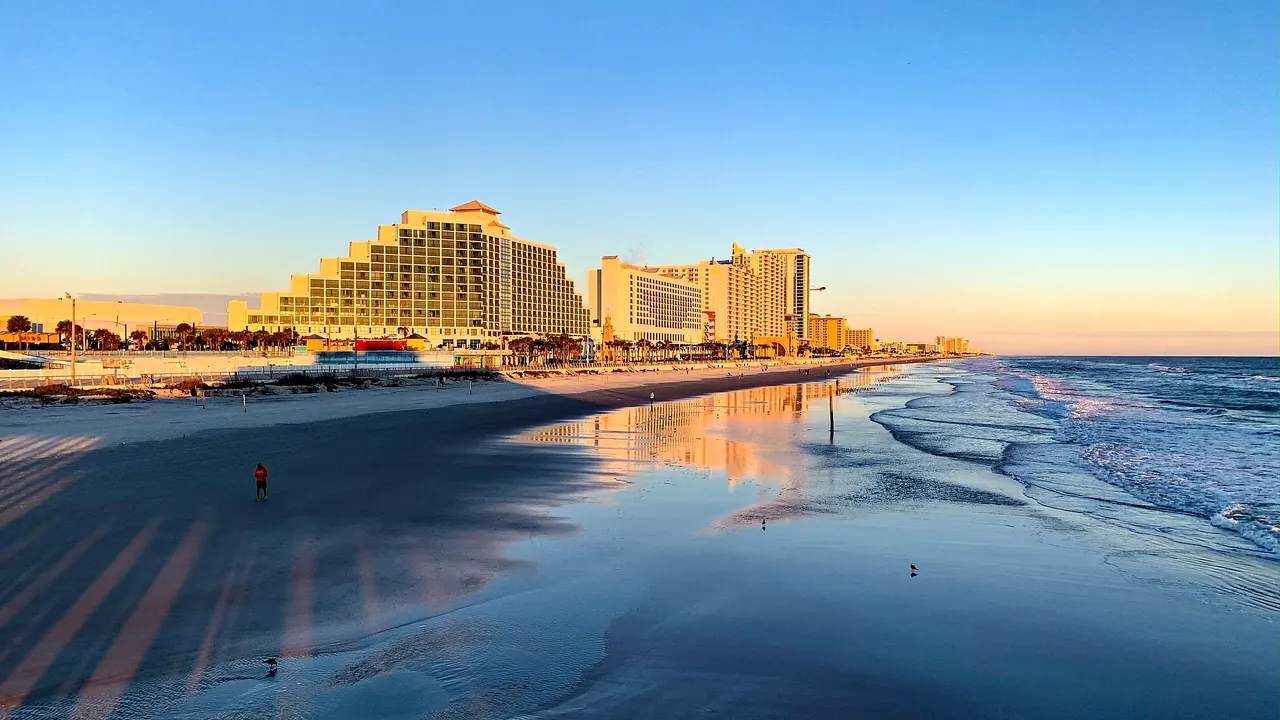
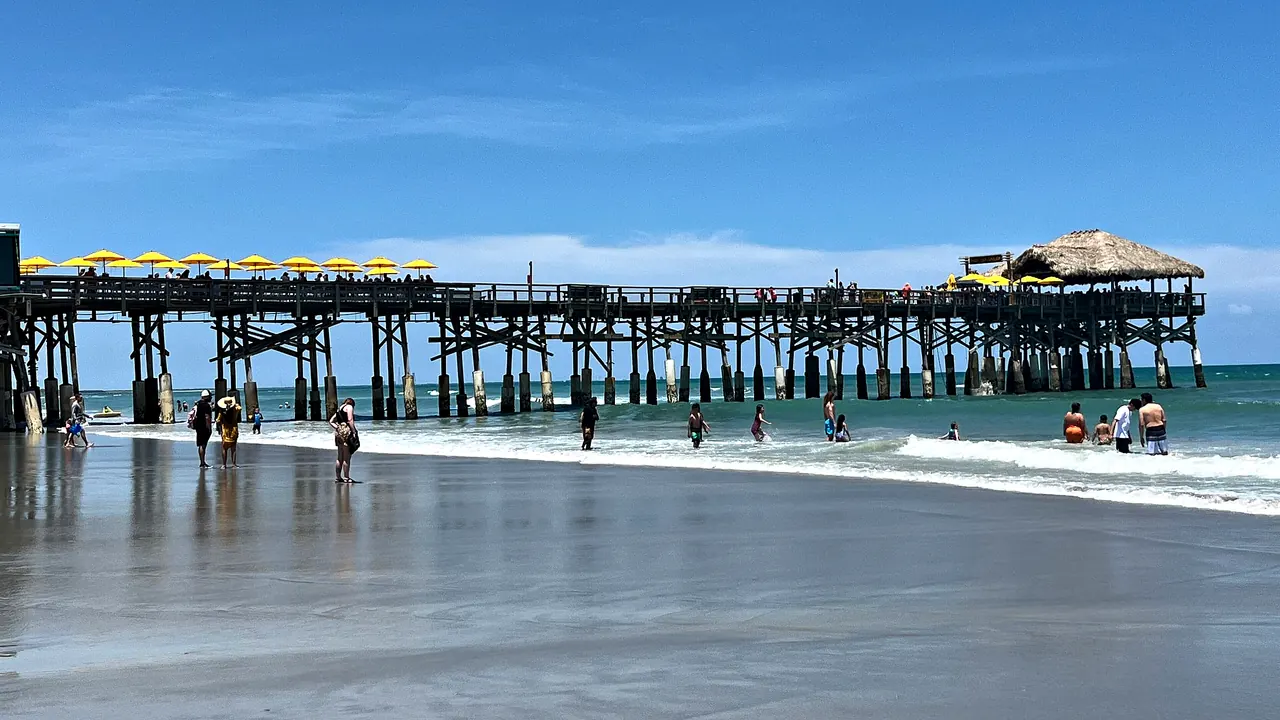
Photos: Daytona Beach by Han Zheng, CC BY-SA 2.0, cropped; Cocoa Beach by Benoît Prieur, CC0.
Daytona Beach or Cocoa Beach?
Our verdict in twelve categories, each scored against the same fixed benchmark cities, and the climate month by month, so you can choose for your trip.
Choose Daytona Beach for
- culture and sights
- live music and the arts
- day trips
Daytona Beach gives a beach stay more to do once the sun goes down or the weather turns. It has the Speedway and its racing history, a proper museum, a climbable lighthouse, a real concert season in winter and a livelier bar scene on Main Street. It is also better placed for outings, with St Augustine an easy hour north. The catch is its big event weeks, which bring motorbikes, crowds and higher room rates, so choose your dates carefully.
Choose Cocoa Beach for
- families
- nature and the outdoors
- getting around
Cocoa Beach suits a quieter, outdoors-minded beach trip, especially with children. The town is a thin strip where the sand is always close, the surf is gentle enough for first lessons, and the lagoon behind it is full of manatees, dolphins and mangrove islands to paddle through. The Kennedy Space Center sits right next door, and rocket launches can be watched from the beach. Evenings are early and there is little to see in town, so it works best for people who are happy with sand, water and the space coast.
Scoreboard
Twelve categories on one fixed scale from 0 to 100. The shaded stretch is the gap between the two.
Your match
Pick a travel style or drag the sliders, and both match scores follow your weighting.
Wins on culture and sights and live music and the arts with your weighting.
Wins on families and nature and the outdoors with your weighting.
What matters to you?
Category by category
What the scores mean for a trip.
Beaches & swimming
On the sand the two are evenly matched. Both have wide, pale Atlantic beaches with greenish water, regular waves and rip currents that make the lifeguarded stretches matter. Cocoa Beach is the more compact of the two: the town is so narrow that the beach is always a few streets away. Its sea also stays a little warmer in winter, and the pier and surf culture set the tone.
Daytona's beach is a longer, harder-packed strand of about 37km, firm enough for cars on marked stretches. Its busy centre is the boardwalk and pier, and Ormond Beach, Ponce Inlet and New Smyrna Beach are close by when you want something quieter.
Food & drink
Neither town is worth travelling to for the food, and on that they are close. Both eat casually and well enough on seafood. Cocoa leans on Port Canaveral rock shrimp, fish tacos and raw bars by the Banana River docks. Daytona's best meals are at the old fish camps on the Halifax River and towards Ponce Inlet, with smoked fish dip, grouper sandwiches and oysters eaten on decks over the water. Chains line the main roads in both.
Culture & sights
Daytona has noticeably more to see. The Speedway, home of the Daytona 500, can be toured, and it tells a story of speed that goes back to land-speed records set on the beach itself. Add the Museum of Arts and Sciences and the climb up Florida's tallest lighthouse, and you have a day or two of proper sightseeing.
In Cocoa Beach the town itself has little beyond the beach and the wooden pier. Its one great sight is a rocket rising from Cape Canaveral, which you can watch from the sand. For museums, visitors leave town.
Nightlife
Daytona has the livelier evenings, though neither has a real club scene. Main Street's biker saloons are its signature, and during Bike Week, Biketoberfest and race weeks the bars spill out onto the street. Outside those weeks it settles into tiki bars, hotel lounges and a few spots that stay open late.
Cocoa Beach is quieter still. Nights out mean cover bands on open-air decks around the pier and the short downtown strip, and most nights are over well before the small hours. Spring break is the exception.
Nature & outdoors
Cocoa Beach is slightly better placed for the outdoors. The Banana River and Indian River Lagoon start right behind town, and the Thousand Islands are an easy paddle among mangroves, manatees and dolphins, with water that glows with bioluminescent plankton on summer nights. Merritt Island refuge and Canaveral National Seashore are just north, and the surf is reliably gentle for learners.
Daytona reaches the same seashore from its other end, on Mosquito Lagoon. It also has inland options Cocoa lacks: manatees gathering at Blue Spring in winter, and canoe routes under live oaks at Tomoka.
Day trips
Daytona is the better base for outings. St Augustine, with its Spanish fort and old streets, is about an hour north. Orlando and Winter Park are an hour inland, and even the Kennedy Space Center is only a little over an hour south. New Smyrna Beach and DeLand make easy half days.
Cocoa Beach has the space centre half an hour away, which is its trump card, and Cocoa Village across the causeway. St Augustine, though, means around two hours each way.
Good for families
Cocoa Beach is the more relaxed choice with children. It has lifeguarded beach parks, surf schools for beginners and the space centre nearby, which most children love. It also avoids the big event weeks, so the town keeps a steady, calm pace.
Daytona has more built specifically for children, with arcades and small rides on the boardwalk, a water park, mini-golf and a planetarium for rainy afternoons. Families have to work around Bike Week, race weekends and spring break, though, when the noise and crowds are out of place for a family trip.
Getting around
You will want a car in both, and neither has buses worth planning around. Cocoa Beach is the easier one to manage day to day: it is one thin strip along a single road, so a bicycle covers downtown and the pier. Orlando's airport is about an hour's drive away. Daytona spreads along wide roads on both sides of the river. Its hard beach doubles as a walking and cycling route, but traffic snarls during big events.
Shopping & style
Daytona offers a little more range, though nobody comes to either town to shop. It has a large outlet centre and a regional mall for brand-name clothing, independent shops and galleries on Beach Street, and Main Street's motorcycle gear.
Cocoa Beach's shopping is surf culture almost entirely. A huge round-the-clock surf store has been a landmark on the main road since the 1960s, and smaller shops sell boards from local shapers. For boutiques, people cross to Cocoa Village.
Affordability
Daytona comes out a little cheaper. It has more older oceanfront motels and condos, and its diners and seafood places keep meals reasonable, although rates jump sharply around the Daytona 500 and Bike Week. Cocoa Beach is moderate by American beach standards, but launch weekends and spring push prices up. A trip there also tends to add the space centre ticket to the hire car you need in both towns.
Live music & performing arts
Daytona has a real, if modest, performance calendar. A long-running winter series brings visiting orchestras and soloists, the Peabody Auditorium hosts touring Broadway shows and concerts, and the oceanfront bandshell has free concerts on summer evenings.
Cocoa Beach's own offer is little more than cover bands on beach-bar decks. For a play or a touring show you drive to the Cocoa Village playhouse or the arts centre in Melbourne.
Wellness & relaxation
Neither town has a spa culture, and they offer much the same: a few day spas and massage studios, and the calm of early walks on the sand. Cocoa Beach is the more reliably peaceful, with quiet weekdays, beach yoga and sunsets over the river. Daytona's bigger resorts do have their own spas, but race weeks and Bike Week shatter the calm, so you need to pick your dates.
When should you go?
Pick your month. The climate figures are measured averages, not a forecast.
Daytona Beach in July
Cocoa Beach in July
Daytime high, °C
Rainfall in the month, mm
Where the figures come from
Cocoa Beach has no rain gauge within 25 km of the centre, so its rainfall comes from a gridded climate dataset read at the city rather than from a gauge further away.
Temperature and rainfall are climate normals, averaged over the years shown. Daytona Beach: 1991-2020 normals, Daytona Beach / Mansfield Mobile Home Park (4.9 km from centre). Cocoa Beach: 1961-1990 (rainfall 1991-2020) normals, Cocoa / Patrick Air Force Base (11.2 km from centre).
The two towns share almost the same climate, with Daytona a little hotter in summer and Cocoa a little milder in the sea in winter. From May to October the Atlantic is warm enough to swim comfortably off both, peaking at about 28°C in late summer. From June to September the rain arrives as afternoon thunderstorms, and September is the wettest month, with about 217mm at Cocoa. Summer days reach 30°C at Cocoa and 33°C at Daytona, which makes walking or exploring anywhere other than the beach hard work after mid-morning.
November to April is the better season for being active outdoors, with mild, drier days in the low to mid twenties. The sea is cooler then, around 21°C at Cocoa in winter and nearer 19°C at Daytona in February, so few people swim. Late April, May and October are the best compromise for both towns, warm enough for the beach without the worst of the heat and storms.
Which traveller are you?
On a family trip with young children, Cocoa Beach makes the days simpler. The condo, the sand and the pier are close together, the space centre is a short drive, and with no Bike Week or race weeks the town stays calmer than Daytona.
For a culture and arts trip, Daytona Beach is the only real choice of the two, though still a modest one. You can fill a couple of days in town, spend another in colonial St Augustine and, in winter, add concert evenings. Cocoa sends you elsewhere for nearly everything.
On a food and nightlife trip, Daytona Beach gives you more evenings worth going out for. A seafood dinner on a deck over the water leads easily into a night of tiki bars and Main Street saloons, while Cocoa usually winds down well before the small hours.
Before you go
| Measure | Daytona Beach | Cocoa Beach |
|---|---|---|
| Currency | US Dollar (USD) | US Dollar (USD) |
| Sockets | AB120 V, 60 Hz | AB120 V, 60 Hz |
| Driving side | Right | Right |
| Time zone | UTC-5, UTC-4 in summer | UTC-5, UTC-4 in summer |
| Emergency number | 911 | 911 |
| Elevation | 4 m | 0 m |
| Main airport | Daytona Beach International Airport (DAB)5 km from centre8 non-stop destinations | Orlando International Airport (MCO)68 km from centre170 non-stop destinations |
| Public holidays this year | 11 days | 11 days |
By the numbers
| Measure | Daytona Beach | Cocoa Beach |
|---|---|---|
| City population | 72,647 | 11,354 |
| People per km² | 440 | 290 |
| Museums within 10 km | 6 | 3 |
| UNESCO World Heritage sites within 50 km | 0 | 0 |
| Swim season, months above 21 °C | 9 months | 11 months |
Where else could you go?
Every comparison below shares a destination with this one, so you can follow Daytona Beach or Cocoa Beach somewhere new.
- Orlandovs Cocoa Beach
- St. Augustinevs Daytona Beach
- Orlandovs Daytona Beach
- Tampavs Cocoa Beach
- St. Augustinevs Cocoa Beach
- West Palm Beachvs Cocoa Beach