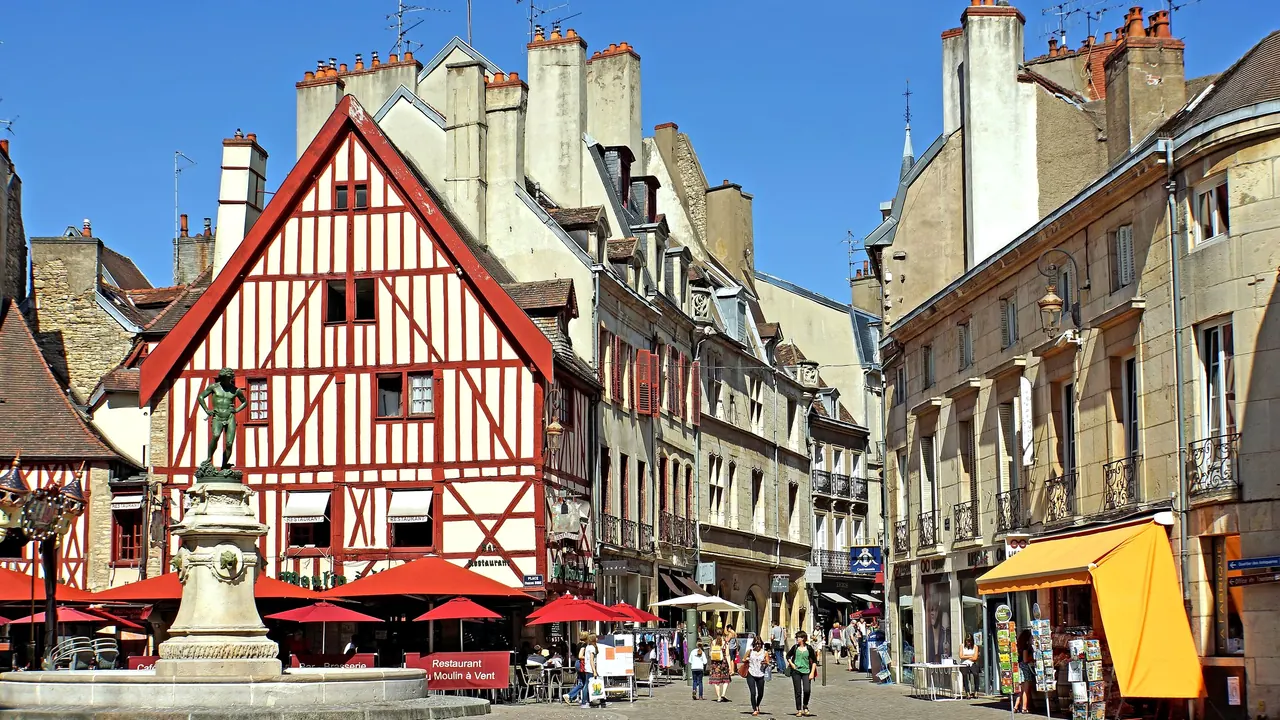
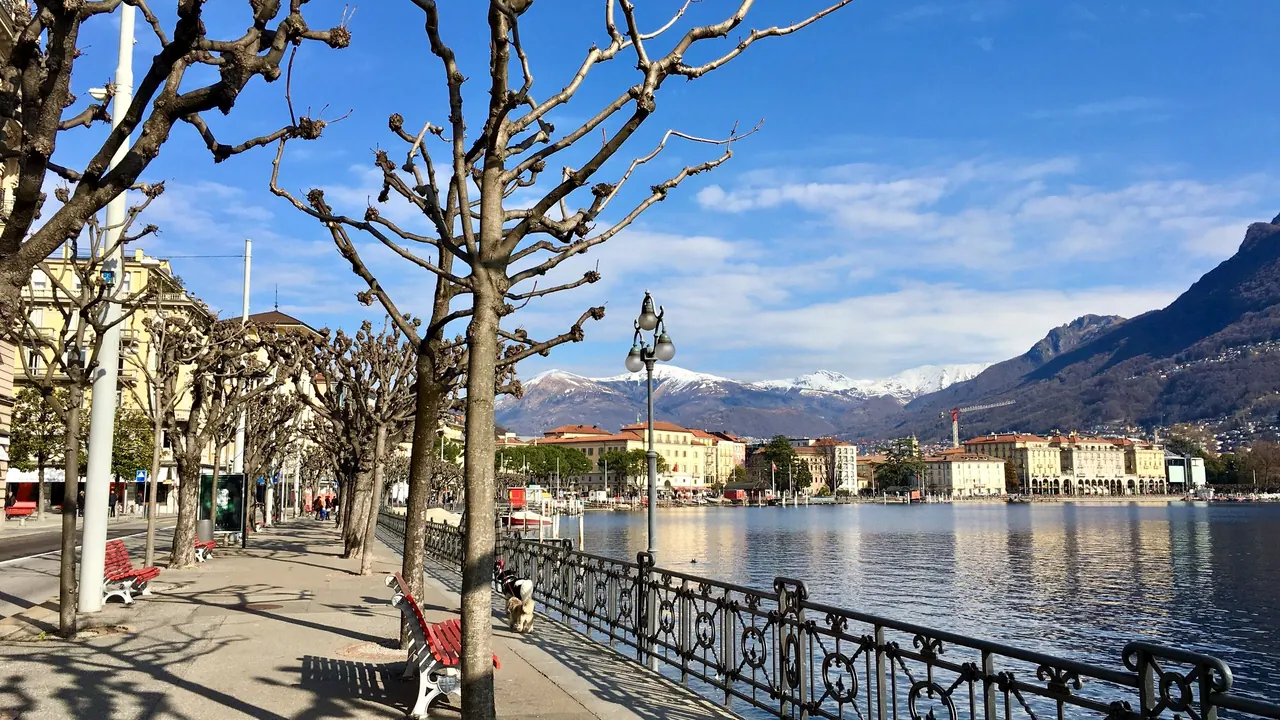
Photos: Dijon by Dennis G. Jarvis, CC BY-SA 2.0, cropped; Lugano by Thomas Woodtli from Zürich, Switzerland, CC BY-SA 2.0, cropped.
Dijon or Lugano?
Our verdict in twelve categories, each scored against the same fixed benchmark cities, and the climate month by month, so you can choose for your trip.
Choose Dijon for
- prices
- culture and sights
- food and drink
Dijon is for travellers who want to eat, drink and look at history. It was the capital of the Valois dukes, and the old centre still shows it. You get Burgundian cooking at its source, cellars and wine bars pouring village Burgundies by the glass, and the Route des Grands Crus starting at the edge of town. It also costs much less, so a long weekend of bistros and tastings won't feel like an extravagance.
Choose Lugano for
- beaches
- nature and the outdoors
- families
Lugano suits people who would rather be outdoors than in a museum. Its lake sits between steep wooded mountains, with funiculars up Monte Brè and San Salvatore, ridge walks and lidos for a summer swim. Milan, Como and Lake Maggiore are all an easy train ride away. Expect to pay Swiss prices for all of it, and don't expect much from the food or the sights in town.
Scoreboard
Twelve categories on one fixed scale from 0 to 100. The shaded stretch is the gap between the two.
Your match
Pick a travel style or drag the sliders, and both match scores follow your weighting.
Too close to call, 2 points apart
Wins on prices and culture and sights with your weighting.
Wins on beaches and nature and the outdoors with your weighting.
What matters to you?
Category by category
What the scores mean for a trip.
Beaches & swimming
Neither city has a sea, but only Lugano has real summer swimming. Its lidos have lawns, decks and ladders straight into the lake, at the Cassarate mouth and along the shore towards Castagnola and Paradiso, and you can take a boat to small bathing spots in the lakeside villages.
In Dijon, swimming means the supervised bathing area at Lac Kir, a reservoir on the edge of town, or a pool. It is fine for a hot afternoon but nothing to plan a trip around.
Food & drink
Dijon is the stronger place to eat. Boeuf bourguignon, jambon persillé, Époisses and Bresse poultry come from the region around it, Les Halles is full of local produce on market days, and the Côte de Nuits wines are poured by the glass. Even here the choice is almost entirely French regional, though.
Lugano's best food is in its grotti, rustic taverns serving polenta, braised meats and Ticino Merlot under chestnut trees. That makes a lovely lunch, but there is little else to explore, and many visitors keep their big meals for Italy.
Culture & sights
Dijon has much more to see. It was a ducal capital: the Palace of the Dukes houses one of France's oldest fine arts museums, and the old centre of half-timbered houses and Renaissance mansions is part of a UNESCO listing. The Valois tombs, Saint-Bénigne's crypt and the Chartreuse de Champmol keep you busy for a couple of days.
Lugano's sights are prettier than they are deep. You get the arcaded squares around Piazza della Riforma, the façade of San Lorenzo, the Luini Passion fresco and the collections split between LAC and Palazzo Reali. A single unhurried day covers them.
Nightlife
Neither is a place for a big night out, but thanks to its university Dijon has a bit more going on. Rue Berbisey's small bars and pubs and the terraces around Place Émile Zola fill up with students during term.
Lugano's evenings are about aperitivo by the lake followed by a long dinner, among a smart, mostly local crowd. Most nights it is quiet before midnight, and young locals head to Milan for clubs.
Nature & outdoors
Here Lugano is clearly ahead. The lake is surrounded by steep mountains you can ride up by funicular or rack railway, with walks down through chestnut woods. The Monte Lema to Monte Tamaro ridge is a proper day hike, and the green rivers of the Verzasca and Maggia valleys are about an hour away.
Dijon's landscape is gentle and good for cycling. There are climbing cliffs in the Combe à la Serre, the flat towpath of the Burgundy Canal and the signed vineyard route towards Beaune. The Morvan is the wildest country nearby, and it has nothing like Lugano's mountain views.
Day trips
Both make excellent bases. Lugano has a slight edge because it reaches into two countries: Milan and the Last Supper are just over an hour away, Como takes half an hour, and you can visit the Bellinzona castles, Lake Maggiore and the Borromean Islands by train or boat.
From Dijon the trips have one main theme, wine and abbeys. You can go down the Route des Grands Crus to Beaune, out to Fontenay Abbey, and on to Semur-en-Auxois and Alésia. Away from the railway many of these places are easier with a car or bike.
Good for families
Lugano is better for children, mostly because of the lake. Boat rides, lido slides, funiculars and the miniature Swiss landmarks at Melide make full days out. The steep streets are hard work with a pushchair, though.
Dijon is flat, safe and largely pedestrian, and it has the planetarium at the Jardin de l'Arquebuse and paddling at Lac Kir. Otherwise, most of a Dijon visit is wine and fine art, which children will find dull.
Getting around
You won't need a car in either city for the town itself. Dijon is flat, and its centre is so compact that the station, Les Halles, the palace and the cathedral are a few minutes apart on foot. Trams and buses cover the outskirts and Lac Kir, regional trains run to Beaune and the TGV reaches Paris quickly. Most of the wine villages are off the railway, though, so seeing the Côte de Nuits properly means a hire car, a bike or a tour.
Lugano is slightly the easier of the two, because public transport takes you to the places you came for. Lake boats call at the waterside villages, funiculars and a rack railway climb Monte Brè, San Salvatore and Generoso, and Swiss trains reach Bellinzona, Locarno and Como. The one drawback is the slope: a short funicular links the station to the old town below.
Shopping & style
In Dijon you shop for things to eat and drink, and in Lugano for things to wear. Dijon has mustard in dozens of flavours, pain d'épices, crème de cassis, cellar merchants selling Burgundy and cheese from Les Halles. That makes it the better place to fill a car boot for home. Rue de la Liberté adds a department store and French chains, but there is little fashion.
Lugano's Via Nassa is lined with Swiss watchmakers, jewellers and Italian fashion houses under its arcades, and the designer outlet near Mendrisio is a short drive away. It is still a shallow offer for younger or cheaper tastes, which is why serious shoppers carry on to Milan.
Affordability
There is a big difference here. Dijon is priced like an ordinary French regional city, with moderate hotels, good-value set lunches and cheap wine by the glass. The bill only climbs if you book serious restaurants and wine tours.
Lugano costs Swiss prices for everything: lakeside hotels, meals, boats and mountain railways. Grotti and the free regional transport that comes with a hotel stay help a little, but there is no cheap way to stay there.
Live music & performing arts
The two are about level, and both cities follow a classical season. Dijon has its own opera company, with the Grand Théâtre and an Auditorium known for its acoustics, plus a national drama centre. Things go quiet in summer.
Lugano is the opposite. Its programme is centred on LAC and the Orchestra della Svizzera italiana, and in summer the free Estival Jazz concerts fill Piazza della Riforma. For opera, people go to La Scala.
Wellness & relaxation
Dijon offers vineyard calm, while Lugano has the lake and its lidos, and the lake makes it the better place to switch off. Neither has a bathing tradition. Dijon's version of rest is provincial and slow: a long bistro lunch, an empty square in the afternoon and a quiet drive through the Côte de Nuits. If you want a treatment, you are limited to a handful of hotel spas, a few of them using grapes.
In Lugano, rest is something you do out of doors. A morning by the palms on the shore can lead into an afternoon on a lido deck and dinner at a grotto under the chestnuts. There are also proper spa facilities, in the large lakeside hotels and at the indoor pool and sauna complex near Rivera.
When should you go?
Pick your month. The climate figures are measured averages, not a forecast.
Dijon in July
Lugano in July
Daytime high, °C
Rainfall in the month, mm
Temperature and rainfall are climate normals, averaged over the years shown. Dijon: 1991-2020 normals, Dijon (7 km from centre). Lugano: 1991-2020 normals, Lugano (1.2 km from centre).
Dijon and Lugano have almost the same temperatures through the year. Both are cold in winter and reach about 27°C in July and August, which is warm enough for long days outdoors but rarely too hot for walking the streets. Dijon's rain is spread fairly evenly across the year, so no season is really drier than another. June to August are its warmest and sunniest months, good for cycling the vineyards and eating on terraces, and May and September are mild for exploring the old centre on foot. Winter there is short of light and often grey.
Lugano is very different in its rain. From April to November it gets far more than Dijon, with May the wettest month at around 178mm, so even summer brings heavy showers and storms. In return its winters are much brighter, with about twice Dijon's sunshine from November to January. Go from June to early September to swim in the lake, or in spring and autumn for hiking, and pack for rain either way.
Which traveller are you?
On a tight budget, choose Dijon. Hotels and set lunches are reasonably priced, wine by the glass is cheap and the centre is easy to walk. In Lugano, almost everything costs far more, from hotels and meals to boat trips and mountain railways.
For an outdoors trip, Lugano wins. Funiculars take you up to mountain views, the path to Gandria and the Monte Lema ridge make good walks, and the Verzasca valley is about an hour away. Around Dijon the country is gentler: combes, canal towpaths and vineyard cycling.
On a culture and arts trip, Dijon gives you more. There is the Palace of the Dukes with the ducal tombs, Notre-Dame's gargoyles and Sluter's Well of Moses, which fill two or three days. Lugano's old town and Luini fresco can be seen in a day.
Before you go
| Measure | Dijon | Lugano |
|---|---|---|
| Official language | French | French, German, Italian, Romansh |
| Currency | Euro (EUR) | Swiss Franc (CHF) |
| Sockets | CE230 V, 50 Hz | CJ230 V, 50 Hz |
| Driving side | Right | Right |
| Time zone | UTC+1, UTC+2 in summer | UTC+1, UTC+2 in summer |
| Emergency number | 112 | 112 |
| Elevation | 220 m | 283 m |
| Main airport | Lyon Saint-Exupéry Airport (LYS)178 km from centre141 non-stop destinations | Milan Malpensa International Airport (MXP)46 km from centre208 non-stop destinations |
| Public holidays this year | 11 days | 15 days |
By the numbers
| Measure | Dijon | Lugano |
|---|---|---|
| City population | 161,830 | 63,495 |
| People per km² | 3,890 | 837 |
| Museums within 10 km | 8 | 17 |
| UNESCO World Heritage sites within 50 km | 1 | 5 |
Where else could you go?
Every comparison below shares a destination with this one, so you can follow Dijon or Lugano somewhere new.