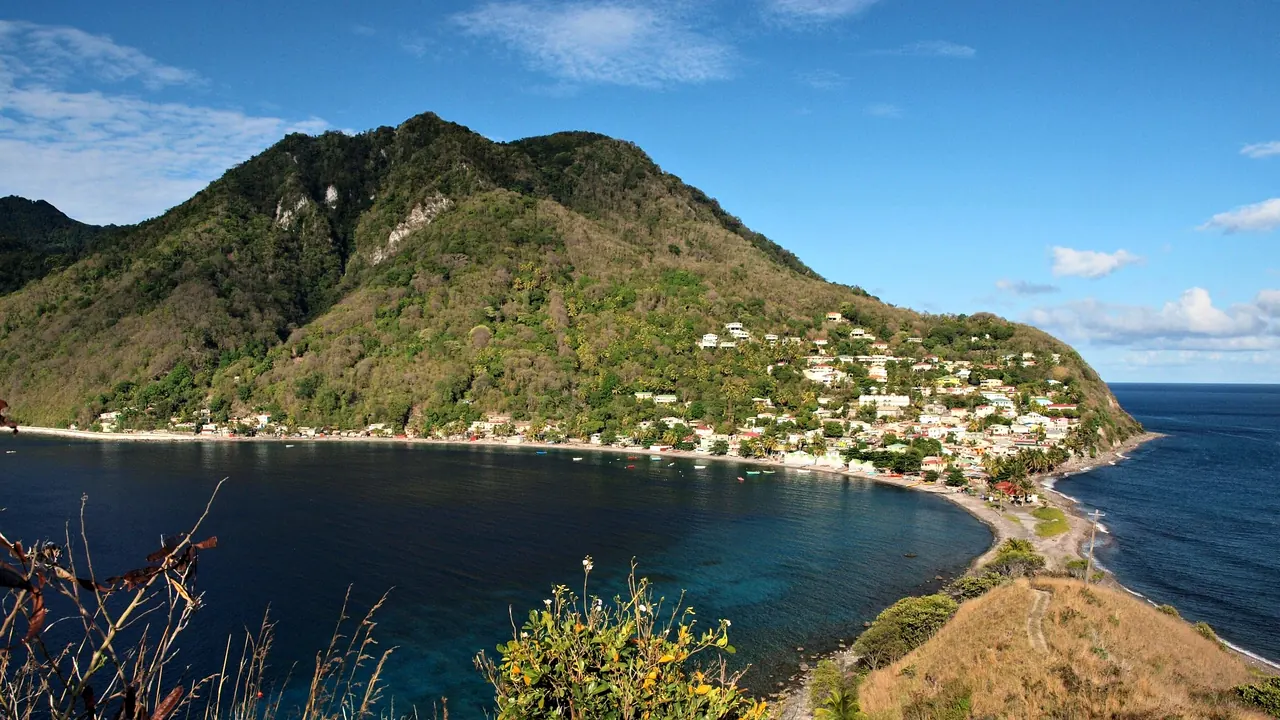
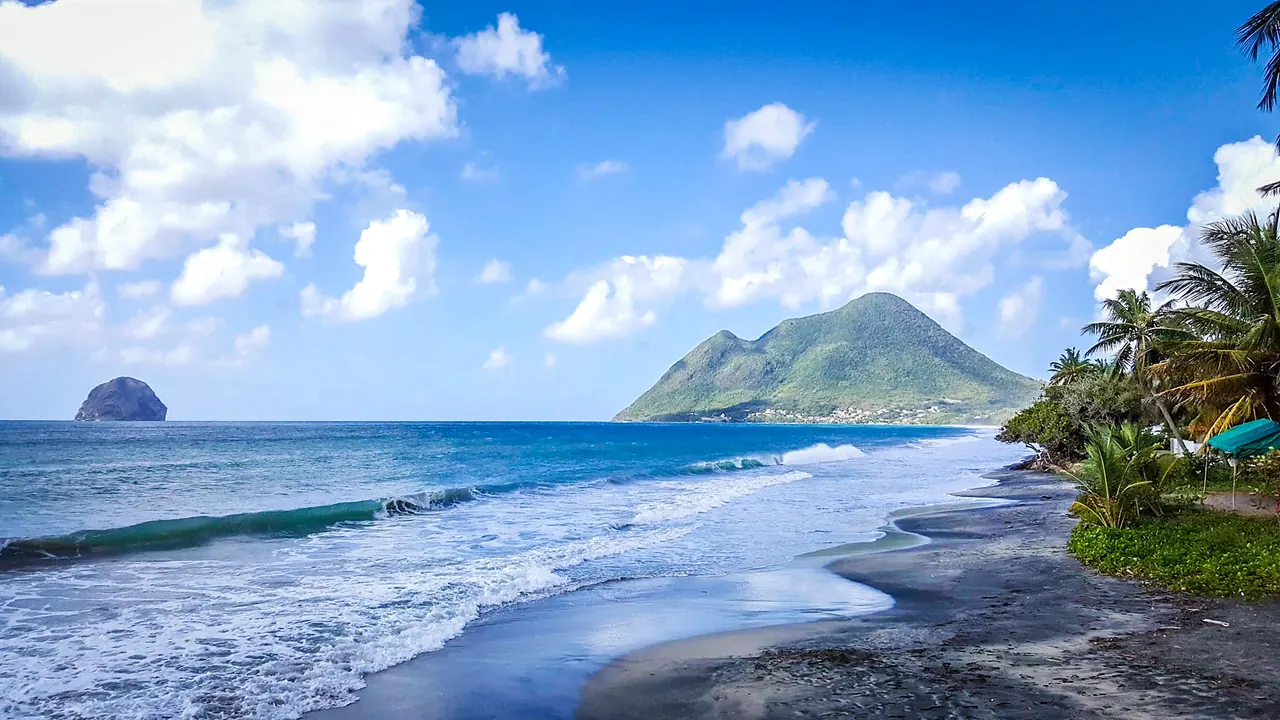
Photos: Dominica by Charlottea, CC BY-SA 3.0, cropped; Martinique by G21designz, CC BY-SA 4.0, cropped.
Dominica or Martinique?
Our verdict in twelve categories, each scored against the same fixed benchmark cities, and the climate month by month, so you can choose for your trip.
Choose Dominica for
- wellness
- nature and the outdoors
- prices
Dominica suits travellers who come for the land itself and don't mind getting muddy. Its rainforest is wilder and goes on for longer, with the hike to the Boiling Lake, the long Waitukubuli Trail and sperm whales offshore all year. After a day on the trails you can soak in the sulphur pools of Wotten Waven. Beaches, restaurants and evenings out are thin, and costs stay a little lower if you eat local and base yourself in Roseau.
Choose Martinique for
- beaches
- food and drink
- day trips
Martinique is the better pick for a rounder Caribbean trip that still has good walking. The calm beaches of the south, such as Grande Anse des Salines, are real beaches. The Creole cooking comes with French bread and rum estates you can tour, and Saint-Pierre, bèlè evenings and the rum country fill the days off the sand. Families with young children will also find it much easier going.
Scoreboard
Twelve categories on one fixed scale from 0 to 100. The shaded stretch is the gap between the two.
Your match
Pick a travel style or drag the sliders, and both match scores follow your weighting.
Wins on wellness and nature and the outdoors with your weighting.
Wins on beaches and food and drink with your weighting.
What matters to you?
Category by category
What the scores mean for a trip.
Beaches & swimming
For beaches, Martinique is clearly ahead. Grande Anse des Salines near Sainte-Anne is a long curve of pale sand on calm, clear water. Along the west coast, Les Anses-d'Arlet and Le Diamant have bays where turtles feed close to shore, and Anse Noire and Anse Dufour give a choice of black or gold sand side by side. A whole stay can be built around swimming.
Dominica's coast is mostly cliff, boulder and dark grey sand. Its golden beaches are concentrated around Calibishie in the far northeast. Mero on the west coast is a long dark strand, and Champagne Reef is more a snorkel over volcanic bubbles than a beach. On both islands the Atlantic shore is rough and better looked at than swum in.
Where in Dominica: Calibishie coast, Mero, Champagne Reef, Portsmouth
Food & drink
Both islands cook Creole, but Martinique adds French bakeries, colombo curries and blaff of fresh fish. Above all it has rhum agricole, made under its own appellation, with old estates where you can taste and a ti-punch before most meals. The covered market in Fort-de-France and the beach snack bars round it out.
Dominica's cooking is simpler home food: callaloo soup, saltfish and bakes, and stews with dasheen and green banana. The fruit and vegetables taste of the island. Roseau has the most choice, and Portsmouth and the seafront kitchens of Calibishie have a little more, but outside those towns most meals are eaten at your lodge.
Where in Dominica: Roseau, Portsmouth, Calibishie
Culture & sights
Martinique has more to see. The ruins of Saint-Pierre, destroyed when Mount Pelée erupted in 1902, make a sobering visit. Fort-de-France has the Schoelcher Library and its cast-iron cathedral, and further out are the Empress Joséphine's birthplace at Les Trois-Îlets and the Anse Cafard slavery memorial.
Dominica's list is shorter. Fort Shirley stands half lost in forest at Cabrits, and Roseau has a small old Creole town. It does have something Martinique lacks: the Kalinago Territory on the east coast, home to descendants of the Caribbean's indigenous people. On neither island will sightseeing fill more than a few days.
Where in Dominica: Cabrits National Park, Roseau, Kalinago Territory
Nightlife
Neither island is built for nights out, but Martinique has more of them. Zouk and kompa clubs around Fort-de-France fill late at weekends, and Le Marin and Les Trois-Îlets have lively marina bars, although you need a car to get between them. Dominica's evenings are rum shops and Friday waterfront drinks in Roseau, with a smaller version in Portsmouth, and elsewhere dinner at the lodge to the sound of tree frogs.
Both come alive at Carnival before Lent. In Roseau it is Mas Domnik, with bouyon bands and jump-ups. In Martinique it is parades and drumming that end with the burning of King Vaval on Ash Wednesday.
Where in Dominica: Roseau, Portsmouth
Nature & outdoors
Both are green volcanic islands with UNESCO-listed forest, but Dominica's wild country is deeper and covers more of the island. Morne Trois Pitons holds the Boiling Lake, the Valley of Desolation, Trafalgar Falls and Titou Gorge. The Waitukubuli Trail runs about 185km from end to end, and you can look for the Sisserou parrot in Morne Diablotins. Offshore, a resident population of sperm whales and the crater-rim dives of Soufriere-Scotts Head add a sea side to match.
Martinique's outdoors is more mixed. Its best walking is the climb up Mount Pelée, the Route de la Trace through the Pitons du Carbet, canyoning in the Falaise gorge and the dry-forest trails of the Caravelle peninsula. At sea there are wreck dives off Saint-Pierre, reefs at Diamond Rock and sailing from Le Marin.
Where in Dominica: Morne Trois Pitons National Park, Waitukubuli National Trail, Soufriere-Scotts Head Marine Reserve, Morne Diablotins National Park
Day trips
Martinique has far more day trips. You can string together the rum estates around Sainte-Marie, Le Robert and Macouba the way you would tour a wine region, or drive out to Grand-Rivière at the end of the north road, or take a boat to the islets off Le François. Fast ferries from Fort-de-France also make a long day in Roseau possible.
Going the other way is harder. The ferries leave Dominica only on certain days, so a same-day return is awkward. On the island itself, almost every outing is into nature, and Portsmouth and the Kalinago Territory are the only other places to visit.
Where in Dominica: Kalinago Territory, Portsmouth
Good for families
Martinique is the easier island with children. The bays at Sainte-Anne, Grande Anse d'Arlet and Anse Mitan are calm and shallow, children can snorkel with turtles just off the sand, and French healthcare and supermarkets make everyday needs simple. There is little built for children beyond the small zoo at Le Carbet, but the beach carries the trip.
Dominica suits active families with older children. In the Roseau Valley they can swim through Titou Gorge and walk to Trafalgar Falls, near Soufriere they can snorkel at Champagne Reef, and around Portsmouth there are rowing trips up the Indian River. With toddlers and a stroller, its trails and steep roads are hard work.
Where in Dominica: Roseau Valley, Soufriere, Portsmouth
Getting around
On both islands you need your own wheels, but Martinique is a little easier. Hire cars are the norm, and passenger ferries across the bay link Fort-de-France with Les Trois-Îlets and Anse Mitan, avoiding the rush-hour jams around Le Lamentin. Staying in the south and driving north on chosen days works well.
Dominica asks for more planning. You need a local permit to rent a car, and the mountain roads make Roseau to Portsmouth slower than it looks on the map. Minibuses run by day but don't reach trailheads, and the airport is well over an hour from Roseau. Basing yourself in the Roseau Valley or hiring a driver-guide solves most of this.
Where in Dominica: Roseau, Roseau Valley
Shopping & style
Neither island is a shopping trip, but Martinique has a bit more to buy. Aged agricole rum bought at the estates is the obvious souvenir, along with vanilla and spices from the Fort-de-France covered market, bright madras cotton, and pottery and carved calabash from craft villages. There are also mainland French chain stores.
Dominica's buys are small and local: Kalinago baskets from roadside stalls on the east coast, bay rum, coconut soap, cocoa and hot sauce. The Saturday market in Roseau is the place to shop for these.
Where in Dominica: Kalinago Territory, Roseau
Affordability
Neither is cheap, but Dominica is the easier one on a budget. Simple guesthouses and lunch counters in Roseau, minibuses out to the villages, and family-run places in Portsmouth and Calibishie keep daily costs modest. Car hire, guides, dives and the hill eco-lodges are what push the bill up.
Martinique charges French prices with an island premium, and a hire car adds to every day. The cheaper way to do it is a self-catering gîte, food from the markets and beach snack bars, and the free or low-cost rum tastings.
Where in Dominica: Roseau, Portsmouth, Calibishie
Live music & performing arts
Martinique has more to see on an ordinary night. Bèlè drum-and-dance evenings in villages of the north and centre are open to anyone, and visitors often end up joining the circle. The national arts centre in Fort-de-France runs theatre, dance and music all year, and the city has a cultural festival in July.
Dominica's music is just as rich, with cadence-lypso, bouyon and jing ping bands, but it mostly comes out at set times of year. These are the World Creole Music Festival in Roseau each October, the Independence season that follows it, and Carnival. Outside those weeks there is little to go to.
Where in Dominica: Roseau
Wellness & relaxation
Dominica comes out ahead because its volcanic heat is something you bathe in, not something you book. In Wotten Waven in the Roseau Valley, sulphur springs feed rustic pools that range from plain stone tubs to landscaped gardens. At Soufriere on the south coast you can go from hot mineral water to the sea in the same afternoon. Beyond that, you rest by taking the island at its own pace, with yoga and massage at the eco-lodges rather than any large spa.
Martinique works the other way round. Its few warm springs in the northern forest are worth a dip but not a journey, so wellness here means the resorts: hotel spas, massage and beach yoga around Les Trois-Îlets and Sainte-Anne. What it does best is the slow rhythm of the south, where a villa on the Caribbean coast and long lunches do most of the unwinding.
Where in Dominica: Wotten Waven, Soufriere, Roseau Valley
When should you go?
Pick your month, and for a country the place in it. The climate figures are measured averages, not a forecast.
Roseau (Dominica) in July
Martinique in July
Daytime high, °C
Rainfall in the month, mm
Where the figures come from
Roseau (Dominica)'s temperatures are measured 80 km from the centre, at Caravelle.
Roseau (Dominica) has no rain gauge within 25 km of the centre, so its rainfall comes from a gridded climate dataset read at the destination rather than from a gauge further away.
Roseau (Dominica)'s sunshine is measured 88 km from the centre, at Le Lamentin.
Temperature and rainfall are climate normals, averaged over the years shown. Roseau (Dominica): 1991-2020 normals, Caravelle (80 km from centre). Martinique: 1991-2020 normals, Le Lamentin (7.7 km from centre).
The two islands have almost the same year. The driest weeks run from February to April, when Roseau gets about 80mm of rain a month. Martinique is just as dry in February and March, but its rain starts to rise a month earlier, in April. From June the wet season builds, and August to November is the wettest stretch on both islands, at roughly 250mm a month. Those months are the hardest for Dominica's high trails, which are easiest from January to May. Sunshine drops only a little in the wet months.
You can swim at any time of year, because the sea stays between 27°C and 29°C. Martinique runs a degree or so warmer on land, with highs reaching 32°C in September, so a midday walk around Fort-de-France is harder work in late summer than a morning walk in Roseau. For both islands, February to April gives the best balance of dry weather and comfortable heat.
Which traveller are you?
On a beach and sun trip, choose Martinique. Sainte-Anne, Le Diamant and Les Anses-d'Arlet sit on calm bays of pale or golden sand. Dominica's good sand is limited to the Calibishie coast, and most of its shore is cliff and boulder.
For an outdoors trip, Dominica has the edge. Morne Trois Pitons gives you the Boiling Lake, Titou Gorge and Middleham Falls, the Waitukubuli Trail crosses the whole island, and whale-watching runs all year. Martinique's Mount Pelée and Route de la Trace are excellent, but there is less of them.
On a relaxing and wellness trip, Dominica's volcanic hot springs are a real draw. Its open-air sulphur pools at Wotten Waven and Soufriere sit among the trees. Martinique offers hotel spas and slow villa days in the south, which are pleasant but more ordinary.
More comparisons
Each shares a side with Dominica or Martinique.
Where else could you go?
Set Dominica against any other country.