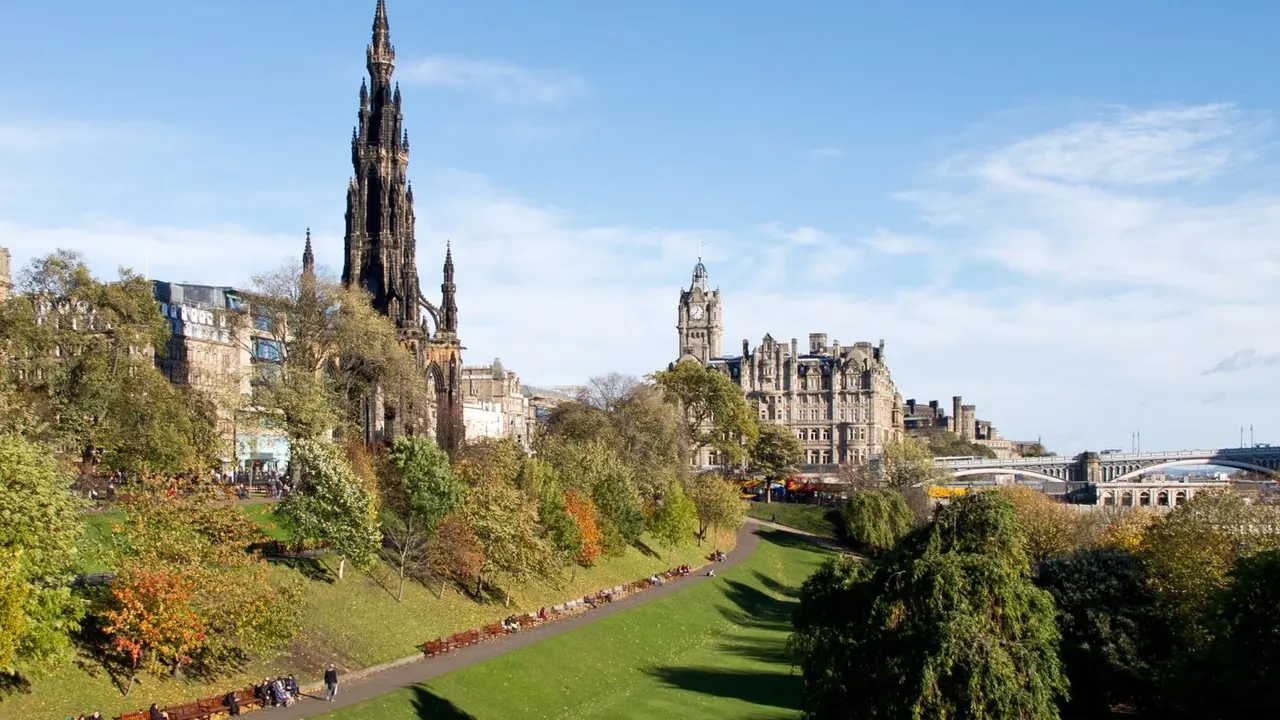
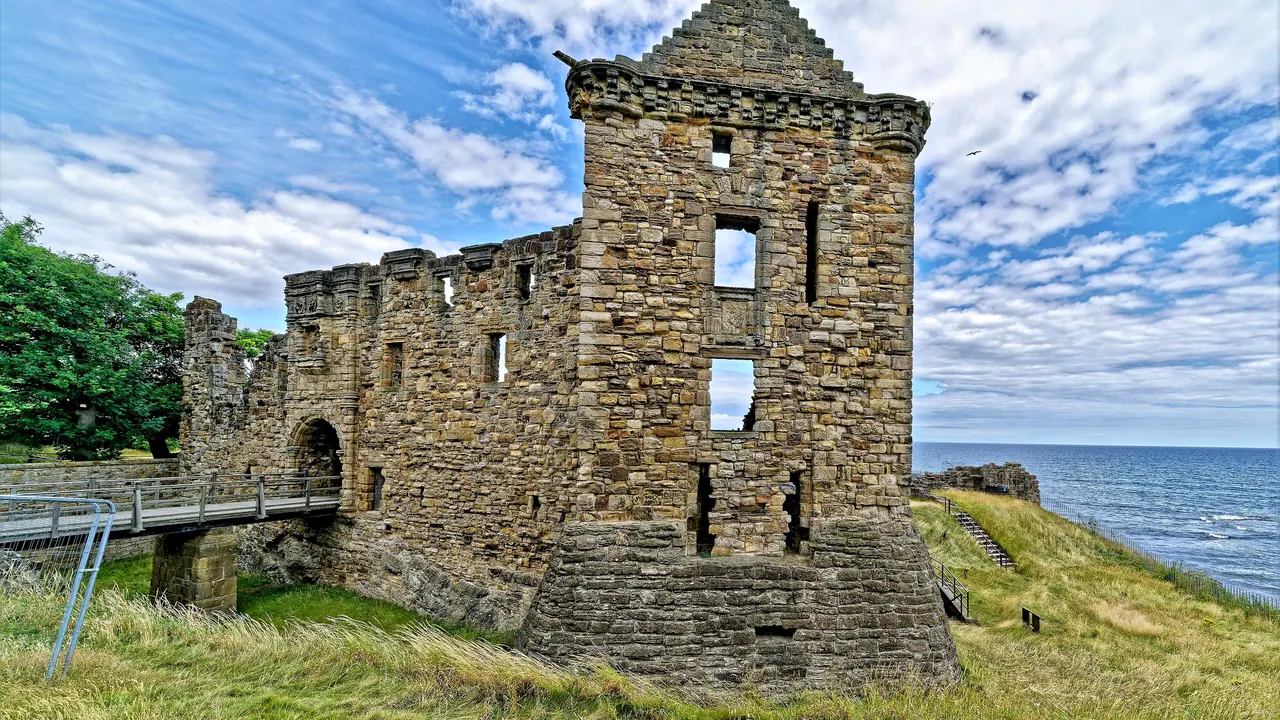
Photos: Edinburgh by Carlos Delgado, CC BY-SA 3.0, cropped; St Andrews by Holger Uwe Schmitt, CC BY-SA 4.0, cropped.
Edinburgh or St Andrews?
Our verdict in twelve categories, each scored against the same fixed benchmark cities, and the climate month by month, so you can choose for your trip.
Choose Edinburgh for
- live music and the arts
- culture and sights
- nightlife
Edinburgh suits travellers who want a real city. It has a castle on its rock, a medieval Old Town and a Georgian New Town, free national museums, a wild volcanic hill a short walk from the Royal Mile, and pubs, concert halls and theatres for the evenings. In August it hosts the largest arts festival in the world, and no small town can offer anything like it.
Choose St Andrews for
- beaches
- wellness
St Andrews is the better pick for a slower, smaller trip built around golf, sea air and long walks on the sand. The cathedral ruins, the clifftop castle and the university quadrangles take a day or two, and after that the East Neuk fishing villages are close by. Evenings are quiet, and Edinburgh is near enough for a day out when you want more going on.
Scoreboard
Twelve categories on one fixed scale from 0 to 100. The shaded stretch is the gap between the two.
Your match
Pick a travel style or drag the sliders, and both match scores follow your weighting.
Wins on live music and the arts and culture and sights with your weighting.
Wins on beaches and wellness with your weighting.
What matters to you?
Category by category
What the scores mean for a trip.
Beaches & swimming
Neither place is for swimming, since both face the same cold North Sea. St Andrews comes out a little ahead because its sand is right on the doorstep. You can walk out of the medieval centre onto West Sands, with its dunes and links, and sheltered East Sands by the harbour suits children.
In Edinburgh you take a bus out to Portobello's Victorian promenade, or travel half an hour to an hour to reach the wide East Lothian beaches at Gullane and Yellowcraig.
Food & drink
Edinburgh offers much more choice. Ambitious kitchens in Leith, the New Town and Stockbridge cook west-coast shellfish, Highland beef and game, and the whisky bars, with staff who guide tastings, are a draw in their own right.
St Andrews keeps things simple: cafés, bakeries, a few good restaurants cooking East Neuk crab and Fife lamb, and the summer ice cream queues. The real treat is fish and chips eaten on a harbour wall in the villages down the coast.
Culture & sights
Edinburgh is in a different league. The whole centre, from the castle down the Royal Mile to Holyroodhouse and across to the Georgian crescents of the New Town, is a World Heritage Site, and the National Museum and the national galleries add several days of free viewing.
St Andrews has a strong medieval story of its own, with the vast ruined cathedral, St Rule's Tower, the castle's siege tunnels and the university, founded in 1413. It is compact, though, and a day or two covers it.
Nightlife
Edinburgh offers a proper night out, mostly in pubs. There are wood-panelled bars on Rose Street, old dens in the Grassmarket, cocktail basements off George Street and the late clubs of the Cowgate, and in August the whole centre stays up.
St Andrews has pubs, golfers' lounges and a students' union that keeps things lively in term. In summer the town is in bed early, and those who want more head to Edinburgh.
Nature & outdoors
Edinburgh has the wilder landscape close at hand. Arthur's Seat rises with crags and lochs a short walk from the Royal Mile, the Water of Leith runs wooded to the sea, and the Pentland Hills offer ridge walking within half an hour.
Around St Andrews the scenery is gentler and coastal. The Fife Coastal Path runs past sea stacks and caves, wading birds gather on the Eden estuary, and seals haul out below Tentsmuir's pine woods. Real hills there mean a drive.
Day trips
Both make good bases, but for different trips. From Edinburgh, Waverley's trains make Glasgow, Stirling and Linlithgow simple outings, and the Borders abbeys and Rosslyn Chapel fill other days without a car.
St Andrews looks east and north instead. The pantiled East Neuk harbours, Falkland Palace and Dundee's V&A and the ship Discovery are all close, but Glamis, Scone and Culross are far easier with a car than by bus.
Good for families
When the rain comes in, Edinburgh has the indoor answers: the hands-on galleries and dinosaurs of the National Museum, Dynamic Earth under its tented roof below Arthur's Seat, and the optical illusions of Camera Obscura. On drier days there are the castle's cannons, the hillside zoo and Holyrood Park to run in, though the Old Town's steps and cobbles are hard going with a buggy.
St Andrews is a beach-and-rock-pool place for a calmer few days. Sandcastles on East Sands, the small aquarium on the Scores, the crawl through the castle's siege tunnels and the miniature railway at Craigtoun Park fill the time, and older children can roam safely in a town this small. A wet spell leaves fewer fallbacks.
Getting around
Edinburgh is easier for a visitor who arrives without a car. The main sights lie within about 2km of each other, buses are dense, a tram runs from the airport to Leith, and Waverley sits in the middle of town for day trips. The cost is the hills, with steep closes and cobbles.
St Andrews is even easier on foot, just a few parallel streets running down to the cathedral. Leaving town is harder, though: the nearest station is at Leuchars, about 8km away, and the countryside really calls for a car.
Shopping & style
Edinburgh's shopping is a capital's mix of high street and Scottish craft, while St Andrews is a small town that specialises in golf. In Edinburgh, Princes Street has the chains, George Street the upmarket labels, and curving Victoria Street and Stockbridge's Sunday market the independents. Specialist kiltmakers and whisky shops with deep selections of malts are what most visitors come for.
St Andrews makes a pleasant afternoon's browse along Market Street and South Street: clubs, clothing and Old Course souvenirs, with some cashmere and good bookshops alongside.
Affordability
Both are expensive, and in both the cost comes from rooms. Edinburgh's hotels peak sharply in August and at Hogmanay, while St Andrews' scarcer rooms peak around golf tournaments and graduation weeks.
They save money in different ways. Edinburgh's free national museums and its free hill views help a lot. In St Andrews the sights cost little, but a round on the famous courses is a major expense, and staying in the East Neuk villages can bring the bill down.
Live music & performing arts
This is one of the widest gaps between the two. Each August, Edinburgh's Fringe, International Festival and Military Tattoo fill the city from morning to past midnight.
The rest of the year Edinburgh still has two national orchestras, Scottish Opera and Scottish Ballet at the Festival Theatre, and new drama at the Traverse. St Andrews has the Byre Theatre, chapel choirs and student concerts in term, and it goes quiet in the summer break.
Wellness & relaxation
Neither is a spa destination, and the restful moments come in different forms. Edinburgh has the Victorian Turkish baths at Portobello and the modernist Commonwealth Pool, but in August the centre is too crowded to unwind.
St Andrews has no public baths. Instead it offers a slower pace all year, with long walks on West Sands and full spas at the golf resorts that non-residents can use. Both places have a habit of cold sea dipping off their beaches.
When should you go?
Pick your month. The climate figures are measured averages, not a forecast.
Edinburgh in July
St Andrews in July
Daytime high, °C
Rainfall in the month, mm
Temperature and rainfall are climate normals, averaged over the years shown. Edinburgh: 1991-2020 (sunshine 1981-2010, rainfall 1981-2010) normals, Edinburgh Airport (10 km from centre). St Andrews: 1991-2020 normals, Leuchars (6.5 km from centre).
The two places share almost exactly the same climate, so the season matters more than the choice between them. Late spring and summer are the time to go. May is the sunniest month, with around 172 hours of sunshine, and July and August reach about 19°C, which is good weather for walking the Royal Mile or the Fife Coastal Path but never beach heat. The North Sea peaks at about 14°C in August off both coasts, so swimming means a cold dip.
Rain comes all year rather than in a single season. Spring is the driest stretch, and October is the wettest month, a little more so in St Andrews at around 80mm. From November to February the days are short and highs sit near 7°C. That still works for museums and pubs in Edinburgh, but it makes for bleak beach walks in St Andrews.
Which traveller are you?
On a culture and arts trip, choose Edinburgh. The castle, the Old and New Towns and the free national galleries fill a rich few days, and orchestras, opera and drama run all year. St Andrews' ruins and university take only a day or two.
On a food and nightlife trip, Edinburgh is the obvious choice. The dining rooms of Leith, whisky bars with hundreds of malts, Victorian pubs and the late bars of the Cowgate are all there. St Andrews goes quiet early, especially outside term.
For golfers, St Andrews is the place. You can walk from your room to the Old Course, cross the Swilcan Bridge, visit the British Golf Museum and play the links courses all around the town. Edinburgh can offer none of this on its doorstep.
Before you go
| Measure | Edinburgh | St Andrews |
|---|---|---|
| Official language | English | English |
| Currency | Pound Sterling (GBP) | Pound Sterling (GBP) |
| Sockets | G230 V, 50 Hz | G230 V, 50 Hz |
| Driving side | Left | Left |
| Time zone | UTC, UTC+1 in summer | UTC, UTC+1 in summer |
| Emergency number | 112 or 999 | 112 or 999 |
| Elevation | 47 m | 24 m |
| Main airport | Edinburgh Airport (EDI)11 km from centre163 non-stop destinations | Edinburgh Airport (EDI)56 km from centre163 non-stop destinations |
| Public holidays this year | 10 days | 10 days |
By the numbers
| Measure | Edinburgh | St Andrews |
|---|---|---|
| City population | 488,050 | 16,460 |
| People per km² | 1,884 | - |
| Museums within 10 km | 32 | 5 |
| UNESCO World Heritage sites within 50 km | 3 | 0 |
| Swim season, months above 21 °C | None | None |
Where else could you go?
Every comparison below shares a destination with this one, so you can follow Edinburgh or St Andrews somewhere new.
- Glasgowvs Edinburgh
- Aberdeenvs St Andrews
- Glasgowvs St Andrews
- Aberdeenvs Edinburgh
- Invernessvs St Andrews
- Invernessvs Edinburgh