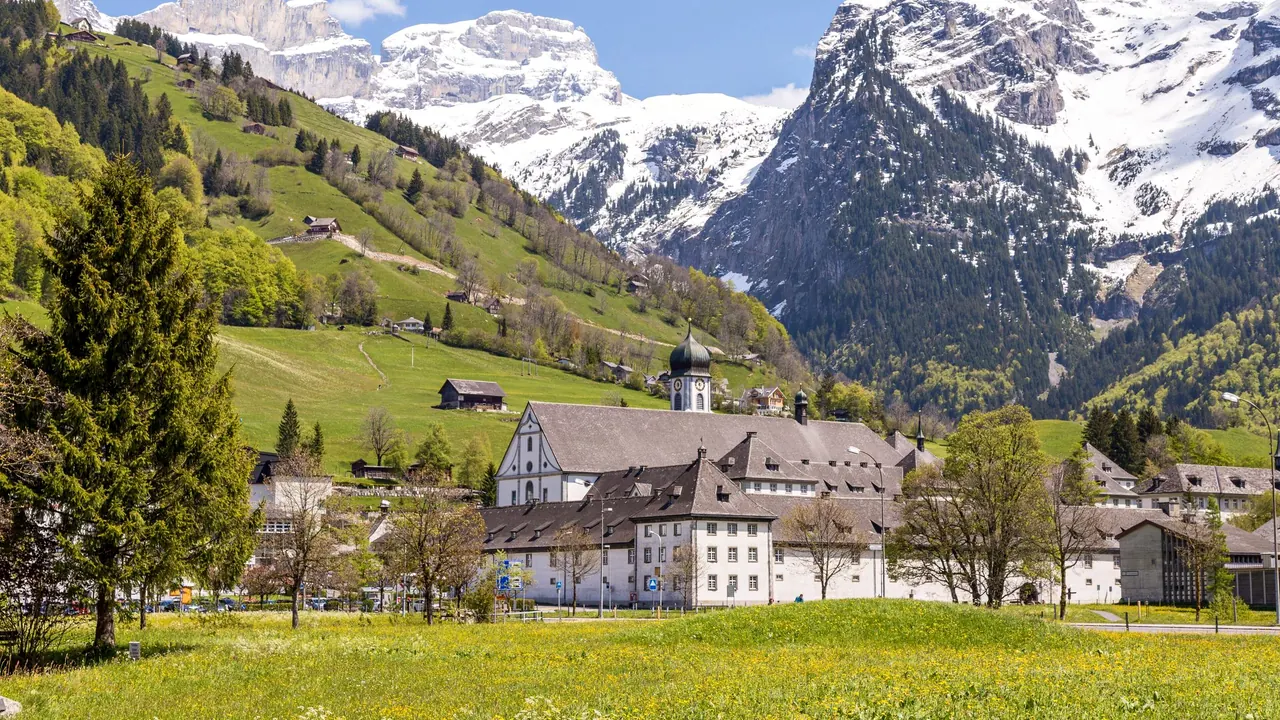
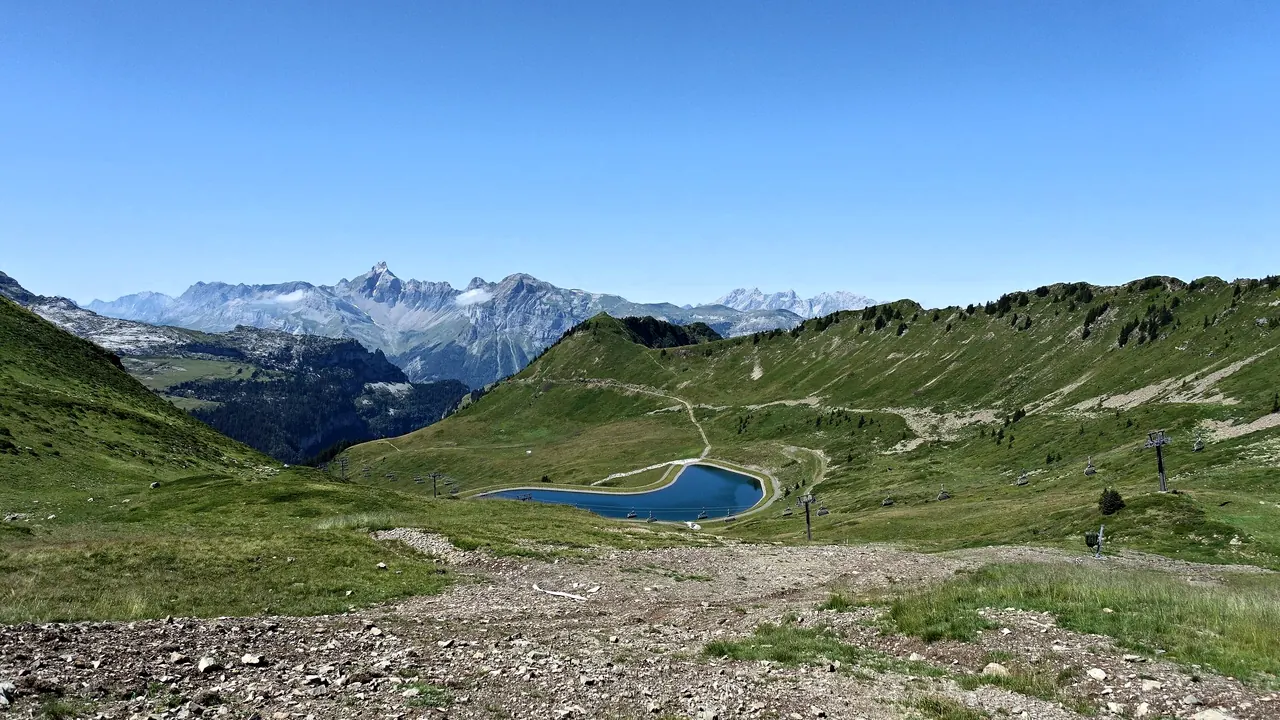
Photos: Engelberg by JoachimKohler-HB, CC BY-SA 4.0, cropped; Flaine by Guilhem Vellut, CC BY 2.0, cropped.
Engelberg or Flaine?
Our verdict in twelve categories, each scored against the same fixed benchmark cities, and the climate month by month, so you can choose for your trip.
Choose Engelberg for
- getting around
- wellness
- beaches
Engelberg suits travellers who want to arrive by train and step straight onto the mountain. The valley railway from Lucerne ends at the village, cable cars climb from its edge to the Titlis glacier, the steep north faces draw freeriders in winter and the Four Lakes route fills summer days. Around all that are gentler pleasures: hotel spas, the abbey church and Lucerne's lakefront within easy reach. The bill is heavy, and you have to accept that before you go.
Choose Flaine for
- prices
- culture and sights
- food and drink
Flaine makes more sense for a ski week built around a self-catering apartment and a car. Cooking for yourself keeps a costly trip under control, the car-free centre puts nursery slopes outside the door, and the linked pistes of the Grand Massif run all the way down to Samoëns and Sixt. Breuer's modernist buildings and an open-air Picasso give it a character no Swiss valley village shares. Expect quiet evenings, though, and a long winding road for any outing.
Scoreboard
Twelve categories on one fixed scale from 0 to 100. The shaded stretch is the gap between the two.
Your match
Pick a travel style or drag the sliders, and both match scores follow your weighting.
Wins on getting around and wellness with your weighting.
Wins on prices and culture and sights with your weighting.
What matters to you?
Category by category
What the scores mean for a trip.
Beaches & swimming
Neither is a place to swim, but Engelberg makes a lake day easier. The train runs down to Lake Lucerne in about an hour, where lidos and lakeside meadows have clear water in midsummer, and the village sports centre has an indoor pool for the other days.
From Flaine, Lake Geneva and Lake Annecy are a long drive down the valley, and the little lake below the resort is only for picnics. In practice, swimming there means a residence or hotel pool.
Food & drink
The two are much alike: hearty mountain cooking, a short range and high prices. What changes is the cuisine and the way people eat. Engelberg serves Swiss dishes such as rösti and Älplermagronen in hotel dining rooms and wood-panelled restaurants, and has the monastery show dairy, where you can watch cheese being made.
Flaine's food is Savoyard, with tartiflette, Reblochon and Abondance, and many guests cook in their apartments from the resort's cheese counters. Its few better restaurants close outside the ski season.
Culture & sights
Flaine gives a curious visitor more to look at. The whole resort is a 1960s design by Marcel Breuer, concrete blocks stepped along a rocky bowl with a building cantilevered over the cliff, and you can walk between Picasso's Sylvette, Dubuffet's Boqueteau and a work by Vasarely. For anyone who likes architecture, it is a real reason to look up from the slopes.
Engelberg's sights come down to its Benedictine abbey: a bright late-baroque church with one of Switzerland's largest organs, plus a small valley museum and a few Belle Époque hotels. It is older and more traditional, but you can see it all in an hour.
Nightlife
Both are quiet once the ski season ends, and in winter the difference is in the crowd more than the amount on offer. Engelberg's après-ski draws young freeriders and seasonal workers, many from Scandinavia, who keep a couple of late bars and a small club busy at weekends. In summer, evenings end with a drink on a hotel terrace.
Flaine's evenings revolve around a few bars at the Forum, with a DJ at weekends, but most guests are families and committed skiers who head back to their apartments after dinner. Outside the season almost nothing stays open.
Nature & outdoors
Both are first-rate mountain bases, and Engelberg has the slight edge because of Titlis. Its cable cars take anyone, skier or not, up to permanent snow, with the ice cave and the suspension bridge, and its steep north faces are famous for freeriding. The Brunni side and the Four Lakes route over the Jochpass give the valley a long walking season.
Flaine's strength is size. It sits in the middle of the Grand Massif, whose linked pistes stretch to Samoëns, Morillon and Sixt beneath a view of Mont Blanc. In summer it has the odd fissured limestone of the Désert de Platé, but the lifts close once its short summer season ends.
Day trips
Engelberg is the better base for days out, mainly because no car is needed. The valley train reaches Lucerne's covered bridges and lake steamers in under an hour, with Stans on the way, and Schwyz, Einsiedeln's abbey, Zug and Zurich are all an easy run beyond.
Flaine's list is attractive, with Annecy's canals, Geneva, Chamonix, stone-built Samoëns and medieval Yvoire. Every outing, though, starts with the long winding road down to the Arve valley, which can be slow in winter, and you need a car to manage it.
Good for families
Both work well with children, but in different seasons. Engelberg works all year: the Härzlisee on Brunni has rafts and stepping stones, the Trübsee has a playground and boats, and Lucerne's transport museum is there for a wet day. Watch very young children at the cold, high glacier station.
Flaine is at its best for a winter ski week. The centre is free of cars and the snow gardens and ski schools are right by the apartments, but in summer there is far less for children to do, and the drive up can tire small ones.
Getting around
Engelberg is easier from the moment you arrive. The cog railway from Lucerne ends in a flat, walkable village with a free winter shuttle and cable cars to both mountain areas, so you can come without a car.
Flaine is car-free inside, with lifts and a shuttle linking the Forum, Forêt and Front de Neige, but getting there is the hard part. The nearest station is down at Cluses, so most visitors drive the mountain road or take a transfer from Geneva airport.
Shopping & style
Neither is a place to shop, but Engelberg's main street has a bit more, with watch and jewellery shops beside the well-stocked outdoor stores, and monastery cheese and Swiss chocolate to take home. Flaine stops at ski hire, supermarkets and a few souvenir counters in the Forum, and anyone who wants more drives to Annecy or Geneva.
Affordability
Both are expensive, but Flaine leaves you more room to control the cost. Its self-catering apartments are modest by the standards of the smartest French resorts, cooking for yourself is normal, and weeks in January, late March or summer cost far less than the French school vacations.
In Engelberg, Swiss hotel, restaurant and drink prices apply everywhere, and the Titlis cable car is a big expense on its own. A Swiss travel pass and supermarket picnics help, but they do not close the gap.
Live music & performing arts
There is very little here for anyone travelling for performances, though Engelberg has a little more. Organ recitals and concerts in the baroque abbey church, a small classical festival in summer and Lucerne's concert halls under an hour away give it real evenings of music. Flaine has only the odd show in the ski season and music at après-ski, with Annecy and Geneva the nearest places for a concert or play.
Wellness & relaxation
Engelberg is the better place to unwind. It first made its name as a health resort, its hotel spas have saunas, steam rooms and pools, and the sports centre adds an indoor pool. The valley is quiet in early summer and midweek, though peak ski weeks feel busier.
Flaine's calm comes from having no cars and quiet evenings, with saunas and pools in the larger residences for after skiing. For a proper thermal bath you would go down to the spa towns of the Chablais.
When should you go?
Pick your month. The climate figures are measured averages, not a forecast.
Engelberg in July
Flaine in July
Daytime high, °C
Rainfall in the month, mm
Where the figures come from
Engelberg has no weather station within reach, so its figures come from a gridded climate model rather than a measured record, and read a broad area rather than one spot.
Flaine has no weather station within reach, so its figures come from a gridded climate model rather than a measured record, and read a broad area rather than one spot.
Temperature and rainfall are climate normals, averaged over the years shown. Engelberg: 2001-2020 normals, NASA POWER reanalysis grid, no weather station within 90 km. Flaine: 2001-2020 normals, NASA POWER reanalysis grid, no weather station within 90 km.
Both places are at their best in winter and high summer, with wet, grey gaps between the two seasons. Engelberg is the milder of the two. In July and August daytime highs reach about 21°C, good weather for the Four Lakes walk and the Brunni meadows, but these are also its wettest months, at around 150mm each, so many summer afternoons bring showers. In midwinter its days stay just above freezing in the valley.
Flaine is colder all year, with daytime highs below freezing from December to February, the stretch when its north-facing bowl holds snow best. Summer peaks at about 18°C, which is cool walking weather on the Désert de Platé, and its rain is spread more evenly through the year instead of building up in summer. Neither is ever warm enough for a beach trip, and in both October and November are the dull gap before the snow.
Which traveller are you?
For a short city break, Engelberg pairs well with Lucerne. Spend a night or two by the lake, then take the train up for a day on Titlis and an hour in the abbey church. Flaine's transfer and mountain road only make sense for a full week.
On a trip on a tight budget, the main draw in Engelberg is the Titlis cable car, so the highlight itself costs a lot. Flaine is kinder. Breuer's buildings and the Picasso and Dubuffet sculptures cost nothing to walk round, and with quiet evenings you spend little at the bar.
For a relaxing and wellness trip, Engelberg makes slowing down simple. There is no car to deal with, and you can stroll round the Trübsee or across the Brunni meadows, then step back into a train for a lakeside afternoon. Flaine is quiet too, but its colder, windier heights and short summer allow fewer gentle days.
Before you go
| Measure | Engelberg | Flaine |
|---|---|---|
| Official language | French, German, Italian, Romansh | French |
| Currency | Swiss Franc (CHF) | Euro (EUR) |
| Sockets | CJ230 V, 50 Hz | CE230 V, 50 Hz |
| Driving side | Right | Right |
| Time zone | UTC+1, UTC+2 in summer | UTC+1, UTC+2 in summer |
| Emergency number | 112 | 112 |
| Elevation | 1,015 m | 1,600 m |
| Main airport | Zürich Airport (ZRH)72 km from centre226 non-stop destinations | Geneva International Airport (GVA)52 km from centre150 non-stop destinations |
| Public holidays this year | 13 days | 11 days |
By the numbers
| Measure | Engelberg | Flaine |
|---|---|---|
| Population | 4,181 | - |
| People per km² | 56 | - |
| Museums within 10 km | 0 | 0 |
| UNESCO World Heritage sites within 50 km | 2 | 2 |
Where else could you go?
Every comparison below shares a destination with this one, so you can follow Engelberg or Flaine somewhere new.
- Samoënsvs Flaine
- Saint-Gervais-les-Bainsvs Flaine
- Chamonixvs Flaine
- Les Getsvs Flaine
- Megèvevs Flaine
- Morzinevs Flaine