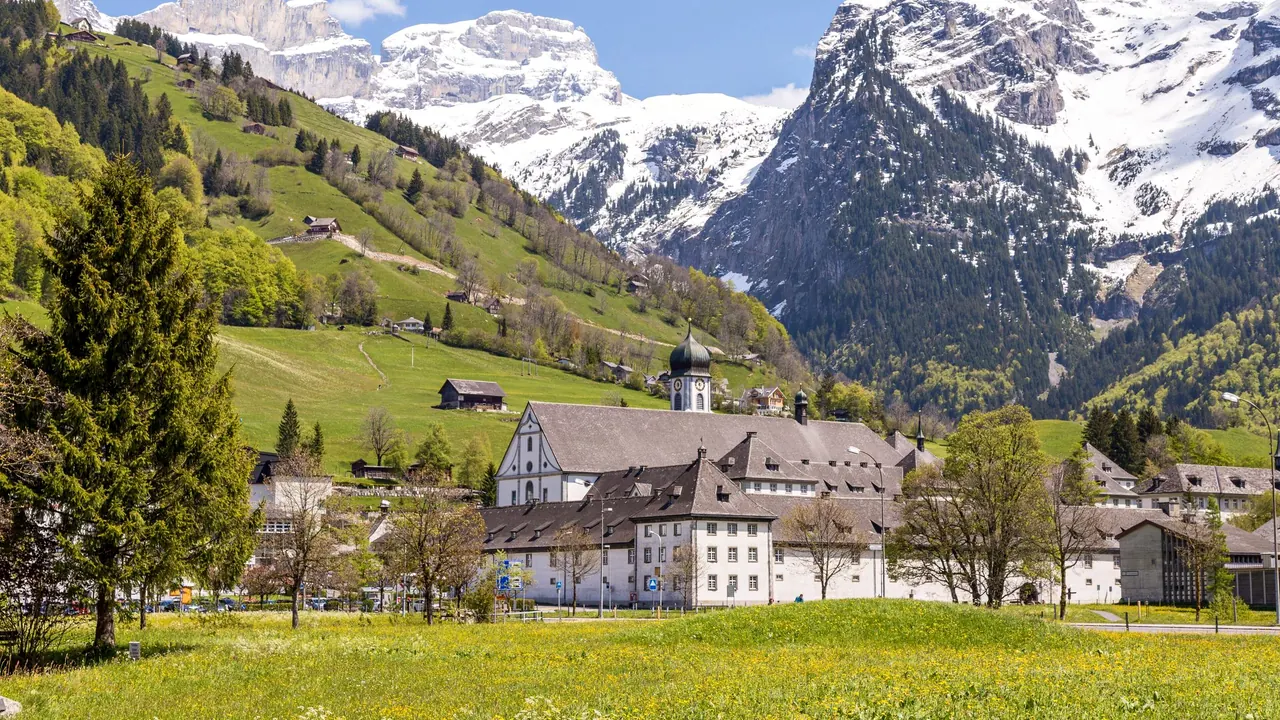
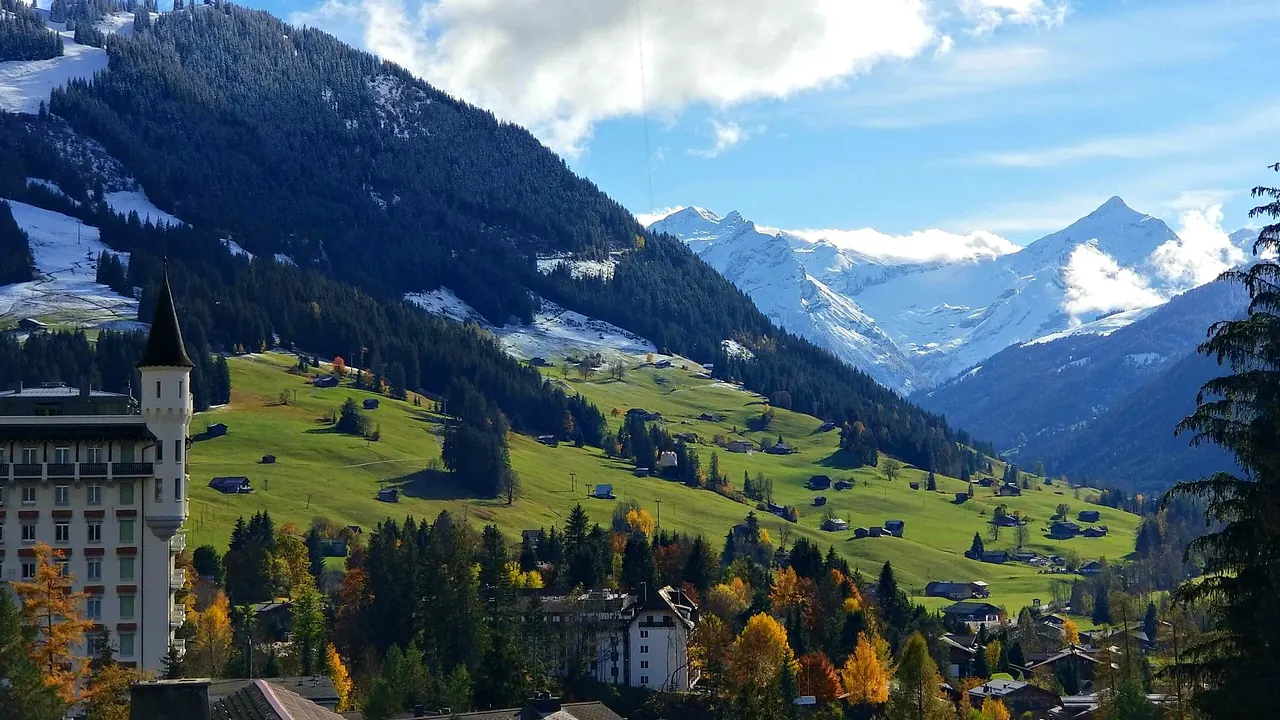
Photos: Engelberg by JoachimKohler-HB, CC BY-SA 4.0, cropped; Gstaad by Samuel Barlow, CC BY-SA 4.0, cropped.
Engelberg or Gstaad?
Our verdict in twelve categories, each scored against the same fixed benchmark cities, and the climate month by month, so you can choose for your trip.
Choose Engelberg for
- families
- prices
- beaches
Engelberg suits travellers who want big mountain scenery from a simple, practical base. The glaciated Titlis rises straight above the village, its steep north faces draw freeriders in winter, and the lakes and play areas at Brunni and the Trübsee keep children busy. A direct train runs to Lucerne, and you never need a car. It is also the slightly less punishing of the two on the wallet, though neither is cheap.
Choose Gstaad for
- shopping
- live music and the arts
- food and drink
Choose Gstaad for a polished, slower stay where the evenings matter as much as the slopes. Grand-hotel spas, gourmet dining rooms, the luxury Promenade and the summer Menuhin Festival give it a social and cultural side that Engelberg lacks. All of this sits in a gentle, pastoral landscape that is arguably at its best in summer. It needs a bigger budget and often a car or a hotel shuttle.
Scoreboard
Twelve categories on one fixed scale from 0 to 100. The shaded stretch is the gap between the two.
Your match
Pick a travel style or drag the sliders, and both match scores follow your weighting.
Wins on families and prices with your weighting.
Wins on shopping and live music and the arts with your weighting.
What matters to you?
Category by category
What the scores mean for a trip.
Beaches & swimming
Neither village is a place to swim, and the gap between them is small. What differs is the water you can reach. Engelberg's Trübsee is for walking round, but the lidos and lakeside meadows of Lake Lucerne are about an hour away by train and pleasantly warm in midsummer. In Gstaad you get quick, cold dips from the grassy shores at Lauenen and Arnensee and a heated outdoor pool in the valley, while Lake Geneva is a long trip over the pass.
Food & drink
Gstaad is the better place to eat. Several of its grand hotels have serious gourmet kitchens, and you can buy the valley's cheeses, Saanen's shaved Hobelkäse and the wood-fired L'Etivaz, straight from small dairies and cheese cellars.
Engelberg's food is plainer: fondue, rösti and Älplermagronen in wood-panelled restaurants and slope huts, with the monastery's show dairy as its one stand-out stop. Neither has street food or much variety, but Gstaad has a top end that Engelberg lacks.
Culture & sights
Both are light on sights, and an hour or two covers either one. Engelberg's interest is concentrated in one place, the Benedictine abbey founded in 1120, with its bright baroque church and huge organ, plus a small valley museum and a few Belle Époque hotels. Gstaad's heritage is spread around the area instead: carved, dark-timbered chalets across the Saanenland, medieval wall paintings in Saanen's church and the old church at Rougemont, which are best seen as stops on a walk.
Nightlife
In both villages going out means winter, and summer evenings end early, but the crowds are different. Engelberg's après-ski is young and casual, kept going by freeriders and seasonal workers, many of them Scandinavian, with a couple of late bars and a small club open at weekends. Gstaad's scene is dressier and more exclusive, with cellar clubs in the grand hotels and much of the social life at private chalet parties between Christmas and February.
Nature & outdoors
Both are excellent mountain bases, but the landscapes are different in character. Engelberg is the more dramatic. Titlis rises above the village, and cable cars carry you to permanent snow, the ice cave and the suspension bridge. Its steep north faces are famous among freeriders, and in summer there is the Four Lakes walk over the Jochpass.
Gstaad is pastoral rather than wild: green valleys meet there, and several ski areas are linked. Its home slopes are gentle and fairly low, so early-season snow can be thin, and Glacier 3000, half an hour away, provides the high-altitude skiing. Summer may be its best season, with walks to Lauenensee and the Geltental waterfalls and rafting on the Saane.
Day trips
Both offer a good handful of outings rather than a long list. From Engelberg every trip starts with the valley train down to Lucerne, under an hour away. From there you can take paddle steamers to Weggis and Vitznau, stop at Stans on the way, or go further round the lake to Schwyz and Einsiedeln.
Gstaad looks in two directions. The GoldenPass line runs down to Montreux, the Castle of Chillon and the Lavaux terraces on Lake Geneva, and Gruyères is under an hour away by car. Eastward lie Lake Thun and Bern. These trips are scenic but longer, and each takes a good part of the day.
Good for families
Engelberg is the better family choice because its mountains are set up for children. There are rafts and stepping stones on the Härzlisee at Brunni, a playground and small boats at the Trübsee, snow on Titlis even in summer, and Lucerne's transport museum for a rainy day. Take care with toddlers at the high glacier station.
Gstaad is just as safe and calm, with beginner slopes, sleigh rides and walks past farm animals. It has nothing designed for children, though, and no indoor fallback when it rains.
Getting around
Engelberg is compact, while Gstaad is spread out. Engelberg is a single flat village at the head of its valley. You walk between the station, the hotels and the cable cars, and a free shuttle runs in the ski season. Coming up from Lucerne by train is simple, but every outing starts with the same ride back down the valley.
Gstaad's centre is a short, mostly car-free promenade, but the resort stretches across several valleys and neighbouring villages. GoldenPass trains, PostBuses and ski buses connect them, though services thin out in the quiet months. That is why many visitors end up using hotel shuttles or a car.
Shopping & style
Gstaad is a real shopping stop for a village its size. The chalets along the Promenade house fine watchmakers, jewellers, fashion labels, cashmere and interior design, and papercut art and carved wood are the local crafts. It is all luxury, though, with nothing for a modest budget.
Engelberg's shops are practical: ski and outdoor gear, rentals, souvenirs and a few watch shops aimed at tour groups. The best things to take home are edible, such as cheese from the monastery dairy, dried meats and chocolate.
Affordability
Neither is cheap, and both charge well above normal European prices. Engelberg is the less expensive of the two. Self-catering and supermarket picnics are easy, and a Swiss travel pass covers the train and gives a discount on some lifts, although the Titlis cable car is still a big expense.
Gstaad is even dearer. Grand hotels and rented chalets dominate, and mid-range rooms are scarce. Staying down the valley in Saanen or Zweisimmen, or coming outside the Christmas and February peak, makes it more manageable.
Live music & performing arts
Gstaad is the clear choice for music. The Menuhin Festival, founded by Yehudi Menuhin, runs for several weeks each summer, with leading soloists and orchestras playing in a large tent and in the intimate churches of Saanen, Rougemont and Lauenen. Winter adds chamber music and New Year concerts.
In Engelberg there are organ recitals and concerts in the abbey church and a small summer festival. For anything more you go to Lucerne's concert halls, less than an hour away. Neither village has a theatre or live music all year.
Wellness & relaxation
Gstaad is the better place to unwind. It has an unusual number of large, lavish hotel spas, with indoor and outdoor pools and treatment rooms looking out over the mountains, and some sell day passes. Days fall into an easy pattern of a walk, a long lunch and a sauna.
Engelberg began as a health resort, and its clean valley air is restful in early summer or midweek in winter. Its spas are ordinary hotel facilities plus the sports-centre pool, though, and in peak ski weeks the village feels more like a resort than a retreat. Neither has thermal springs.
When should you go?
Pick your month. The climate figures are measured averages, not a forecast.
Engelberg in July
Gstaad in July
Daytime high, °C
Rainfall in the month, mm
Where the figures come from
Engelberg has no weather station within reach, so its figures come from a gridded climate model rather than a measured record, and read a broad area rather than one spot.
Gstaad's temperatures are measured 78 km from the centre, at Les Eplatures.
Gstaad has no rain gauge within 25 km of the centre, so its rainfall comes from a gridded climate dataset read at the destination rather than from a gauge further away.
Temperature and rainfall are climate normals, averaged over the years shown. Engelberg: 2001-2020 normals, NASA POWER reanalysis grid, no weather station within 90 km. Gstaad: 2010-2020 (rainfall 1991-2020) normals, Les Eplatures (77.5 km from centre).
The two villages are equally warm in summer, with daytime highs around 21°C in July and August. That is good walking weather but not lake-swimming weather at this altitude. Rain is the difference. Engelberg's summers are clearly wetter, with about 150mm a month from May to August against roughly 110mm in Gstaad, so showers are a more regular part of a hiking week in Engelberg. In both places September is mild and a little drier, which makes it a good late-season choice.
Winter is colder in Engelberg, where highs stay barely above freezing from December to February. Gstaad is a couple of degrees milder, which matters because its home slopes are lower. December is Gstaad's wettest month, while Engelberg's wettest months come in summer. Late autumn and early spring are grey in-between seasons in both villages, and many places close.
Which traveller are you?
On a family trip with children, Engelberg is the better pick. Its mountains have play areas waiting at the lifts, hotels are a short walk from the cable cars, and Lucerne is close for a wet day. Gstaad gives children far less to do.
For a shopping trip, Gstaad wins easily. If the plan includes one serious purchase, such as a fine watch or a cashmere coat, its single short street offers more than many cities. Engelberg's shops are for kit and edible souvenirs.
On a culture and arts trip, Gstaad comes out ahead, as long as you go in summer. Neither village has much to see, but Gstaad's festival weeks bring top-class concerts to the valley churches. Engelberg's abbey fills an afternoon at most.
Before you go
| Measure | Engelberg | Gstaad |
|---|---|---|
| Official language | French, German, Italian, Romansh | French, German, Italian, Romansh |
| Currency | Swiss Franc (CHF) | Swiss Franc (CHF) |
| Sockets | CJ230 V, 50 Hz | CJ230 V, 50 Hz |
| Driving side | Right | Right |
| Time zone | UTC+1, UTC+2 in summer | UTC+1, UTC+2 in summer |
| Emergency number | 112 | 112 |
| Elevation | 1,015 m | 1,050 m |
| Main airport | Zürich Airport (ZRH)72 km from centre226 non-stop destinations | Geneva International Airport (GVA)94 km from centre150 non-stop destinations |
| Public holidays this year | 13 days | 10 days |
By the numbers
| Measure | Engelberg | Gstaad |
|---|---|---|
| Population | 4,181 | 2,960 |
| People per km² | 56 | - |
| Museums within 10 km | 0 | 0 |
| UNESCO World Heritage sites within 50 km | 2 | 4 |
Where else could you go?
Every comparison below shares a destination with this one, so you can follow Engelberg or Gstaad somewhere new.
- Adelbodenvs Gstaad
- Crans-Montanavs Gstaad
- Andermattvs Engelberg
- Leukerbadvs Gstaad
- Grindelwaldvs Engelberg
- Châtelvs Gstaad