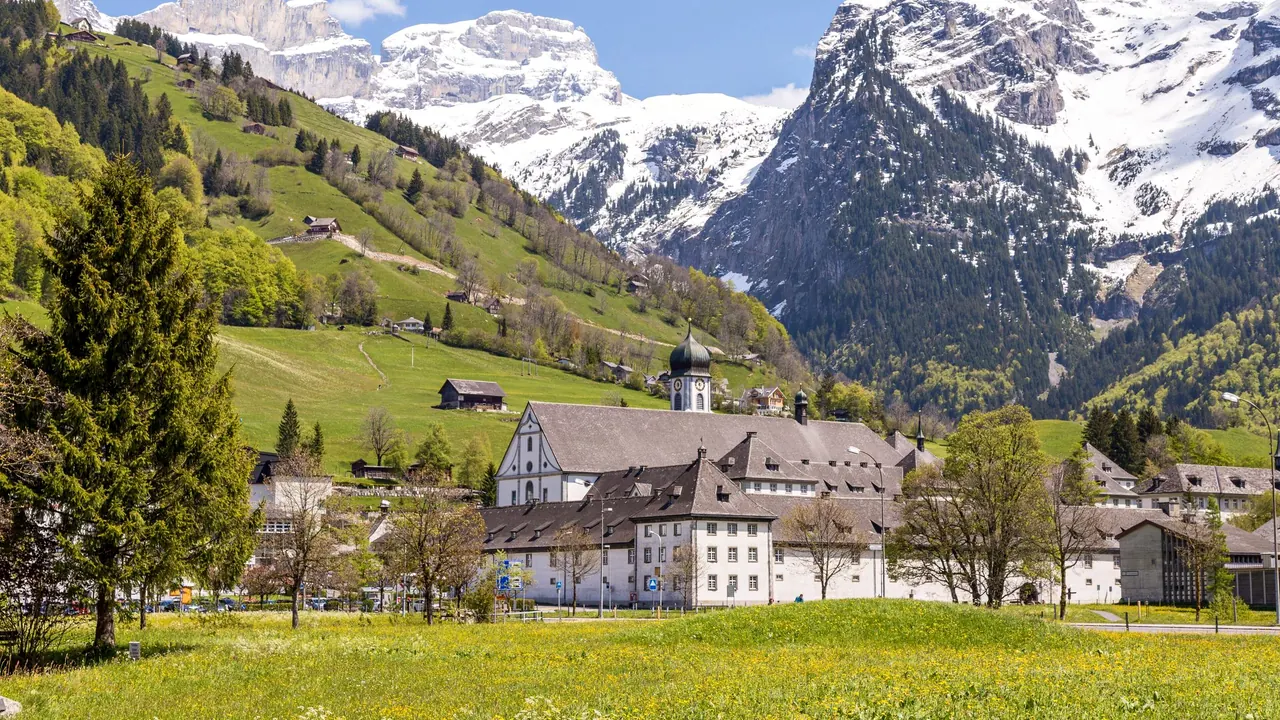
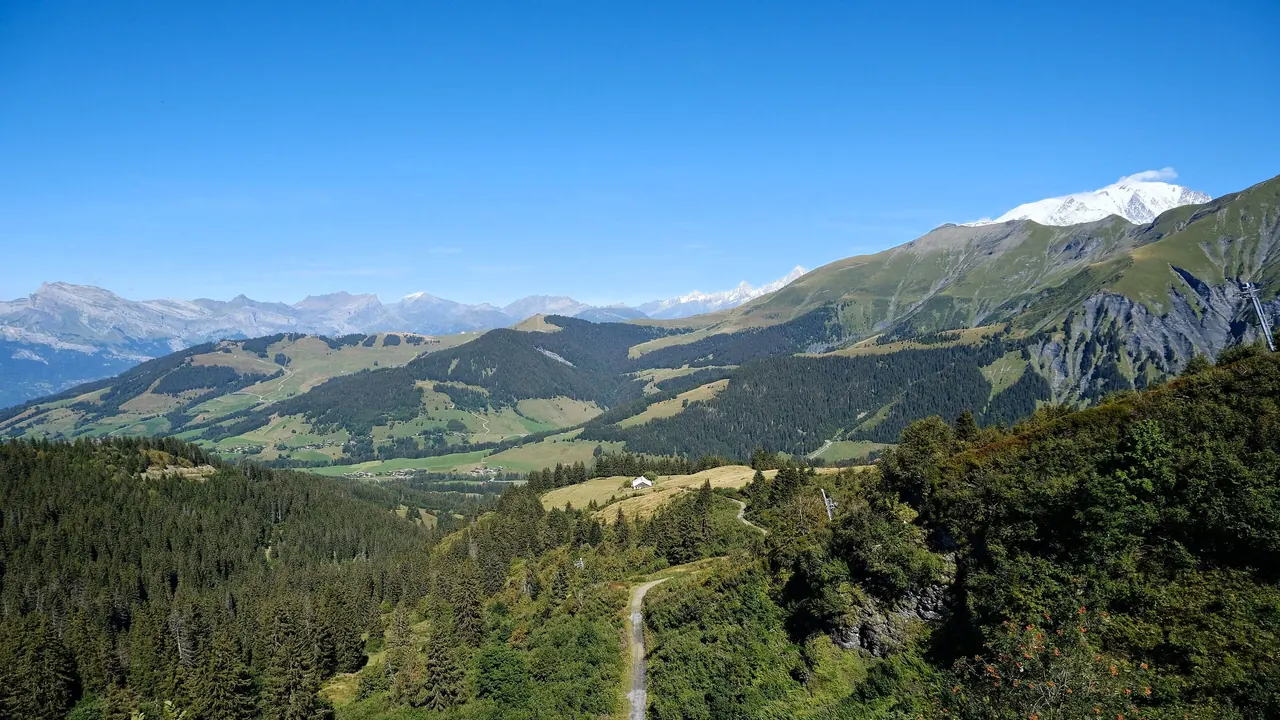
Photos: Engelberg by JoachimKohler-HB, CC BY-SA 4.0, cropped; Megève by Guilhem Vellut, CC BY 2.0, cropped.
Engelberg or Megève?
Our verdict in twelve categories, each scored against the same fixed benchmark cities, and the climate month by month, so you can choose for your trip.
Choose Engelberg for
- getting around
- families
- nature and the outdoors
Engelberg suits travellers who want the mountain to do the work and the car to stay at home. The train climbs up from Lucerne, the village is easy to walk, and cable cars lift you straight onto the Titlis glacier. That makes it easy for families, and serious freeriders come for its steep north faces. Expect simple Alpine meals, and early nights outside the ski season.
Choose Megève for
- food and drink
- shopping
- wellness
If the evenings and the dinner table matter as much as the slopes, Megève is the better pick. Its Michelin-starred kitchens, hotel spas, piano bars and boutique lanes make for a more indulgent stay. Its wide wooded pistes facing Mont Blanc suit intermediate skiers. Bring a car, because the region's best outings, from Chamonix to Annecy and Aosta, are by road.
Scoreboard
Twelve categories on one fixed scale from 0 to 100. The shaded stretch is the gap between the two.
Your match
Pick a travel style or drag the sliders, and both match scores follow your weighting.
Wins on getting around and families with your weighting.
Wins on food and drink and shopping with your weighting.
What matters to you?
Category by category
What the scores mean for a trip.
Beaches & swimming
Neither village is a swimming destination, and both send keen swimmers about an hour away. From Engelberg you take the train down to the lidos and lakeside meadows of Lake Lucerne. From Megève you drive to Lake Annecy, which is a little warmer in high summer.
Near the village, the difference is in the setting. Engelberg's mountain lakes are for walking round, so swimming there means an indoor pool. Megève has natural bathing ponds in the neighbouring valleys and an outdoor pool at the Palais for warm summer afternoons.
Food & drink
Megève is by far the better place to eat. Besides the fondue and tartiflette found all over the Alps, it has several Michelin-starred restaurants in the village and on Mont d'Arbois. In summer there are long lunches at farmhouse auberges in the side valleys.
Engelberg's best food moments are simpler: a terrace lunch with a glacier view, Älplermagronen in a wood-panelled room, and cheese made in front of you at the monastery dairy. After a few days, though, the same short menu starts to repeat, which happens much later in Megève.
Culture & sights
Each village can be seen in a morning, but what you see is different. Engelberg has one great building, the Benedictine abbey founded in 1120, with its baroque church and huge organ, plus a few Belle Époque hotels from the age of the grand Alpine resorts.
Megève offers a walk rather than a monument: the medieval lanes around Saint-Jean-Baptiste, the chapels of the Calvaire climbing the hillside, and the elegant interwar chalets of Henry Jacques Le Même. For grander baroque churches, you have to go to the villages next to Megève.
Nightlife
Megève has more to do after dark. Evenings start with après-ski on the terraces, then move to fireside hotel bars and to piano bars and wine bars in the cobbled centre. A couple of clubs stay open late on peak weeks, and the well-off crowd tends to linger over dinner.
Engelberg's nights out draw a younger crowd but last a shorter season. At winter weekends, freeriders and seasonal workers fill a few late bars and a small club, while summer evenings end with a drink on a hotel terrace. Both villages go almost silent between seasons.
Nature & outdoors
Both are first-rate mountain bases, but the mountains are different. Engelberg's draw is height and ice. Cable cars climb from the village to the glacier on Titlis, a peak of 3,238m, where there is an ice cave and a suspension bridge. In summer there is the Four Lakes walk over the Jochpass, and in winter the steep north faces make it a freeride destination.
Megève is lower and gentler, with wide wooded pistes for intermediates and summer meadows on Mont Joly, all facing the Mont Blanc massif. Because its slopes are low, snow at the bottom varies from year to year, while Engelberg's glacier keeps snow within reach all year.
Day trips
The choice of outings is about the same, but the trips feel different. From Engelberg every outing starts with the valley train to Lucerne. That puts its covered bridges, old town and paddle steamers less than an hour away without a car, with Einsiedeln and Zurich further on.
From Megève you need a car, but the trips reach further and cross a border. Chamonix, Annecy and Geneva are within an hour or so. Courmayeur and Roman Aosta lie through the Mont Blanc tunnel, with a change of language and food.
Good for families
Engelberg is the easier family base. Short walks link the station, the hotels and the lifts, and the mountains are set up for children: rafts and stepping stones on the Härzlisee, boats at the Trübsee, snow on Titlis even in summer, and Lucerne's transport museum for a wet day. The one caution is the glacier station, whose altitude and cold are hard on very young children.
Megève does well for skiing children, with a car-free centre, ski kindergartens, sleigh rides and an ice rink. It has little to offer on a rainy day, though.
Getting around
Engelberg is much simpler to reach and to get around. The valley railway runs up from Lucerne in under an hour, the flat village is easy to walk, and cable cars leave for both mountain areas, so you never need a car. The only catch is that every outing starts with the same train back down the valley.
Megève has no railway station. Once you arrive, the pedestrian centre and the winter shuttles work well. But many chalets sit on steep hillside roads, summer shuttles are sparse, and getting there means a bus or taxi from Sallanches, so most visitors rent a car.
Shopping & style
Megève is the one for shopping. Its cobbled lanes hold designer ski-wear, cashmere, jewellers and galleries of Alpine interior design, and Allard, the ski-wear house founded there in the 1920s, is the local institution. It is still small, though, and fits into a few streets.
Engelberg's shops are mostly outdoor gear, rental counters and souvenirs. Its best buys are things to eat, above all the cheese from the monastery dairy.
Affordability
Neither is a budget choice. Both charge far above European norms for hotels, meals and lifts. What differs is how you can soften the bill. In Engelberg, self-catering, supermarket picnics and a Swiss travel pass that covers the train all help, though the Titlis cable car is still a big expense.
In Megève, summer and the quieter weeks of January and March cost less, and many budget-minded visitors stay in the valley towns below and drive up.
Live music & performing arts
Live performance is limited in both, and different in character. Engelberg's is sacred and classical: organ recitals and concerts in the abbey church and a small summer festival. Lucerne's concert halls are less than an hour away by train.
Megève leans towards jazz, with a jazz cellar or piano bar in season and a few open-air concerts in summer. Neither village has a theatre.
Wellness & relaxation
Megève is the better place to unwind. Its grand hotels compete on their spas, with pools, hammams and Alpine treatments. The Palais adds a public wellness area, and the thermal baths at Saint-Gervais, in use since the early 19th century, are twenty minutes away by car.
Engelberg began as a health resort and still has its quiet valley and clean air. Its wellness, though, comes down to hotel spas and the sports-centre pool, with no bathing tradition, and in peak ski weeks it feels more like a resort than a retreat.
When should you go?
Pick your month. The climate figures are measured averages, not a forecast.
Engelberg in July
Megève in July
Daytime high, °C
Rainfall in the month, mm
Where the figures come from
Engelberg has no weather station within reach, so its figures come from a gridded climate model rather than a measured record, and read a broad area rather than one spot.
Megève's temperatures are measured 29 km from the centre, at Bourg-St-Maurice.
Megève's station stands 162 m below the city centre, so the centre is likely a little cooler than the figures say.
Megève has no rain gauge within 25 km of the centre, so its rainfall comes from a gridded climate dataset read at the destination rather than from a gauge further away.
Temperature and rainfall are climate normals, averaged over the years shown. Engelberg: 2001-2020 normals, NASA POWER reanalysis grid, no weather station within 90 km. Megève: 1999-2020 (rainfall 1991-2020) normals, Bourg-St-Maurice (29.1 km from centre).
Engelberg is the colder of the two. From December to February the days barely climb above freezing, which keeps the valley under snow. Summer stays mild, with July and August reaching only about 21°C, which is good weather for walking but not for swimming. Summer is also Engelberg's wettest season, with around 150mm a month from May to August, so expect cloud and showers on hikes. September is cooler but clearly drier, which makes it a good month for the high trails.
Megève is several degrees warmer all year. Highs reach about 27°C in July, warm enough for afternoons at the bathing ponds or Lake Annecy, and summer is its driest stretch. Its rain comes in late autumn and winter instead, peaking at about 140mm in December. Spring also warms up sooner there, so April and May are pleasant for walking in Megève while Engelberg is still cool and wet.
Which traveller are you?
On a family trip with young children, Engelberg is the easier choice. You arrive by train, walk everywhere and ride the lifts to lakes with rafts and boats, with Lucerne close for a wet day. Megève suits skiing families best.
For a food and nightlife trip, Megève wins clearly. Engelberg's menus soon repeat and its late bars belong to young freeriders. In Megève you can eat at a farm auberge one day and a starred table the next, with clubs open late over the peak weeks.
On a relaxing and wellness trip, Megève is the stronger choice. Engelberg is calm, but its spas stay inside the hotels. In Megève the grand hotels compete on their spas, the car-free centre sets a slow pace, and Saint-Gervais has thermal water nearby.
Before you go
| Measure | Engelberg | Megève |
|---|---|---|
| Official language | French, German, Italian, Romansh | French |
| Currency | Swiss Franc (CHF) | Euro (EUR) |
| Sockets | CJ230 V, 50 Hz | CE230 V, 50 Hz |
| Driving side | Right | Right |
| Time zone | UTC+1, UTC+2 in summer | UTC+1, UTC+2 in summer |
| Emergency number | 112 | 112 |
| Elevation | 1,015 m | 1,027 m |
| Main airport | Zürich Airport (ZRH)72 km from centre226 non-stop destinations | Geneva International Airport (GVA)58 km from centre150 non-stop destinations |
| Public holidays this year | 13 days | 11 days |
By the numbers
| Measure | Engelberg | Megève |
|---|---|---|
| Population | 4,181 | 2,893 |
| People per km² | 56 | 66 |
| Museums within 10 km | 0 | 2 |
| UNESCO World Heritage sites within 50 km | 2 | 1 |
Where else could you go?
Every comparison below shares a destination with this one, so you can follow Engelberg or Megève somewhere new.
- Saint-Gervais-les-Bainsvs Megève
- La Clusazvs Megève
- Le Grand-Bornandvs Megève
- Flainevs Megève
- Chamonixvs Megève
- Andermattvs Engelberg