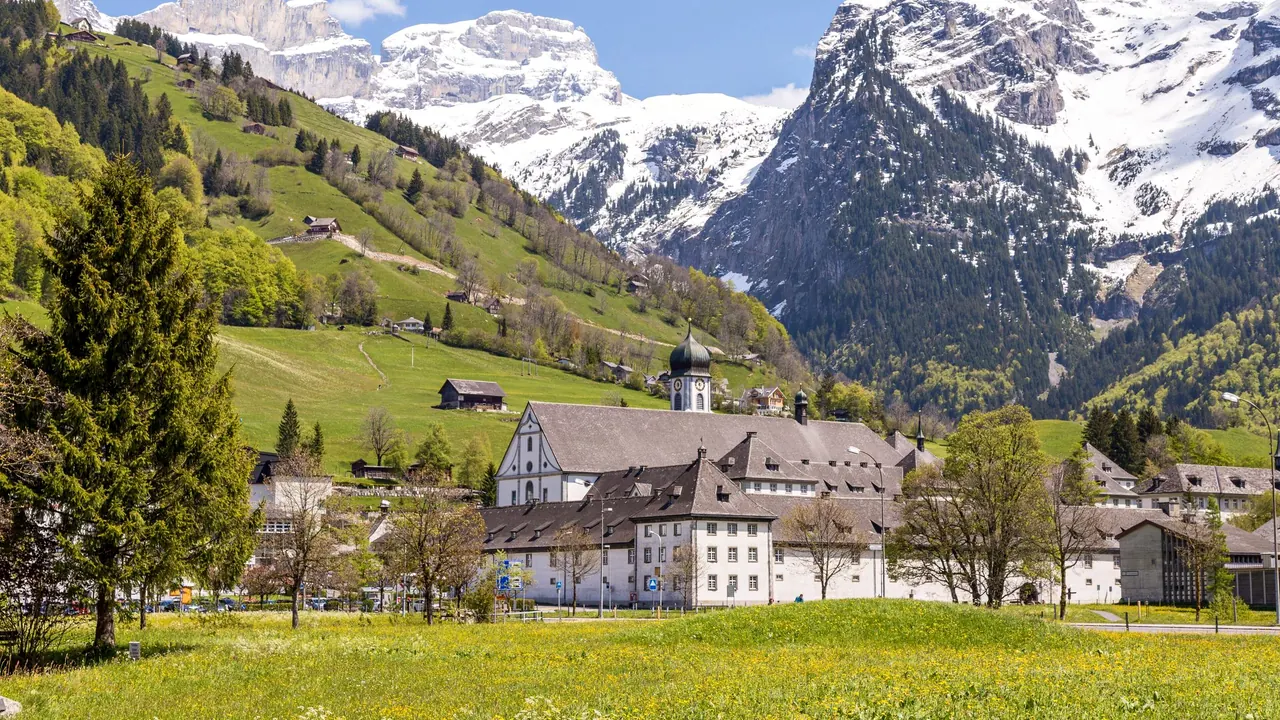
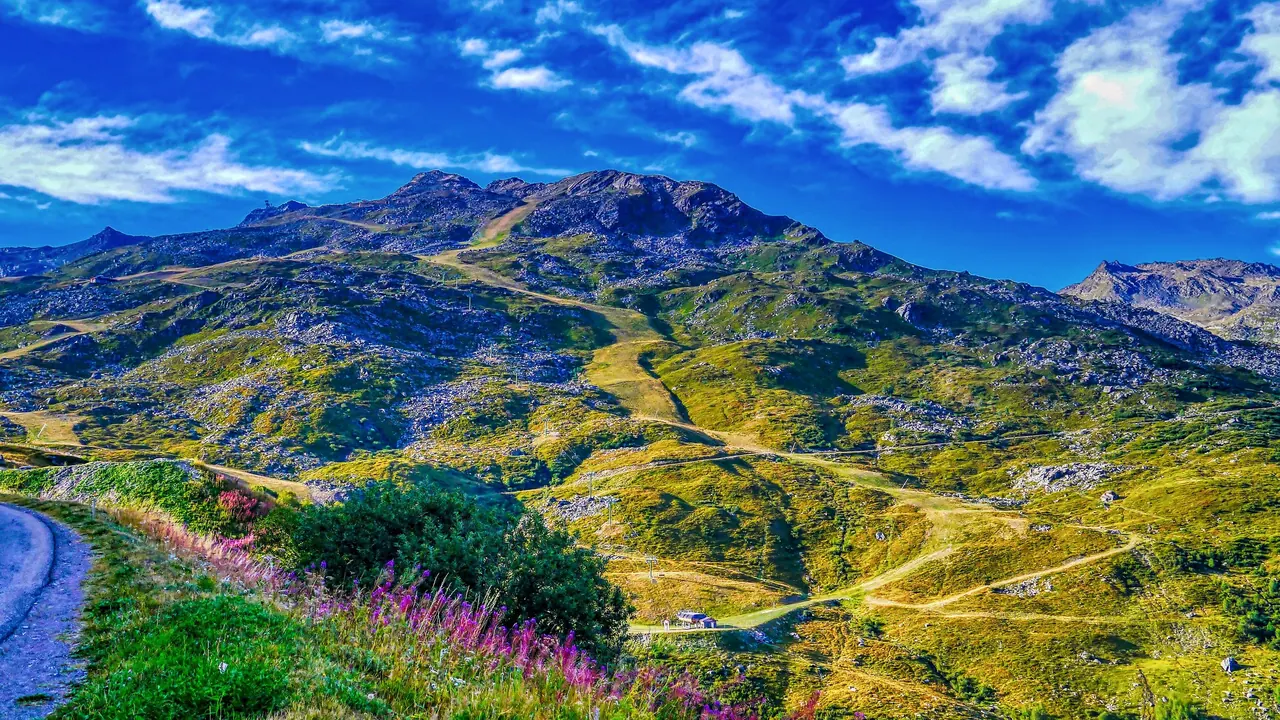
Photos: Engelberg by JoachimKohler-HB, CC BY-SA 4.0, cropped; Val Thorens by Zairon, CC BY-SA 4.0, cropped.
Engelberg or Val Thorens?
Our verdict in twelve categories, each scored against the same fixed benchmark cities, and the climate month by month, so you can choose for your trip.
Choose Engelberg for
- day trips
- families
- beaches
Engelberg suits travellers who want the mountains in summer as much as in winter, and who would rather arrive by train than by hairpin road. The Titlis glacier, the Four Lakes walk and the green Brunni slopes work without skis, the abbey gives the village a centre, and Lucerne is close enough for a lake day. Families and anyone after quieter evenings will feel more at home.
Choose Val Thorens for
- nightlife
- food and drink
- prices
Val Thorens is the pick for a ski week pure and simple. Its height keeps the snow reliable from late November into May, the lifts open the whole Three Valleys from the door, and the après-ski and late clubs make it the better choice for groups of friends who want long nights. Getting there takes more effort and there is little to do off the snow, but for keen skiers that rarely matters.
Scoreboard
Twelve categories on one fixed scale from 0 to 100. The shaded stretch is the gap between the two.
Your match
Pick a travel style or drag the sliders, and both match scores follow your weighting.
Wins on day trips and families with your weighting.
Wins on nightlife and food and drink with your weighting.
What matters to you?
Category by category
What the scores mean for a trip.
Beaches & swimming
Neither is a place to swim outdoors, but Engelberg has a real option in midsummer. The train runs down to Lake Lucerne in about an hour, where lidos and lakeside meadows offer clear water warm enough for a proper swim.
Val Thorens has nothing like that within reach. Its glacier-fed lakes stay far too cold, so swimming means an indoor pool at the sports centre or in a hotel.
Food & drink
Val Thorens eats better, mainly because of its top end. Alongside the Savoyard staples of tartiflette, diots and Beaufort, a handful of upmarket hotels run serious gastronomic kitchens, which gives a ski week at least one memorable dinner.
Engelberg's menus are narrower: rösti, raclette and Älplermagronen in panelled dining rooms and huts. Its one stand-out is the cheese dairy inside the monastery, where you watch cheese being made. In both, expect the same few mountain dishes all week.
Culture & sights
Engelberg has a cultural centre and Val Thorens does not. The Benedictine abbey, founded in 1120, with its bright baroque church and huge organ, plus a valley museum and a few Belle Époque grand hotels, make for a pleasant hour or so.
Val Thorens was put up on a bare slope in the 1970s as a ski station, with no old town and no museum. Any Savoyard history means driving down to the valley.
Nightlife
Val Thorens is clearly the livelier of the two. Dancing on tables at the mountain terraces starts as the lifts close, then the crowd of students and groups moves on to the village pubs and a well-known underground club that stays open into the early hours.
Engelberg's winter evenings are smaller: après-ski bars at the foot of the slopes, then a couple of late bars and one small club that freeriders keep busy at high-season weekends. In both resorts the party stops when the snow goes.
Nature & outdoors
Both are first-rate mountain destinations, but the landscapes differ a great deal. Engelberg is a deep green valley of meadows under the Titlis glacier, where the cable car, ice cave and suspension bridge bring permanent snow within reach of non-skiers. Summer brings the Four Lakes walk over the Jochpass and the via ferrata at Brunni, and in winter the steep north faces of Titlis draw serious freeriders.
Val Thorens is bare ground of rock, snowfields and glaciers above the treeline. Its strength is scale: the lifts link straight into the Three Valleys, so a skier can range across to Méribel and Courchevel without taking off their skis. Its summer is brief, with marmots and ibex on trails at the edge of the Vanoise.
Day trips
Engelberg is much the better base for days away. The valley train reaches Lucerne's covered bridges and lake steamers in under an hour, with Stans on the way, and Schwyz, Einsiedeln's abbey and even Zurich all work as easy rail outings.
From Val Thorens, most "trips" are ski runs into neighbouring valleys. Off the mountain it is a long, winding drive down to Moûtiers or Conflans, and Annecy and Chambéry, the towns most worth seeing, take about two hours each way.
Good for families
Engelberg is the gentler place for children. Walks between the station, hotels and lifts are short, Brunni and the Trübsee have play areas, lakes and boats, and the 3,000m glacier station is only a visit, not a place you sleep.
Val Thorens works well on the practical side, with a car-free centre, slope-side beds, ski schools and a long toboggan run. But the altitude brings cold, wind, lift closures and restless nights for small children, and the party crowd sets much of the mood.
Getting around
Inside the resorts the two are much alike: compact, walkable, with free shuttle buses, and in Val Thorens many beds are ski-in, ski-out. The real difference is arriving and leaving.
Engelberg is at the end of a railway, with a cog section climbing from Lucerne in under an hour, so you never need a car. For Val Thorens you take a train to Moûtiers and then a bus or taxi up an hour of hairpins, and there is little public transport for going anywhere once you are up there.
Shopping & style
Neither is a shopping destination, and in both the main streets are lined with ski hire and technical gear. The difference lies in what you take home: Engelberg has monastery cheese, Swiss chocolate and a few watch shops aimed at tour groups, while Val Thorens has delicatessens selling Beaufort and Savoyard charcuterie.
Affordability
Both are expensive, but Engelberg costs more. Swiss prices apply to every meal, room and drink, and the Titlis cable car is a big expense on its own, though a Swiss travel pass and supermarket picnics help a little.
Val Thorens is never cheap either, and school vacation weeks are the dearest of all. Still, it is less exclusive than its smartest Three Valleys neighbours, and groups who share an apartment kitchen can bring a week's cost down noticeably.
Live music & performing arts
Neither has a theatre, but Engelberg offers something Val Thorens lacks: organ recitals and concerts in the baroque abbey church, a small classical festival in summer, and Lucerne's concert halls less than an hour away. In Val Thorens, live music means cover bands, DJs and the odd event on the slopes.
Wellness & relaxation
Engelberg is the more restful of the two. It began as a health resort, and its quiet valley and clean air still suit a slow week, especially early summer or midweek in winter, with hotel spas and the village pool for the rest.
Val Thorens has good saunas, pools and massage in its better hotels and residences, and Brides-les-Bains, an hour down the valley, has a genuine thermal spa tradition. The resort itself is built around hard skiing and late nights, though, so calm is limited to quiet mornings.
When should you go?
Pick your month. The climate figures are measured averages, not a forecast.
Engelberg in July
Val Thorens in July
Daytime high, °C
Rainfall in the month, mm
Where the figures come from
Engelberg has no weather station within reach, so its figures come from a gridded climate model rather than a measured record, and read a broad area rather than one spot.
Val Thorens has no weather station within reach, so its figures come from a gridded climate model rather than a measured record, and read a broad area rather than one spot.
Temperature and rainfall are climate normals, averaged over the years shown. Engelberg: 2001-2020 normals, NASA POWER reanalysis grid, no weather station within 90 km. Val Thorens: 1991-2020 normals, TerraClimate 4 km grid at the town, no weather station within 90 km.
Engelberg sits far lower and has two real seasons. From June to August daytime highs reach about 21°C, warm enough for long walks and a train down to Lake Lucerne for a swim, though these are also the wettest months, at around 150mm each. Winter brings highs just above freezing, good skiing weather, while spring in the valley turns mild well before the high resorts do.
Val Thorens stays cold for most of the year. Highs sit below freezing from December to February, around -3°C at their lowest, and November is the wettest month at 180mm, much of it falling as snow that sets up the season. Even in August the high reaches only about 16°C, so summer is short and cool, fine for hiking but never for lounging outdoors. For snow late in spring Val Thorens is the safer bet; for summer warmth, Engelberg.
Which traveller are you?
On a family trip with young children, Engelberg is the easier choice. The rafts on the Härzlisee, the Trübsee playground and Lucerne's transport museum fill the days, and you sleep in a sheltered valley rather than at the altitude of Val Thorens.
For a food and nightlife trip, Val Thorens has more going on. Afternoon après-ski on the terraces turns into pubs and an underground club late into the night, and a few ambitious hotel kitchens raise the eating above the usual fondue.
On a relaxing and wellness trip, Engelberg's history as a health resort still shows in its quiet valley and clean air, especially midweek. Val Thorens has good hotel spas, but the whole resort runs on hard skiing and loud evenings.
Before you go
| Measure | Engelberg | Val Thorens |
|---|---|---|
| Official language | French, German, Italian, Romansh | French |
| Currency | Swiss Franc (CHF) | Euro (EUR) |
| Sockets | CJ230 V, 50 Hz | CE230 V, 50 Hz |
| Driving side | Right | Right |
| Time zone | UTC+1, UTC+2 in summer | UTC+1, UTC+2 in summer |
| Emergency number | 112 | 112 |
| Elevation | 1,015 m | 1,710 m |
| Main airport | Zürich Airport (ZRH)72 km from centre226 non-stop destinations | Geneva International Airport (GVA)111 km from centre150 non-stop destinations |
| Public holidays this year | 13 days | 11 days |
By the numbers
| Measure | Engelberg | Val Thorens |
|---|---|---|
| Population | 4,181 | - |
| People per km² | 56 | - |
| Museums within 10 km | 0 | 0 |
| UNESCO World Heritage sites within 50 km | 2 | 1 |
Where else could you go?
Every comparison below shares a destination with this one, so you can follow Engelberg or Val Thorens somewhere new.
- Les Menuiresvs Val Thorens
- Méribelvs Val Thorens
- Courchevelvs Val Thorens
- La Plagnevs Val Thorens
- Val Cenisvs Val Thorens
- Andermattvs Engelberg