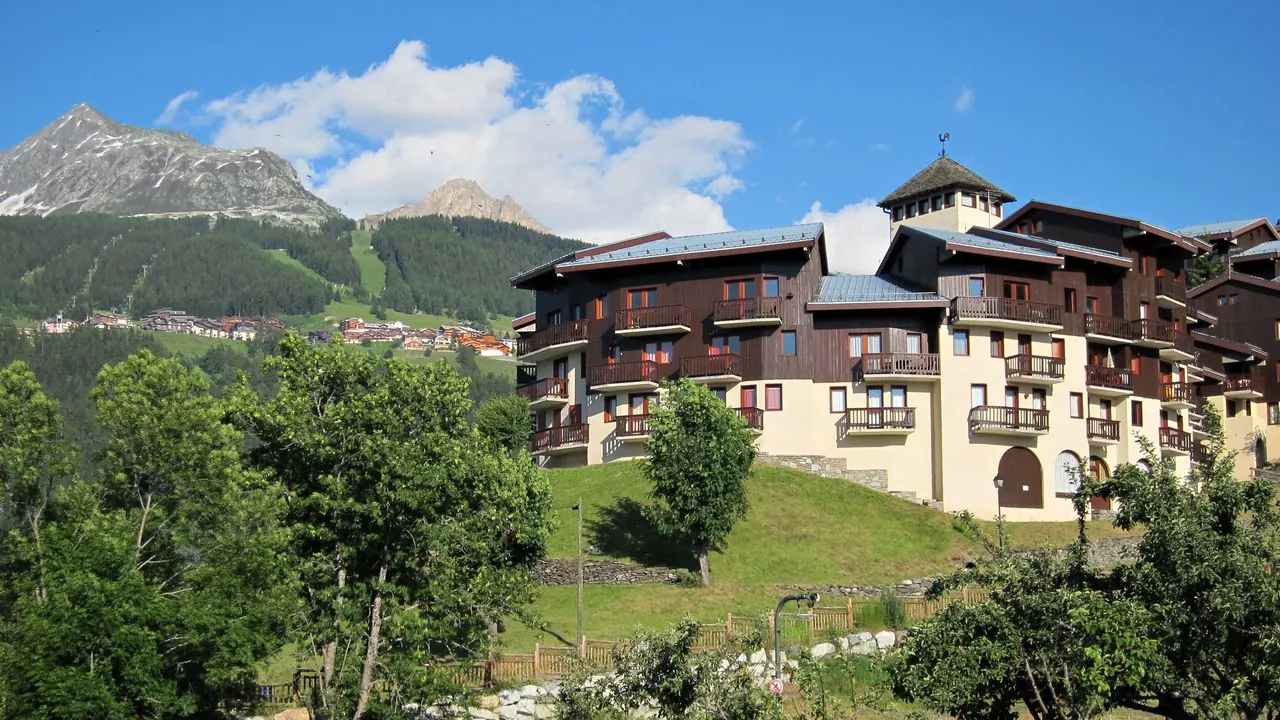
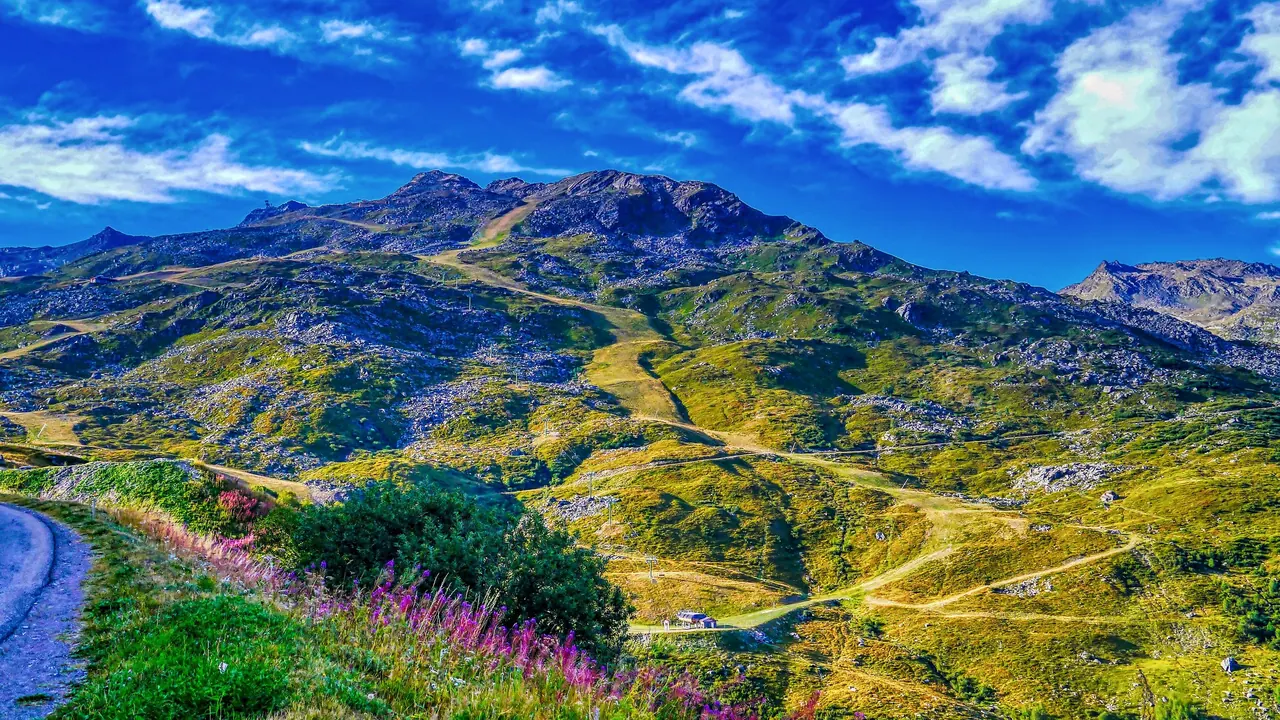
Photos: La Plagne by Henk Monster, CC BY 3.0, cropped; Val Thorens by Zairon, CC BY-SA 4.0, cropped.
La Plagne or Val Thorens?
Our verdict in twelve categories, each scored against the same fixed benchmark cities, and the climate month by month, so you can choose for your trip.
Choose La Plagne for
- families
- day trips
- prices
La Plagne suits families and mixed groups who want gentle, wide runs, car-free villages set on the snow and a calmer week overall. Its ten villages, tree-lined descents to Montchavin and Champagny, and easier access to valley towns such as Aime and Conflans give it more variety off the slopes, and its big stock of apartments makes the cost easier to manage.
Choose Val Thorens for
- nightlife
- getting around
- food and drink
Young groups of friends and keen skiers will get more from Val Thorens. Sitting at the head of the Three Valleys at Europe's highest resort altitude, it offers reliable snow late into spring, glacier terrain and an après-ski scene that runs from table-dancing on the terraces to clubs in the early hours. It is colder, windier and harder on small children, but for a hard-skiing, late-night week it is the stronger choice.
Scoreboard
Twelve categories on one fixed scale from 0 to 100. The shaded stretch is the gap between the two.
Your match
Pick a travel style or drag the sliders, and both match scores follow your weighting.
Too close to call, 2 points apart
Wins on families and day trips with your weighting.
Wins on nightlife and getting around with your weighting.
What matters to you?
Category by category
What the scores mean for a trip.
Beaches & swimming
Neither resort offers anything like a beach, so swimming in both comes down to pools. The small difference is that La Plagne has heated outdoor pools at its leisure centres and a few valley leisure lakes good for a summer picnic, while Val Thorens has only its sports-centre and hotel pools, with glacier-fed lakes far too cold to enter.
Food & drink
Both serve the same Savoyard staples of fondue, raclette and tartiflette, at their best on a sunny terrace at a slope-side restaurant over lunch. La Plagne's village choice runs mainly to pizzerias, crêperies and a few more ambitious rooms, and many visitors cook for themselves.
Val Thorens goes further at the top end, with a few serious gastronomic kitchens in its upmarket hotels, which makes it the better pick for a special dinner. Day to day, menus in both are repetitive, and both largely shut outside the seasons.
Culture & sights
Neither resort has old heritage, and for Romanesque churches and old Savoyard villages both send you down to the valley. La Plagne at least has something to look at: the stepped concrete block of Aime 2000, run aground on the slope like a liner, the high-rises of Plagne Centre from the first wave of French ski planning, and the bobsleigh track left by the Albertville Olympics. Val Thorens, a cluster of chalet-clad blocks built a decade later on a bare slope, has only the mountains themselves to show.
Nightlife
Val Thorens is the party resort of the two. Après-ski starts with dancing on mountain terraces as the lifts close, moves through the village bars and finishes in clubs that run into the early hours, drawing students and groups of friends.
La Plagne has a fair après-ski scene in peak weeks, with pubs and late bars in Plagne Centre and Belle Plagne and a small club or two, but most guests are families who head to bed early. Out of winter, both go quiet.
Nature & outdoors
Both give access to huge linked ski areas, but the terrain feels different. La Plagne, part of Paradiski and linked to Les Arcs by the Vanoise Express, spreads over wide sunny slopes from about 1,250m to the Bellecôte glacier, with forest runs down to Montchavin and Champagny that help in poor visibility.
Val Thorens sits far above the treeline at the head of the Three Valleys, with rock, snowfields and glacier terrain and the most dependable snow of the pair. In summer, La Plagne has the greener landscape, with high pastures and the protected Champagny-le-Haut valley leading into the Vanoise, while Val Thorens offers starker high lakes on the park's edge.
Day trips
La Plagne is better placed for leaving the mountain. Aime's Romanesque basilica is just below, Conflans is under an hour, and in summer the open passes bring the Beaufortain cheese villages and Italy's Aosta Valley within a day's drive.
From Val Thorens the main outings are on skis to Méribel and Courchevel. Below the long hairpin road there is only modest Moûtiers before Conflans, with Chambéry and Annecy a long two-hour drive away.
Good for families
La Plagne was designed around families and is the easier choice with children. Belle Plagne and other car-free villages sit right on the snow, the wide gentle runs suit nervous beginners, and a padded bob-raft ride down the Olympic track thrills older children.
Val Thorens works well practically, with car-free streets, beginner areas in the centre and a long toboggan run. But its height brings biting cold, wind and lift closures, small children can sleep badly at altitude, and the young party crowd sets the mood.
Getting around
Getting up to either resort means a bus climbing a winding road from a valley station, Aime for La Plagne and Moûtiers for Val Thorens, and snow chains or a car help in both.
Once there, Val Thorens is simpler: one compact, largely car-free village with shuttle loops, opening onto lifts that cross the whole Three Valleys. La Plagne's ten villages are spread across the mountain, so moving between them relies on free shuttles, a small cable car between Plagne Centre and Aime 2000, or the lifts themselves.
Shopping & style
Shopping is equally limited in both, mostly ski hire, technical gear and small supermarkets. The best souvenirs in either are edible: Beaufort, cured sausages and génépi. La Plagne's cheese and produce counters, with local honey too, make it slightly more rewarding for foodie gifts.
Affordability
Neither makes for a cheap week. In both, lift passes, equipment hire, ski school and lunches on the mountain make up most of the bill. La Plagne is easier to keep under control because so much of its accommodation is self-catering apartments, which is how many families hold costs down. Summer stays and the quieter weeks of the ski season are also noticeably cheaper.
Val Thorens costs more from the start. Hotel rooms are priced at high-altitude rates, and school vacation weeks are the dearest of the season. Groups who share an apartment and cook for themselves can cut the cost a lot. The resort is also less exclusive than Courchevel and Méribel, its smarter neighbours in the Three Valleys, but it never becomes a budget trip.
Live music & performing arts
Both resorts are equally empty of theatre and concerts. Entertainment in each is limited to cover bands and DJs at après-ski bars, though La Plagne adds torchlight descents and a few open-air concerts in season. For anything more, both send you down to Chambéry or beyond.
Wellness & relaxation
At the end of a ski day both resorts offer much the same comforts: saunas, hot tubs, steam rooms and massage in hotels and apartment residences, plus public pools at La Plagne's aquatic centres and Val Thorens' sports centre. For real thermal bathing, both send you down to the same Tarentaise spa towns, Brides-les-Bains and La Léchère, roughly an hour's drive from either.
What differs is the mood around the pool. La Plagne is the gentler place to unwind, with quiet evenings and a summer when the villages empty out among green pastures. Val Thorens is built around hard skiing and late nights in bare, cold country above the treeline, so slowing down there means a quiet morning and a hotel spa.
When should you go?
Pick your month. The climate figures are measured averages, not a forecast.
La Plagne in July
Val Thorens in July
Daytime high, °C
Rainfall in the month, mm
Where the figures come from
La Plagne has no weather station within reach, so its figures come from a gridded climate model rather than a measured record, and read a broad area rather than one spot.
Val Thorens has no weather station within reach, so its figures come from a gridded climate model rather than a measured record, and read a broad area rather than one spot.
Temperature and rainfall are climate normals, averaged over the years shown. La Plagne: 2001-2020 normals, NASA POWER reanalysis grid, no weather station within 90 km. Val Thorens: 1991-2020 normals, TerraClimate 4 km grid at the town, no weather station within 90 km.
Both are winter destinations first. From December to February daytime highs stay below freezing in both, and the long ski season runs from late autumn into spring. Val Thorens is the more snow-sure of the two: it is higher and much wetter, and most of that falls as snow in winter, peaking around 180mm in November against 88mm at La Plagne. La Plagne is drier through the year, and its lower villages feel the spring thaw earlier.
In summer neither is warm enough for swimming outdoors, but both work well for walking from late June to early September. La Plagne is the milder of the two, reaching about 18°C in July, while Val Thorens tops out near 16°C in August and can turn cold at any time. Spring and late autumn, between the seasons, are quiet and changeable in both.
Which traveller are you?
On a family trip with young children, La Plagne is the better choice. Belle Plagne and its neighbouring villages are car-free and set right on gentle slopes, ski schools cater for small children, and the lower altitude spares little ones the bitter cold and wind of Val Thorens.
For a food and nightlife trip, Val Thorens wins clearly. Its après-ski is famous across the Alps and carries on into clubs after midnight, and a handful of gastronomic hotel kitchens raise its dining above the mostly fondue-and-pizza offering at La Plagne.
On a tight budget, La Plagne is the gentler on the wallet. Neither resort is cheap, but La Plagne's large stock of self-catering apartments, cheaper summer stays and quieter ski weeks make it easier to control costs than at high-altitude Val Thorens.
Before you go
| Measure | La Plagne | Val Thorens |
|---|---|---|
| Official language | French | French |
| Currency | Euro (EUR) | Euro (EUR) |
| Sockets | CE230 V, 50 Hz | CE230 V, 50 Hz |
| Driving side | Right | Right |
| Time zone | UTC+1, UTC+2 in summer | UTC+1, UTC+2 in summer |
| Emergency number | 112 | 112 |
| Elevation | 1,974 m | 1,710 m |
| Main airport | Geneva International Airport (GVA)92 km from centre150 non-stop destinations | Geneva International Airport (GVA)111 km from centre150 non-stop destinations |
| Public holidays this year | 11 days | 11 days |
By the numbers
| Measure | La Plagne | Val Thorens |
|---|---|---|
| Museums within 10 km | 2 | 0 |
| UNESCO World Heritage sites within 50 km | 0 | 1 |
Where else could you go?
Every comparison below shares a destination with this one, so you can follow La Plagne or Val Thorens somewhere new.
- Les Menuiresvs Val Thorens
- Courchevelvs La Plagne
- Méribelvs Val Thorens
- Les Arcsvs La Plagne
- Courchevelvs Val Thorens
- Méribelvs La Plagne