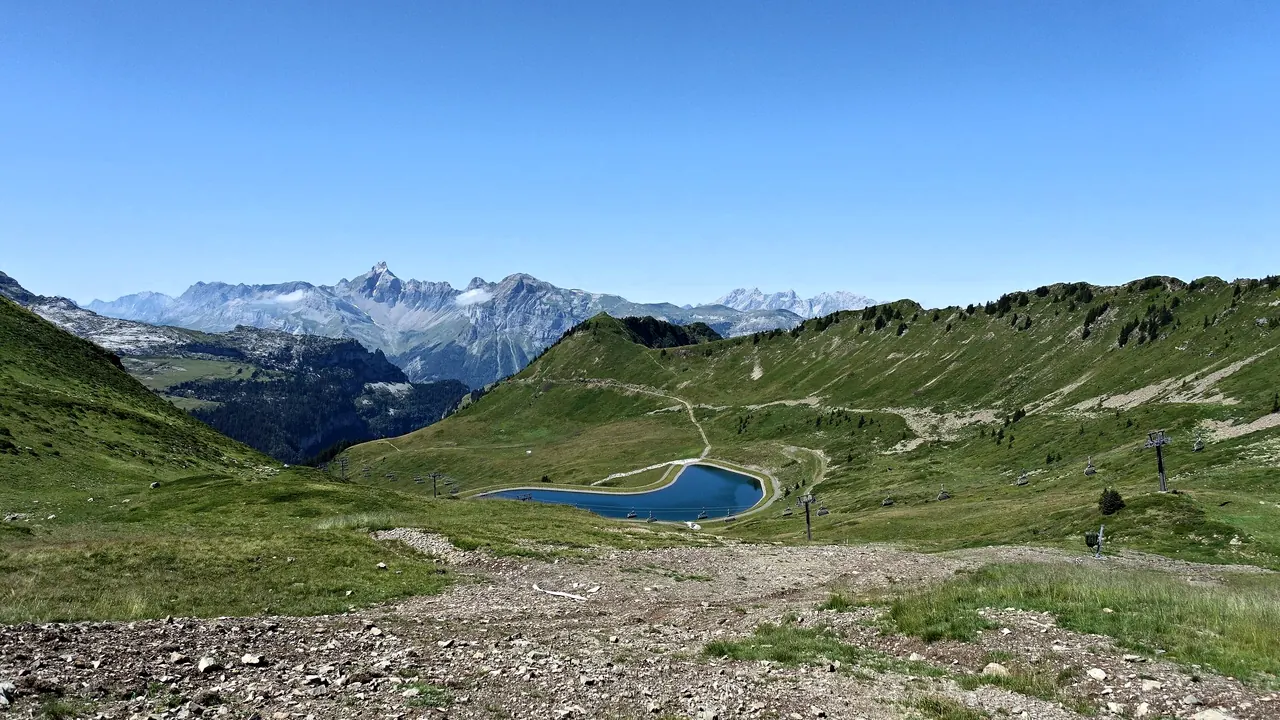
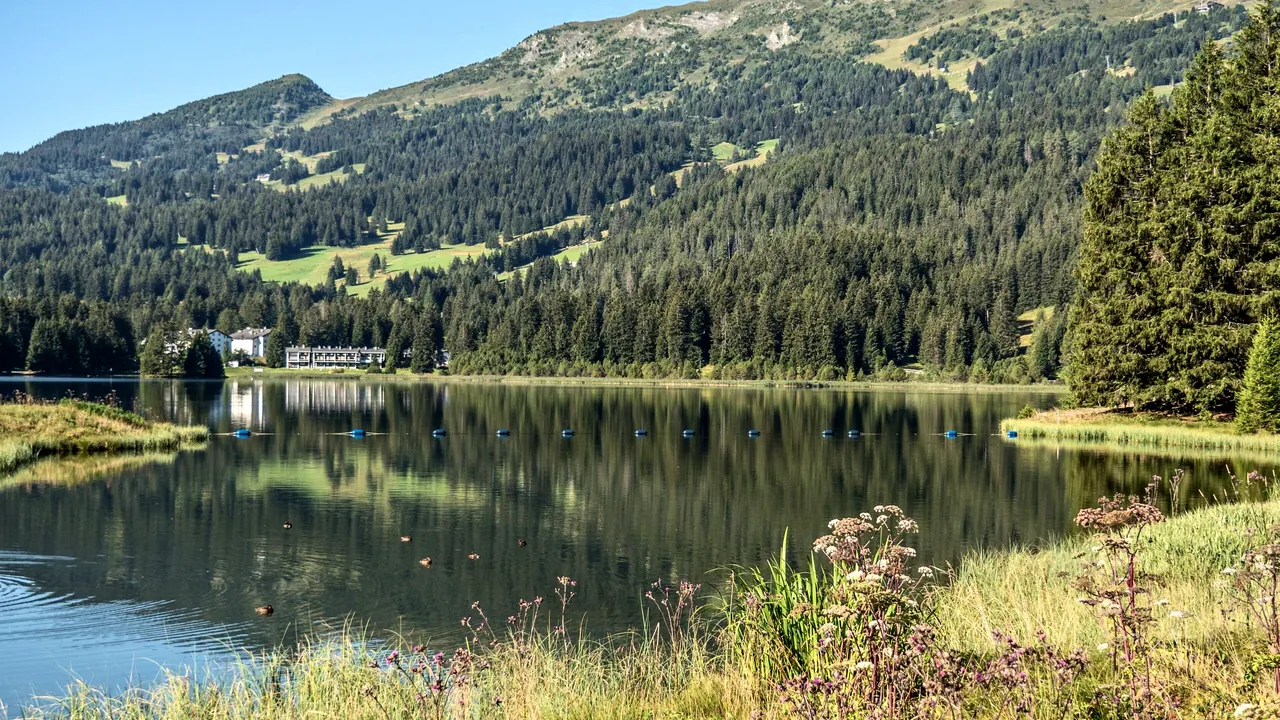
Photos: Flaine by Guilhem Vellut, CC BY 2.0, cropped; Lenzerheide by Jag9889, CC BY-SA 4.0, cropped.
Flaine or Lenzerheide?
Our verdict in twelve categories, each scored against the same fixed benchmark cities, and the climate month by month, so you can choose for your trip.
Choose Flaine for
- prices
- culture and sights
Flaine suits skiers who want a week on the snow without Swiss costs, and especially families who like the idea of stepping out of a car-free apartment straight onto the nursery slopes. Its north-facing bowl keeps snow well, and the resort carries something no ordinary ski station has: Marcel Breuer's modernist architecture with Picasso and Dubuffet sculptures standing in the snow. Choose it for a winter trip run on self-catering, with a car for days out at Annecy or Chamonix.
Choose Lenzerheide for
- wellness
- beaches
- nature and the outdoors
Lenzerheide is the better pick for active travellers who want to come in both seasons and can afford Swiss prices. The mountain terrain is wider, with the link to Arosa in winter and one of the Alps' leading bike parks in summer, and the Heidsee gives the village a lake to swim in and walk around. The hotel spas are better, and the PostBus to Chur means you can arrive and explore without driving.
Scoreboard
Twelve categories on one fixed scale from 0 to 100. The shaded stretch is the gap between the two.
Your match
Pick a travel style or drag the sliders, and both match scores follow your weighting.
Too close to call, 2 points apart
Wins on prices and culture and sights with your weighting.
Wins on wellness and beaches with your weighting.
What matters to you?
Category by category
What the scores mean for a trip.
Beaches & swimming
Neither place is a swimming destination, but Lenzerheide at least has water you can get into. The Heidsee at the foot of the village has a lido and a grassy shore, and in July and August it is fine for a brisk dip, with mountain tarns nearby for hardier swimmers.
Flaine's small lake is for walking and picnics, not bathing, so a swim means a residence pool or a day's drive down to Lake Annecy or Lake Geneva.
Food & drink
The two are about equal for eating out: hearty mountain food in huts and hotel dining rooms, a narrow range and many places closing between seasons. The difference is in the regional cooking. Flaine serves Savoyard fondue, raclette and tartiflette with Reblochon and Abondance, and its self-catering culture means many evenings are spent cooking with cheese from the resort counters.
Lenzerheide's menus are from Graubünden, with capuns, pizokel, barley soup, air-dried beef and Engadine nut tart, plus Bündner Herrschaft wines, and a couple of hotel kitchens aim higher. For a proper food scene, Flaine sends you to Annecy and Lenzerheide to Chur.
Culture & sights
Flaine has more to look at, because the resort itself is the attraction. Marcel Breuer planned it in the 1960s as a single modernist composition, and walking past its concrete blocks, the modernist chapel and the sculptures by Picasso, Dubuffet and Vasarely is a real outing for anyone interested in design, even if it fills only a couple of hours.
Lenzerheide is a string of chalets and hotels along a valley road, with small churches and Romansh place names as the only reminders of older Graubünden. For history, you go down to Chur.
Nightlife
Both are quiet after dark, with après-ski as the high point of the evening. Lenzerheide has a little more going on: slope-side bars at the lift bases get loud in the late afternoon, and a small club stays open on peak weekends. Flaine's handful of bars round the Forum sometimes have a DJ at weekends, but the crowd of families and keen skiers is mostly back home soon after dinner.
Nature & outdoors
These are two strong mountain bases, and Lenzerheide has the edge in breadth. The ski area links to Arosa, the Rothorn cable car climbs to 2,865m, and there are cross-country loops and a biathlon arena round the Heidsee. In summer its bike park, which hosts international races, makes it one of the best mountain-biking bases in the Alps.
Flaine's strengths are its snow and its stranger landscape. The north-facing bowl holds snow well, the Grand Massif runs from the Grandes Platières with Mont Blanc in view down to Samoëns and Sixt, and the off-piste is good. In summer the fissured limestone of the Désert de Platé makes for unusual hiking, though the season is shorter.
Day trips
The range of day trips is similar, but the way you reach them differs. From Flaine nearly everything needs a car and starts with the winding road down to the Arve valley. Once down, Annecy's canals, Chamonix below Mont Blanc, Geneva and the stone village of Samoëns are all within about an hour or a little more.
Lenzerheide works without driving. The PostBus reaches Chur in half an hour, and from there the UNESCO-listed Albula line climbs over spirals and viaducts to St Moritz, while Maienfeld, the Bündner Herrschaft wine villages and Vaduz make gentler days out.
Good for families
Both work well for families, and the difference is mainly the season. Flaine is designed for a winter ski week with children: a car-free centre, apartments by the snow, and ski schools and snow gardens close to the doors, though there is less for children to do in summer.
Lenzerheide keeps children busy in both seasons, with its beginner areas in winter and the lido, pedalos, playgrounds, summer toboggan runs and easy bike trails in summer. In bad weather, neither has much indoor entertainment.
Getting around
Lenzerheide is the easier place to reach and leave. The PostBus from Chur station connects it to the Swiss rail network, and local buses link Valbella, Parpan and the lifts, although the village spreads along several kilometres of road, so walking only covers the centre and the lake.
Flaine is more compact and car-free once you are there, with lifts, a shuttle and ski-in ski-out lodgings. The difficulty is getting there, by the long mountain road or a transfer from Geneva, and any day trip really requires a car.
Shopping & style
Neither is a shopping destination. Both offer gear hire, supermarkets and delis, with Flaine's counters selling Savoyard cheese and wine and Lenzerheide adding a few village boutiques and Graubünden sausage and nut tart. For real shopping, Flaine visitors go to Annecy or Geneva, and Lenzerheide visitors go to Chur or Zurich.
Affordability
Flaine is clearly the cheaper place. The lift pass, ski hire and lessons still add up, but the modest self-catering apartments and kitchen dinners keep costs down, and quiet January weeks and summer are much cheaper than French school vacations.
Lenzerheide charges Swiss resort prices for nearly everything: rooms, passes, hire and meals. The guest card's free buses help a little, and self-catering from the village supermarkets is the main way to save.
Live music & performing arts
Neither resort has a theatre, a concert hall or a regular programme, so the choice comes down to the nearest city. Lenzerheide's open-air summer concerts around its big sporting events give it a few more evenings of live music, and Chur is close for anything else. From Flaine, an evening of music or theatre means the drive to Annecy or Geneva.
Wellness & relaxation
Lenzerheide is the better place to rest. Several of its larger hotels have substantial spas, the lake gives an easy walk at the end of the day, and Bad Ragaz's thermal baths are about an hour away, with Vals further off.
Flaine's wellness consists of the pools and saunas in its bigger residences, useful after skiing but no reason to choose it. Its car-free calm and quiet evenings help, but for thermal water you go down to the Chablais spa towns.
When should you go?
Pick your month. The climate figures are measured averages, not a forecast.
Flaine in July
Lenzerheide in July
Daytime high, °C
Rainfall in the month, mm
Where the figures come from
Flaine has no weather station within reach, so its figures come from a gridded climate model rather than a measured record, and read a broad area rather than one spot.
Lenzerheide's temperatures are measured 33 km from the centre, at Samedan.
Lenzerheide's station stands 234 m above the city centre, so the centre is likely a little warmer than the figures say.
Lenzerheide has no rain gauge within 25 km of the centre, so its rainfall comes from a gridded climate dataset read at the destination rather than from a gauge further away.
Temperature and rainfall are climate normals, averaged over the years shown. Flaine: 2001-2020 normals, NASA POWER reanalysis grid, no weather station within 90 km. Lenzerheide: 2015-2025 (rainfall 1991-2020) normals, Samedan (32.9 km from centre).
Both are winter and high-summer destinations, but they run on different weather. Flaine is the colder of the two through the ski months, with daytime highs around -2°C in January and February, while Lenzerheide is already a little above freezing by February and keeps its pistes in brighter, milder conditions in late winter. Spring and late autumn are cold and grey in both, the lifts mostly close, and neither is a place for those weeks.
Summer is where they split most. Lenzerheide is the warmer, reaching about 20°C in July against Flaine's 18°C, and July and August are the only months its lake is warm enough for a dip. It is also much wetter in summer, with around 164mm in August, so afternoon showers come with the hiking and biking. Flaine's rain is spread fairly evenly across the year, and Lenzerheide's driest stretch is winter, with as little as 64mm in February.
Which traveller are you?
On a trip on a tight budget, Flaine makes the money go further. You still ski one of the largest linked areas in the French Alps, and most of what you spend goes on the mountain itself, while Lenzerheide adds a Swiss premium to every room and meal.
For a culture and arts trip, Flaine is the one to pick, though mainly if you love modern design. You stay inside a resort planned as one piece in the 1960s, so you live with the architecture all week. Lenzerheide sends you to Chur for history.
On a relaxing and wellness trip, Lenzerheide suits better. Rest is part of the stay, with a sauna or pool in your own hotel after an easy walk through the forest and long, unhurried evenings. Flaine is calm too, but offers little in the way of pampering.
Before you go
| Measure | Flaine | Lenzerheide |
|---|---|---|
| Official language | French | French, German, Italian, Romansh |
| Currency | Euro (EUR) | Swiss Franc (CHF) |
| Sockets | CE230 V, 50 Hz | CJ230 V, 50 Hz |
| Driving side | Right | Right |
| Time zone | UTC+1, UTC+2 in summer | UTC+1, UTC+2 in summer |
| Emergency number | 112 | 112 |
| Elevation | 1,600 m | 1,473 m |
| Main airport | Geneva International Airport (GVA)52 km from centre150 non-stop destinations | Zürich Airport (ZRH)112 km from centre226 non-stop destinations |
| Public holidays this year | 11 days | 9 days |
By the numbers
| Measure | Flaine | Lenzerheide |
|---|---|---|
| Population | - | 2,641 |
| Museums within 10 km | 0 | 1 |
| UNESCO World Heritage sites within 50 km | 2 | 1 |
Where else could you go?
Every comparison below shares a destination with this one, so you can follow Flaine or Lenzerheide somewhere new.
- Samoënsvs Flaine
- Arosavs Lenzerheide
- Saint-Gervais-les-Bainsvs Flaine
- Chamonixvs Flaine
- Les Getsvs Flaine
- Megèvevs Flaine