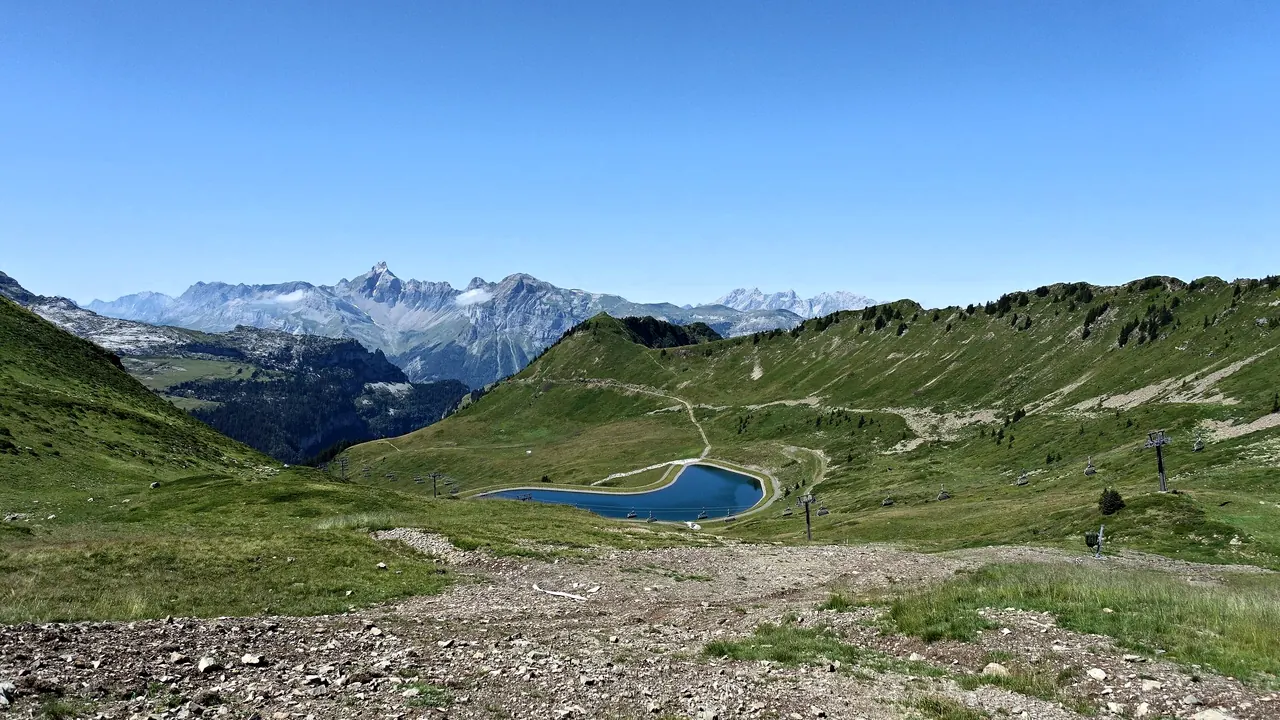
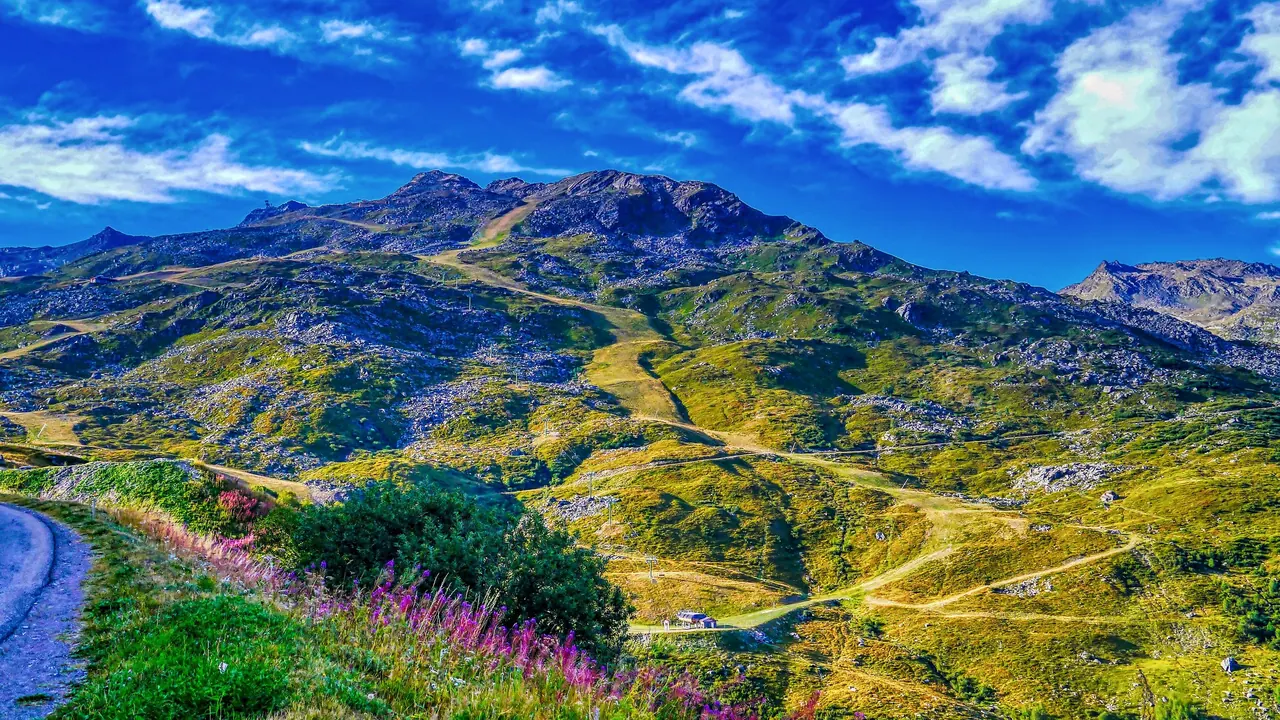
Photos: Flaine by Guilhem Vellut, CC BY 2.0, cropped; Val Thorens by Zairon, CC BY-SA 4.0, cropped.
Flaine or Val Thorens?
Our verdict in twelve categories, each scored against the same fixed benchmark cities, and the climate month by month, so you can choose for your trip.
Choose Flaine for
- day trips
- culture and sights
- families
Flaine suits families on a ski week, and anyone who wants a calmer, somewhat cheaper base with more to see once the skis come off. Its car-free centre puts the nursery slopes right beside the apartments. Marcel Breuer's modernist buildings and the Picasso and Dubuffet sculptures fill an afternoon. With a car, Annecy, Geneva and the stone village of Samoëns are all within reach for a day out.
Choose Val Thorens for
- nightlife
- food and drink
- getting around
If the skiing and the evenings matter most, go for Val Thorens. It sits at the head of the Three Valleys, so you get higher, more snow-sure terrain over a vast linked area. Après-ski runs from the mountain terraces into clubs that stay open late, and a few ambitious hotel kitchens raise the standard of dinner. In return you pay more for the week, face harsher cold and share the resort with a crowd that is mostly young groups rather than families.
Scoreboard
Twelve categories on one fixed scale from 0 to 100. The shaded stretch is the gap between the two.
Your match
Pick a travel style or drag the sliders, and both match scores follow your weighting.
Too close to call, 1 point apart
Wins on day trips and culture and sights with your weighting.
Wins on nightlife and food and drink with your weighting.
What matters to you?
Category by category
What the scores mean for a trip.
Beaches & swimming
You can't swim outdoors in either resort. Flaine at least puts the lakeside beaches of Lake Geneva and Lake Annecy within a day's drive, and its small lake is good for a picnic. Val Thorens's glacier-fed lakes are too cold even in high summer, so there swimming means the sports centre pool or a hotel pool.
Food & drink
Both serve the same Savoyard dishes of fondue, raclette and tartiflette on sunny slope-side terraces. Val Thorens has the more interesting top end, with a few ambitious gastronomic kitchens in its upmarket hotels. Flaine has only a few places for a careful dinner, and many visitors there cook for themselves with Reblochon and Abondance from the resort's cheese counters.
In both resorts the everyday menu is narrow and shrinks outside the winter season. From Flaine, the valley towns and Annecy are close enough for a market morning or a proper restaurant meal.
Culture & sights
Flaine is the one with something to look at. Marcel Breuer planned it in the 1960s as one modernist whole, with concrete blocks stepped along the rocky bowl and a building cantilevered over the cliff. Works by Picasso, Dubuffet and Vasarely stand outdoors. It takes an hour or two, and it is a real draw for anyone interested in architecture.
Val Thorens has nothing comparable. It is a 1970s cluster of chalet-clad blocks on a bare slope, and its only landmarks are the peaks around it. For Savoyard heritage you go down to the valley.
Nightlife
This is where the two differ most. Val Thorens is one of the liveliest party resorts in the Alps. People dance on the tables at mountain terraces as the lifts close, then move to the village pubs and a few clubs, one of them underground, that stay open into the early hours for a young crowd of students and groups of friends.
Flaine goes quiet after dinner. There is a handful of bars around the Forum for après-ski and perhaps a DJ at the weekend, and most guests are families and serious skiers. Out of season, both resorts are almost silent at night.
Nature & outdoors
Both are first-rate ski destinations, and the difference is one of character. Val Thorens is higher, with lifts climbing past 3,200m, glacier terrain and the whole Three Valleys linked on skis, all on bare rock and snow above the treeline. Flaine's Grand Massif tops out at about 2,500m but has views of Mont Blanc, north-facing snow that holds well and a long tree-lined run down to Sixt.
In summer, Flaine's fissured limestone pavements on the Désert de Platé make for unusual hiking, and there are via ferratas and paragliding too. Val Thorens's summer trails lead to high lakes and the edge of the Vanoise, where you may see marmots and ibex.
Day trips
With a car, Flaine is much better placed for days out. Geneva and Chamonix are each about an hour away and Annecy a little further. The stone-built village of Samoëns and the abbey at Sixt-Fer-à-Cheval are close by, although every outing begins with the winding road down to the Arve valley.
From Val Thorens, the easy outings are ski trips to Méribel and Courchevel. Off the snow, Moûtiers and the medieval quarter of Conflans are modest, and Annecy or Chambéry are around two hours away, which makes a long day.
Good for families
For a family ski week Flaine comes out ahead, mostly because of what happens on the snow. Its wide, gentle runs give children room to build confidence once the first lessons are over, and anyone who would rather not ski can go sledging or snowshoeing. Off the snow there is less to offer. Nothing in the resort is built for children, summer gives them less to do, and the long winding drive up can wear out small passengers.
Val Thorens is well organised for skiing families, with children's clubs, beginner areas in the middle of the village, a long toboggan run and a pool at the sports centre for a day off. What counts against it is the setting. At about 2,300m it is often bitterly cold and windy, bad weather can shut the lifts, small children may sleep poorly, and the young party crowd shapes the mood more than families do.
Getting around
Once you arrive, both are compact and largely car-free, with plenty of ski-in, ski-out lodging. Val Thorens is the easier of the two: free shuttle buses loop through the village, and the lifts carry skiers across the whole Three Valleys. Flaine's Forum, Forêt and Front de Neige are linked by lifts and a shuttle.
Getting there is the hard part in both. Val Thorens is about an hour up a road of hairpin bends from the station at Moûtiers, and cars stay in paid car parks at the edge of the resort. Flaine means the long mountain road up from Cluses or a transfer from Geneva airport.
Shopping & style
In Flaine, shopping ends at the ski hire shops, a few supermarkets and the souvenir counters in the Forum, and a Reblochon or a bottle of local wine is the best thing to take home. Val Thorens has more technical gear and resort clothing, at high-altitude prices, but it has nothing else to browse either.
The real difference is how far you have to go for proper shops. From Flaine, Annecy and Geneva are close enough for an afternoon in town. From Val Thorens, any town worth the trip means a long day on the road.
Affordability
Neither is cheap, but Flaine is easier on the wallet. Most of its accommodation is modest self-catering apartments, and summer there is far cheaper once you no longer need a lift pass. Val Thorens charges high-altitude prices for everything from hotel rooms to ski school, and it is never a budget trip.
In both, you save money the same way: share an apartment, cook for yourselves and avoid the French school vacation weeks.
Live music & performing arts
Neither has a theatre, a concert hall or a regular programme. The live music in both comes with après-ski, and in Val Thorens it is louder, with cover bands, DJs and occasional on-slope events. Flaine has the odd concert or show in the ski season. For a proper concert or play, Flaine has the advantage of Annecy and Geneva, each within an easy drive.
Wellness & relaxation
Both offer wellness in much the same form: pools, saunas, steam rooms and massage in the hotels and residences. Val Thorens adds a public pool and spa area at its sports centre, and the old thermal town of Brides-les-Bains is about an hour away.
What Flaine offers instead is calm. It has no cars, clean air and quiet evenings, while days in Val Thorens are built around hard skiing and its evenings around après-ski.
When should you go?
Pick your month. The climate figures are measured averages, not a forecast.
Flaine in July
Val Thorens in July
Daytime high, °C
Rainfall in the month, mm
Where the figures come from
Flaine has no weather station within reach, so its figures come from a gridded climate model rather than a measured record, and read a broad area rather than one spot.
Val Thorens has no weather station within reach, so its figures come from a gridded climate model rather than a measured record, and read a broad area rather than one spot.
Temperature and rainfall are climate normals, averaged over the years shown. Flaine: 2001-2020 normals, NASA POWER reanalysis grid, no weather station within 90 km. Val Thorens: 1991-2020 normals, TerraClimate 4 km grid at the town, no weather station within 90 km.
Both are winter destinations first. From December to March, daytime highs in both stay around freezing, close to -2°C in midwinter, so this is the time for skiing rather than strolling. The difference shows in spring. Flaine warms to about 7°C by April, while Val Thorens is still near 3°C, and the higher resort keeps good snow into May. Val Thorens is also much the wetter of the two, especially in late autumn and early winter, with about 180mm in November, and at that height much of it falls as snow.
In summer Flaine is the milder one, reaching about 18°C in July and August, which is pleasant for walking the limestone plateau. Val Thorens stays a few degrees cooler and can turn cold at any time. Rain is spread through the year in Flaine, so pack waterproofs whichever month you choose.
Which traveller are you?
On a family trip with young children, Flaine is the better choice. Ski schools and snow gardens sit right by the apartments in its car-free centre, and the runs are gentle. Its lower altitude and quiet evenings are also kinder to small children than Val Thorens.
For a food and nightlife trip, Val Thorens wins easily. Après-ski starts on the mountain terraces and carries on in clubs until the early hours. A few gastronomic hotel kitchens also lift dinner above the fondue routine that Flaine mostly sticks to.
On a tight budget, Flaine makes the money go further. Neither resort is cheap, but Flaine's modest self-catering apartments and much cheaper summer season keep costs down. Val Thorens charges high-altitude prices for almost everything.
Before you go
| Measure | Flaine | Val Thorens |
|---|---|---|
| Official language | French | French |
| Currency | Euro (EUR) | Euro (EUR) |
| Sockets | CE230 V, 50 Hz | CE230 V, 50 Hz |
| Driving side | Right | Right |
| Time zone | UTC+1, UTC+2 in summer | UTC+1, UTC+2 in summer |
| Emergency number | 112 | 112 |
| Elevation | 1,600 m | 1,710 m |
| Main airport | Geneva International Airport (GVA)52 km from centre150 non-stop destinations | Geneva International Airport (GVA)111 km from centre150 non-stop destinations |
| Public holidays this year | 11 days | 11 days |
By the numbers
| Measure | Flaine | Val Thorens |
|---|---|---|
| Museums within 10 km | 0 | 0 |
| UNESCO World Heritage sites within 50 km | 2 | 1 |
Where else could you go?
Every comparison below shares a destination with this one, so you can follow Flaine or Val Thorens somewhere new.
- Les Menuiresvs Val Thorens
- Samoënsvs Flaine
- Méribelvs Val Thorens
- Saint-Gervais-les-Bainsvs Flaine
- Courchevelvs Val Thorens
- Chamonixvs Flaine