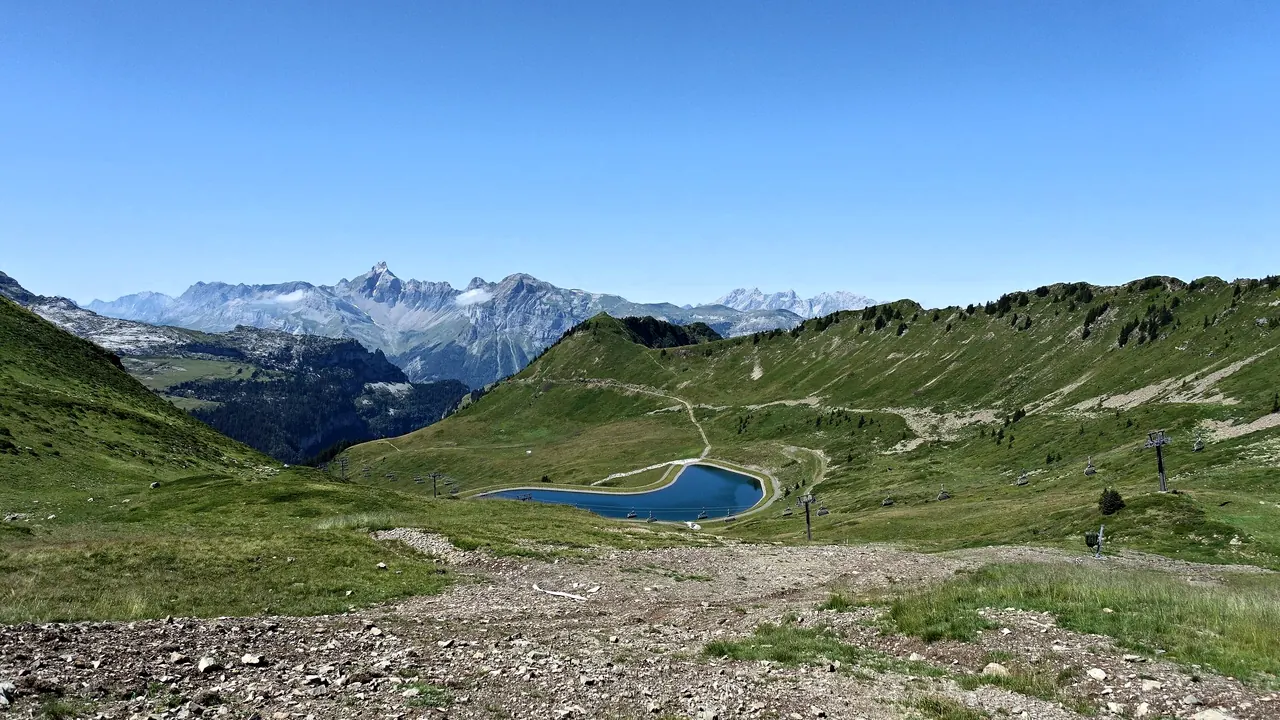
Photos: Flaine by Guilhem Vellut, CC BY 2.0, cropped.
Flaine or Verbier?
Our verdict in twelve categories, each scored against the same fixed benchmark cities, and the climate month by month, so you can choose for your trip.
Choose Flaine for
- prices
- families
- culture and sights
Flaine suits a ski week built around children and a budget that has to stretch. The car-free centre, nursery slopes right by the apartments and wide gentle runs make the days easy for families, and self-catering keeps costs within reach in a way Verbier never manages. It also rewards anyone curious about modernist architecture, since the resort itself is a Breuer design with Picasso and Dubuffet on the walkways. Evenings are quiet and the food is simple Savoyard fare, and that is exactly what its regulars want.
Choose Verbier for
- nightlife
- live music and the arts
- food and drink
Verbier is the pick for strong skiers and for adults who want the evenings to matter as much as the mountain. Its terrain runs higher and steeper, with freeride slopes known well beyond Switzerland, and after the lifts close the village offers proper après-ski, late clubs, chef-led dining and Valais wine. In summer the classical music festival gives it a cultural draw Flaine has nothing to match. The price of all this is steep, and the hillside village is far less convenient for small children.
Scoreboard
Twelve categories on one fixed scale from 0 to 100. The shaded stretch is the gap between the two.
Your match
Pick a travel style or drag the sliders, and both match scores follow your weighting.
Wins on prices and families with your weighting.
Wins on nightlife and live music and the arts with your weighting.
What matters to you?
Category by category
What the scores mean for a trip.
Beaches & swimming
There is no swimming to speak of at either resort. Flaine's small lake below the resort is for picnics, and Verbier's alpine lakes such as Lac des Vaux stay too cold to bathe in even in August.
What differs is the fallback. Verbier has a public pool at its sports centre and Lake Geneva a little over an hour away, while in Flaine you rely on a residence pool or a longer drive down to Lake Annecy or Lake Geneva.
Food & drink
Both resorts eat from the same alpine cheese board, but Flaine keeps it plainer. Meals there are hearty Savoyard dishes such as tartiflette, croziflette and fondue, eaten at a resort table or on a hut terrace between runs. Many guests hardly eat out at all, buying Reblochon, Abondance and charcuterie in the resort and cooking in their apartments. Good evening meals are hard to come by, and after the ski season even those disappear, so a memorable dinner means driving down off the mountain.
Verbier is the better place to book a table. Raclette there is the valley's own cheese rather than a resort dish, the Bagnes wheels being among the most prized in Switzerland, and a few kitchens run by ambitious chefs cook for the wealthy winter crowd, with Petite Arvine and Cornalin from the Rhône valley below. It stays busy through midsummer as well as winter, but at any time of year there is little for a quick or inexpensive meal.
Culture & sights
Neither is a place for museums, but Flaine has more to look at. The resort is a single Marcel Breuer design from the 1960s, with stepped concrete blocks, a building cantilevered over the cliff and monumental works by Picasso, Dubuffet and Vasarely, an hour or two of genuine interest for anyone fond of design.
Verbier is a spread of chalets with little of note in the village itself. Its heritage lies down in Le Châble, with a stone church, a small museum of Bagnes life and old granaries along the valley.
Nightlife
This is where the two part ways most. Verbier in winter has one of the best-known après-ski scenes in the Alps, starting on terraces at the lift base, moving to bars around the Place Centrale and ending in late clubs, with seasonal workers and wealthy visitors in the same rooms.
Flaine has a few bars around the Forum that fill as the lifts close and one or two that stay open later at weekends, but most guests are home soon after dinner. Out of season, both go quiet, Flaine almost completely.
Nature & outdoors
Flaine sits in a north-facing limestone bowl in the Grand Massif, where the snow holds well and long runs drop to Samoëns and Sixt from lifts that top out at about 2,500m. In summer the fissured pavements of the Désert de Platé make for strange, memorable hiking, but the season is short.
Verbier goes higher and wilder. Its lifts reach Mont Fort at about 3,300m, with glacier views as far as the Matterhorn, the linked Four Valleys form one of Switzerland's largest ski areas, and its freeride slopes are known to serious skiers worldwide. Summer brings high trails, a bike park and the Haute Route close by.
Day trips
Verbier has the broader choice, thanks to its position where Switzerland, France and Italy meet. Martigny's Roman remains, Sion's castles, the abbey at Saint-Maurice, the Château de Chillon and the Lavaux terraces are all within an easy drive, and Roman Aosta lies over the Great St Bernard.
Flaine's outings are mostly in Haute-Savoie: Annecy's canals and lake, Geneva, Chamonix, the stone village of Samoëns and medieval Yvoire. Each one starts with the winding road down to the Arve valley, which can be slow in winter.
Good for families
Flaine was designed for family ski weeks, and it shows. The centre is free of cars, apartments sit close to the snow, ski schools and snow gardens are by the lodgings, and broad gentle runs let children build confidence, with sledging and snowshoeing for non-skiers.
Verbier does run snow gardens and lessons, and La Tzoumaz and Savoleyres have easier slopes, but the village is steep and scattered, the skiing is known for difficulty and the evenings lean towards adults. Neither has attractions aimed at children beyond the snow.
Getting around
The two are broadly level but the trouble sits in different places. Flaine is hard to reach, with the nearest station at Cluses and a long mountain road from Geneva airport, but once you arrive the compact, car-free resort and its ski-in ski-out lodgings mean you hardly move the car.
Verbier is the reverse: a train to Le Châble and a gondola up make arrival easy, but its chalets are scattered on a steep hillside, so daily life often means uphill walks on icy roads, shuttle buses or taxis.
Shopping & style
Neither is a shopping destination, though Verbier gives you more to browse. Its centre has well-stocked sports and technical outdoor shops plus a few upmarket fashion, jewellery and interiors boutiques for chalet owners.
Flaine has ski hire, supermarkets and a few souvenir counters in the Forum. In both, the best things to take home are cheese and local wine, and serious shopping means Annecy or Geneva from Flaine, Lausanne or Geneva from Verbier.
Affordability
Flaine is the cheaper of two expensive places. Lift passes, hire and lessons still dominate the bill, but its modest self-catering apartments and a much cheaper summer give you room to control costs, especially outside French school vacation weeks.
Verbier stands among the costliest resorts in the Alps, with hotels, chalets and mountain dining all priced for a wealthy crowd. Staying down in Le Châble or cooking for yourself softens it a little, but there is no cheap version of a week here.
Live music & performing arts
Verbier has one real asset that Flaine lacks: its summer classical festival, held since 1994, which brings leading soloists and chamber musicians to a festival hall and the village church, with public masterclasses from its academy. Music lovers should time a visit for those weeks, as the rest of the year is quiet.
Flaine offers only the odd concert in the ski season and live music at après-ski, so any evening of theatre or concerts means driving to Annecy or Geneva.
Wellness & relaxation
Verbier offers more for unwinding. Its upmarket hotels and luxury chalets have spas and pools, the sports centre adds a public wellness area, and the thermal baths at Saillon and Lavey-les-Bains are within about an hour.
Flaine's wellness is limited to pools and saunas in the larger residences, though the car-free resort and early nights give it a calm that Verbier's busy winter weeks lack. For real thermal bathing, you head down to the Chablais or Lake Geneva.
When should you go?
Pick your month. The climate figures are measured averages, not a forecast.
Flaine in July
Verbier in July
Daytime high, °C
Rainfall in the month, mm
Where the figures come from
Flaine has no weather station within reach, so its figures come from a gridded climate model rather than a measured record, and read a broad area rather than one spot.
Verbier has no weather station within reach, so its figures come from a gridded climate model rather than a measured record, and read a broad area rather than one spot.
Temperature and rainfall are climate normals, averaged over the years shown. Flaine: 2001-2020 normals, NASA POWER reanalysis grid, no weather station within 90 km. Verbier: 1991-2020 normals, TerraClimate 4 km grid at the town, no weather station within 90 km.
Both are high mountain resorts with a short summer and a long snowy winter, and their year runs almost in step. From December to March daytime highs sit around freezing, and Flaine is the colder of the two, staying below zero through midwinter (-2°C in January) while Verbier hovers just above. That cold is what keeps the snow good, but it makes for bracing village walks. July and August bring highs of about 18°C in both, pleasant for hiking but never beach weather, and May to June and September to October are cool shoulder months.
Neither has a dry season. Rain or snow falls steadily all year, and Verbier is noticeably the wetter of the two in late autumn and winter, with around 145mm in December against Flaine's 110mm, while summer is slightly drier in Verbier. For walking, late June to early September suits both; for snow, January to March.
Which traveller are you?
On a family trip with young children, Flaine is the easier choice. Its car-free centre puts ski schools, snow gardens and gentle runs at the apartment door, while Verbier's steep, spread-out village and hard terrain make the same week more work.
For a food and nightlife trip, Verbier is far ahead. Après-ski moves from slope-side terraces to packed bars and late clubs, and the village has ambitious restaurants and Valais wines, where Flaine offers fondue and an early night.
On a trip on a tight budget, Flaine is the realistic option. Neither is cheap, but Flaine's modest self-catering apartments and cheaper summer season bring a mountain week within reach, whereas Verbier has no inexpensive way in.
Before you go
| Measure | Flaine | Verbier |
|---|---|---|
| Official language | French | French, German, Italian, Romansh |
| Currency | Euro (EUR) | Swiss Franc (CHF) |
| Sockets | CE230 V, 50 Hz | CJ230 V, 50 Hz |
| Driving side | Right | Right |
| Time zone | UTC+1, UTC+2 in summer | UTC+1, UTC+2 in summer |
| Emergency number | 112 | 112 |
| Elevation | 1,600 m | 1,490 m |
| Main airport | Geneva International Airport (GVA)52 km from centre150 non-stop destinations | Geneva International Airport (GVA)88 km from centre150 non-stop destinations |
| Public holidays this year | 11 days | 9 days |
By the numbers
| Measure | Flaine | Verbier |
|---|---|---|
| Museums within 10 km | 0 | 4 |
| UNESCO World Heritage sites within 50 km | 2 | 0 |
Where else could you go?
Every comparison below shares a destination with this one, so you can follow Flaine or Verbier somewhere new.
- Samoënsvs Flaine
- Saint-Gervais-les-Bainsvs Flaine
- Chamonixvs Flaine
- Les Getsvs Flaine
- Megèvevs Flaine
- Morzinevs Flaine