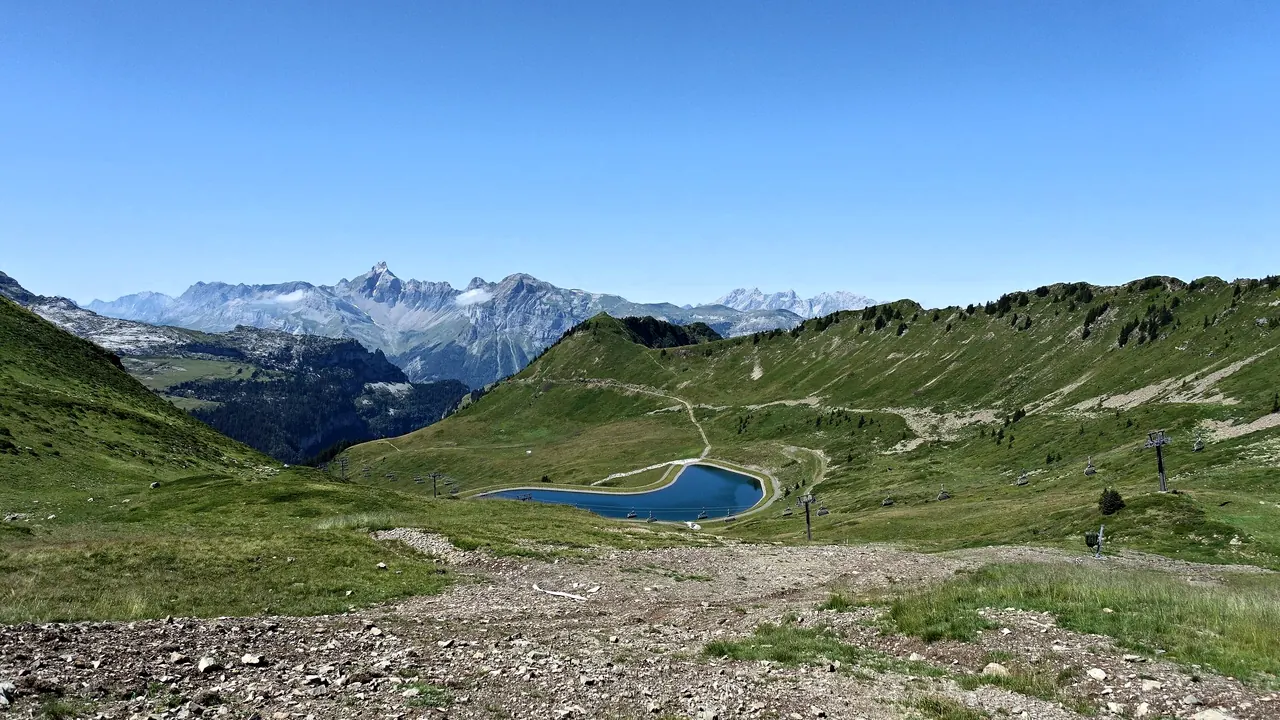
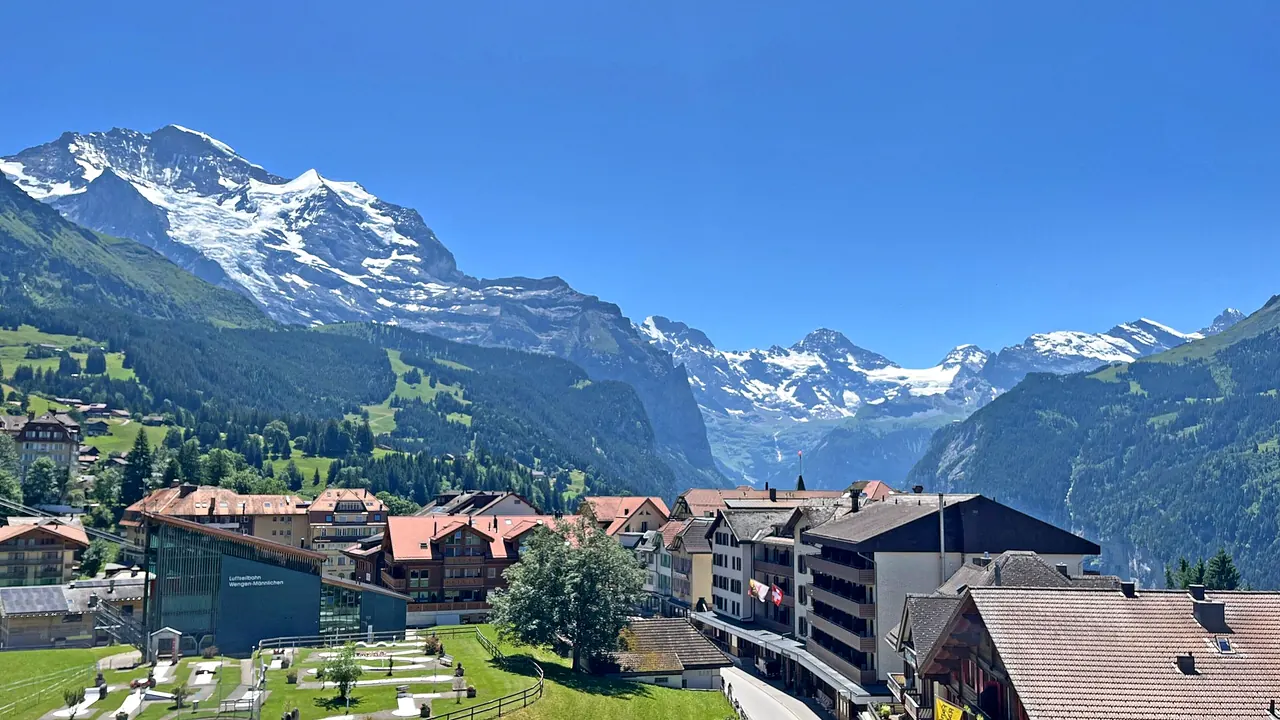
Photos: Flaine by Guilhem Vellut, CC BY 2.0, cropped; Wengen by Charles J. Sharp, CC BY-SA 4.0, cropped.
Flaine or Wengen?
Our verdict in twelve categories, each scored against the same fixed benchmark cities, and the climate month by month, so you can choose for your trip.
Choose Flaine for
- prices
- culture and sights
- families
Flaine is the better pick for a family ski week where the budget still has limits. Its apartments sit close to nursery slopes and snow gardens, cooking for yourself keeps the bills in check, and the Grand Massif gives children and strong skiers plenty of terrain to grow into. Anyone curious about modernist design also gets Breuer's concrete resort and its outdoor sculptures.
Choose Wengen for
- getting around
- wellness
- nature and the outdoors
Choose Wengen when the mountains themselves are the point and cost matters less. Its view across the Lauterbrunnen valley to the Jungfrau, the trails that leave from the village and the railways that climb to the Jungfraujoch make it the stronger place for walkers and sightseers. With no road up, the train does the work. In return, it asks a great deal of your wallet.
Scoreboard
Twelve categories on one fixed scale from 0 to 100. The shaded stretch is the gap between the two.
Your match
Pick a travel style or drag the sliders, and both match scores follow your weighting.
Too close to call, level with your weighting
Wins on prices and culture and sights with your weighting.
Wins on getting around and wellness with your weighting.
What matters to you?
Category by category
What the scores mean for a trip.
Beaches & swimming
Neither is a place to swim, but Wengen gets you to the water more easily. The train down to Interlaken takes about an hour, and the lidos on Lake Thun make a decent afternoon on a hot day. Lake Brienz is cooler.
From Flaine, the small lake below the resort is for strolls and picnics, not bathing. Reaching Lake Annecy or Lake Geneva means a long drive down the winding valley road, so most summer swimming happens in a residence pool.
Food & drink
Both serve hearty mountain cooking and little else, so the difference lies in how you eat. Flaine is a self-catering resort built around Savoyard cheese: fondue and tartiflette in the slope-side huts, and Reblochon and Abondance from the cheese counters to cook with in your own apartment.
Wengen relies on hotel dining rooms and half-board, with rösti and veal in cream sauce, and its best meal is a terrace lunch facing the Jungfrau. It has even fewer casual or cheap places to eat.
Culture & sights
Flaine has a real, if brief, cultural draw. Marcel Breuer designed the whole resort in the 1960s, with a block cantilevered over the cliff, a modernist chapel and outdoor works by Picasso, Dubuffet and Vasarely. Design lovers can spend a satisfying couple of hours on it.
Wengen has wooden chalets, a few Belle Époque hotels from its days as an English resort and a small church. They make a pleasant stroll but are not really sights. For museums, both send you down to the valley.
Nightlife
Evenings are quiet in both, and the difference is mostly one of timing. Flaine's après-ski gathers in the bars around the Forum, and a place or two brings in a DJ on winter weekends, though the family crowd heads home after dinner.
Wengen is quieter still for most of the year, but the Lauberhorn downhill weekend in January turns the village into a party. In summer, neither has much going on after dark.
Nature & outdoors
Both are serious mountain places, but Wengen puts you closer to the high peaks and gives you more to do outdoors through the year. Flaine's strength is skiing. Its north-facing limestone bowl holds snow well, the Grand Massif pistes carry you down to Samoëns and along the long wooded run to Sixt, and the off-piste and ski touring are good. In summer the fissured rock of the Désert de Platé makes odd, memorable walking, but the lifts close soon afterwards.
Wengen looks straight across to the Jungfrau, with the Eiger and Mönch behind it, and the Lauterbrunnen valley drops away below the village with its sheer walls and waterfalls. Meadow paths lead down to the valley floor, the panorama walk to Kleine Scheidegg follows the line of the peaks, and the railway climbs on to the glacier at the Jungfraujoch. Winter adds a large ski area shared with Grindelwald and the long Lauberhorn run, and late spring brings wildflowers and falls in full flood.
Day trips
Both put a slow descent between you and the towns, and both repay the effort about equally. The difference is how you travel. From Flaine you need a car for Annecy's canals, Geneva or Chamonix, each an hour or a little more away, and Samoëns and Yvoire are closer.
Wengen does it by rail and lake steamer. You can reach Thun and its castle, the castles at Oberhofen and Spiez, and Brienz with the Ballenberg open-air museum, and Bern's arcaded old town makes a long but rewarding day.
Good for families
Both villages keep cars out, which matters with children, but Flaine was planned around the family ski week. Snow gardens, ski schools and nursery slopes sit beside the apartments, and the wide runs suit children who are still learning.
Wengen has the same calm and some gentle summer walks reached by train. But its steep lanes are hard going with a buggy, and feeding a family there costs a great deal. Neither has attractions made for children.
Getting around
Wengen is the easier place to get around without a car. The rack railway brings you up from Lauterbrunnen and hotel carts collect your luggage. The same line carries on to Kleine Scheidegg and the Jungfraujoch, and a cable car runs up to the Männlichen.
Flaine is simple once you are there, with lifts and a shuttle linking Forum, Forêt and Front de Neige. Reaching it, though, means the long road up from Cluses or a transfer from Geneva, and outings really need a car.
Shopping & style
Shopping is minimal in both: ski hire, gear shops and a small grocery. What sets Flaine apart is food to take home, with Savoyard cheese and local wine from its delis, while Wengen's short main street adds chocolate counters. For real shopping you go to Annecy or Geneva from Flaine, and to Interlaken or Bern from Wengen.
Affordability
In Flaine most of the money goes on the mountain itself. Lift passes, ski hire and lessons take the largest share, and a lunch on a slope-side terrace adds to it. Your bed is the part you can control, because its apartments are plainer than those in France's smartest resorts, and the French school vacation weeks are the ones to avoid if you can.
Wengen costs more at every turn, not only on the slopes. Rooms, dinners and drinks all carry Swiss resort prices, and every outing by rack railway or cable car adds its own fare, with the trip up to the Jungfraujoch the dearest of all. The walking trails cost nothing, but no choice of season or lodging makes a stay here cheap.
Live music & performing arts
There is almost no performance in either. Flaine has the odd show in the ski season and live music at après-ski, while Wengen's version is more Swiss in flavour, with yodelling, an occasional alphorn evening and a village brass band. For a proper concert or play, Flaine looks to Annecy or Geneva and Wengen to Interlaken or Bern.
Wellness & relaxation
Neither has a bathing tradition, so rest comes from calm rather than spas, and Wengen does calm better. Its car-free village is quiet enough to hear cowbells and waterfalls, and an afternoon on a balcony facing the Jungfrau is restorative in itself.
Flaine is peaceful too, with clean air and early nights. But the pools and saunas in its larger residences are mainly a comfort after skiing, and for a proper thermal bath you have to drive down to the spa towns of the Chablais.
When should you go?
Pick your month. The climate figures are measured averages, not a forecast.
Flaine in July
Wengen in July
Daytime high, °C
Rainfall in the month, mm
Where the figures come from
Flaine has no weather station within reach, so its figures come from a gridded climate model rather than a measured record, and read a broad area rather than one spot.
Wengen has no weather station within reach, so its figures come from a gridded climate model rather than a measured record, and read a broad area rather than one spot.
Temperature and rainfall are climate normals, averaged over the years shown. Flaine: 2001-2020 normals, NASA POWER reanalysis grid, no weather station within 90 km. Wengen: 1991-2020 normals, TerraClimate 4 km grid at the town, no weather station within 90 km.
Both are cold, snowy places from December to March, with daytime highs around or below freezing. In midwinter Flaine is the colder of the two, dipping to -2°C against Wengen's 0°C, which helps its north-facing slopes hold their snow. Spring comes slowly to both, and neither feels warm before June.
For walking, July and August are the months to go. Flaine reaches 18°C and Wengen stays a little cooler at 16°C, and September is still pleasant in both. Neither has a dry season. Rain is spread through the year, and early summer is among the wettest spells, with Wengen's June near 113mm. October turns cool and quiet in both before the cold returns in November.
Which traveller are you?
On a trip on a tight budget, Flaine is the more manageable choice. Neither is cheap, but its self-catering apartments, supermarket cheese counters and cheaper summer weeks leave room to save. Wengen charges Swiss resort prices for every meal, room and railway ride.
For an outdoors trip, Wengen wins. Trails start at the door, from the Männlichen ridge to the path beneath the Eiger north face, and trains lift you up to glacier level. Flaine's Désert de Platé is striking, but its summer season is short.
On a family trip with young children, Flaine edges ahead. Ski schools, snow gardens and wide gentle runs sit beside the apartments in a car-free centre. Wengen has no cars either, but steep lanes, buggies that struggle in snow and high meal costs make family life harder work.
Before you go
| Measure | Flaine | Wengen |
|---|---|---|
| Official language | French | French, German, Italian, Romansh |
| Currency | Euro (EUR) | Swiss Franc (CHF) |
| Sockets | CE230 V, 50 Hz | CJ230 V, 50 Hz |
| Driving side | Right | Right |
| Time zone | UTC+1, UTC+2 in summer | UTC+1, UTC+2 in summer |
| Emergency number | 112 | 112 |
| Elevation | 1,600 m | 1,274 m |
| Main airport | Geneva International Airport (GVA)52 km from centre150 non-stop destinations | Zürich Airport (ZRH)106 km from centre226 non-stop destinations |
| Public holidays this year | 11 days | 10 days |
By the numbers
| Measure | Flaine | Wengen |
|---|---|---|
| Population | - | 1,116 |
| People per km² | - | 31 |
| Museums within 10 km | 0 | 2 |
| UNESCO World Heritage sites within 50 km | 2 | 1 |
Where else could you go?
Every comparison below shares a destination with this one, so you can follow Flaine or Wengen somewhere new.
- Mürrenvs Wengen
- Samoënsvs Flaine
- Grindelwaldvs Wengen
- Saint-Gervais-les-Bainsvs Flaine
- Chamonixvs Flaine
- Les Getsvs Flaine