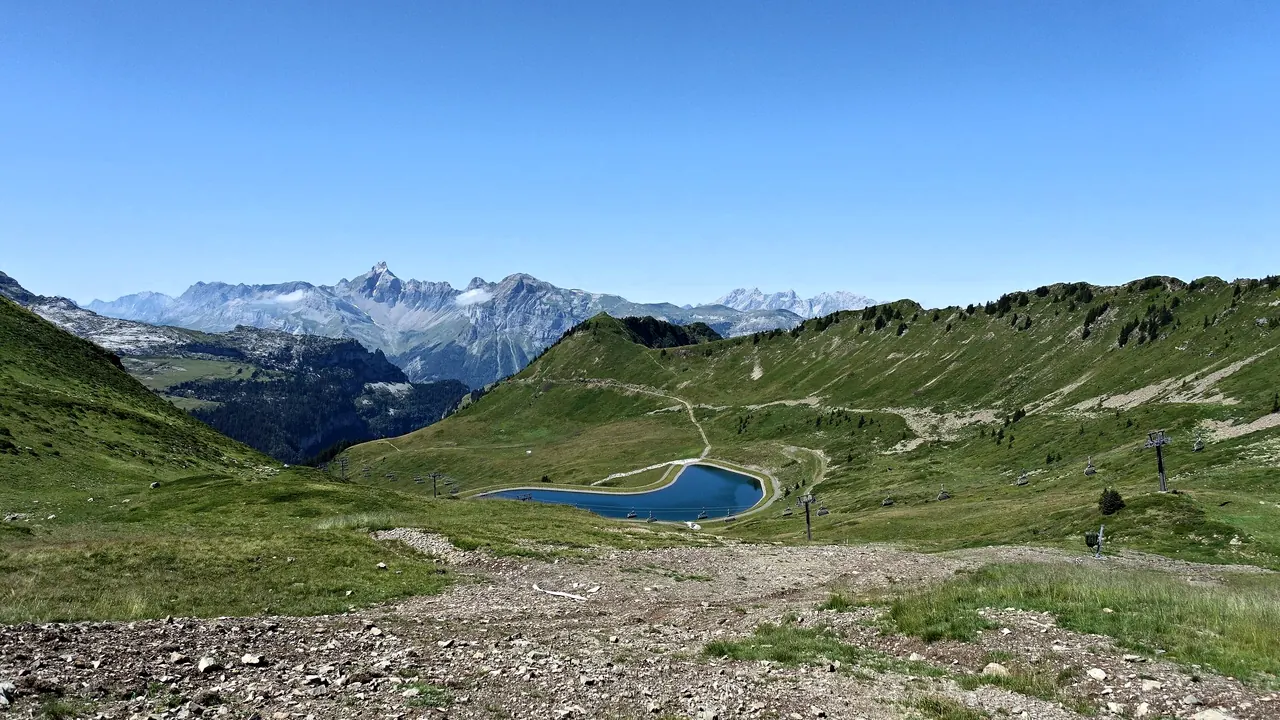
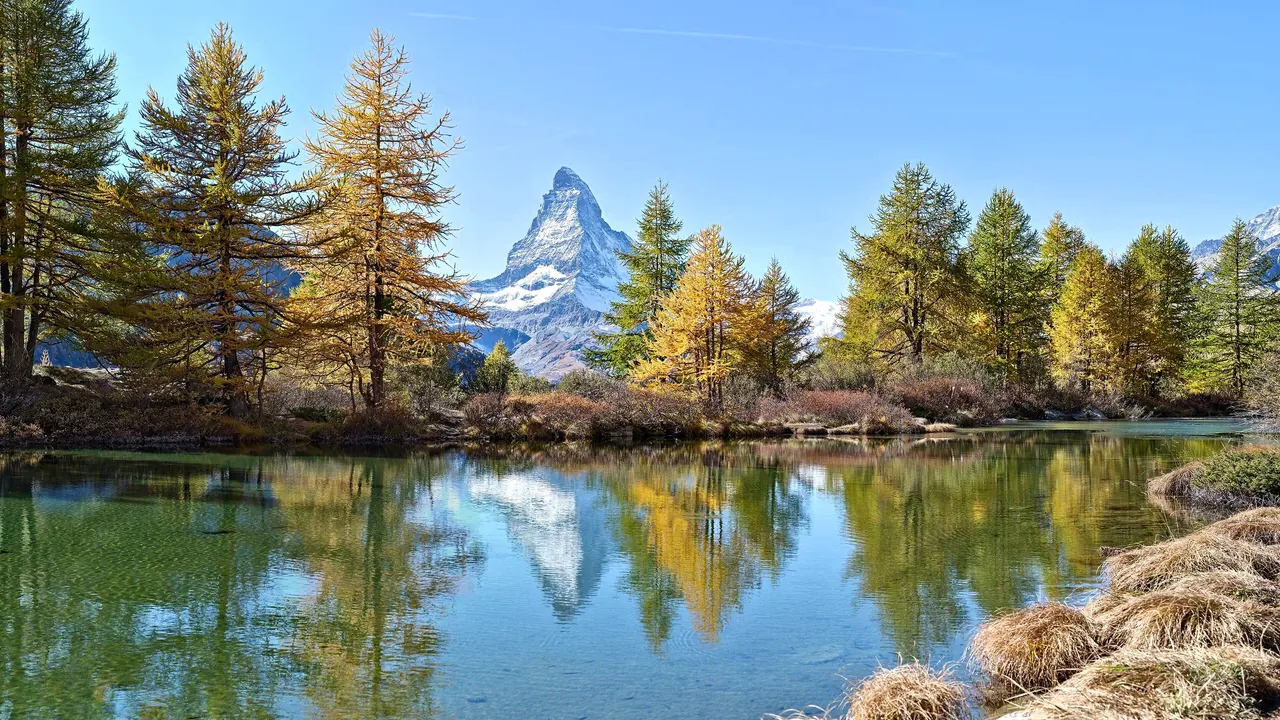
Photos: Flaine by Guilhem Vellut, CC BY 2.0, cropped; Zermatt by Roy Egloff, CC BY-SA 4.0, cropped.
Flaine or Zermatt?
Our verdict in twelve categories, each scored against the same fixed benchmark cities, and the climate month by month, so you can choose for your trip.
Choose Flaine for
- prices
- day trips
- families
Flaine makes more sense for a family ski week where the budget has to stretch. The resort is free of cars and was built around nursery slopes and ski schools. Its apartments sit by the snow, so you can cook for yourselves, and the Grand Massif gives you a big linked ski area. With a car it also works as a base for Annecy, Geneva and Chamonix, and the modernist resort is a curiosity in its own right.
Choose Zermatt for
- getting around
- shopping
- wellness
Choose Zermatt when the mountains themselves are the point and money is less of a worry. The Matterhorn stands over the village and the lifts climb to glacier terrain above 3,800m. You also get better mountain lunches, livelier après-ski and a deep choice of hotel spas, all reached on foot from a village with no cars and a train line into the Swiss network. It costs far more, and there is less to do beyond the valley.
Scoreboard
Twelve categories on one fixed scale from 0 to 100. The shaded stretch is the gap between the two.
Your match
Pick a travel style or drag the sliders, and both match scores follow your weighting.
Wins on prices and day trips with your weighting.
Wins on getting around and shopping with your weighting.
What matters to you?
Category by category
What the scores mean for a trip.
Beaches & swimming
Neither is a place to swim, and in both resorts swimming means a hotel or residence pool. Flaine has a small lake below the resort for picnics, and with a car you can reach real beaches on Lake Annecy or Lake Geneva for the day. Zermatt's tarns are for photographing the Matterhorn's reflection, and they stay too cold for bathing even in August.
Food & drink
Flaine serves plain Savoyard food: fondue, tartiflette and Reblochon in resort restaurants and slope-side huts. Many visitors simply cook in their apartments, and a careful dinner out often means driving down to the valley or to Annecy.
Zermatt eats noticeably better. Its wooden chalets in the hamlets of Findeln, Furi and Zum See make lunch something you ski or walk to, and the village has a few serious fine-dining kitchens. Valais wines such as Petite Arvine and Cornalin come with the raclette and air-dried beef. The choice is still narrow, and many places close between seasons.
Culture & sights
You can see the sights of either resort in a morning, but they are very different sights. Flaine is itself a piece of 1960s modernism by Marcel Breuer, with concrete blocks stepped across the bowl and open-air works by Picasso, Dubuffet and Vasarely, so it appeals to people who love architecture and design.
Zermatt's heritage is mountaineering: the Matterhorn Museum and the story of the 1865 first ascent, the climbers' graves by the parish church and the old larch-wood granaries of the Hinterdorf. The Gornergrat cog railway adds a historic ride.
Nightlife
Zermatt has the livelier evenings. The slope-side bars fill up as the runs come back into the village, and a few bars and small clubs on the main street stay open past midnight on busy weekends. Flaine's après-ski is a handful of bars around the Forum, and with a crowd of families and committed skiers most people are home soon after dinner. In both resorts summer evenings end early.
Nature & outdoors
Flaine is a fine mountain base in its own right. It has the size of the Grand Massif ski area, snow that holds well in its north-facing bowl, good off-piste and a view of Mont Blanc from the Grandes Platières. In summer the rock pavements of the Désert de Platé make for an unusual hike, though the season is short.
Zermatt goes a good deal further. The Matterhorn rises over the village, with dozens of four-thousand-metre peaks around it. The lifts reach glacier terrain where some pistes stay open in summer, and the skiing crosses into Italy. Summer adds the Five Lakes walk, the Europaweg and guided ascents of the high peaks.
Day trips
Flaine is the better base for days out, as long as you have a car. Annecy's old town and lake, Geneva and Chamonix are all within about an hour or a little more. Samoëns, Sixt-Fer-à-Cheval and lakeside Yvoire are also in reach, although every trip starts with the winding road down to the Arve valley.
From Zermatt every outing begins with the train down the valley, and there is less to choose from: Sion with its castle hills and the Valère basilica, Brig's Stockalper Palace, or Saas-Fee by bus. Most visitors stay up in the mountains instead.
Good for families
Neither resort lets ordinary cars into its centre, which makes both easy with children, but Flaine was designed for family ski weeks. Apartments sit close to the snow, with nursery slopes, ski schools and snow gardens on the doorstep, and wide gentle runs where children can build confidence. Its weak spot is summer, when there is less to keep children busy.
Zermatt has children's ski schools on the Sunnegga side, and in summer there are marmots and cog railways. Still, little else is aimed at children, and the viewpoints above 3,000m can be too cold and thin-aired for small ones.
Getting around
Flaine is easy once you are there, with lifts and a shuttle linking Forum, Forêt and Front de Neige. Getting there is harder. The nearest station is at Cluses down in the valley, so most visitors either drive up the mountain road or take a transfer from Geneva airport, and day trips need a car.
Zermatt is the simpler trip without a car. You come by train, usually changing at Täsch, and then walk everywhere in the compact village. Electric taxis and ski buses serve the outlying lift stations, and the train out of the valley connects smoothly with the rest of the Swiss rail network.
Shopping & style
Flaine has nothing like Zermatt's shopping street. There are no watch or jewellery boutiques and no specialist mountaineering outfitters, only the shops a ski week needs. The best you can take home is a wedge of Savoyard cheese or a bottle of local wine, and for real shopping you have to drive down to Annecy or Geneva.
Zermatt has more to browse, though it is all on one main street running from the station to the church. Swiss watch and jewellery boutiques serve wealthy skiers, and the mountaineering outfitters are worth a visit if you need good equipment. Between them are shops selling cowbells, chocolate and Matterhorn souvenirs. There is no market or design scene, and independent shops are few.
Affordability
Flaine is still expensive, but it costs much less than Zermatt. The lift pass, ski hire and lessons take most of the money, while the self-catering apartments are modest by French resort standards. Avoiding the school vacation weeks, or coming in summer, cuts the bill further.
Zermatt is among the most expensive places in the Alps. Rooms are steep even in plain hotels, terrace meals cost a great deal, and so do the lifts and railways. Self-catering or sleeping down in Täsch helps, but it remains a splurge.
Live music & performing arts
Neither has a theatre or concert hall, but Zermatt's two festivals give it the edge. Zermatt Unplugged brings acoustic sets in spring, and a chamber music festival fills the village church in late summer. In Flaine there is only the odd concert in the ski season and live music at après-ski, so for a proper evening of music you go to Annecy or Geneva.
Wellness & relaxation
After a day on the slopes, Zermatt gives you far more places to unwind than Flaine. In Flaine the pools, saunas and steam rooms belong to the larger residences and hotels. They are welcome after skiing but not a reason to book, though the car-free resort's quiet evenings are restful in their own way.
Zermatt has an unusually dense cluster of fine hotel spas, many with pools looking out at the peaks, and a few sell day access to non-residents. In peak weeks the village feels active rather than slow. Thermal springs are missing in both places, so for proper thermal bathing Flaine's visitors go down to the Chablais and Lake Geneva, and Zermatt's to the spa towns lower in the Valais.
When should you go?
Pick your month. The climate figures are measured averages, not a forecast.
Flaine in July
Zermatt in July
Daytime high, °C
Rainfall in the month, mm
Where the figures come from
Flaine has no weather station within reach, so its figures come from a gridded climate model rather than a measured record, and read a broad area rather than one spot.
Zermatt has no weather station within reach, so its figures come from a gridded climate model rather than a measured record, and read a broad area rather than one spot.
Temperature and rainfall are climate normals, averaged over the years shown. Flaine: 2001-2020 normals, NASA POWER reanalysis grid, no weather station within 90 km. Zermatt: 1991-2020 normals, TerraClimate 4 km grid at the town, no weather station within 90 km.
Both are winter resorts first. From December to March daytime highs hover around freezing in both, about -2°C in midwinter, which is good for skiing and cold for strolling. Spring arrives sooner in Flaine, at about 7°C in April, while Zermatt is still a few degrees colder. In summer Flaine is also the warmer of the two, at 18°C in July and August against Zermatt's 14°C. Both are pleasant for hiking then, but neither is ever warm enough for outdoor swimming.
Flaine is the wetter resort, with more than 100mm in most summer months and again in midwinter, so pack proper rain gear for walks. Zermatt stays drier through both the summer and the ski season, and its wettest month is November.
Which traveller are you?
On a family trip with young children, Flaine is the better pick. The lodgings sit beside nursery slopes, ski schools and snow gardens, and wide gentle runs let children progress. Zermatt's best viewpoints are high and cold for small children.
For a trip on a tight budget, Flaine is the realistic choice. Self-catering apartments and supermarket cheese counters keep costs in hand, and summer is much cheaper. Zermatt stays expensive at every level, from plain hotel rooms to lunch on a terrace.
On an outdoors trip, Zermatt wins. The Matterhorn, glacier pistes that stay open into summer, skiing across into Italy and hundreds of kilometres of marked trails make it one of the great Alpine bases. Flaine offers a big ski area and unusual karst hikes on a smaller scale.
Before you go
| Measure | Flaine | Zermatt |
|---|---|---|
| Official language | French | French, German, Italian, Romansh |
| Currency | Euro (EUR) | Swiss Franc (CHF) |
| Sockets | CE230 V, 50 Hz | CJ230 V, 50 Hz |
| Driving side | Right | Right |
| Time zone | UTC+1, UTC+2 in summer | UTC+1, UTC+2 in summer |
| Emergency number | 112 | 112 |
| Elevation | 1,600 m | 1,624 m |
| Main airport | Geneva International Airport (GVA)52 km from centre150 non-stop destinations | Geneva International Airport (GVA)128 km from centre150 non-stop destinations |
| Public holidays this year | 11 days | 9 days |
By the numbers
| Measure | Flaine | Zermatt |
|---|---|---|
| Population | - | 6,023 |
| People per km² | - | 25 |
| Museums within 10 km | 0 | 2 |
| UNESCO World Heritage sites within 50 km | 2 | 2 |
Where else could you go?
Every comparison below shares a destination with this one, so you can follow Flaine or Zermatt somewhere new.
- Samoënsvs Flaine
- Saint-Gervais-les-Bainsvs Flaine
- Chamonixvs Flaine
- Les Getsvs Flaine
- Saas-Feevs Zermatt
- Megèvevs Flaine