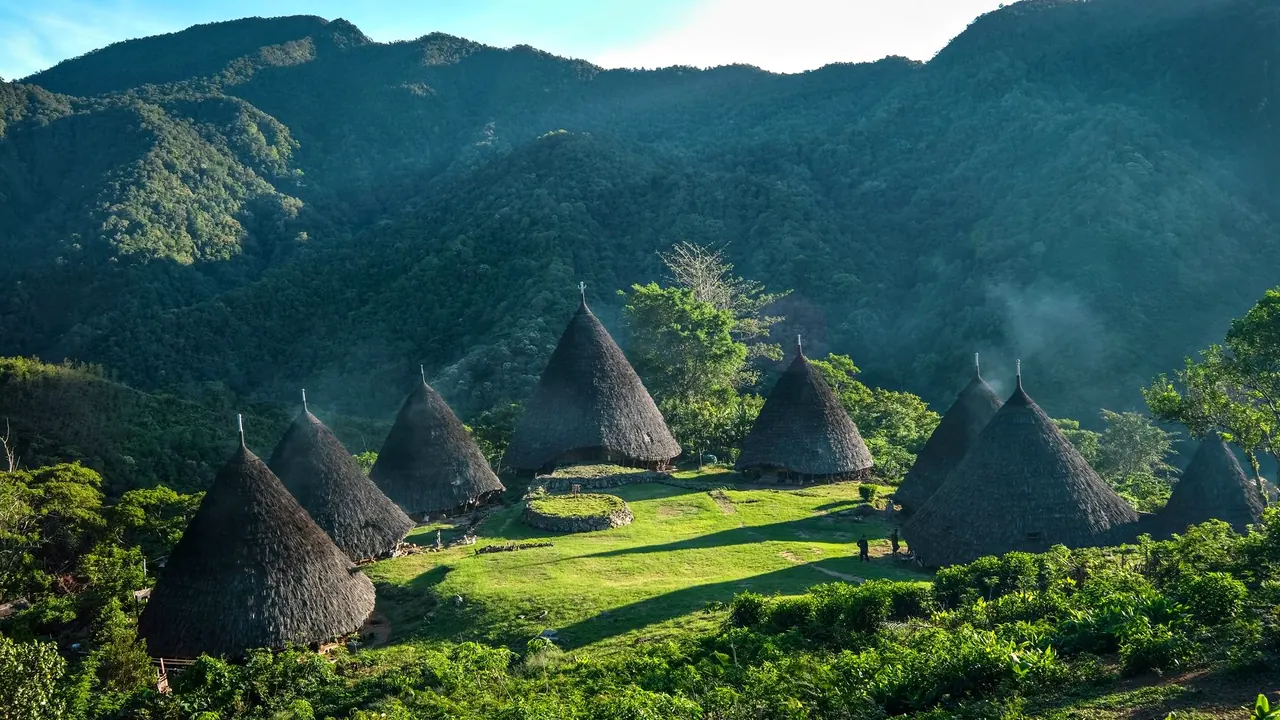
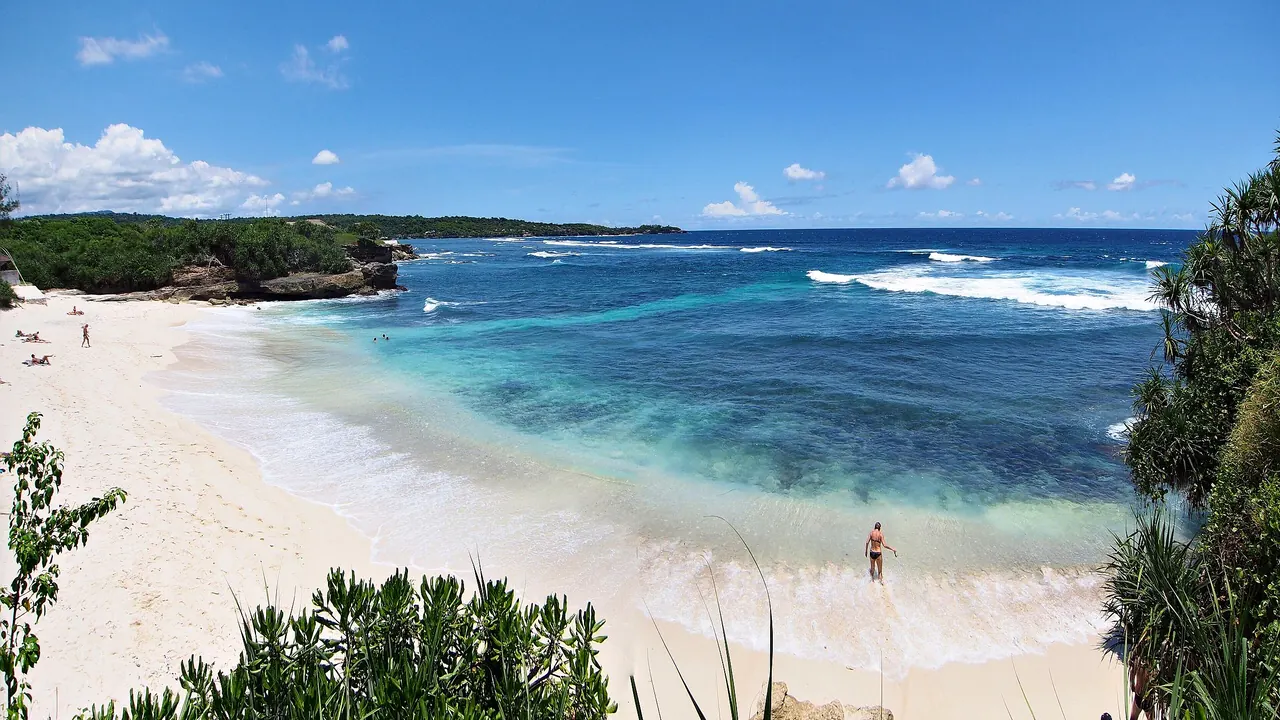
Photos: Flores by Wayan Yatika, CC BY-SA 4.0, cropped; Nusa Lembongan by rheins, CC BY 3.0, cropped.
Flores or Nusa Lembongan?
Our verdict in twelve categories, each scored against the same fixed benchmark cities, and the climate month by month, so you can choose for your trip.
Choose Flores for
- culture and sights
- nature and the outdoors
- shopping
Flores is the trip for travellers who want an expedition. Komodo dragons on the savannah, mantas and reefs in the national park, crater lakes at Kelimutu and highland villages like Bena and Wae Rebo make it far richer in wildlife, scenery and living heritage. The price is days of slow, twisting roads and early starts, so it rewards people with time, curiosity and a tolerance for rough edges.
Choose Nusa Lembongan for
- wellness
- day trips
- getting around
For a few easy days by the sea, Nusa Lembongan is the better pick. It is a small island half an hour from Bali, with calm coves on the west coast, strong diving and snorkelling in the channels, massage and yoga on every lane and almost nothing to organise. You give up the volcanoes, the dragons and the village culture, but you gain a stay that actually feels like rest.
Scoreboard
Twelve categories on one fixed scale from 0 to 100. The shaded stretch is the gap between the two.
Your match
Pick a travel style or drag the sliders, and both match scores follow your weighting.
Too close to call, 2 points apart
Wins on culture and sights and nature and the outdoors with your weighting.
Wins on wellness and day trips with your weighting.
What matters to you?
Category by category
What the scores mean for a trip.
Beaches & swimming
These two are broadly level, but the beach day works differently on each. On Flores the best sand lies offshore, on Pink Beach, Kanawa, Seraya and Kelor, so swimming means taking a boat out of Labuan Bajo and snorkelling off the shore of an islet, with Riung's islets as a quieter extra.
Nusa Lembongan gives you beaches you can walk to. Mushroom Bay and Tamarind Bay are calm enough for an everyday swim, while Dream Beach and Sandy Bay are better for looking at than swimming because of the currents. Its coves are small, and on the Jungutbatu shore the tide decides whether you can swim at all.
Food & drink
Neither island is a place to come for the food, and the two are much alike at the table: grilled fish, rice dishes at warungs and Western cafés for visitors. Flores has the harbourfront night market in Labuan Bajo and its highland arabica, roasted over wood fires in the villages around Bajawa and Ruteng. Lembongan has sunset restaurants and breakfast cafés, but good Balinese cooking means a trip to the mainland.
Culture & sights
Flores is far ahead here. Its heritage lives in villages, the stone megaliths and high-roofed houses of Bena under Inerie and the conical houses of Wae Rebo, where visitors stay the night. Add the Liang Bua cave where Homo floresiensis was found, the spiderweb rice fields of Manggarai, Sukarno's house of exile in Ende and Larantuka's Portuguese-rooted Holy Week.
On Lembongan, culture is a short walk around the village: the carved gates of Pura Puseh and Pura Dalem, the hand-dug underground house and the seaweed plots on the Ceningan channel. It is interesting, but it takes an afternoon, not a trip.
Nightlife
Both islands go to bed early because the boats leave at dawn. The difference is in the setting. On Flores, evenings happen only in Labuan Bajo, with sunset bars above the bay and a few backpacker spots, and the inland towns are silent after dinner. Lembongan's evenings centre on cliff-top bars and beach clubs on the west and south coasts, with the odd DJ night in Jungutbatu, and anyone after a proper night out takes the boat to Bali.
Nature & outdoors
Flores is one of the great wild places of the region. Komodo National Park has dragons on Komodo and Rinca, the view from Padar, and reefs and manta stations among the richest anywhere, while the island's volcanic spine holds Kelimutu's three coloured lakes and the green Manggarai hills.
Lembongan's nature is mostly underwater, and very good there: mantas off Penida all year, sunfish in the cold months and fast drift dives. On land the island is low scrub, so the mangroves by kayak, the blowholes at Devil's Tear and a long boat day to the Kelingking cliffs on Penida have to stand in for real scenery.
Day trips
Lembongan makes the easier base for outings. Ceningan is a walk over the bridge, Penida's cave temple at Goa Giri Putri and its coast are a short crossing away, and Sanur is about half an hour by fast boat, although Ubud and the rice terraces make a tiring day.
Flores hardly works as a base at all. Apart from the boat trips out of Labuan Bajo and the Ngada villages near Bajawa, each place of interest is hours from the next, so you travel the island in stages rather than going out and back.
Good for families
Neither island is built for children, but Lembongan is the simpler choice for a family. Calm Mushroom Bay or Tamarind Bay makes a base, kayaking in the mangroves keeps older children busy, and the mainland is close if something goes wrong. Wading out to the boats and the steep roads are the main nuisances.
Flores asks more of a family: long winding drives, early and sometimes choppy boat days, and basic hospitals away from the towns. Kept to Labuan Bajo and short trips into the park, though, it offers what Lembongan cannot, a ranger walk among real dragons.
Getting around
Lembongan is the easier of two awkward islands. It is only a few kilometres across, so a scooter or a hotel truck gets you anywhere in minutes, even if the roads are steep and potholed and the boats land on the beach.
Flores is a matter of days, not minutes. The Trans-Flores Highway from Labuan Bajo to Kelimutu usually takes three or four days with a hired driver, buses are slow, and the small airports at Ende and Maumere are mainly useful for skipping the return leg.
Shopping & style
Flores has the one thing on either island worth shopping for: hand-woven ikat, bought straight from the women who weave it. Each region has its own style, the indigo of Sikka, the earth tones of Ende, the bold Ngada motifs. Lembongan offers sarongs, beachwear and minimarts, and leaves crafts to the Bali mainland.
Affordability
Costs are much the same, and on both islands simple guesthouses and warung meals are cheap, with the money going on what happens at sea. On Flores the big costs are Komodo boat trips, park fees, liveaboards and a car and driver for the crossing. Lembongan's extras are smaller and closer to hand, dives, manta trips and the fast boat, though everyday food costs a little more because it is shipped in.
Live music & performing arts
Neither island has a stage, but Flores has a little more to see. Caci whip duels in Manggarai are often put on for visitors, the ja'i dance belongs to Ngada ceremonies, and the Catholic church choirs are worth hearing. On Lembongan, temple gamelan is something you only come across by chance, and staged Balinese dance means going to Ubud.
Wellness & relaxation
Lembongan is much the more restful island. With almost no cars and a day shaped by the tides, there is open-air massage in Jungutbatu, spas at the cliff-top resorts above Mushroom Bay and Sandy Bay, and regular yoga classes, so a few slow days take no planning.
Flores has the hot river at Malanage and the Soa springs, simple soaks used mostly by locals, plus a few spas in Labuan Bajo. Its long overland journey makes most trips more tiring than relaxing.
When should you go?
Pick your month. The climate figures are measured averages, not a forecast.
Flores in July
Nusa Lembongan in July
Daytime high, °C
Rainfall in the month, mm
Where the figures come from
Flores has no weather station within reach, so its figures come from a gridded climate model rather than a measured record, and read a broad area rather than one spot.
Nusa Lembongan's temperatures are measured 32 km from the centre, at Denpasar / Ngurah-Rai.
Nusa Lembongan has no rain gauge within 25 km of the centre, so its rainfall comes from a gridded climate dataset read at the destination rather than from a gauge further away.
Temperature and rainfall are climate normals, averaged over the years shown. Flores: 2001-2020 normals, NASA POWER reanalysis grid, no weather station within 90 km. Nusa Lembongan: 1991-2020 normals, Denpasar / Ngurah-Rai (32.1 km from centre).
Both islands are warm all year, so the rain decides the month. Around Labuan Bajo on Flores the wet season is long and heavy, running from November to April and peaking at about 356mm in December. The dry heart of the year, June to August, is the time to go, with August down to roughly 25mm and the calmest seas for boats and diving. May and September are good months on either side of it, and October is wetter but still workable. Days are steadily warm rather than fierce, a little hotter from September to November, and the sea is warm in every month.
Nusa Lembongan has a shorter, lighter wet season, at its worst around 218mm in January, and it dries out from May. August and September are the driest months. August is also the sunniest, October is almost as bright though a little wetter, and July and September are not far behind. From December to June its afternoons are hotter than on Flores, so walking its steep roads at midday is tiring. From July to September the two are level, or Flores is the warmer. Its one quirk is the sea: from July to October cool upwellings chill it, down to around 26°C in August. That suits divers looking for sunfish, but the water feels fresher for swimming than the steady warmth off Flores.
Which traveller are you?
On a relaxing and wellness trip, Nusa Lembongan is the clear choice. Massage pavilions, cliff-top spas and yoga studios are all within a short ride, and the quiet evenings help. Flores has hot springs near Bajawa, but its long drives and early starts work against rest.
For a culture and arts trip, Flores offers far more. There are the megaliths and ancestral houses of Bena, a night in Wae Rebo, the Liang Bua cave and caci duels in Manggarai. On Lembongan a couple of temples and the seaweed farms fill an hour or two.
On an outdoors trip, Flores is the stronger destination. Komodo dragons, the ridges of Padar, manta dives in the park, Kelimutu's crater lakes and a climb up Inerie make a journey Lembongan cannot match, though its reefs and mangroves are fine for a shorter stay.
Before you go
| Measure | Flores | Nusa Lembongan |
|---|---|---|
| Official language | Indonesian | Indonesian |
| Currency | Rupiah (IDR) | Rupiah (IDR) |
| Sockets | CF50 Hz | CF50 Hz |
| Driving side | Left | Left |
| Time zone | UTC+8 | UTC+8 |
| Emergency number | 112 | 112 |
| Main airport | Komodo Airport (LBJ)8 non-stop destinations | Denpasar I Gusti Ngurah Rai International Airport (DPS)64 non-stop destinations |
By the numbers
| Measure | Flores | Nusa Lembongan |
|---|---|---|
| Population | 1,831,000 | 5,000 |
| People per km² | 135 | - |
| Swim season, months above 21 °C | 12 months | 12 months |
Where else could you go?
Every comparison below shares a destination with this one, so you can follow Flores or Nusa Lembongan somewhere new.
- Nusa Penidavs Nusa Lembongan
- Lombokvs Nusa Lembongan
- Gili Islandsvs Nusa Lembongan
- Lombokvs Flores
- Gili Islandsvs Flores
- Nusa Penidavs Flores