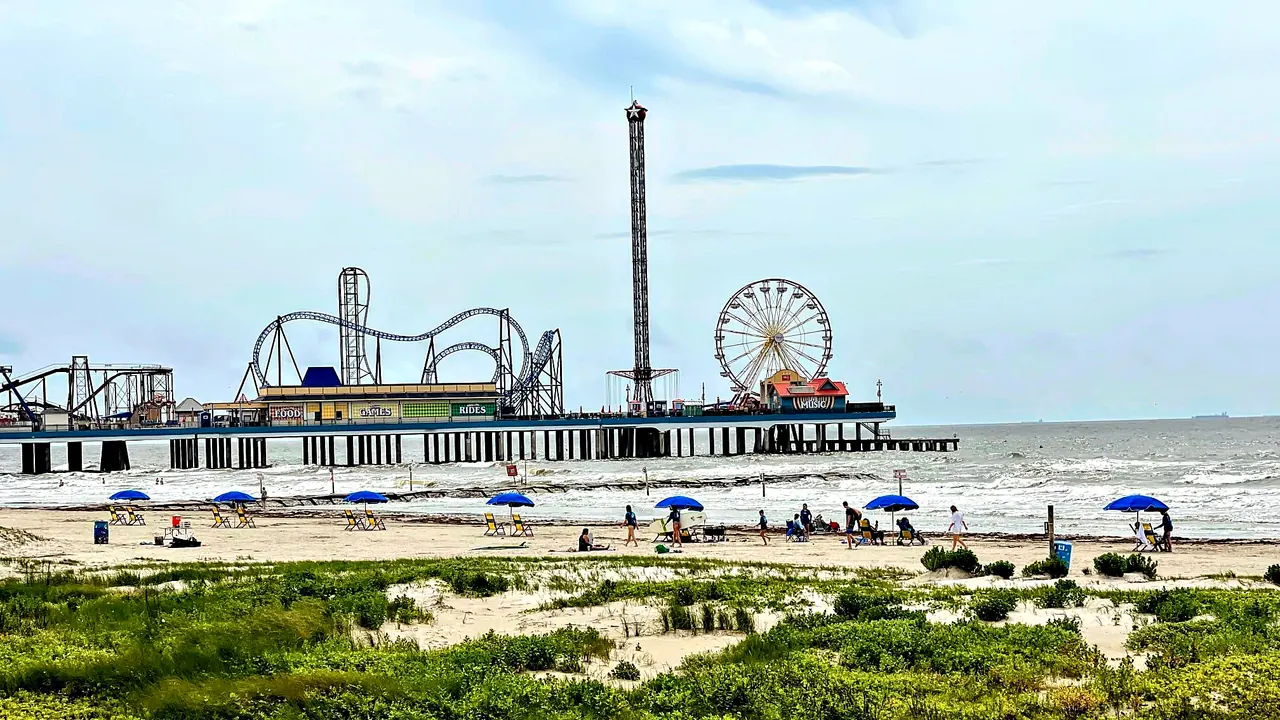
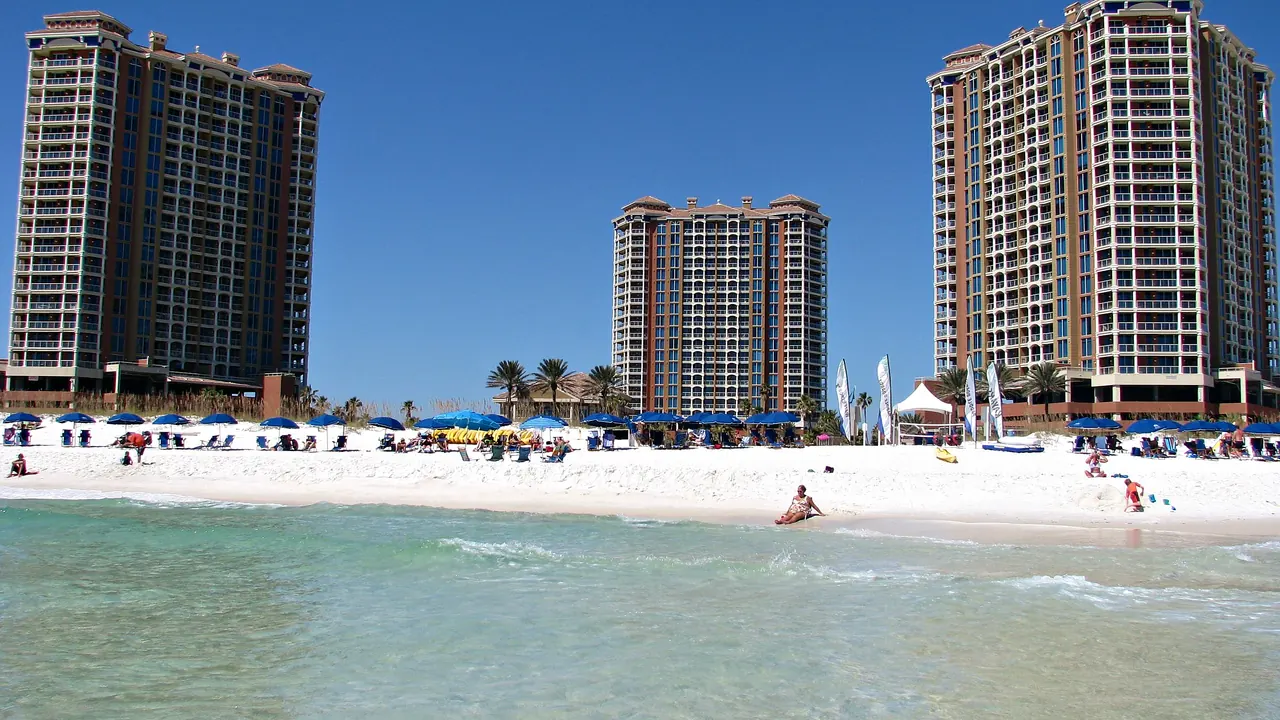
Photos: Galveston by Devin P Morris, CC BY-SA 4.0, cropped; Pensacola by Jason Meredith, CC BY 2.0, cropped.
Galveston or Pensacola?
Our verdict in twelve categories, each scored against the same fixed benchmark cities, and the climate month by month, so you can choose for your trip.
Choose Galveston for
- getting around
- families
- day trips
Galveston is the better pick for a family beach week where the sand is only half the plan. Moody Gardens' glass pyramids, the waterpark and the funfair pier on the Seawall fill the hot or rainy days, and Space Center Houston and Houston's museums are close enough for an easy outing. The water is murky, but it is warm, and the Victorian Strand gives adults something to wander through in the evening.
Choose Pensacola for
- beaches
- nature and the outdoors
- nightlife
If the shoreline itself is what you are travelling for, Pensacola wins clearly. The white quartz sand and clear green water of Santa Rosa Island and the national seashore are a different kind of beach from Galveston's silty Gulf, and the dunes, bay and rivers give you more to do outdoors. Downtown around Palafox Street also has the livelier evenings, though you will drive almost everywhere.
Scoreboard
Twelve categories on one fixed scale from 0 to 100. The shaded stretch is the gap between the two.
Your match
Pick a travel style or drag the sliders, and both match scores follow your weighting.
Too close to call, 2 points apart
Wins on getting around and families with your weighting.
Wins on beaches and nature and the outdoors with your weighting.
What matters to you?
Category by category
What the scores mean for a trip.
Beaches & swimming
Both cities have long stretches of warm Gulf sand, but the water looks very different. Galveston's water is brown-green with river silt, and some summers bring drifts of sargassum. Its beaches are wide, flat and practical, from the busy Seawall to the lifeguarded family sand at Stewart Beach and the quieter West End.
Pensacola has the beach people picture when they think of the Gulf Coast: white quartz sand, low dunes and clear green water along Santa Rosa Island and the national seashore. The sound side adds calm shallows, and Perdido Key is quieter. The catch is that the best sand is a drive over the bridges from town rather than outside your door.
Food & drink
The two eat much alike: raw and chargrilled oysters, shrimp, gumbo and fried fish by the water, with chain seafood houses along the beach strips. Galveston leans more towards Texas, with Tex-Mex, barbecue and po'boys, and its better independent places are around the Strand. Pensacola's downtown on Palafox Street has more modern Southern cooking, craft breweries and a Saturday market, and it has royal red shrimp as a local speciality.
Culture & sights
Each fills two days, but with different history. Galveston's story is that of a rich Victorian port. You see it in the cast-iron fronts of the Strand, the porch-lined East End, mansions such as Bishop's Palace, and the Elissa tall ship. The Great Storm of 1900 runs through all of it.
Pensacola's past goes back further, through Spanish, French and British rule, and you see it in the colonial houses around Plaza Ferdinand and in the brick Fort Pickens. Its single biggest sight, the National Naval Aviation Museum, sits on an active base, so bring ID.
Nightlife
Neither is a clubbing town, but Pensacola has the fuller evenings. Palafox Street and the Seville Quarter pack in cocktail bars, rooftop terraces and taprooms, with a crowd of locals and young Navy personnel. Add sand-floored island bars and the rowdy old roadhouse on the state line at Perdido Key.
Galveston mostly means a drink in a Strand pub or on a Seawall patio, and the island is quiet early on weeknights. Its big exception is Mardi Gras, when downtown fills with parades and street parties.
Nature & outdoors
Both are flat, watery coasts, but Pensacola gives you more ways to get out into them. The national seashore has dunes, salt marsh and maritime forest with a bike path and boardwalks. There is kayaking and paddleboarding on the bay, clear sand-bottomed canoeing on the Blackwater River, and the sunken aircraft carrier is there for divers.
Galveston's strength is narrower but real: it lies on a major migration flyway. In spring, Bolivar Flats and High Island are full of warblers, shorebirds and spoonbills. Otherwise it is marsh trails in the state park and fishing from the jetties.
Day trips
Galveston has the stronger outings because Houston is so close. Space Center Houston is about 45 minutes away. The city itself adds the Museum of Fine Arts, the Menil Collection and the Rothko Chapel, and Kemah and the San Jacinto Monument are on the way.
From Pensacola, the best trip is west to Mobile for its antebellum streets and battleship, with Fairhope and Fort Morgan nearby. Heading east brings mostly more beach towns, such as Destin and Seaside.
Good for families
Galveston keeps children busier away from the sand. Stewart Beach has lifeguards, showers and warm shallows, and the island's big attractions are built to save a scorching or rainy afternoon indoors. The price is driving, because they are strung out along the island, and keeping young swimmers well away from the rip currents by the jetties.
Pensacola's strength is the water. The gentle summer surf and the calm, clear shallows on the sound side suit toddlers better than Galveston's murky Gulf, and condos with kitchens and pools make a long stay easy. Children who love planes get the aviation museum and the Blue Angels, and the zoo, the lighthouse climb and Fort Pickens' tunnels fill a few more days. After that the list runs short, and families hoping for theme parks will find none.
Getting around
You will want a car in both, but Galveston is a little easier without one. A heritage trolley and island buses link the walkable Strand with parts of the Seawall, and the flat beachfront is easy to cycle. Moody Gardens and the West End still mean driving, and there is no rail link from Houston's airports.
Pensacola is more spread out. The beach, the naval air station and Perdido Key are separated by highways and bridges, and apart from a seasonal beach trolley, the buses are of little use to visitors.
Shopping & style
Neither city is somewhere to shop seriously, so the difference is in what kind of browsing you get. Galveston has antiques, galleries and sweet shops in Victorian storefronts, plus downtown art walks, but no mall, so serious shoppers go to Houston. Pensacola has fewer of these, just a scattering of Palafox boutiques and a Saturday craft market, but it does have an ordinary chain mall inland.
Affordability
Costs are much the same: moderate for a US beach trip, with tips, tax and a hire car on top. Galveston helps with free public beaches, plenty of motels and rental beach houses, though Seawall rooms go up sharply on summer weekends and at Mardi Gras. In Pensacola, the aviation museum is free and rooms in town undercut the beachfront. Out of season, prices across the island fall a long way.
Live music & performing arts
Pensacola has a somewhat fuller stage. Its 1925 Saenger Theatre hosts a symphony, an opera company, a ballet and touring shows, so a classical evening is easier to find. Galveston's Grand 1894 Opera House is a lovely Victorian room for touring musicals, comedy and the community symphony, but the island has no opera company. In both, it is an evening out rather than a reason to come.
Wellness & relaxation
Slowing down in Galveston is a small-town pleasure: long, flat bike rides along the Seawall and quiet evenings among the porch-lined streets of the East End. Pensacola's version is emptier and closer to the shore, with the quiet stretches of Perdido Key and the island itself turning slow and uncrowded once the summer peak has passed. In both, treatments go no further than a massage or a day spa in the larger hotels.
When should you go?
Pick your month. The climate figures are measured averages, not a forecast.
Galveston in July
Pensacola in July
Daytime high, °C
Rainfall in the month, mm
Temperature and rainfall are climate normals, averaged over the years shown. Galveston: 1991-2020 normals, Scholes Field (8 km from centre). Pensacola: 1991-2020 normals, Pensacola / Pleasant Grove (12.3 km from centre).
Both cities share the same Gulf rhythm. Swimming starts in late May and lasts into October, with the sea near 30°C in July and August. From June to September daytime highs reach 33°C, which makes walking the streets hard work after mid-morning. Spring and autumn are the comfortable seasons for sightseeing and being outdoors in both. In winter the days are mild, though in Galveston the sea drops to about 15°C, too cool for most swimmers. Pensacola's water stays a little warmer, but in both places the winter beaches are for walking.
Rain is where they differ. Pensacola is wetter all year, and its summer is the wettest stretch, with around 200mm in July as thunderstorms build most afternoons. Galveston's summer is drier by comparison. Its wettest month is September, at about 167mm, so late spring is its most reliable time for a beach trip. In Pensacola, May and October offer warm water with less rain.
Which traveller are you?
For a beach and sun trip, choose Pensacola. Its clear green water, white sand and gentle surf along the protected Gulf Islands National Seashore beat Galveston's flat, murky beachfront. The water is just as warm, and sound-side shallows give calmer swimming.
On a family trip with children, Galveston has more lined up beyond the sand. You get Moody Gardens' aquarium and rainforest pyramids, a large waterpark, the funfair pier, dolphins from the free Bolivar ferry, and Space Center Houston within easy reach for older children.
On an outdoors trip, Pensacola gives you more to do. You can cycle and walk the boardwalks through the seashore's dunes and maritime forest, kayak the bay, canoe the clear Blackwater River, or dive the sunken aircraft carrier. Galveston's outdoors is mostly birdwatching and fishing.
Before you go
| Measure | Galveston | Pensacola |
|---|---|---|
| Currency | US Dollar (USD) | US Dollar (USD) |
| Sockets | AB120 V, 60 Hz | AB120 V, 60 Hz |
| Driving side | Right | Right |
| Time zone | UTC-6, UTC-5 in summer | UTC-6, UTC-5 in summer |
| Emergency number | 911 | 911 |
| Elevation | 2 m | 31 m |
| Main airport | William P. Hobby Airport (HOU)60 km from centre73 non-stop destinations | Pensacola International Airport (PNS)6 km from centre27 non-stop destinations |
| Public holidays this year | 13 days | 11 days |
By the numbers
| Measure | Galveston | Pensacola |
|---|---|---|
| City population | 53,695 | 54,312 |
| People per km² | 99 | 515 |
| Museums within 10 km | 7 | 5 |
| UNESCO World Heritage sites within 50 km | 0 | 0 |
| Swim season, months above 21 °C | 7 months | 7 months |
Where else could you go?
Every comparison below shares a destination with this one, so you can follow Galveston or Pensacola somewhere new.
- Orange Beachvs Pensacola
- Gulf Shoresvs Pensacola
- Destinvs Pensacola
- Houstonvs Galveston
- Panama City Beachvs Pensacola
- New Orleansvs Pensacola