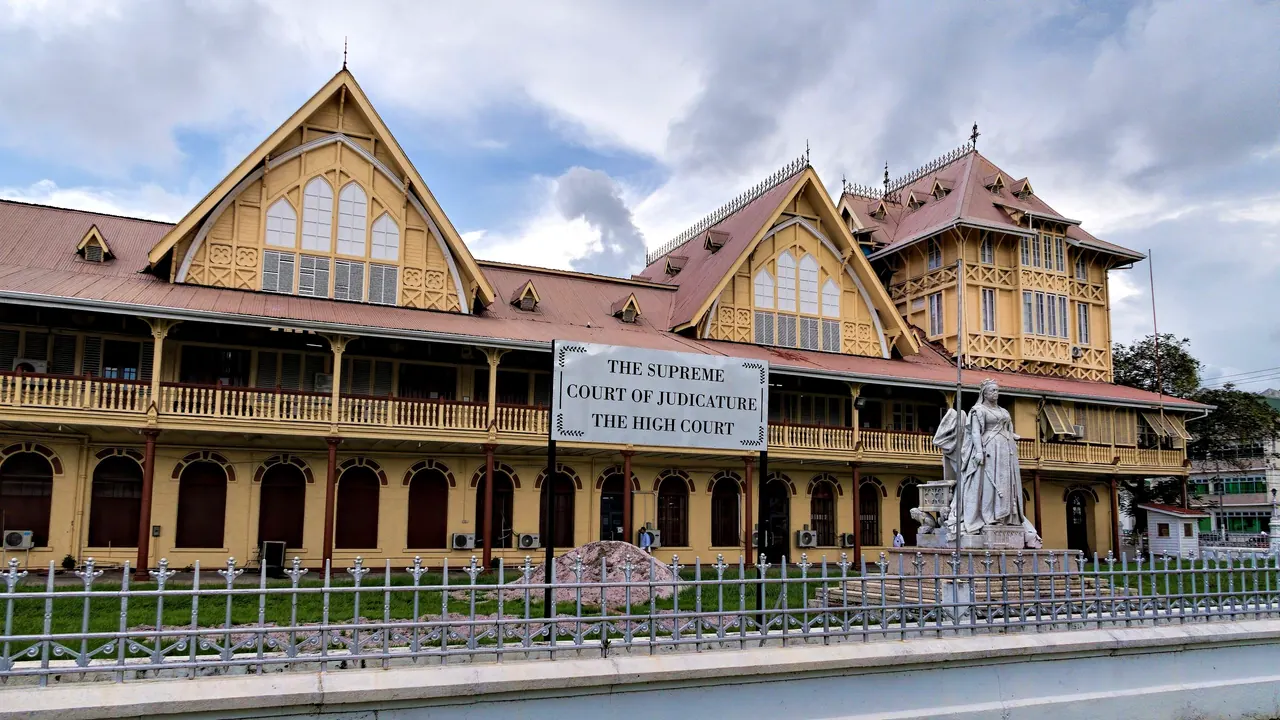
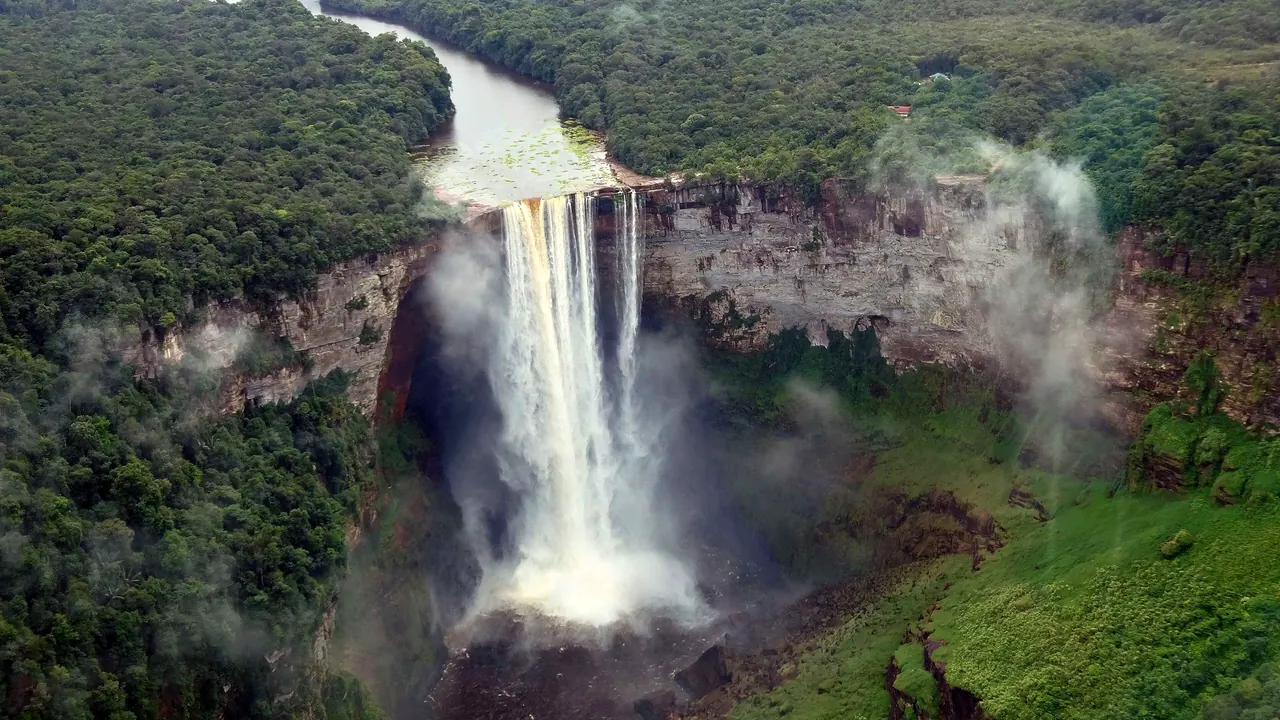
Photos: Georgetown by Dan Lundberg, CC BY-SA 2.0, cropped; Kaieteur Falls by Amanda, CC BY 2.0, cropped.
Georgetown or Kaieteur Falls?
Our verdict in twelve categories, each scored against the same fixed benchmark cities, and the climate month by month, so you can choose for your trip.
Choose Georgetown for
- food and drink
- nightlife
- culture and sights
Georgetown suits the traveller who wants Guyana's people, food and history: a city of white timber buildings, canals and markets, where you can eat pepperpot and Chinese-Guyanese chow mein, catch a weekend night out on Sheriff Street and use taxis and minibuses to get about. It is a base rather than a showpiece, and its sights fill a day or two, but it is the only place on this page with restaurants, museums, shops or a stage.
Choose Kaieteur Falls for
- nature and the outdoors
Kaieteur Falls is for the traveller who has come for wild scenery and will pay for it. A single drop of over 200m off a sandstone plateau, shared with a few dozen people and reached by small plane over unbroken forest, is the most striking natural sight in the country. There is nothing else to do there: no food worth the name, no towns, no evenings. Most visitors treat it as a costly, weather-dependent day out from Georgetown rather than as a destination in its own right.
Scoreboard
Twelve categories on one fixed scale from 0 to 100. The shaded stretch is the gap between the two.
Your match
Pick a travel style or drag the sliders, and both match scores follow your weighting.
Wins on food and drink and nightlife with your weighting.
Wins on nature and the outdoors with your weighting.
What matters to you?
Category by category
What the scores mean for a trip.
Beaches & swimming
Neither destination has a beach, and Georgetown's edge is a slight one. Its silty brown Atlantic is for walking beside on the seawall, but you can swim in the warm blackwater creeks south of the city where local families go at weekends, and the sandy river beaches near Bartica are within a long day's reach.
At Kaieteur the river above the drop is too fast to swim in. The only time you get into the water is in the shallow jasper pools at Orinduik Falls, and only if your flight stops there as well.
Food & drink
Georgetown is where you eat in Guyana. Its cooking draws on Indian, African, Chinese, Portuguese and Amerindian kitchens: pepperpot made with cassareep, cook-up rice, curry with dhal puri, pine tarts from the bakeries, and Demerara rum. Stabroek and Bourda markets add fruit and river fish. Serious restaurants are few, but home cooking is plentiful.
Kaieteur has no food culture at all. Day visitors get a packed lunch near the airstrip, overnight guests get rice and chicken at the park lodging, and the sensible plan is to eat well in the city on either side of the flight.
Culture & sights
Georgetown has a modest but genuine set of sights. There is the timber cathedral of St George's, the Gothic City Hall, Stabroek Market's iron clock tower, and museums covering Amerindian peoples, colonial history and national art, plus the 1763 Monument to the Berbice uprising.
Kaieteur offers none of that. Its cultural layer is the Patamona story of Kai paddling over the edge and the history of one of South America's early protected areas, both told by the guides on the walk to the viewpoints.
Nightlife
Georgetown's nights are small-scale but real, with rum shops, open-air bars playing soca and chutney, a cluster of late venues around Sheriff Street at weekends and cars with music on the seawall. You go between them by taxi. At Kaieteur the evening means frogs and the river for the few who stay, and most visitors are back in the city before dark anyway.
Nature & outdoors
Georgetown makes a decent gateway. There are manatees in the Botanical Gardens, hoatzin trips on the Mahaica River, and blackwater creeks within a couple of hours, but the city itself is flat reclaimed coast.
Kaieteur is the main event that Georgetown points towards. The Potaro pours about 226m into a forested gorge, viewed from unfenced rock at the lip with only a few dozen others around, and there are swifts circling behind the water and tiny golden frogs in the bromeliads. A day flight gives the view from the air but little time on the ground. The overland trek up the river trades that for several days of rapids, forest and a steep final climb.
Day trips
Georgetown has a short but usable list of outings. You can go up the Essequibo to Fort Zeelandia on Fort Island, on to the river town of Bartica, to Santa Mission on its blackwater creek, or along the coast past sugar estates and temples to New Amsterdam.
From Kaieteur there is nowhere to go except Orinduik Falls on a combined flight. The nearby settlements are hours away by rough road or river, so the park is a single stop rather than a base.
Good for families
Georgetown is the easier of the two with children, though it is still hard work. The zoo and Botanical Gardens, where children feed the manatees, the weekend kites on the seawall and the creek parks along the Linden highway give you some outings. The heat, the open canals beside the pavements and the fast traffic wear small children down.
Kaieteur works only for older children who cope with small planes. They tend to love the falls and the frogs, but the viewpoints have no railings above a huge drop and the facilities are a shelter and basic toilets, so toddlers are better left out of it.
Getting around
In Georgetown the sights cluster around Stabroek Market and Main Street, close enough to walk by day despite the broken pavements and drains. Registered taxis are plentiful for everything else and for after dark, and crowded minibuses run numbered routes for the confident.
Reaching Kaieteur is the hard part. It lies about 250km inland with no road to the top, so you need an hour's light-aircraft flight that leaves only when seats fill and the cloud allows, and a spare day in your plans helps. Once you land, the viewpoints are an hour or two's guided walk over rock and roots.
Shopping & style
Georgetown is where you buy anything at all. There is the produce and household chaos of Stabroek Market, the food stalls of Bourda, and craft outlets selling woven baskets, balata figures, hammocks and carvings, as well as Guyanese gold jewellery and aged rum. Kaieteur has at most a few souvenirs by the airstrip, so buy your crafts in the city.
Affordability
Day to day, Georgetown is the cheaper of the two. Street food, roti shops, minibuses and taxis cost little, and the main expense is a decent hotel room, priced for business travellers. With simple guesthouses a frugal stay is possible.
Kaieteur reverses the picture. There is almost nothing to spend money on once you arrive, but the charter seat, park fee and guide come as a package that is costly for a few hours at the falls, and the overland trek costs more again. Budget for it as the single biggest outlay of a Guyana trip.
Live music & performing arts
Georgetown has a small stage life. Plays, dance and concerts are put on at the National Cultural Centre, and a playhouse stages sharp local comedy. Its real performance season is in the festivals: Mashramani's steel pan and costume bands, the chowtal singing of Phagwah and the Diwali motorcades. Kaieteur has no venues or events, only the roar of the water.
Wellness & relaxation
Neither place is built for rest, and they fall short in different ways. Georgetown has a few hotel spas and massage salons, and you can find calm in a breeze on the seawall or a shaded bench in the Botanical Gardens, though the minibus horns are never far off.
Kaieteur has no treatments of any kind. What it does have is silence for anyone who stays the night, with the plateau empty after the planes leave and the falls in evening light. For day visitors it is a rushed few hours of flying and walking.
When should you go?
Pick your month. The climate figures are measured averages, not a forecast.
Georgetown in July
Kaieteur Falls in July
Daytime high, °C
Rainfall in the month, mm
Where the figures come from
Kaieteur Falls has no weather station within reach, so its figures come from a gridded climate model rather than a measured record, and read a broad area rather than one spot.
Temperature and rainfall are climate normals, averaged over the years shown. Georgetown: 1961-1990 (sunshine 1991-2020, rainfall 1991-2020) normals, Georgetown (0.7 km from centre). Kaieteur Falls: 2001-2020 normals, NASA POWER reanalysis grid, no weather station within 90 km.
Georgetown is hot all year, with daytime highs of about 29°C to 31°C, so the streets are never cool and the rain decides when to go. It has two wet seasons. The heavier one runs from May to July, with June bringing about 317mm, and the second begins in November and lasts through December and January. The drier spells are February and March, and then September and October, when rain falls to about 71mm in October. Those two autumn months are also the sunniest, which makes them the easiest time for walking the centre. The sea stays warm all year, but nobody bathes off this coast.
Kaieteur's figures are measured on the plateau, which is a little cooler in mid-year, at around 26°C in June and July. It has one main rainy season, from May to August with the peak in June, and it stays fairly dry from September through to March, with no December and January wet spell to match Georgetown's. That gives you a trade-off. The rainy months make the falls run fullest but bring the cloud that delays flights, while the drier months give easier trails and more reliable flying but a thinner flow. February and March, and September and October, are the windows when both places are dry, so they suit a trip that combines the two.
Which traveller are you?
On an outdoors trip, Kaieteur Falls is the place. It has the great free-falling drop, rainforest trails to unfenced viewpoints, golden frogs and cock-of-the-rock, and an overland trek for those with several days. Georgetown's nature mostly means boat trips and the Botanical Gardens.
For a culture and arts trip, Georgetown is the only real choice. It has St George's Cathedral, the Walter Roth Museum, Castellani House and festivals such as Mashramani and Phagwah. At Kaieteur the culture is a Patamona legend told by the guides.
On a trip on a tight budget, Georgetown is far kinder. Roti shops, market snacks and minibuses cost little and simple guesthouses exist. A Kaieteur visit means a charter flight package, and it is likely to be the most expensive single day of the trip.
Before you go
| Measure | Georgetown | Kaieteur Falls |
|---|---|---|
| Official language | English | English |
| Currency | Guyana Dollar (GYD) | Guyana Dollar (GYD) |
| Sockets | ABG240 V, 60 Hz | ABG240 V, 60 Hz |
| Driving side | Left | Left |
| Time zone | UTC-4 | UTC-4 |
| Emergency number | 999 | 999 |
| Elevation | 0 m | - |
| Main airport | Cheddi Jagan International Airport (GEO)36 km from centre16 non-stop destinations | Kaieteur Airport (KAI)2 non-stop destinations |
| Public holidays this year | 11 days | 11 days |
By the numbers
| Measure | Georgetown | Kaieteur Falls |
|---|---|---|
| Population | 235,017 | - |
| People per km² | 1,592 | - |
| Museums within 10 km | 3 | - |
| UNESCO World Heritage sites within 50 km | 0 | - |
| Swim season, months above 21 °C | 12 months | - |
Where else could you go?
Every comparison below shares a destination with this one, so you can follow Georgetown or Kaieteur Falls somewhere new.
- Paramaribovs Georgetown
- Amazonvs Kaieteur Falls
- Puerto Iguazuvs Kaieteur Falls
- Bridgetownvs Georgetown
- Niagara Fallsvs Kaieteur Falls
- Victoria Fallsvs Kaieteur Falls