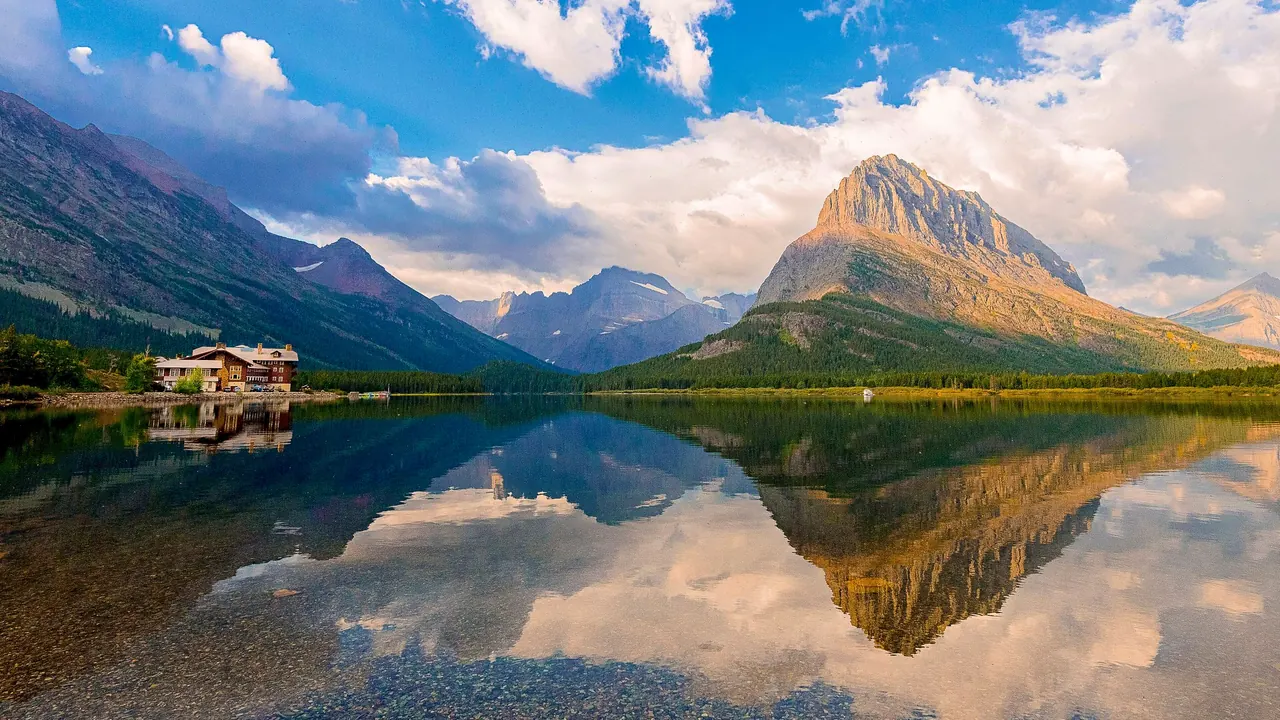
Photos: Glacier National Park by Viveksk1, CC BY-SA 4.0, cropped.
Glacier National Park or Mount Rainier?
Our verdict in twelve categories, each scored against the same fixed benchmark cities, and the climate month by month, so you can choose for your trip.
Choose Glacier National Park for
- beaches
- live music and the arts
- food and drink
Glacier National Park suits travellers planning a longer wilderness trip with wildlife at its heart: grizzlies, mountain goats and moose among glacier-carved peaks and hundreds of turquoise lakes. It also gives more away from the trail, with lake swimming at Flathead, Blackfeet culture on the east side, and the restaurants and saloons of Whitefish for the evenings.
Choose Mount Rainier for
- day trips
- prices
- wellness
For a mountain trip that fits into a visit to the cities of the Pacific Northwest, Rainier is the stronger pick. A single huge volcano, wildflower meadows and rainforest valleys lie within a couple of hours of Seattle and Tacoma. It costs a little less, and its deep snow makes it a winter choice for snowshoers and skiers too.
Scoreboard
Twelve categories on one fixed scale from 0 to 100. The shaded stretch is the gap between the two.
Your match
Pick a travel style or drag the sliders, and both match scores follow your weighting.
Wins on beaches and live music and the arts with your weighting.
Wins on day trips and prices with your weighting.
What matters to you?
Category by category
What the scores mean for a trip.
Beaches & swimming
Neither is a swimming destination, but Glacier comes closer. Its own lakes are snowmelt-cold, so a dip off the pebble shore at Apgar is a bracing moment rather than a swim. A short drive out of the park, though, brings you to the town beach on Whitefish Lake and the state park beaches of Flathead Lake, which warms to about 20°C in August.
Around Rainier, the high lakes such as Reflection Lakes are for wading at most. The nearest swimming is at lowland reservoirs like Alder Lake near Elbe, with no sand and nothing to plan your days around.
Food & drink
In both parks, food is mostly fuel for hikers, but Glacier's surroundings eat better. Whitefish has a handful of thoughtful restaurants, craft breweries and a summer farmers' market. Huckleberry pie and the cherry stands along Flathead Lake give the area a regional taste of its own.
Rainier's gateway towns of Ashford and Packwood offer diners, pizza and the odd brewpub, and a proper restaurant meal means driving back towards Tacoma. There, a picnic at the trailhead is often the better meal.
Culture & sights
Both keep their heritage in grand timber lodges. Glacier's were built by the Great Northern Railway in Swiss-chalet style, and Rainier's at Paradise and Longmire set the pattern for American park architecture. Glacier has a little more to add. The Going-to-the-Sun Road, cut into the cliffs in the 1920s and 1930s, is a landmark in itself, and the Blackfeet Reservation on the east side, with the Museum of the Plains Indian in Browning, brings a living Native culture into the trip.
Rainier's extras are more modest: visitor-centre exhibits on volcanoes and glaciers, old fire lookouts on the ridges, and small local museums in Eatonville and Enumclaw.
Nightlife
Neither park is a place for going out, and in both most evenings are over soon after dark. Glacier at least gives you the option. Inside the park, a nightcap in a lodge bar while the light fades on the peaks is about as late as it gets. Outside the west entrance, Whitefish has a few Western-style bars and brewery taprooms that draw hikers in summer and skiers in winter, and Saturday night there is the closest the area comes to a night out.
At Rainier, even that is out of reach. At most you will have one beer in a tavern in Ashford or Packwood, with nowhere to go on to afterwards, and then you head back to the cabin or tent.
Nature & outdoors
Both are mountain parks of the first rank, so the choice comes down to the kind of mountain you want. Glacier is a whole range of sharp, ice-carved peaks along the Continental Divide, scattered with turquoise lakes. Grizzlies, mountain goats and moose are a big part of the draw, and Many Glacier and the Highline Trail lead the hiking.
Rainier is one huge glaciated volcano of 4,392m that fills every view. It has wildflower meadows at Paradise, close views of the Emmons Glacier from Sunrise and mossy rainforest in the Carbon River valley. Its season also runs beyond summer, with guided summit climbs, snowshoeing at Paradise and lift skiing at Crystal Mountain and White Pass.
Day trips
Rainier has the better days out, because it sits within reach of real cities. Tacoma's waterfront museums, among them a glass museum with a working hot shop, and the domed capitol at Olympia are each about an hour and a half away. Seattle is close enough to fold into the same trip.
Glacier's outings are gentler and more rural: Waterton and its old railway hotel across the Canadian border, an afternoon in Whitefish, or the arts village of Bigfork on Flathead Lake. Beyond those, Montana's long distances take over.
Good for families
Both suit outdoor-loving families with school-age children better than toddlers. Both run a junior ranger programme, and both share the same drawbacks of winding drives and basic food. Glacier offers historic boat tours on Many Glacier and Two Medicine lakes, the chance to see a bear from a safe distance, and warm lake swimming outside the park.
Rainier has more made for children just beyond the park. There is a tram through the Northwest Trek wildlife park and a steam railway from Elbe, and snow lingers at Paradise into early summer.
Getting around
You will need a car in both, and summer trailhead car parks fill early in each. Glacier gives a little more help to those without one. The cross-country train stops at West and East Glacier, a free summer shuttle runs along the Going-to-the-Sun Road, and the airport near Kalispell is about half an hour from the west entrance.
Rainier has no useful public transport, and Paradise and Sunrise are about two hours apart by road. That makes your choice of base in Ashford, Packwood or Enumclaw matter more. In winter, only the road up to Paradise stays open, and chains are required.
Shopping & style
Whitefish gives Glacier the edge here, with a main street of galleries and shops for Western wear and outdoor clothing. The most meaningful thing to take home, though, is beadwork by Blackfeet artists from around Browning.
At Rainier, the choice stops at park gift shops and a few craft shops in the gateway towns, so buy your outdoor gear in Seattle or Tacoma before you arrive.
Affordability
Neither is cheap in summer, though Rainier is a little easier on the wallet. Its rooms are few and fill early, but meals cost ordinary American prices rather than resort rates, and June and late September bring room prices down.
Glacier's park lodges and Whitefish hotels cost more and book out far ahead. In both parks, camping makes the biggest saving, as does staying in the motels of Kalispell or Columbia Falls when visiting Glacier. In both, the trails themselves cost nothing.
Live music & performing arts
Glacier's surroundings have a small but real summer season. Bigfork's long-established playhouse stages Broadway musicals in repertory, and the Flathead Valley has a regional symphony and community theatre in Whitefish. Rainier has nothing like this: an evening out means a ranger talk at a campground amphitheatre or the occasional musician in a tavern, with concerts only back in Tacoma or Seattle.
Wellness & relaxation
Neither has hot springs to soak in or a real spa culture. Rainier's small springs at Ohanapecosh are something to look at on a walk, and at Glacier, spa treatments are limited to a few resort hotels around Whitefish. What both offer is quiet, in different settings: at Glacier, a lakeside lodge without televisions and a porch facing the peaks, and at Rainier, a cabin under the firs near Ashford or Packwood with river noise at night and no phone signal.
When should you go?
Pick your month. The climate figures are measured averages, not a forecast.
Glacier National Park in July
Mount Rainier in July
Daytime high, °C
Rainfall in the month, mm
Where the figures come from
Glacier National Park's temperatures are measured 33 km from the centre, at Glacier Park International Airport.
Glacier National Park has no rain gauge within 25 km of the centre, so its rainfall comes from a gridded climate dataset read at the destination rather than from a gauge further away.
Mount Rainier has no weather station within reach, so its figures come from a gridded climate model rather than a measured record, and read a broad area rather than one spot.
Temperature and rainfall are climate normals, averaged over the years shown. Glacier National Park: 1991-2020 normals, Glacier Park International Airport (32.7 km from centre). Mount Rainier: 1991-2020 normals, TerraClimate 4 km grid at the town, no weather station within 90 km.
Both are summer destinations, but the summers differ. Where most visitors stay at Glacier, July and August are warm and fairly dry, with highs near 28°C. This is the only stretch for a swim in Flathead Lake, and the high trails are clear of snow from July to September. June is the wettest month of the year there. From October the highs drop quickly, and midwinter sits around freezing.
Around Rainier's gateway towns, summer is milder, peaking at about 23°C in August, so long climbs on the trails are more comfortable than in Glacier's July heat. July and August are the only reliably dry months. The rain returns heavily in October, and from November to January more than 300mm falls each month, much of it as snow on the upper mountain. Outside high summer, Rainier is far wetter than Glacier.
Which traveller are you?
On a beach and sun trip, neither park should be the first choice. If lake days must share a mountain vacation, though, pick Glacier, stay on the west side in late July or August, and hike in the morning and swim in the afternoon. Rainier's cooler summer never allows that rhythm.
For a food and nightlife trip, only Glacier is worth considering, and only if you sleep in Whitefish rather than in a park lodge and drive in for the hikes. At Rainier, the evenings will be quiet and early whatever you plan.
On a trip on a tight budget, Rainier makes the money go further, especially with a tent. Pack picnics for the trailheads and the main costs are fuel and a campsite. Glacier can be done cheaply too, but its short, crowded season leaves less room for flexible dates.
Before you go
| Measure | Glacier National Park | Mount Rainier |
|---|---|---|
| Currency | US Dollar (USD) | US Dollar (USD) |
| Sockets | AB120 V, 60 Hz | AB120 V, 60 Hz |
| Driving side | Right | Right |
| Time zone | UTC-7, UTC-6 in summer | UTC-8, UTC-7 in summer |
| Emergency number | 911 | 911 |
| Main airport | Glacier Park International Airport (FCA)17 non-stop destinations | Seattle–Tacoma International Airport (SEA)136 non-stop destinations |
| Public holidays this year | 12 days | 11 days |
By the numbers
| Measure | Glacier National Park | Mount Rainier |
|---|---|---|
| Population | - | 875 |
Where else could you go?
Every comparison below shares a destination with this one, so you can follow Glacier National Park or Mount Rainier somewhere new.
- Olympic National Parkvs Mount Rainier
- Banffvs Glacier National Park
- Yellowstonevs Glacier National Park
- Redwood National Parkvs Mount Rainier
- Olympic National Parkvs Glacier National Park
- Yellowstonevs Mount Rainier