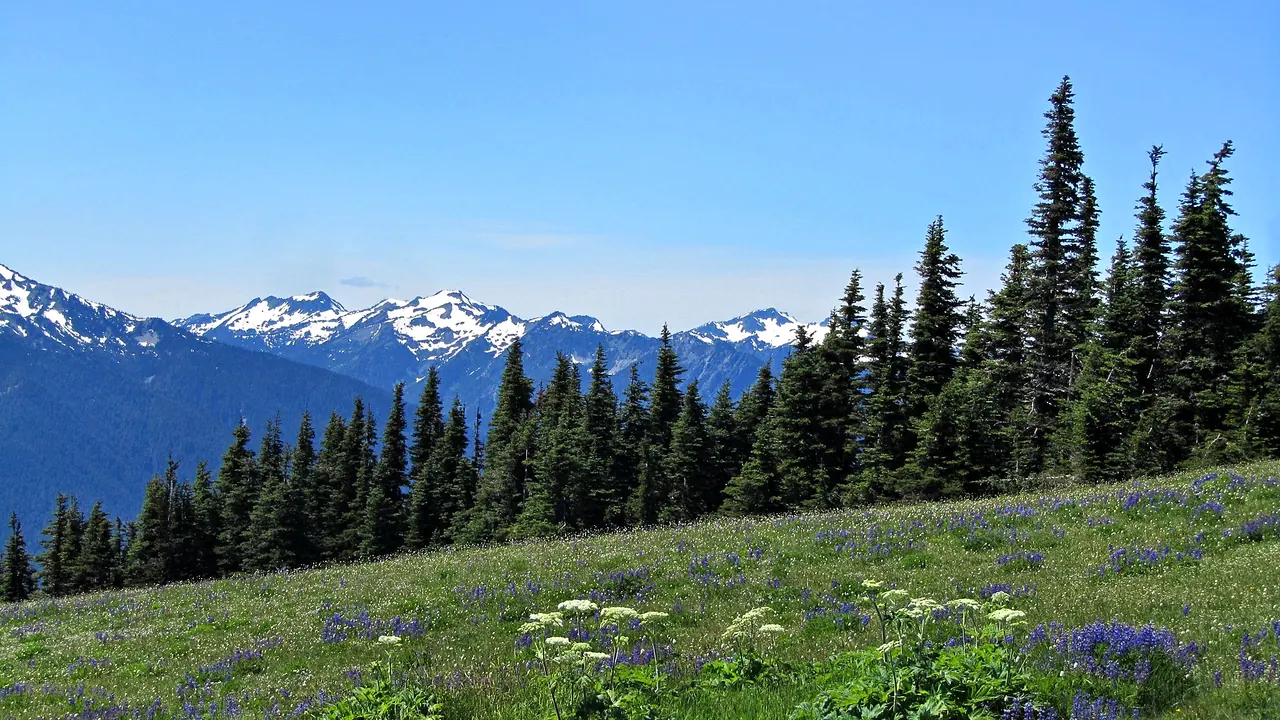
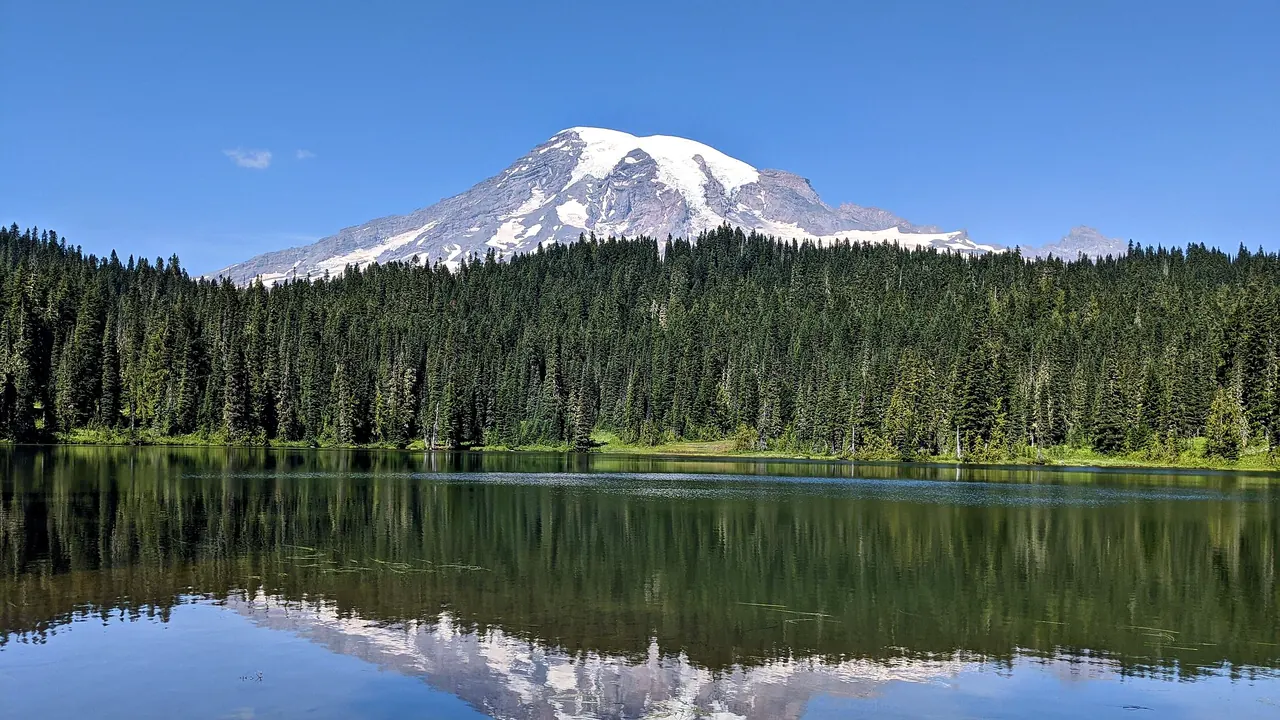
Photos: Olympic National Park by Jeffhollett, CC BY-SA 4.0, cropped; Mount Rainier by Angelina Suzuki, CC BY-SA 4.0, cropped.
Olympic National Park or Mount Rainier?
Our verdict in twelve categories, each scored against the same fixed benchmark cities, and the climate month by month, so you can choose for your trip.
Choose Olympic National Park for
- live music and the arts
- wellness
- food and drink
For a longer trip with more variety, Olympic National Park is the stronger choice. Mountains, rainforest and a wild Pacific coast share one park, and the north-shore towns, Port Townsend above all, add crab and oysters, a Victorian seaport, summer music at Fort Worden and a soak at Sol Duc. The price is driving. The park is a loop around its own edge, so a stay works best split between two bases.
Choose Mount Rainier for
- prices
Mount Rainier suits travellers who want one great mountain and little else. Glaciers fill the view from Paradise and Sunrise, the meadows flower in high summer, experienced climbers can go for the summit with a guide, and in winter there is lift skiing at Crystal Mountain and White Pass. It is also an easier drive from Tacoma and Seattle, with no ferry. The cost is that almost everything away from the trails is thin: meals, evenings and the towns themselves.
Scoreboard
Twelve categories on one fixed scale from 0 to 100. The shaded stretch is the gap between the two.
Your match
Pick a travel style or drag the sliders, and both match scores follow your weighting.
Wins on live music and the arts and wellness with your weighting.
Wins on prices with your weighting.
What matters to you?
Category by category
What the scores mean for a trip.
Beaches & swimming
Neither is a swimming destination, but Olympic at least has a coast worth the trip. Rialto, Ruby and Second Beach have sea stacks, piles of driftwood and tide pools to explore at low tide. Rainier has no shore at all apart from the lowland reservoir at Alder Lake.
For an actual swim, Olympic's Lake Crescent and Lake Quinault are bearable on a warm summer afternoon. Rainier's snowmelt lakes, such as Reflection Lakes, are for wading at most.
Food & drink
Around Rainier, food is fuel. There are diners, pizza places and a brewpub or two in Ashford and Packwood, dining-room meals at the Paradise and Longmire lodges, and a drive towards Tacoma for anything more.
Olympic has more to eat, though only along its north shore. Dungeness crab, Hood Canal oysters and smoked salmon are local, and Port Townsend's bakeries, seafood places and cider make a proper evening out. On the west side, around Forks, the choice is as thin as Rainier's.
Culture & sights
Rainier's heritage is the story of the park itself, and it fits around the walking. At Longmire, the first park headquarters and a small museum show how the national parks began, and its rustic buildings became the pattern that lodges and ranger stations across the country later followed. Paradise Inn, with its great beamed lobby, is the one landmark people go out of their way to see. Taken together, they fill a morning between trails rather than a whole day.
Olympic has more to see and a wider story to tell, though most of it lies outside the park boundary. Port Townsend has kept its nineteenth-century port town largely unchanged, so an afternoon on its streets and at the former army fort of Fort Worden is a walk through that century. At Neah Bay, the Makah Museum shows objects from Ozette, a village sealed under a mudslide, and tells the story of a people who hunted whales off this coast long before there was a park.
Nightlife
Evenings are quiet in both. Port Townsend and Port Angeles at least have pubs, taprooms and wine bars for a drink after dinner. Around Rainier you get a tavern in Ashford or Packwood, then an early night before a dawn start.
Nature & outdoors
Both are among the great landscapes of the Pacific Northwest, and the difference is one of shape. Rainier is a single glaciated volcano of 4,392m that fills the sky. You see it up close from the Skyline Trail at Paradise or facing the Emmons Glacier at Sunrise, and there is rainforest in the Carbon River valley.
Olympic spreads three landscapes across one park: the meadows of Hurricane Ridge, the moss-hung rainforest of the Hoh and Quinault valleys, and a roadless Pacific coast with beach hikes timed to the tides and grey whales passing in spring. Rainier has the grander mountain and winter skiing, while Olympic has the greater variety.
Day trips
Olympic has the better outings, led by the car ferry from Port Angeles to Victoria in British Columbia, about an hour and a half across the strait. There is also Port Townsend, the onward ferry to Whidbey Island, and Sequim's lavender farms in July.
From Rainier the day trips lead down to the lowlands, mainly Tacoma's waterfront museums, including a glass museum with a working hot shop, or the capitol at Olympia. From both, Seattle works better as a stop on the way than as a day out.
Good for families
Both suit families who like being outdoors, but the peninsula keeps children busy for longer. The drive-through animal park near Sequim, where bears come up to the car, and easy walks such as the Hall of Mosses and the path to Marymere Falls cover a wider mix of settings.
Rainier has its own highlights: the footbridge over Box Canyon, the junior ranger programme, the steam railway from Elbe and the tram at Northwest Trek. Its limits are basic food and drop-offs on the higher trails, so a few days is enough.
Getting around
You need a car for both, and the drives are long, but the layout differs. Rainier's sights sit around a single mountain, with Paradise and Sunrise about two hours apart by road. In winter only the road from Longmire to Paradise stays open, and chains are needed.
Olympic is a loop. Highway 101 runs round three sides with no road across the mountains, so traffic is light but the full circuit takes most of a day, and most visitors split their stay between Port Angeles and the west side. Reaching it from Seattle usually means a ferry, which Rainier does not.
Shopping & style
Maps, field guides and souvenirs from the park gift shops are about the limit around Rainier. Add a few general stores and small craft shops in the gateway towns, and buy any outdoor gear in Seattle or Tacoma before you arrive.\n\nOlympic gives a shopper a little more to do. Port Townsend's Victorian main street has galleries, antique dealers and bookshops for an unhurried afternoon, Sequim sells lavender in every form, and Native carvings and prints turn up here and there along the coast.
Affordability
Costs come out much the same. The trails are free once you are inside, summer rooms are expensive, meals cost ordinary American prices, and camping is the way to save in both parks. The difference is in the beds: Olympic has chain and independent motels in Port Angeles, Sequim and Forks, while Rainier's few lodges, cabins and motels fill early in July and August, so June and late September bring the clearest savings there.
Live music & performing arts
Here the peninsula is clearly ahead. Fort Worden in Port Townsend holds summer workshops and festivals of jazz, blues and old-time fiddle music, the town has a small professional theatre and local bands, and Port Angeles has a community symphony.
At Rainier the evening programme is a ranger talk at a campground amphitheatre. Anyone who wants a concert drives back to Tacoma or Seattle.
Wellness & relaxation
Both offer quiet more than treatments: a cabin under the firs near Ashford or Packwood, or a lodge on the peninsula's lakes, with no phone signal and the sound of rain or a river at night. Where they differ is the water.
Sol Duc's hot spring pools at the end of a forest road, open roughly from spring to autumn, give a simple outdoor soak. Rainier's springs at Ohanapecosh are only for looking at, and pampering there stops at a hot tub on a cabin deck.
When should you go?
Pick your month. The climate figures are measured averages, not a forecast.
Olympic National Park in July
Mount Rainier in July
Daytime high, °C
Rainfall in the month, mm
Where the figures come from
Olympic National Park has no rain gauge within 25 km of the centre, so its rainfall comes from a gridded climate dataset read at the destination rather than from a gauge further away.
Olympic National Park's sunshine is measured 87 km from the centre, at Quillayute State Airport.
Mount Rainier has no weather station within reach, so its figures come from a gridded climate model rather than a measured record, and read a broad area rather than one spot.
Temperature and rainfall are climate normals, averaged over the years shown. Olympic National Park: 2006-2020 (sunshine 1981-2010, rainfall 1991-2020) normals, Port Angeles / Firwest Mobile Home Park (5.1 km from centre). Mount Rainier: 1991-2020 normals, TerraClimate 4 km grid at the town, no weather station within 90 km.
Both parks are summer destinations, and the good season is short. Around Mount Rainier, July and August are the dry heart of the year, with highs near 23°C where visitors stay and the high trails clear of snow. September is still good, but from October the rain comes back hard and peaks around 327mm in November. Winter there is for snowshoes and skis, not walking, and the high country can still lie under snow in June.
Olympic follows the same pattern more gently. High summer is slightly cooler, the winter months are far less wet where most visitors stay, and July and August are the sunniest months, with around 200 hours of sunshine each. May, June and September make reasonable shoulder months on the peninsula. The Pacific never gets above about 12°C, so even in August the coast is for walking, not swimming.
Which traveller are you?
On an outdoors trip built around high mountains, Mount Rainier is the pick. One glaciated volcano dominates every trail, the Wonderland Trail circles it and guided parties climb to the summit. In winter Paradise becomes snowshoe country, with two lift-served ski areas nearby.
For a relaxing and wellness trip, Olympic National Park goes further. The pools at Sol Duc give you a real soak among the trees, the north-shore towns have a few small spas, and a lakeside lodge makes it easy to switch off for days.
On a family trip with children, the peninsula has more to fill the days: tide pools on the coast, elk in the Hoh valley and a marine life centre in Port Angeles. Rainier makes a good few days of short trails and snow, but it runs out sooner.
Before you go
| Measure | Olympic National Park | Mount Rainier |
|---|---|---|
| Currency | US Dollar (USD) | US Dollar (USD) |
| Sockets | AB120 V, 60 Hz | AB120 V, 60 Hz |
| Driving side | Right | Right |
| Time zone | UTC-8, UTC-7 in summer | UTC-8, UTC-7 in summer |
| Emergency number | 911 | 911 |
| Main airport | Seattle–Tacoma International Airport (SEA)136 non-stop destinations | Seattle–Tacoma International Airport (SEA)136 non-stop destinations |
| Public holidays this year | 11 days | 11 days |
By the numbers
| Measure | Olympic National Park | Mount Rainier |
|---|---|---|
| Population | - | 875 |
| Swim season, months above 21 °C | None | - |
Where else could you go?
Every comparison below shares a destination with this one, so you can follow Olympic National Park or Mount Rainier somewhere new.
- Vancouver Islandvs Olympic National Park
- Vancouver Islandvs Mount Rainier
- Redwood National Parkvs Mount Rainier
- Glacier National Parkvs Mount Rainier
- Glacier National Parkvs Olympic National Park
- Redwood National Parkvs Olympic National Park