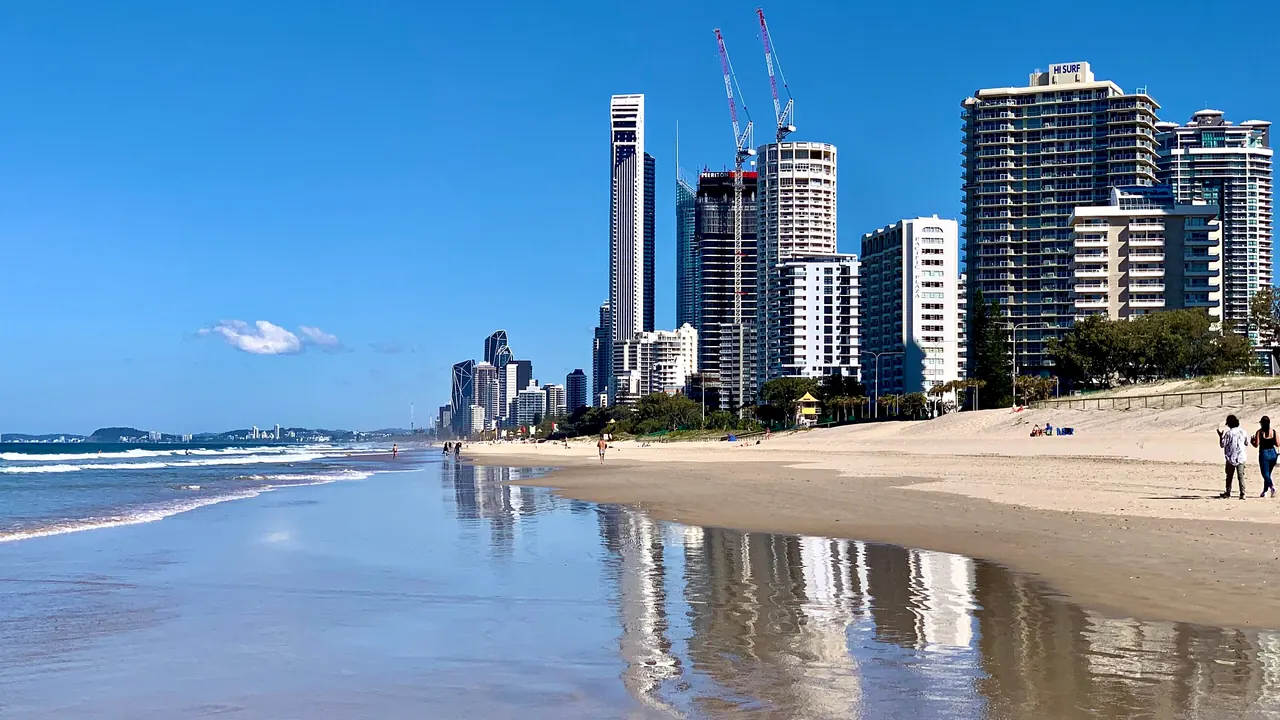
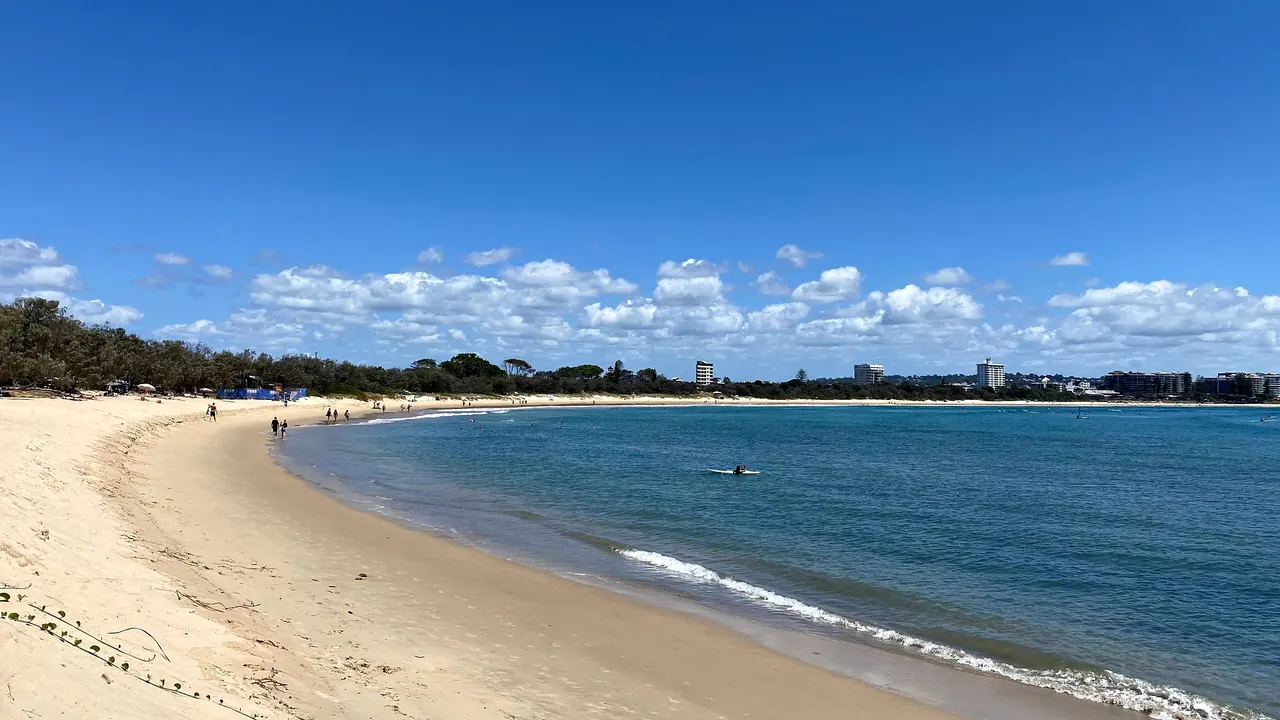
Photos: Gold Coast by Kgbo, CC BY-SA 4.0, cropped; Sunshine Coast by -wuppertaler, CC BY 4.0, cropped.
Gold Coast or Sunshine Coast?
Our verdict in twelve categories, each scored against the same fixed benchmark cities, and the climate month by month, so you can choose for your trip.
Choose Gold Coast for
- nightlife
- families
- beaches
The Gold Coast suits travellers who want more of everything in one long, connected city. Its beaches are the stronger of the two, the theme parks between Coomera and the Spit make it the easier family choice, and Surfers Paradise gives it a real late-night scene. The hinterland rainforest at Springbrook and Lamington is an hour or so away. It is the better pick for groups, young adults and families who want full, active days and a light rail along the beachfront.
Choose Sunshine Coast for
- wellness
- food and drink
- getting around
The Sunshine Coast is for those who would rather slow down. It works as a string of separate beach towns: polished Noosa, sociable Mooloolaba, the quiet bays of Caloundra and the wilder sand at Coolum and Peregian. The spas, river yoga and hinterland retreats around Maleny and Montville make it the more restful place, and evenings end early over dinner. You give up the big nights and the theme parks, and you will need a car to see much.
Scoreboard
Twelve categories on one fixed scale from 0 to 100. The shaded stretch is the gap between the two.
Your match
Pick a travel style or drag the sliders, and both match scores follow your weighting.
Wins on nightlife and families with your weighting.
Wins on wellness and food and drink with your weighting.
What matters to you?
Category by category
What the scores mean for a trip.
Beaches & swimming
Both coasts are lined with patrolled Pacific surf beaches and warm water all year, but the Gold Coast's sand is more continuous and comes in more forms. It runs almost without a break from Main Beach to Coolangatta, past tower-backed Surfers, grassy Burleigh and the sheltered point beaches at Rainbow Bay and Greenmount. The Broadwater lagoon and the creek mouths add calm water.
The Sunshine Coast's 60km is broken up by headlands and river mouths, so each town has its own beach. North-facing Noosa Main Beach and Caloundra's tidal pools are the gentle swims, and Coolum and Peregian are for emptier, wilder sand.
Food & drink
Neither coast has a cuisine to travel for, and both serve prawns, Moreton Bay bugs and good café breakfasts. The Sunshine Coast has a slight edge in polish and produce. Hastings Street in Noosa has the most refined dining, Mooloolaba serves its seafood by the harbour, and the hinterland farms supply macadamias, ginger and cheese.
The Gold Coast's best eating is in Burleigh and Mermaid Beach brunch spots, the Broadbeach restaurants and the craft breweries in the industrial estates. Surfers itself is mostly chains.
Culture & sights
Sightseeing is thin on both, and on either coast a day of museums means the train to Brisbane. The Gold Coast offers urban landmarks: the HOTA gallery on the Nerang River and the SkyPoint view over its towers and canals. The Sunshine Coast's landmarks are natural and Aboriginal ones, chiefly the Glass House Mountains, with the Caloundra lighthouses and craft galleries in Montville and Maleny for an afternoon.
Nightlife
The Gold Coast is the place for a proper night out. Cavill and Orchid Avenues in Surfers Paradise are a loud, unpolished party strip of big clubs and backpacker crowds, Broadbeach has more grown-up bars, and Burleigh and Miami have sunset taprooms.
The Sunshine Coast mostly ends the evening with a surf-club drink or a long dinner. Mooloolaba's esplanade and Ocean Street in Maroochydore have a few late bars and clubs, and Noosa's wine bars are quiet by midnight. Night owls there end up driving to Brisbane.
Nature & outdoors
The Gold Coast hinterland is grander. Springbrook and Lamington are World Heritage rainforest with waterfalls, ancient trees, abundant birds and the glow-worm cave at Natural Bridge, and the surf breaks at Snapper Rocks and Kirra are world famous.
The Sunshine Coast's outdoors is gentler and more varied in kind. There are koalas on the Noosa headland track, short climbs in the Glass House Mountains and waterfall walks on the Blackall Range. The tea-coloured Noosa Everglades are explored by kayak, and there is wreck diving off Mooloolaba. Whales pass both coasts in winter.
Day trips
Brisbane is the main day out from both, and it is a little easier from the Gold Coast by train. Beyond that, the Gold Coast has the advantage of a state border: Byron Bay and the villages of Bangalow and Mullumbimby are about an hour south. The Sunshine Coast's outings are rural, with the Eumundi market, Maleny's dairy country, and Rainbow Beach's coloured sand cliffs as the gateway to a long 4WD day on K'gari.
Good for families
The Gold Coast is built for a family vacation. Five big theme and water parks, Currumbin Wildlife Sanctuary, calm creek mouths and large foreshore playgrounds give children more than a week's worth of days.
The Sunshine Coast is easier going but has fewer big attractions. Australia Zoo is the one great day out, with the Mooloolaba aquarium and a small park near Woombye adding smaller ones. Its sheltered beaches at Noosa and Caloundra and the barbecue areas do most of the work. Self-catering apartments are the norm on both.
Getting around
Neither coast is simple without wheels, but they work differently. The Gold Coast is one long city with the G:link light rail along the beachfront, linked to the Brisbane train, so a stay in Surfers or Broadbeach can manage without a car until you head for the hinterland. On the Sunshine Coast a hire car is close to essential, because the buses are slow, the trains stop inland, and parking in Noosa and Mooloolaba gets tight in summer.
Shopping & style
Shopping is modest on both, and surf shops line every beach on either. The Gold Coast leans to malls: Pacific Fair for chains, Harbour Town for outlet bargains and the Carrara weekend market. The Sunshine Coast is better for crafts. The Eumundi Markets, running since the late 1970s, are the stand-out, with Hastings Street boutiques and hinterland pottery and art studios alongside.
Affordability
Both carry full Australian prices for meals, drinks and attractions, and both reward self-catering. On the Gold Coast the large supply of apartments keeps rooms reasonable outside the peaks, but theme-park tickets add up quickly. On the Sunshine Coast the cost depends on the base: Noosa is the dear one, and Mooloolaba, Maroochydore and Caloundra are kinder. Car hire there is usually an extra cost to plan for.
Live music & performing arts
Serious theatre, opera and orchestras mean a trip to Brisbane from either. The Gold Coast has a firmer base in HOTA's theatres and outdoor stage, plus pub and brewery gigs and Blues on Broadbeach. The Sunshine Coast's ordinary nights are thinner, with cover bands at surf clubs and Caloundra's regional theatre. Its festivals stand out, though, including the Woodford Folk Festival over New Year and Noosa's jazz and arts events in the cooler months.
Wellness & relaxation
The Sunshine Coast is the more restful choice. Noosa gathers resort spas, yoga studios and morning classes by the river, and the Blackall Range guesthouses around Maleny and Montville suit days of doing very little. The whole coast moves at a slow pace.
The Gold Coast has resort day spas and rainforest health retreats at Tamborine Mountain and Currumbin Valley. Its calm is limited to the southern suburbs such as Palm Beach and Coolangatta, because noisy Surfers Paradise sits in the middle. Neither coast has a bathing tradition or thermal springs.
When should you go?
Pick your month. The climate figures are measured averages, not a forecast.
Gold Coast in July
Sunshine Coast in July
Daytime high, °C
Rainfall in the month, mm
Where the figures come from
Gold Coast's sunshine is measured 75 km from the centre, at Brisbane Airport.
Sunshine Coast's sunshine is measured 83 km from the centre, at Brisbane Airport.
Temperature and rainfall are climate normals, averaged over the years shown. Gold Coast: 1991-2020 normals, Gold Coast Seaway (13 km from centre). Sunshine Coast: 1991-2020 normals, Sunshine Coast Airport (5.6 km from centre).
The two coasts have almost the same subtropical year. Daytime highs reach about 29°C from December to February and fall to around 22°C in winter. The sea stays warm enough to swim all year, so the beach season never closes. Summer is the hot, humid and wet part of the year on both, and the strong sun makes the middle of the day better spent in the shade than walking. Winter brings mild, clear days that suit hinterland walks and whale watching, and there is plenty of sunshine in every month.
The difference is in the rain. On the Gold Coast it peaks in January and February at around 200mm and then eases through autumn. July to October is the settled stretch, with September the driest month at about 40mm. October stays fairly dry there, so early spring is a good time for the southern coast. Around the Sunshine Coast's main towns the wet season peaks in February and stays damp through autumn, May included. July to September is the driest window there. October brings the rain back, but November is drier, and noticeably drier than on the Gold Coast, so late spring is a good time to head north.
Which traveller are you?
For a food and nightlife trip, the Gold Coast is the clear choice. Surfers Paradise has clubs that run into the small hours, Broadbeach has cocktail bars and Burleigh has rooftop terraces. The Sunshine Coast eats about as well but goes quiet by midnight.
On a family trip with children, the Gold Coast has more to fill the days. Dreamworld, Movie World, Sea World and two water parks sit alongside Currumbin's koalas and patrolled beaches. The Sunshine Coast has Australia Zoo and calm bays, but far fewer big attractions.
For a relaxing and wellness trip, the Sunshine Coast is the better fit. Noosa has resort spas and riverside yoga, and the Blackall Range has guesthouses with rainforest views. Beach-town life there moves slowly, while the Gold Coast's calm lies mostly in its southern suburbs.
Before you go
| Measure | Gold Coast | Sunshine Coast |
|---|---|---|
| Official language | English | English |
| Currency | Australian Dollar (AUD) | Australian Dollar (AUD) |
| Sockets | I230 V, 50 Hz | I230 V, 50 Hz |
| Driving side | Left | Left |
| Time zone | UTC+10 | UTC+10 |
| Emergency number | 000 | 000 |
| Elevation | 12 m | - |
| Main airport | Gold Coast Airport (OOL)20 km from centre19 non-stop destinations | Sunshine Coast Airport (MCY)8 non-stop destinations |
| Public holidays this year | 11 days | 11 days |
By the numbers
| Measure | Gold Coast | Sunshine Coast |
|---|---|---|
| Population | 607,665 | 284,131 |
| People per km² | 433 | 614 |
| Museums within 10 km | 2 | - |
| UNESCO World Heritage sites within 50 km | 1 | - |
| Swim season, months above 21 °C | 12 months | 10 months |
Where else could you go?
Every comparison below shares a destination with this one, so you can follow Gold Coast or Sunshine Coast somewhere new.
- Brisbanevs Gold Coast
- Byron Bayvs Gold Coast
- K'garivs Sunshine Coast
- Noosavs Gold Coast
- Sydneyvs Gold Coast
- Hunter Valleyvs Sunshine Coast