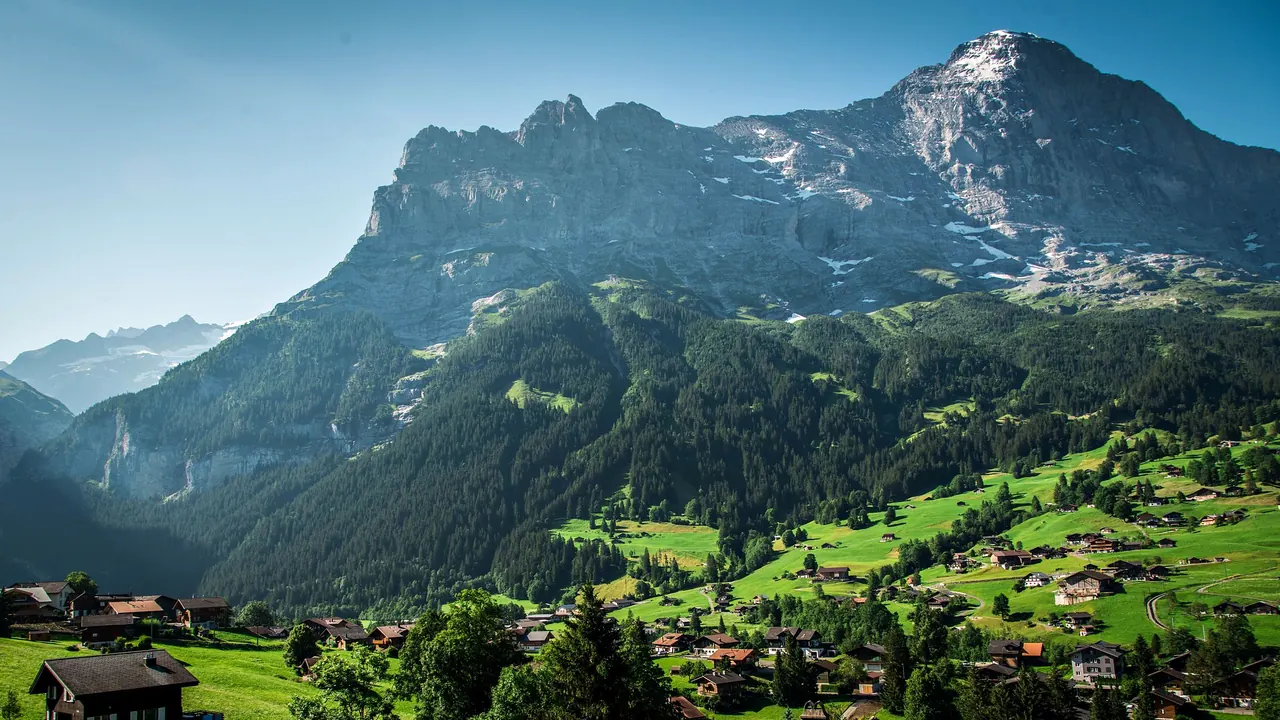
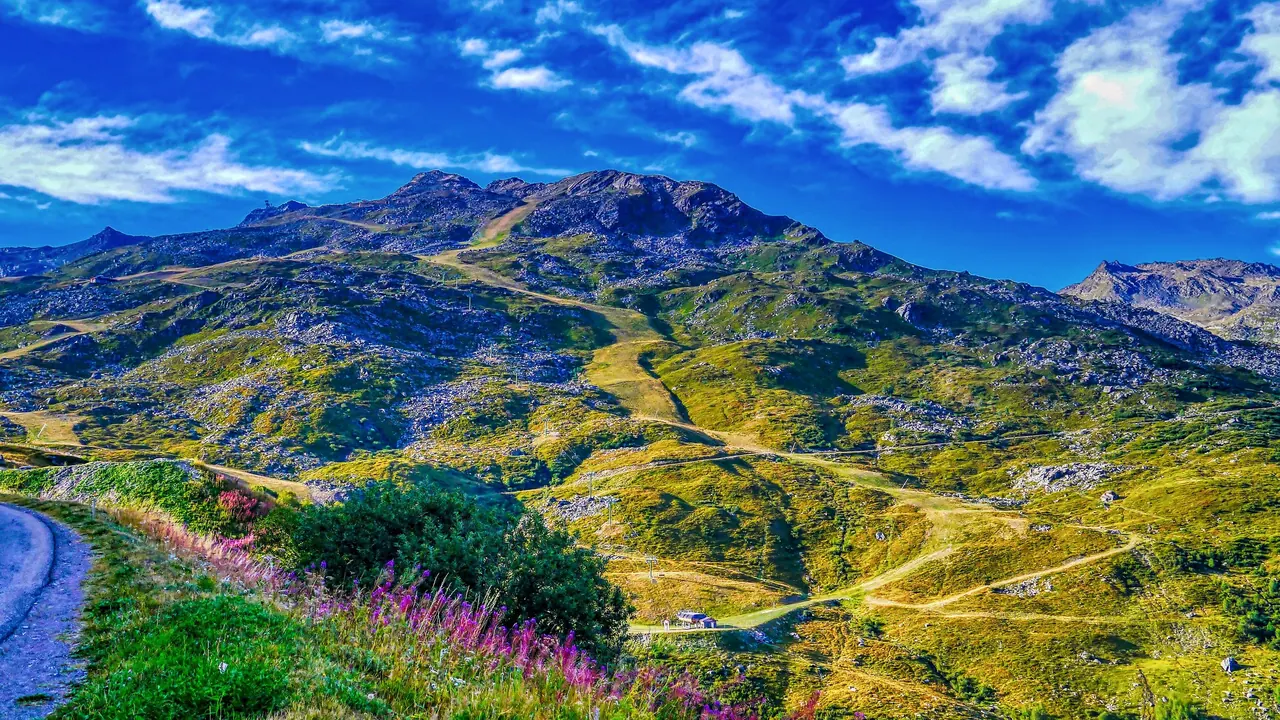
Photos: Grindelwald by Christopher Becke, Pexels License; Val Thorens by Zairon, CC BY-SA 4.0, cropped.
Grindelwald or Val Thorens?
Our verdict in twelve categories, each scored against the same fixed benchmark cities, and the climate month by month, so you can choose for your trip.
Choose Grindelwald for
- day trips
- families
- beaches
Grindelwald suits travellers who want the high Alps right outside the window in summer as much as in winter. The Eiger north face rises above the village, gondolas run up to First and Männlichen, and the railway climbs to the Jungfraujoch. It is the calmer, more family-minded choice, and the train down to Interlaken puts the lakes, the cliff villages of Wengen and Mürren, and Bern within easy reach without a car.
Choose Val Thorens for
- nightlife
- food and drink
- prices
Val Thorens is built for a winter ski week, ideally with a group of friends. Its height keeps the snow reliable from late November into May, the Three Valleys open up a huge linked ski area, and its après-ski and clubs give the evenings far more energy than anything in the Bernese Oberland. It suits summer visitors, small children and anyone who wants to explore the wider region much less well.
Scoreboard
Twelve categories on one fixed scale from 0 to 100. The shaded stretch is the gap between the two.
Your match
Pick a travel style or drag the sliders, and both match scores follow your weighting.
Wins on day trips and families with your weighting.
Wins on nightlife and food and drink with your weighting.
What matters to you?
Category by category
What the scores mean for a trip.
Beaches & swimming
Neither is a swimming destination, but Grindelwald at least gives you a real summer option. Lake Thun warms to around 20°C in a good summer, and turquoise Lake Brienz is bracing, both with lawns and bathing spots within an hour by train and bus.
Val Thorens has nothing comparable. Its glacier-fed lakes are far too cold even in summer, and swimming means an indoor pool at the sports centre or your hotel.
Food & drink
Both kitchens run on melted cheese, Swiss rösti and Älplermagronen in Grindelwald, Savoyard tartiflette, diots and Beaufort in Val Thorens. In Grindelwald the setting does most of the work: a terrace lunch facing the Eiger or cheese from a summer dairy, with hotel dining rooms and a few pizza and Asian kitchens otherwise.
Val Thorens comes out ahead because a handful of upmarket hotels run serious gastronomic kitchens, and long slope-side lunches are part of the ski day. The catch is that much of the village closes outside winter and its brief summer window.
Culture & sights
Neither offers much here, and in both the mountains are the only real monument. Grindelwald has a little more texture: a small museum on farming, early tourism and the Eiger climbers, a whitewashed Reformed church and old chalets with painted gables. Val Thorens is a purpose-built 1970s ski station with no old buildings at all, so any Savoyard heritage means going down to the valley.
Nightlife
This is where Val Thorens pulls well ahead. Après-ski starts on the mountain terraces as the lifts close, moves into the village pubs, and finishes in clubs that run into the early hours, among them an underground one well known to skiers. The crowd is young and many come in groups.
Grindelwald goes to bed early. A few après-ski and hotel bars fill up in winter, but summer hikers turn in before sunrise starts. Outside the ski season Val Thorens goes almost as quiet, so the gap only really exists in winter.
Nature & outdoors
Both put you among big mountains, but Grindelwald gives you more of them for more of the year. The Eiger, Wetterhorn and Schreckhorn rise straight above the village, the Panoramaweg runs beneath the Eiger, Mönch and Jungfrau, and the rack railway reaches the Aletsch Glacier, with the Glacier Canyon just below the houses.
Val Thorens is the purer ski proposition: Europe's highest resort, reliable snow and a vast linked area across Méribel and Courchevel. Its treeless rock-and-glacier landscape is starker, though, and its short summer brings marmots, ibex and the edge of the Vanoise rather than Grindelwald's wealth of trails.
Day trips
Grindelwald is far better placed for days out, since every trip starts with a train to Interlaken. From there come Wengen and Mürren above the Lauterbrunnen valley, the castles at Thun and Spiez, Ballenberg's rural houses near Brienz, lake steamers, and Bern's arcaded old town about an hour and a half away.
From Val Thorens most outings are Méribel and Courchevel on skis. The hairpin road leads to modest Moûtiers and medieval Conflans, while Annecy and Chambéry are about two hours' drive, a long day.
Good for families
Grindelwald suits families better, especially in summer. Scooter-bikes and mountain carts at First, the Pfingstegg toboggan run, playgrounds at the mid-stations and short themed walks keep children busy, and the village is calm, with farm animals everywhere and gondolas that take pushchairs.
Val Thorens works for families who ski, with a car-free centre, children's clubs and beginner slopes close to the apartments. The altitude counts against it, though: cold, wind, lift closures and poor sleep for small children, plus a party crowd that sets the tone.
Getting around
Grindelwald is easier from door to mountain. Trains arrive in the middle of the village, timetables connect with the gondolas and the line to Kleine Scheidegg, and the wider region is all on rails. Its weak point is the long, sloping village, where some hotels mean a steep walk or a local bus.
Val Thorens is compact, largely car-free and often ski-in, ski-out, with free shuttles looping the village. Reaching it is the effort, about an hour up hairpins from the station at Moûtiers, and there is little public transport for exploring beyond.
Shopping & style
Both are shopping dead ends where the main purchases are walking poles, ski hire and a warmer layer. What differs is the souvenir: Grindelwald's main street adds Swiss watches, army knives, chocolate and cowbells, while Val Thorens offers delicatessens with Savoyard cheese and charcuterie to take home.
Affordability
Grindelwald is the steeper bill of the two. Swiss resort prices for rooms and meals come on top of the cost of moving around, because gondolas, lift passes and above all the railway to the Jungfraujoch are central to any stay. Regional and Swiss travel passes, apartments and supermarket picnics soften it, but only so far.
Val Thorens is expensive too, yet a group sharing a self-catering apartment and cooking for itself can bring a ski week down a long way, and the resort is less exclusive than its smartest Three Valleys neighbours. Avoid the school vacation weeks, which are the dearest of its season.
Live music & performing arts
Live music in Grindelwald is folk: in summer the village programme may bring yodelling choirs, alphorn players and brass bands, or a folk evening at a hotel. Those are pleasant to come across, but they are not a reason to book.
In Val Thorens it means cover bands and DJs in the après-ski bars, plus the odd on-slope event in winter. There is no theatre or concert hall in either place, and for a play or a classical evening Grindelwald at least has the larger towns down the valley.
Wellness & relaxation
Grindelwald edges ahead mainly because of its pace. Hotel spas with windows facing the Eiger, a public pool and sauna, cowbells and quiet balcony evenings make it a restful place, especially out of season.
Val Thorens has comparable hotel and sports-centre spas, and it can reach a real thermal tradition at Brides-les-Bains about an hour away, which Grindelwald lacks. The resort itself is geared to hard skiing and late nights, so calm comes from a hotel spa rather than from the place.
When should you go?
Pick your month. The climate figures are measured averages, not a forecast.
Grindelwald in July
Val Thorens in July
Daytime high, °C
Rainfall in the month, mm
Where the figures come from
Grindelwald has no weather station within reach, so its figures come from a gridded climate model rather than a measured record, and read a broad area rather than one spot.
Val Thorens has no weather station within reach, so its figures come from a gridded climate model rather than a measured record, and read a broad area rather than one spot.
Temperature and rainfall are climate normals, averaged over the years shown. Grindelwald: 1991-2020 normals, TerraClimate 4 km grid at the town, no weather station within 90 km. Val Thorens: 1991-2020 normals, TerraClimate 4 km grid at the town, no weather station within 90 km.
Grindelwald is two destinations in one year. From June to September the high trails are clear of snow and July days reach about 17°C, which is pleasant for walking rather than warm. Those summer months are also the wettest, at around 119mm, so expect cloud to hide the peaks on some days. From December to February daytime highs hover around freezing, which is the season for skiing and sledging.
Val Thorens is colder all year and lives mainly in winter. January highs sit near -3°C, and the heaviest precipitation comes in late autumn and early winter, with November at about 180mm, which builds the snow for a season running into May. Summer is short, and even August only reaches about 16°C at this altitude. Neither place has a beach season.
Which traveller are you?
For an outdoors trip, Grindelwald is the stronger pick. Hundreds of kilometres of marked summer trails, the Bachalpsee, via ferratas and paragliding sit alongside winter skiing, while Val Thorens offers bare high ground with a short summer and a mostly skiing focus.
On a food and nightlife trip, Val Thorens wins clearly. Afternoon dancing on mountain terraces leads into village bars and clubs open into the early hours, and a few ambitious hotel kitchens raise the food above Grindelwald's hearty but narrow menus.
On a family trip with children, Grindelwald is easier. Mountain carts and the cliff walk at First, the Pfingstegg toboggan run and gentle themed walks fill summer days, and the village stays calm, whereas Val Thorens brings biting cold, altitude and a party crowd.
Before you go
| Measure | Grindelwald | Val Thorens |
|---|---|---|
| Official language | French, German, Italian, Romansh | French |
| Currency | Swiss Franc (CHF) | Euro (EUR) |
| Sockets | CJ230 V, 50 Hz | CE230 V, 50 Hz |
| Driving side | Right | Right |
| Time zone | UTC+1, UTC+2 in summer | UTC+1, UTC+2 in summer |
| Emergency number | 112 | 112 |
| Elevation | 1,034 m | 1,710 m |
| Main airport | Zürich Airport (ZRH)100 km from centre226 non-stop destinations | Geneva International Airport (GVA)111 km from centre150 non-stop destinations |
| Public holidays this year | 10 days | 11 days |
By the numbers
| Measure | Grindelwald | Val Thorens |
|---|---|---|
| Population | 3,942 | - |
| People per km² | 23 | - |
| Museums within 10 km | 0 | 0 |
| UNESCO World Heritage sites within 50 km | 2 | 1 |
Where else could you go?
Every comparison below shares a destination with this one, so you can follow Grindelwald or Val Thorens somewhere new.
- Les Menuiresvs Val Thorens
- Wengenvs Grindelwald
- Méribelvs Val Thorens
- Mürrenvs Grindelwald
- Courchevelvs Val Thorens
- Interlakenvs Grindelwald