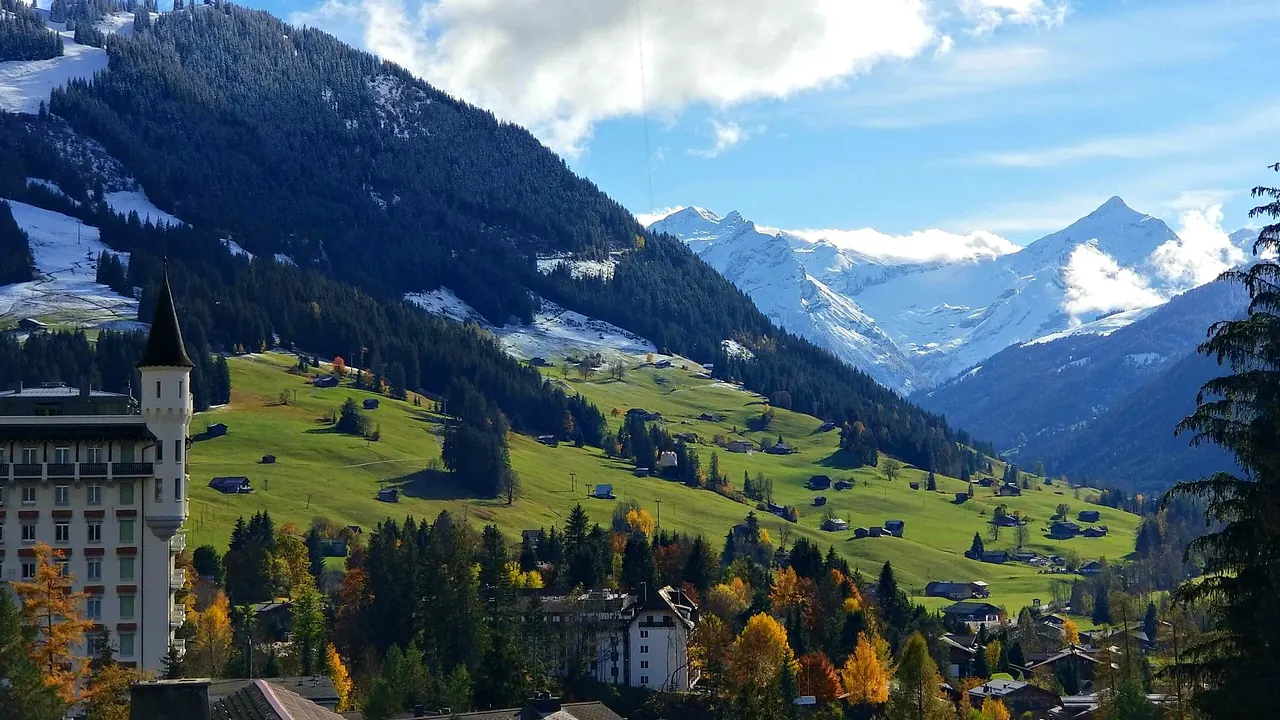
Photos: Gstaad by Samuel Barlow, CC BY-SA 4.0, cropped.
Gstaad or Verbier?
Our verdict in twelve categories, each scored against the same fixed benchmark cities, and the climate month by month, so you can choose for your trip.
Choose Gstaad for
- shopping
- getting around
- live music and the arts
Gstaad suits travellers who want the mountains as a backdrop to a comfortable, unhurried stay. Its slopes and valleys are gentle, its small car-free centre is easy on foot, and its grand-hotel spas, Promenade boutiques and summer festival concerts give the days a polished, quiet rhythm. Couples, families with small children and anyone planning a trip around classical music will feel at home.
Choose Verbier for
- nightlife
- nature and the outdoors
- day trips
Choose Verbier if the mountain itself is the point. The 4 Vallées and the freeride slopes off Mont Fort draw strong skiers from around the world, summer brings high trails and a bike park, and after dark the bars around the Place Centrale are far livelier than anything in the Saanenland. It is the better pick for a group of confident skiers who want hard days and late nights, and less suited to anyone who wants to walk everywhere.
Scoreboard
Twelve categories on one fixed scale from 0 to 100. The shaded stretch is the gap between the two.
Your match
Pick a travel style or drag the sliders, and both match scores follow your weighting.
Too close to call, 2 points apart
Wins on shopping and getting around with your weighting.
Wins on nightlife and nature and the outdoors with your weighting.
What matters to you?
Category by category
What the scores mean for a trip.
Beaches & swimming
Neither is a swimming destination, but Gstaad gives a little more. Lauenensee and Arnensee have grassy banks for a quick, cold dip on a hot afternoon, and the heated outdoor pool in the valley makes a summer swim easy.
Verbier sits higher. Its lakes, such as Lac des Vaux, are for looking at rather than bathing, and summer swimming usually means the indoor pool at the sports centre. From either resort, the nearest open water is Lake Geneva, which takes a good part of the day to get to and back.
Food & drink
Both eat well in the same alpine style, with rösti and cheese dishes on sunny hut terraces and expensive dining rooms in the village. Both are also short of casual or cheap meals, especially out of season. The difference is in what each valley makes.
Gstaad is about cheese: thin curls of long-aged Saanen Hobelkäse and fire-made L'Etivaz, bought straight from cellars in the valley, with the serious cooking found in the grand hotels. Verbier is the place for a proper raclette made from Val de Bagnes cheese, and with the Valais vineyards just below, a glass of Petite Arvine or Cornalin comes with most meals.
Culture & sights
Neither is a sightseeing destination, and you will not fill a day with museums in either. Gstaad's interest is in the village itself: the carved and painted timber chalets of the Saanenland and the medieval wall paintings in Saanen's late-Gothic church make good stops on a walk.
Verbier is a twentieth-century ski resort with little old building of its own. What history there is lies down in Le Châble, with its stone church, small museum of Bagnes life and old granaries along the valley.
Nightlife
In winter, Verbier is the place to go out. Après-ski moves from the terraces at the lift stations to packed bars around the Place Centrale and on to late clubs, with young seasonal workers and wealthy guests in the same rooms.
Gstaad's evenings are smaller and more private: hotel bars, a couple of exclusive cellar clubs in the grand hotels and chalet parties in the peak weeks. Out of season both go quiet, but Verbier keeps a few bars open, while in Gstaad the evening usually ends by the fire after dinner.
Nature & outdoors
Gstaad's mountains are soft and pastoral. Its skiing is spread over several separate hills around the Saanenland, among them Wispile, Eggli and the slopes above Saanenmöser. Most runs are gentle and low enough that a lean early winter can leave them short of snow, and then Glacier 3000, half an hour away, becomes the fallback. Summer may suit Gstaad better, with easy walks to Lauenensee and the Geltental waterfalls, rafting on the Saane and paragliding above farmland.
Verbier is the more serious mountain destination. It starts higher and its top lifts climb above 3,000m, so its snow is more reliable, and its steep freeride and touring terrain facing the Grand Combin is what draws strong skiers. Its summers are high-alpine rather than green, with paths past small lakes below the glaciers, and the Haute Route between Chamonix and Zermatt passes close by.
Day trips
Both have more to explore nearby than their size suggests, and both can reach Montreux, Chillon and the Lavaux terraces. The difference is in how you travel and where you can go.
From Gstaad, the scenic GoldenPass railway takes you down to Lake Geneva in one direction and to Lake Thun and Bern's arcaded old town in the other, and Gruyères is under an hour by car. Verbier's outings cross borders: Roman Martigny, Sion's castles and the abbey at Saint-Maurice are close, and further afield lie the Great St Bernard pass, Aosta in Italy and Chamonix, trips that are far easier by car.
Good for families
Gstaad is the easier choice with young children. Its gentle home slopes and ski schools suit beginners, and sledge runs, sleigh rides and walks past grazing cows and goats fill the rest of the day in a small, quiet village.
Verbier runs good snow gardens, and La Tzoumaz and Savoleyres have softer slopes, but the village is steep and spread out and built around difficult skiing and après-ski. Neither has a zoo, an aquarium or an attraction for a rainy day.
Getting around
Gstaad is simpler to get around. Its centre is a short car-free promenade, GoldenPass trains stop at Saanen, Schönried and Saanenmöser where lifts start, and PostBuses run up to Lauenen and the Glacier 3000 cable car, though services thin out in the quiet months.
Verbier is easy to reach by train and gondola from Le Châble, but its chalets are scattered across a steep hillside. Many guests rely on shuttles or taxis rather than walking uphill on icy roads in ski boots.
Shopping & style
Gstaad is clearly the better place to shop, as long as it is luxury shopping you want. Its chalet-lined Promenade packs in watchmakers, jewellers, fashion labels, cashmere and interior design, along with local papercuts and carved wood.
Verbier's shops are mostly about the mountains, with technical outdoor brands, ski hire and a few boutiques for chalet owners. It is a good place to buy touring gear, but for serious browsing you have to go to Lausanne or Geneva.
Affordability
There is no cheap option here: both are among the most expensive resorts in the Alps, with hotels, chalets, lift passes and meals all at the top of Swiss prices. The way to save is the same in both: stay lower down the valley, in Saanen or Zweisimmen for Gstaad and in Le Châble for Verbier, and avoid the winter peak. In Verbier, self-catering is another way to bring the cost down.
Live music & performing arts
Both are known for classical music in summer, and Gstaad offers more. The Menuhin Festival runs for several weeks, with concerts in a large tent and in the old churches of Saanen, Rougemont and Lauenen, and winter adds chamber music and New Year concerts.
The Verbier Festival is shorter, a couple of weeks of leading soloists in the festival hall, with the bonus of public masterclasses from its academy. Outside these festivals, neither village has a regular programme of performances.
Wellness & relaxation
For calm and comfort, Gstaad has the edge. It has an unusual number of large hotel spas for its size, with pools and saunas looking out on the mountains, and the village is quiet and dark at night.
Verbier's spas are mostly in hotels and luxury chalets, plus a public wellness area at the sports centre, and the peak winter weeks are loud rather than restful. What it does offer is the Rhône valley's thermal baths at Saillon and Lavey-les-Bains, each within about an hour, for anyone who wants to soak in warm spring water.
When should you go?
Pick your month. The climate figures are measured averages, not a forecast.
Gstaad in July
Verbier in July
Daytime high, °C
Rainfall in the month, mm
Where the figures come from
Gstaad's temperatures are measured 78 km from the centre, at Les Eplatures.
Gstaad has no rain gauge within 25 km of the centre, so its rainfall comes from a gridded climate dataset read at the destination rather than from a gauge further away.
Verbier has no weather station within reach, so its figures come from a gridded climate model rather than a measured record, and read a broad area rather than one spot.
Temperature and rainfall are climate normals, averaged over the years shown. Gstaad: 2010-2020 (rainfall 1991-2020) normals, Les Eplatures (77.5 km from centre). Verbier: 1991-2020 normals, TerraClimate 4 km grid at the town, no weather station within 90 km.
Gstaad sits lower and is the milder of the two all year. Its summer days reach about 21°C in July and August, which is pleasant for walking and the odd chilly lake dip. Verbier's warmest months are a few degrees cooler and feel fresher still on the high trails. Neither is ever warm enough for a beach trip. In winter Verbier's daytime highs stay around freezing for weeks, which helps its snow. Gstaad stays a little above freezing, which is pleasant on the village streets but can mean thin cover on its lower slopes early in the season.
Both are wet. Gstaad's rain is spread fairly evenly, heaviest in December and through the summer, with May to August each over 100mm. Verbier is wettest from November to January, up to 145mm in December, and noticeably drier from July to September, so late summer is its most dependable time for hiking.
Which traveller are you?
For a food and nightlife trip, Verbier is the stronger choice. Both eat equally well: Verbier has raclette and Valais wine, Gstaad has aged cheese and gourmet hotel cooking. But Verbier's après-ski bars and late clubs keep a winter evening going far longer.
On an outdoors trip, Verbier wins for anyone who skis or hikes hard. The 4 Vallées, the freeride slopes off Mont Fort and the high summer trails outclass Gstaad's gentler pastures, though Gstaad suits walkers who prefer green valleys to glaciers.
On a relaxing and wellness trip, Gstaad is the better fit. Its many grand-hotel spas, quiet car-free centre and still nights set an unhurried pace, while Verbier's peak weeks are loud and its calm depends on visiting outside the busy season.
Before you go
| Measure | Gstaad | Verbier |
|---|---|---|
| Official language | French, German, Italian, Romansh | French, German, Italian, Romansh |
| Currency | Swiss Franc (CHF) | Swiss Franc (CHF) |
| Sockets | CJ230 V, 50 Hz | CJ230 V, 50 Hz |
| Driving side | Right | Right |
| Time zone | UTC+1, UTC+2 in summer | UTC+1, UTC+2 in summer |
| Emergency number | 112 | 112 |
| Elevation | 1,050 m | 1,490 m |
| Main airport | Geneva International Airport (GVA)94 km from centre150 non-stop destinations | Geneva International Airport (GVA)88 km from centre150 non-stop destinations |
| Public holidays this year | 10 days | 9 days |
By the numbers
| Measure | Gstaad | Verbier |
|---|---|---|
| Population | 2,960 | - |
| Museums within 10 km | 0 | 4 |
| UNESCO World Heritage sites within 50 km | 4 | 0 |
Where else could you go?
Every comparison below shares a destination with this one, so you can follow Gstaad or Verbier somewhere new.
- Adelbodenvs Gstaad
- Crans-Montanavs Gstaad
- Leukerbadvs Gstaad
- Crans-Montanavs Verbier
- Chamonixvs Verbier
- Châtelvs Verbier