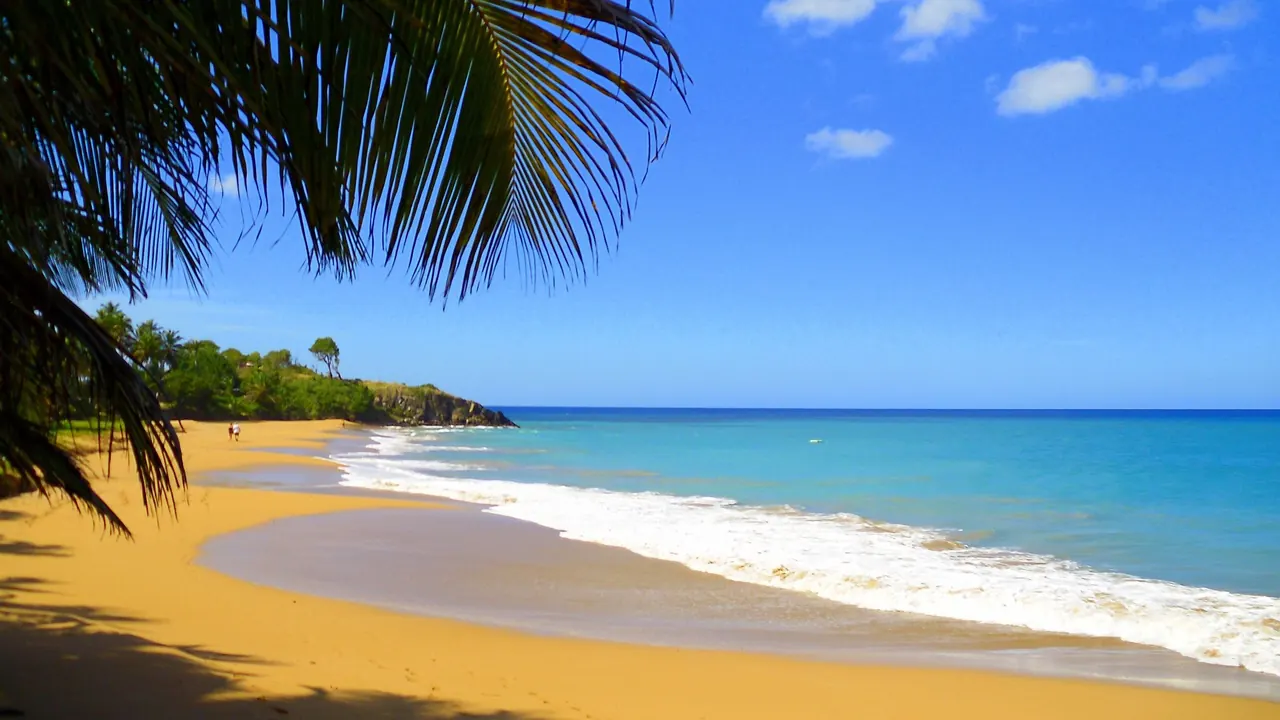
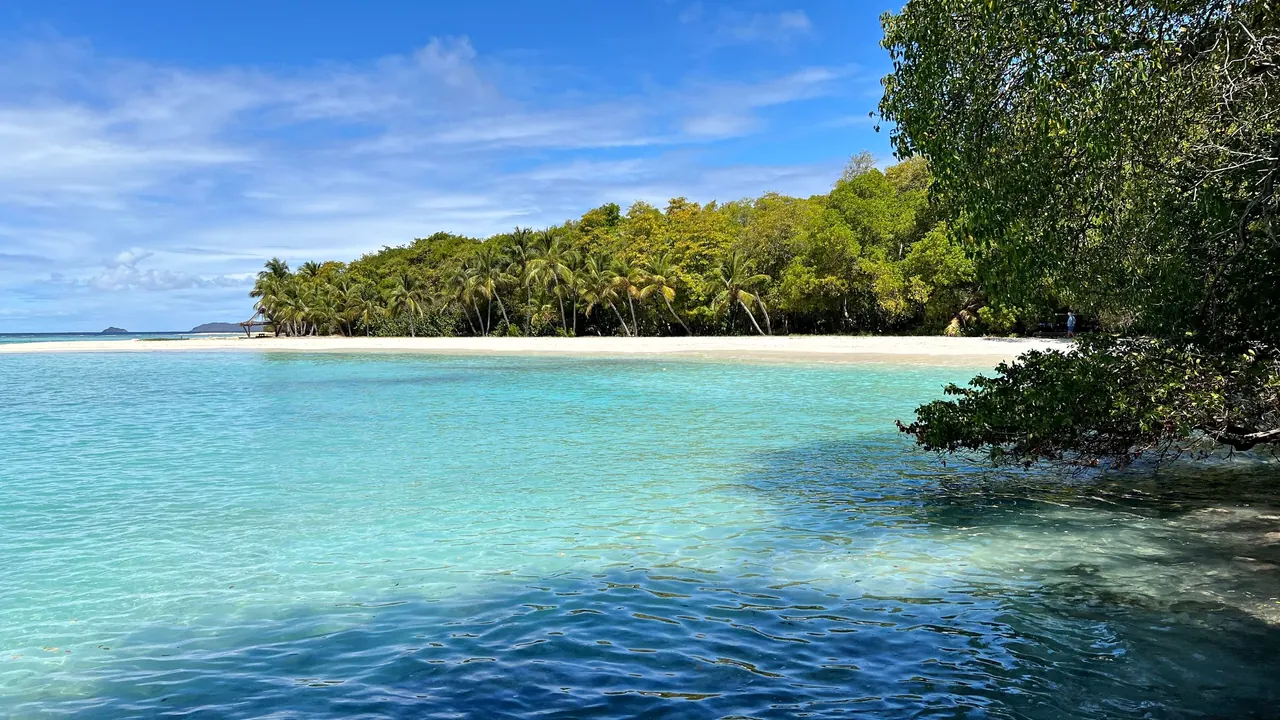
Photos: Guadeloupe by ROLLAND POMARET, CC BY 2.0, cropped; Mustique by Alecstatic, CC BY-SA 4.0, cropped.
Guadeloupe or Mustique?
Our verdict in twelve categories, each scored against the same fixed benchmark cities, and the climate month by month, so you can choose for your trip.
Choose Guadeloupe for
- culture and sights
- nature and the outdoors
- prices
Guadeloupe suits travellers who want a big island to explore by car. You can climb a steaming volcano in the morning and eat colombo at a beach shack in the evening. The rainforest of Basse-Terre, the reef lagoons of Grande-Terre and the ferry islands of Les Saintes and Marie-Galante give a fortnight real variety. Creole food, rum distilleries, gwoka drumming and carnival add a culture you can join in. It is also far easier on the budget, with villas and guesthouses to suit families and groups.
Choose Mustique for
- getting around
- beaches
Mustique is for the traveller whose idea of a perfect week is an empty cove, a villa with staff and nothing on the calendar. It is tiny, private and very expensive. There is little to see, buy or do at night, and you should expect that going in. What you get is pale sand with nobody on it, a buggy ride from your terrace, and a level of seclusion Guadeloupe's busier south coast cannot offer.
Scoreboard
Twelve categories on one fixed scale from 0 to 100. The shaded stretch is the gap between the two.
Your match
Pick a travel style or drag the sliders, and both match scores follow your weighting.
Wins on culture and sights and nature and the outdoors with your weighting.
Wins on getting around and beaches with your weighting.
What matters to you?
Category by category
What the scores mean for a trip.
Beaches & swimming
Both islands have superb beaches, but Mustique's are emptier and more uniformly beautiful. Its small bays nearly all have pale sand and clear water and stay quiet even in the busiest months. Calm swimming is on the western bays, and Macaroni Beach on the Atlantic side suits confident swimmers.
Guadeloupe offers more variety rather than more perfection. You get white-sand lagoons from Le Gosier to Saint-François, darker and wilder Basse-Terre beaches such as Grande Anse, and snorkelling off Malendure. Sargassum can wash onto some shores in some months, but the island is big enough to switch to another coast, which tiny Mustique cannot match.
Food & drink
Guadeloupe is the place to eat. Its Creole kitchen runs from accras and colombo curries to court-bouillon of fish, and you can eat it at roadside bokit vans, beachside lolos and the covered markets of Pointe-à-Pitre. Agricultural rum, above all from Marie-Galante's distilleries, gives you tastings to plan whole days around.
On Mustique the eating is mostly private. A villa cook grills lobster and fish on the terrace, and beyond that there are two hotel dining rooms, the jetty bar and a deli. It is fresh and well made, but there is no street food or market to explore.
Culture & sights
Guadeloupe has a real layer of history, even if it is spread out. The Mémorial ACTe in Pointe-à-Pitre is a serious museum of slavery and the Caribbean. There are also the forts above Basse-Terre town and on Terre-de-Haut, Amerindian rock carvings at Trois-Rivières and the windmills of Marie-Galante.
Mustique has almost nothing to visit. A former cotton warehouse, the fishing hamlet at Lovell and the wreck of the Antilles off the north coast are about all there is, and the villas that give the island its character are mostly private.
Nightlife
Neither island is built for going out, but Guadeloupe gives you more to choose from. Le Gosier has bars, a casino and weekend clubs playing zouk and dancehall, and the waterfronts at Sainte-Anne and Saint-François stay lively until around midnight. Carnival keeps the whole island up late from January to Ash Wednesday.
Mustique's evenings centre on a single bar on stilts at Britannia Bay and its weekly jump-up night. The winter villa parties need an invitation.
Nature & outdoors
Guadeloupe's landscape is on another scale. Basse-Terre is volcanic rainforest, most of it national park, with the climb up La Soufrière, the Carbet falls and the Route de la Traversée under giant trees. Add the Cousteau Reserve's turtles, mangroves to kayak in the Grand Cul-de-Sac Marin and the windswept Pointe des Châteaux.
Mustique is gentle by comparison: low dry hills, a salt pond, reefs close to shore, horse riding on the beaches and kitesurfing on the windward side. Its finest natural outing actually lies off the island, a chartered boat day to the turtle grounds of the Tobago Cays.
Day trips
Guadeloupe has easy ferry outings. You can spend a day in the painted village and bays of Terre-de-Haut, an unhurried night among Marie-Galante's cane fields and distilleries, or take a longer crossing to Dominica. On the main island, Deshaies and Sainte-Anne each fill an afternoon.
From Mustique every outing means a boat, usually a private charter. Bequia's harbour at Port Elizabeth is the best of a short list that also includes Mayreau, Canouan and Kingstown on St Vincent.
Good for families
Guadeloupe works better for most families. Its knee-deep lagoons at places such as Sainte-Anne suit small children, and there are easy outings to the aquarium, the forest zoo and the Deshaies botanical garden. Older children get snorkelling at Malendure and boat trips to Les Saintes, and French healthcare is reassuring.
Mustique offers something different: a safe, quiet island where older children can roam freely, with villa pools, pony rides and tennis. Nothing there is made for children, though, and teenagers soon run out of things to do.
Getting around
Once you have arrived, Mustique is far simpler. The island is about 5km long, and you drive yourself between villa, beach and bar in an open buggy on a few quiet roads. Getting there by small plane or an infrequent ferry is the hard part.
Guadeloupe is easy to reach but needs a hire car for almost everything, because the buses are of little use to a visitor. Traffic around Pointe-à-Pitre and the bridges between the two wings can be slow, so many visitors pick one side as a base.
Shopping & style
Neither island is a shopping destination, but Guadeloupe at least has souvenirs worth seeking out: vanilla, spices, punches and madras cloth at the Pointe-à-Pitre spice market, and rum bought at the distilleries. Mustique has a few resort-wear boutiques near Britannia Bay and a general store, so bring what you need.
Affordability
Guadeloupe is not cheap, with prices at or above mainland France and a hire car on top. Still, apartments, villas shared with a kitchen and food from lolos and bokit vans let you keep a stay reasonable.
Mustique is in another bracket entirely and is among the costliest places anywhere to spend a vacation. You stay in a staffed villa let by the week or one of two luxury hotels, almost everything is imported, and small planes and boat charters add a lot to the bill.
Live music & performing arts
Guadeloupe's music is a living tradition you can join in. There are gwoka drumming at léwòz evenings, zouk everywhere, weeks of carnival drums and conch shells, and L'Artchipel in Basse-Terre town for theatre and concerts. Marie-Galante adds the Terre de Blues festival around Pentecost.
On Mustique live music comes down to the jump-up band at the beach bar and steel pan players at hotel dinners in winter, with no stage of any kind.
Wellness & relaxation
Both islands are good for slowing down, but they offer different things. Guadeloupe has the warmth of its volcano: forest pools at the Bains Jaunes, hot water among the shoreline rocks near Bouillante and a small thermal spa at Ravine Chaude. Its quietest corners are Deshaies, Les Saintes and Marie-Galante.
Mustique has no springs or bathing tradition. What it offers is near-total privacy and silence, with massage or yoga arranged on your villa terrace and a hotel spa in a garden.
When should you go?
Pick your month. The climate figures are measured averages, not a forecast.
Guadeloupe in July
Mustique in July
Daytime high, °C
Rainfall in the month, mm
Where the figures come from
Mustique has no weather station within reach, so its figures come from a gridded climate model rather than a measured record, and read a broad area rather than one spot.
Temperature and rainfall are climate normals, averaged over the years shown. Guadeloupe: 1991-2020 normals, Le Raizet, Guadeloupe (7.3 km from centre). Mustique: 2001-2020 normals, NASA POWER reanalysis grid, no weather station within 90 km.
Both islands are warm all year, and the sea is pleasant for swimming in every month, at around 26°C to 29°C. The real difference is the rain. Guadeloupe's figures are for the island as a whole, and rain varies a lot across it: the rainforest highlands of Basse-Terre are far wetter than the flatter, drier coasts of Grande-Terre. In the figures given, February and March are the driest months and sunshine holds strong through spring. Showers build from May and are heaviest from September to November, with October the wettest, though there is still plenty of sun between downpours. Late-summer days reach 32°C, which makes midday walks in Pointe-à-Pitre tiring.
Mustique runs about 2 to 3°C cooler than Guadeloupe through most of the year, so the midday heat is easier to live with, and its temperatures barely change from month to month. Its wet season is longer and heavier, though. June is already wet, and from July to November the rain often runs well over 200mm a month. That makes the dry spell from about February to April clearly the best time for its beaches, while Guadeloupe copes better with an early-summer visit.
Which traveller are you?
For a beach and sun trip, Mustique has the edge. Nearly every bay has pale sand and clear water and stays close to empty, so you can have a cove to yourself, with calm swimming on the west coast at Britannia and Endeavour bays.
On an outdoors trip, choose Guadeloupe. Basse-Terre's national park offers the climb up La Soufrière, rainforest trails to the Carbet falls and diving in the Cousteau Reserve. Mustique's gentle hills, horse rides and a boat day to the Tobago Cays are pleasant but much more limited.
On a trip with a tight budget, Guadeloupe is the only realistic choice of the two. Its prices are high by Caribbean standards, but bokit vans, lolos, market food and self-catering apartments keep costs in hand. On Mustique the only choices are villas with staff or luxury hotels, and almost everything is imported.
Before you go
| Measure | Guadeloupe | Mustique |
|---|---|---|
| Official language | - | English |
| Currency | Euro (EUR) | East Caribbean Dollar (XCD) |
| Sockets | CE230 V, 50 Hz | ACEGIK230 V, 50 Hz |
| Driving side | Right | Left |
| Time zone | UTC-4 | UTC-4 |
| Emergency number | 112 | Police 911/999, fire 911/999 |
| Main airport | Maryse Condé International Airport (PTP)19 non-stop destinations | Mustique Airport (MQS)4 non-stop destinations |
| Public holidays this year | 12 days | 12 days |
By the numbers
| Measure | Guadeloupe | Mustique |
|---|---|---|
| Population | 384,160 | 500 |
| People per km² | 236 | 88 |
| Swim season, months above 21 °C | 12 months | 12 months |
Where else could you go?
Every comparison below shares a destination with this one, so you can follow Guadeloupe or Mustique somewhere new.
- Bequiavs Mustique
- Roseauvs Guadeloupe
- Martiniquevs Mustique
- Martiniquevs Guadeloupe
- Tobagovs Mustique
- St Bartsvs Guadeloupe