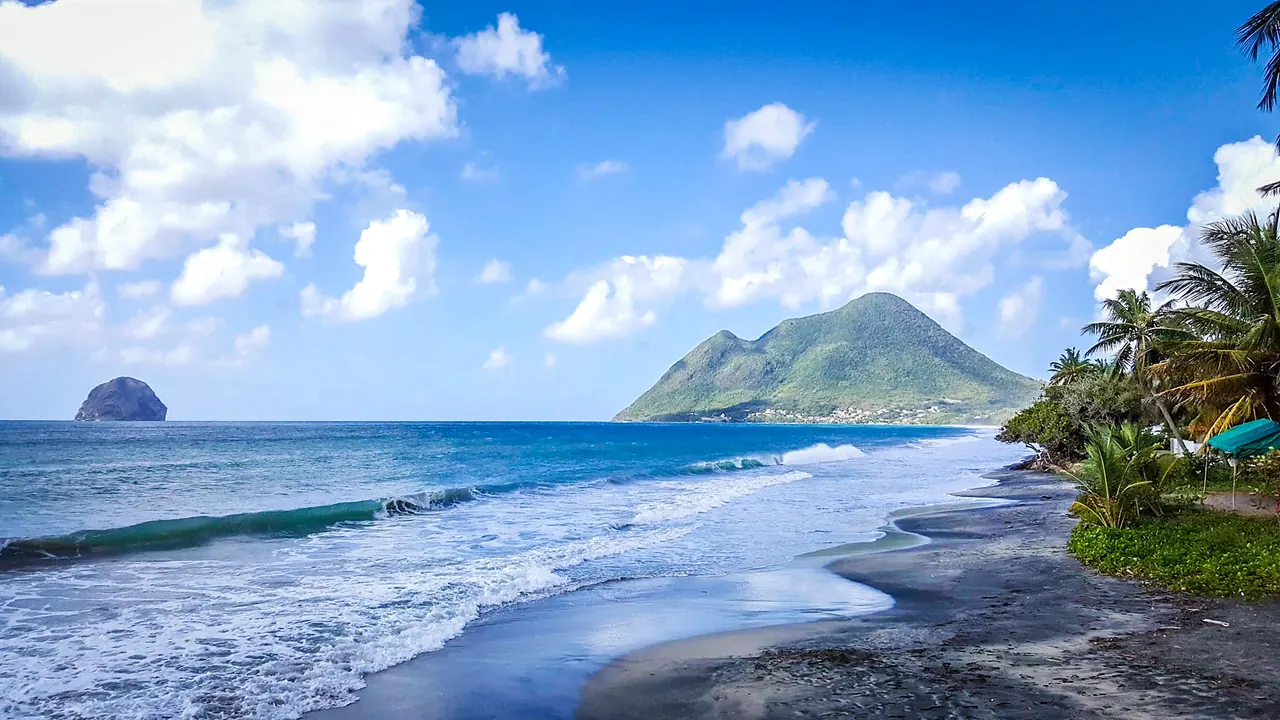
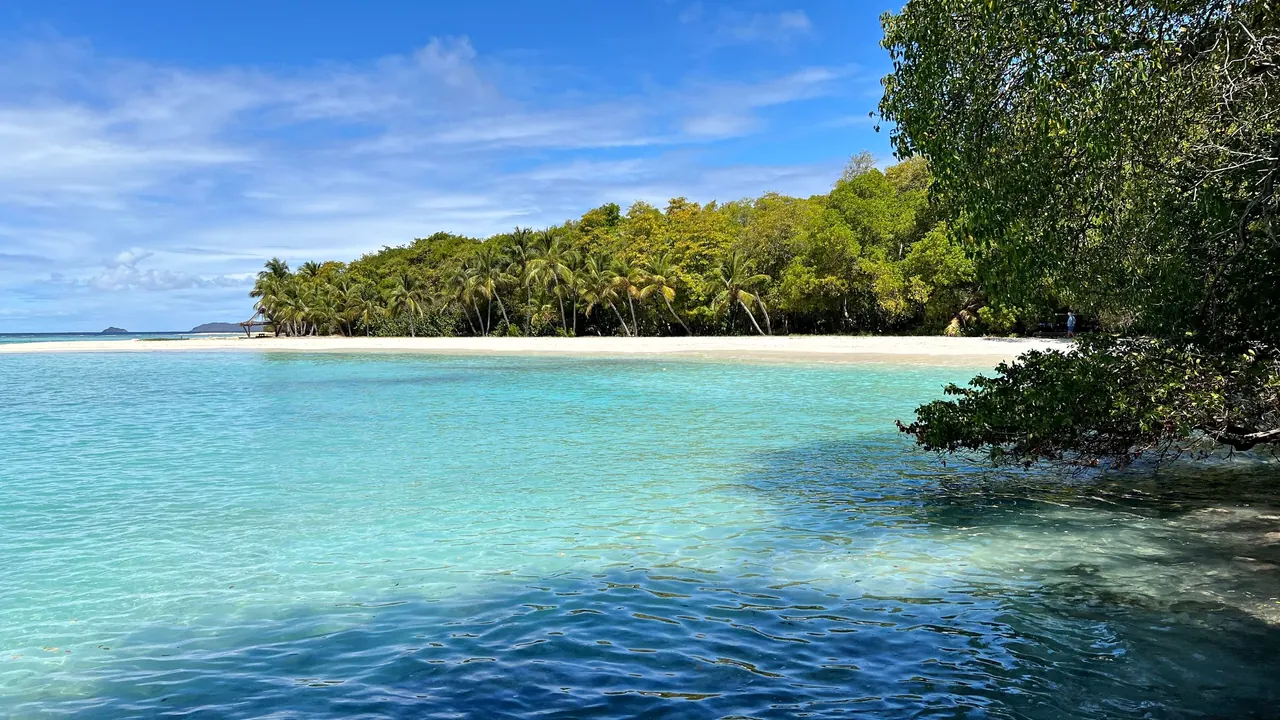
Photos: Martinique by G21designz, CC BY-SA 4.0, cropped; Mustique by Alecstatic, CC BY-SA 4.0, cropped.
Martinique or Mustique?
Our verdict in twelve categories, each scored against the same fixed benchmark cities, and the climate month by month, so you can choose for your trip.
Choose Martinique for
- culture and sights
- food and drink
- nature and the outdoors
Martinique suits travellers who want a large island to explore as well as a beach to lie on. You can climb Mount Pelée in the morning cloud, wander the ruins of Saint-Pierre, taste rhum agricole at old cane estates and eat Creole food at roadside stalls. You will need a hire car and some patience in traffic. It is not cheap, but self-catering and market shopping keep it within reach of a normal budget.
Choose Mustique for
- getting around
- wellness
- beaches
Mustique is for a different kind of trip altogether. It is a small, private island where almost every bay is pale sand and close to empty, a buggy takes you from villa to beach, and nobody bothers you. It suits a week of swimming, sailing and doing very little, for people who can afford some of the highest prices in the Caribbean and don't need sights, shops or evenings out.
Scoreboard
Twelve categories on one fixed scale from 0 to 100. The shaded stretch is the gap between the two.
Your match
Pick a travel style or drag the sliders, and both match scores follow your weighting.
Wins on culture and sights and food and drink with your weighting.
Wins on getting around and wellness with your weighting.
What matters to you?
Category by category
What the scores mean for a trip.
Beaches & swimming
These are two strong beach islands, and Mustique comes out a little ahead because of how empty it is. Britannia Bay and Endeavour Bay give calm, shallow swimming, and even in the busiest months most villas have a quiet cove a few minutes away. Macaroni Beach on the Atlantic side is the showpiece, though its waves suit confident swimmers.
Martinique has more variety. Grande Anse des Salines is a long palm-backed curve of pale sand, and on the west coast you can choose between black and gold sand at Anse Noire and Anse Dufour, with turtles grazing off Les Anses-d'Arlet. On busy weekends you share these coves with local families, and most of the Atlantic side is too rough for swimming.
Food & drink
Martinique is the island to eat on. Creole cooking with a French base gives you accras of salt cod, goat colombo, fish blaff and grilled conch at beach shacks, along with proper bakeries and the covered market in Fort-de-France. The cane estates make rhum agricole under their own appellation, and you can visit them to taste.
On Mustique most meals come from a villa cook on the terrace. Beyond that there are the two hotel dining rooms, the jetty bar at Britannia Bay and a deli. The seafood is very fresh, but there is no market, no street food and little range.
Culture & sights
Martinique has real history to see, though the sights are spread out. The main ones are the ruins of Saint-Pierre beneath Mount Pelée, the Schoelcher Library in Fort-de-France, Joséphine's birthplace at Les Trois-Îlets and the stone figures of the Anse Cafard slave memorial. Together they make a few rewarding days out.
Mustique has almost nothing to see. The old cotton warehouse that now houses the historic hotel, the fishing hamlet at Lovell and the wreck of the Antilles off the north coast are about all there is.
Nightlife
Neither island is a place to go out, but Martinique offers more. Zouk and kompa clubs around Fort-de-France fill late at weekends, the marina bars at Le Marin liven up, and Carnival brings nights of parades and drumming until King Vaval burns on Ash Wednesday.
On Mustique the evening centres on one place, the stilted bar at Britannia Bay and its weekly jump-up night. In peak season the parties happen in private villas, and you need an invitation to get in.
Nature & outdoors
Martinique's landscape is on another scale. Mount Pelée rises to about 1,400m through cloud forest, the Pitons du Carbet are covered in rainforest crossed by the Route de la Trace, and you can wade or canyon through gorges such as the Falaise. Add the wild Caravelle peninsula, the diving at Diamond Rock and the Saint-Pierre wrecks, and Le Marin as a sailing base.
Mustique is gentle by comparison: low green hills, a salt pond, reefs just off the western bays, and horse riding on the sand. Its best outing is a charter to the turtle-rich Tobago Cays.
Day trips
From Martinique you can drive to a good choice of outings. You can string together rum estates around Sainte-Marie and Le Robert, follow the north coast road to Grand-Rivière, or take a boat out to the islets off Le François. Fast ferries from Fort-de-France reach Dominica or St Lucia in about an hour and a half.
From Mustique every outing goes by sea, usually on a hired boat. Bequia's harbour at Port Elizabeth is the best of them, followed by Mayreau and Canouan. Each one takes planning and money.
Good for families
Martinique gives families more to work with. Its southern bays have shallow water where children can snorkel with turtles, French supermarkets and healthcare make things easy, and there are a few extras such as the small zoo at Le Carbet and glass-bottom boat trips. Long, winding drives are the main thing that wears children out.
Mustique offers safety and freedom. Older children can roam on their own, and villa pools, pony rides and an arranged nanny fill the gaps. Once the beach gets old there is very little else, and teenagers tend to feel it.
Getting around
Once you have arrived, Mustique is far easier. The island is about 5km long, and you drive yourself between villa, beach and bar in an open buggy on quiet roads. Getting there is the effort: small planes from Barbados or St Vincent, or a ferry that does not run every day.
On Martinique you need a hire car. Buses do not serve beaches or trailheads in any useful way, the northern roads are steep and slow, and traffic clogs around Fort-de-France and Le Lamentin. The bay ferries to Les Trois-Îlets are a pleasant way to avoid some of it.
Shopping & style
Martinique at least has things worth taking home: aged rum bought at the estates, spices and vanilla from the Fort-de-France market, madras cotton and basketry from craft villages. On Mustique the shopping is a few boutiques near Britannia Bay selling kaftans and swimwear, so bring what you need.
Affordability
Martinique is the one of the two where a careful traveller can still control the cost. Prices are French with an island premium, and a hire car adds to every day, but a self-catering gîte, market fish and fruit, beach snack bars and free hiking keep spending in check.
Mustique offers no such way out. Almost every stay is a staffed villa let by the week or a room in one of two luxury hotels. Nearly everything is imported, and small-plane flights and boat charters add to the bill before you have even reached a beach.
Live music & performing arts
Martinique has a living tradition to seek out: bèlè drum-and-dance evenings in the villages of the north and centre, where visitors often get pulled into the circle. On top of that come the national arts centre in Fort-de-France and its July festival, though most formal performances are in French. On Mustique live music means the band at the weekly jump-up, plus steel pan or calypso players at hotel dinners in season.
Wellness & relaxation
Neither island has a bathing culture, so the difference lies in the atmosphere. Mustique is the more restful: no crowds, no traffic noise, no hawkers, and a slow pattern of swim, lunch and rest, with massage or yoga brought to your villa terrace and a garden spa at the historic hotel.
Martinique can match that pace in a villa in the south, with resort spas around Les Trois-Îlets and Sainte-Anne and warm volcanic springs in the northern forest. Busy roads and a bigger, busier island make it harder to switch off completely.
When should you go?
Pick your month. The climate figures are measured averages, not a forecast.
Martinique in July
Mustique in July
Daytime high, °C
Rainfall in the month, mm
Where the figures come from
Mustique has no weather station within reach, so its figures come from a gridded climate model rather than a measured record, and read a broad area rather than one spot.
Temperature and rainfall are climate normals, averaged over the years shown. Martinique: 1991-2020 normals, Le Lamentin (7.7 km from centre). Mustique: 2001-2020 normals, NASA POWER reanalysis grid, no weather station within 90 km.
Both islands are warm in every month, and the sea around both stays between 27°C and 29°C all year, so you can swim in any season. Martinique is the hotter of the two. Its daytime highs are two to three degrees above Mustique's in every month and reach 32°C in September, so walking around town or climbing in late summer is sticky work. Mustique stays in the high twenties all year and is most comfortable in winter. On Martinique, March and April are the sunniest months.
The dry season comes at about the same time on both islands but lasts a little longer on Mustique. Martinique is driest in February and March, which makes them the best months for long walks, and April is already noticeably wetter. On Mustique the dry spell runs from February through April. On both islands the rain builds from June, and October and November are the wettest months, with around 260mm each. Martinique's August is just as wet as those two. Either island is a good bet for a beach trip from December to May, while June to November brings the heavy rain.
Which traveller are you?
On a beach and sun trip, Mustique has the edge. Nearly every bay is pale sand on clear water and stays almost empty, while Martinique's best coves around Sainte-Anne and Les Anses-d'Arlet are lovely but fill with local families at weekends.
For an outdoors trip, Martinique is far richer. It has the climb up Mount Pelée, rainforest walks on the Route de la Trace, canyoning in the gorges, wreck dives off Saint-Pierre and sailing from Le Marin. Mustique's low hills and reefs are gentle by comparison.
On a trip on a tight budget, Martinique is the only realistic choice. A self-catering gîte, market produce and beach snack bars keep costs down, whereas Mustique has nothing between staffed villas and two luxury hotels, and charters add to every outing.
Before you go
| Measure | Martinique | Mustique |
|---|---|---|
| Official language | - | English |
| Currency | Euro (EUR) | East Caribbean Dollar (XCD) |
| Sockets | CE220 V, 50 Hz | ACEGIK230 V, 50 Hz |
| Driving side | Right | Left |
| Time zone | UTC-4 | UTC-4 |
| Emergency number | 112 | Police 911/999, fire 911/999 |
| Main airport | Martinique Aimé Césaire International Airport (FDF)17 non-stop destinations | Mustique Airport (MQS)4 non-stop destinations |
| Public holidays this year | 13 days | 12 days |
By the numbers
| Measure | Martinique | Mustique |
|---|---|---|
| Population | 360,630 | 500 |
| People per km² | 320 | 88 |
| Swim season, months above 21 °C | 12 months | 12 months |
Where else could you go?
Every comparison below shares a destination with this one, so you can follow Martinique or Mustique somewhere new.
- Bequiavs Mustique
- Roseauvs Martinique
- Bequiavs Martinique
- Guadeloupevs Martinique
- Tobagovs Mustique
- Guadeloupevs Mustique