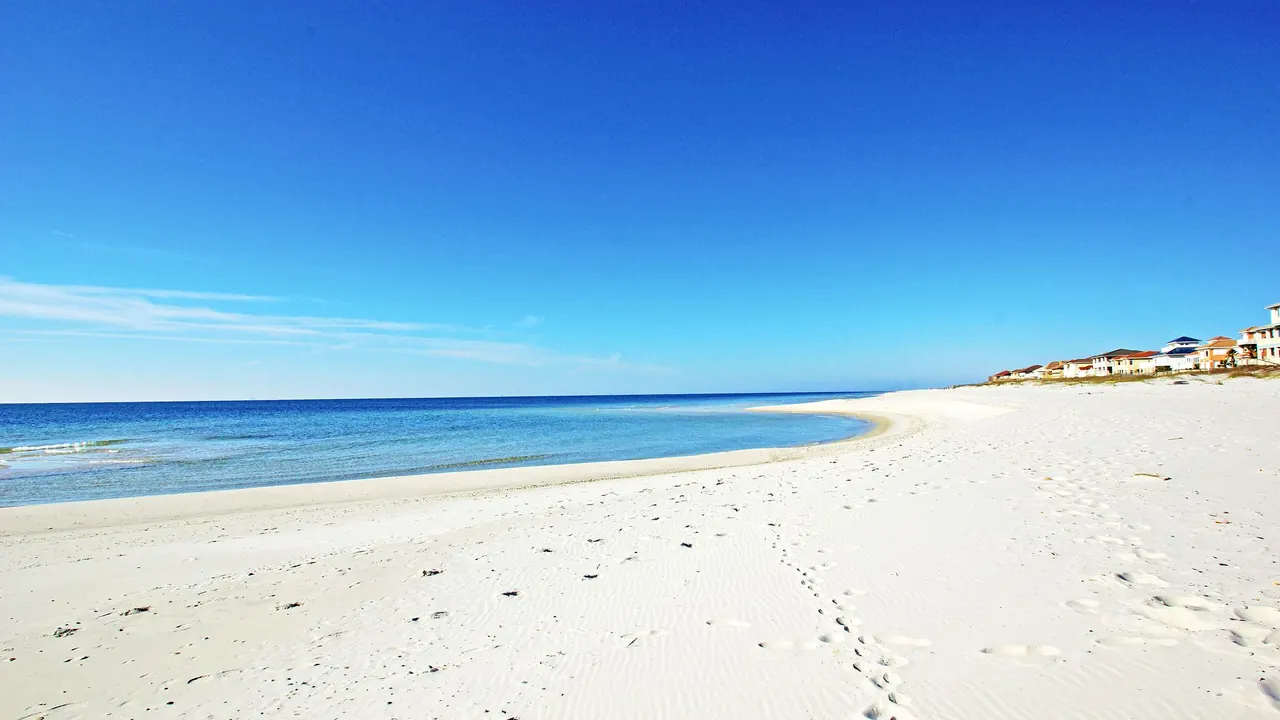
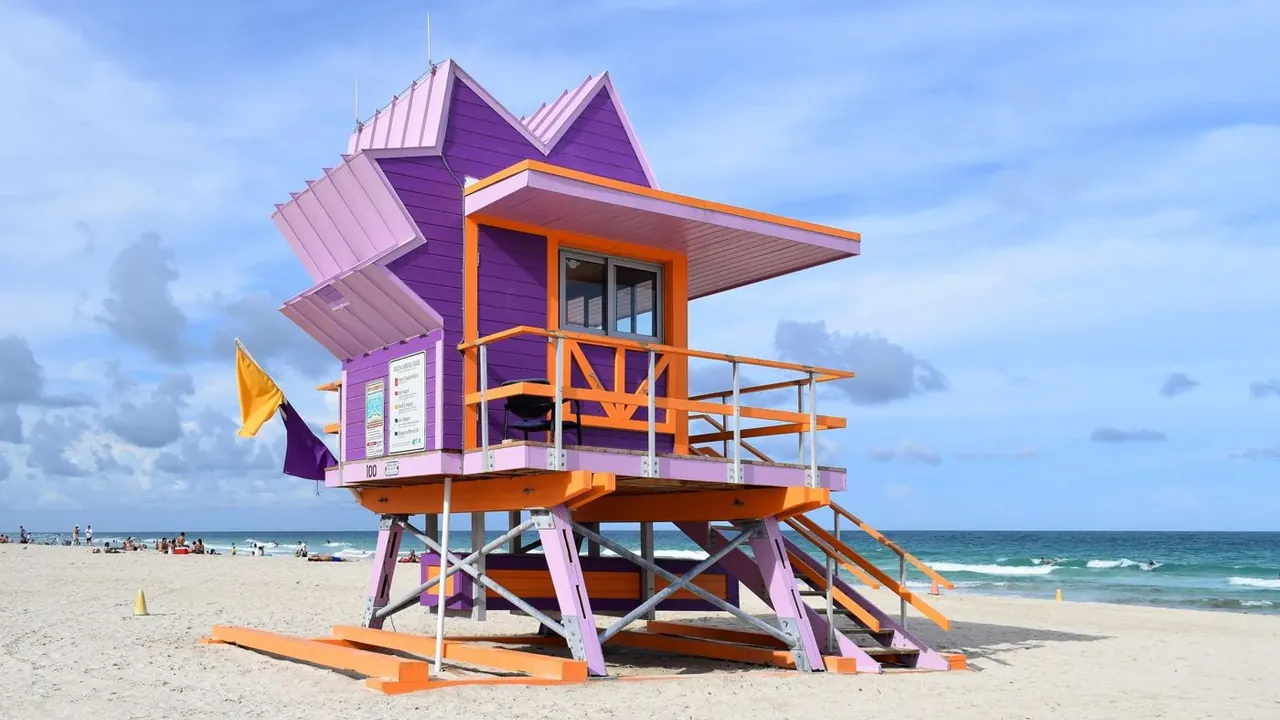
Photos: Gulf Shores by ourgulfshoresvacation.com, CC BY-SA 4.0, cropped; Miami by Radomianin, CC BY-SA 4.0, cropped.
Gulf Shores or Miami?
Our verdict in twelve categories, each scored against the same fixed benchmark cities, and the climate month by month, so you can choose for your trip.
Choose Gulf Shores for
- prices
- families
- day trips
Gulf Shores suits a family beach week on a steadier budget: a condo with a kitchen above soft white quartz sand, a pool downstairs, a water park or the Gulf State Park trails for the afternoons, and an early night. It asks little of you beyond hiring a car, and the towns around Mobile Bay make for more varied day outings than Miami's surroundings. Expect few sights, simple seafood and not much to do after dark.
Choose Miami for
- nightlife
- shopping
- culture and sights
Choose Miami when the beach is only half the point. The sea stays warm enough to swim through the winter, and around it you get Cuban and Latin American cooking, the Art Deco streets of South Beach, the Everglades, serious shopping and a club scene that runs until dawn. It costs more and the city is spread out, but a week here fills itself in a way a resort town cannot.
Scoreboard
Twelve categories on one fixed scale from 0 to 100. The shaded stretch is the gap between the two.
Your match
Pick a travel style or drag the sliders, and both match scores follow your weighting.
Wins on prices and families with your weighting.
Wins on nightlife and shopping with your weighting.
What matters to you?
Category by category
What the scores mean for a trip.
Beaches & swimming
Both are long, flat strands of pale sand, and in summer the water is equally warm on either coast. Gulf Shores has the finer sand, white quartz that squeaks underfoot, with low dunes in Gulf State Park and towards Fort Morgan. Its drawbacks are rip currents and a winter sea too cold for most swimmers.
Miami edges ahead because you can swim all year: the Atlantic stays warm through the winter. It also has more variety, from the Art Deco crowd of South Beach to the calm shallows of Crandon Park on Key Biscayne. In return, the shoreline is more built-up and seaweed can wash in during the warmer months.
Food & drink
Gulf Shores does one thing: Gulf seafood eaten casually. That means Royal Red shrimp, chargrilled oysters and Louisiana-style gumbo at open-air shacks, and many visitors simply buy shrimp at a seafood market and cook it in the condo. The food is honest and filling, but there is little choice beyond that.
Miami's food is far broader. Cuban cooking runs through the city, from cafecito at a ventanita window on Calle Ocho to slow-cooked lechon, and Venezuelan, Peruvian, Haitian and Nicaraguan kitchens add more. Stone crab in winter and chef-led restaurants in Brickell and the Design District give it a high end that Gulf Shores lacks.
Culture & sights
On culture, Miami is far ahead. Gulf Shores has Fort Morgan, the brick star fort from the Battle of Mobile Bay, a small local museum and little else, so anyone wanting more drives to Mobile or Pensacola.
Miami's real draw is its architecture: the pastel 1930s hotels of the South Beach Art Deco district. Add Vizcaya on Biscayne Bay, the Perez Art Museum, the Wolfsonian and Wynwood's murals. Almost nothing is more than a century old and a few days covers it, but it gives a beach trip some culture to go with it.
Nightlife
A night out in Gulf Shores means a beach-bar deck with sand underfoot and frozen drinks. The legendary roadhouse on the state line at Perdido Key is the loudest option, while most of the resort is asleep early.
Miami goes out until dawn. South Beach and downtown have big clubs with international DJs and dress codes, Wynwood has warehouse bars and breweries, Brickell has rooftop cocktail bars and Calle Ocho has salsa nights. It suits people with money and stamina.
Nature & outdoors
Both coasts are flat and watery, but Miami has the bigger wild places on its doorstep. The Everglades are within an hour, with alligators and wading birds along the Anhinga Trail boardwalks and airboat rides. Biscayne National Park and the reefs off Key Largo add snorkelling.
Gulf Shores is quieter: cycling the paved trails of Gulf State Park, watching migrating birds on the western peninsula, taking dolphin cruises and kayaking the Mobile-Tensaw Delta. In both places summer heat pushes activity into the early morning, and in Miami the outdoors is really best in winter.
Day trips
Gulf Shores has the better choice of outings within an hour. Mobile has ironwork balconies and the USS Alabama, Fairhope has bayside gardens, Pensacola has its naval aviation museum, and a car ferry runs from Fort Morgan to Dauphin Island. None is famous, but they make easy and varied days.
From Miami the nearby options are thinner: the canals of Fort Lauderdale and the Gilded Age mansions of Palm Beach. Key West is three to four hours away each way, so it works better as an overnight trip, and most visitors spend their spare days in the Everglades instead.
Good for families
Gulf Shores is built around families. It has beachfront condos with kitchens and pools, soft sand, an unhurried pace, and a water park, small zoo and Ferris wheel for the afternoons. On the other hand, every outing needs a car and children need watching in the surf.
Miami has bigger attractions in Zoo Miami, the aquarium at the Frost Science Museum and the Venetian Pool in Coral Gables, plus calm water at Key Biscayne. But distances are long, and South Beach's late-night side is not where most parents want to stay.
Getting around
You need a car in both places for anything beyond the beach, but Gulf Shores depends on it completely. The resort runs along one long beach road, the attractions sit on inland highways and there is almost no public transport. Bikes are only really useful inside Gulf State Park.
Miami at least has some walkable areas. South Beach is easy on foot, the free Metromover links downtown and Brickell, and ride-hailing gets you to Wynwood and Little Havana without a hire car. You will still want a car for the Everglades or the Keys.
Shopping & style
In Gulf Shores, shopping means beachwear and souvenir emporiums, fishing shops and a large outlet mall in Foley for a rainy afternoon.
Miami is a luxury shopping destination in its own right. The major fashion houses have flagship stores in the Design District, Bal Harbour has a very exclusive open-air mall, and there are huge malls and outlets, with Lincoln Road for mainstream brands. Neither city has much local craft, though Little Havana has cigar shops and guayabera makers.
Affordability
Gulf Shores is the cheaper of the two, though summer is its expensive season. Beachfront condos cost a lot in June and July, but winter and shoulder-month rentals drop sharply, and a condo kitchen keeps food costs down.
Miami costs more across the board. Beachfront hotels add resort fees and parking, club drinks are very expensive, and tax and tipping push up restaurant bills. Cuban lunch counters, the free Metromover and staying in a mainland neighbourhood all help.
Live music & performing arts
Gulf Shores has music rather than performing arts. Bands play daily on beach-bar stages, the state-line roadhouse hosts a long-running songwriters' festival every November, and the Orange Beach amphitheatre brings in touring country and rock acts. For a symphony you drive an hour to Mobile.
Miami has a proper main stage in the Adrienne Arsht Center, home to Florida Grand Opera and touring Broadway shows. It also has Miami City Ballet and the New World Symphony, which plays in a Frank Gehry building. Its most local sound is Cuban and Caribbean music in Little Havana.
Wellness & relaxation
Neither city has a real bathing tradition, but Miami offers more. The big hotels on Miami Beach and Key Biscayne have large spa floors, there is sunrise yoga on the sand, and a long-established Russian and Turkish bath house has steam rooms and cold plunges.
Gulf Shores has a few day spas, and the rest it offers comes from the quiet itself: early nights and sunsets from a condo balcony away from summer weekends. In Miami you have to look for calm in Surfside or on Key Biscayne, away from the noise of South Beach.
When should you go?
Pick your month. The climate figures are measured averages, not a forecast.
Gulf Shores in July
Miami in July
Daytime high, °C
Rainfall in the month, mm
Where the figures come from
Gulf Shores has no rain gauge within 25 km of the centre, so its rainfall comes from a gridded climate dataset read at the city rather than from a gauge further away.
Temperature and rainfall are climate normals, averaged over the years shown. Gulf Shores: 2006-2020 (rainfall 1991-2020) normals, Gulf Shores / Bay Village Mobile Home Park (3.7 km from centre). Miami: 1991-2020 normals, Miami International Airport (10 km from centre).
Gulf Shores is a warm-season resort. From May to October the Gulf is warm enough for a proper swim, reaching about 29°C in late summer. In winter, though, daytime highs fall to around 16°C and the shore is for walking, not swimming. June to September is hot and the wettest stretch of the year, with heavy rainfall. Spring and October are the most comfortable months for cycling the trails and being outdoors.
Miami's best season is the other way round. From December to April the days are in the mid-20s, the sea stays near 25°C and rain is light, so a winter beach trip only works here. From May the rain builds, reaching about 267mm in June, and by midsummer the heat and humidity make long walks around the Art Deco streets hard going. In late spring and early autumn the water is warm on both coasts.
Which traveller are you?
On a family trip with young children, Gulf Shores is easier: the whole resort keeps a child's pace and goes quiet by evening. Miami's bigger outings each mean a long drive, and its beach scene leans towards adults.
For a food and nightlife trip, Gulf Shores runs out after a couple of evenings: good seafood by the water, then the same beach-bar deck. Miami can fill a week of dinners without repeating a cuisine, and it stays out far later.
On a tight budget, Gulf Shores lets you fill a week with free beaches and park trails, and the hire car is the one cost you can't avoid. In Miami, saving money means skipping much of what people go there for.
Before you go
| Measure | Gulf Shores | Miami |
|---|---|---|
| Currency | US Dollar (USD) | US Dollar (USD) |
| Sockets | AB120 V, 60 Hz | AB120 V, 60 Hz |
| Driving side | Right | Right |
| Time zone | UTC-6, UTC-5 in summer | UTC-5, UTC-4 in summer |
| Emergency number | 911 | 911 |
| Elevation | 2 m | 2 m |
| Main airport | Pensacola International Airport (PNS)54 km from centre27 non-stop destinations | Miami International Airport (MIA)7 km from centre198 non-stop destinations |
| Public holidays this year | 13 days | 11 days |
By the numbers
| Measure | Gulf Shores | Miami |
|---|---|---|
| City population | 15,014 | 442,241 |
| People per km² | 207 | 3,046 |
| Museums within 10 km | 1 | 17 |
| UNESCO World Heritage sites within 50 km | 0 | 0 |
| Swim season, months above 21 °C | 8 months | 12 months |
Where else could you go?
Every comparison below shares a destination with this one, so you can follow Gulf Shores or Miami somewhere new.