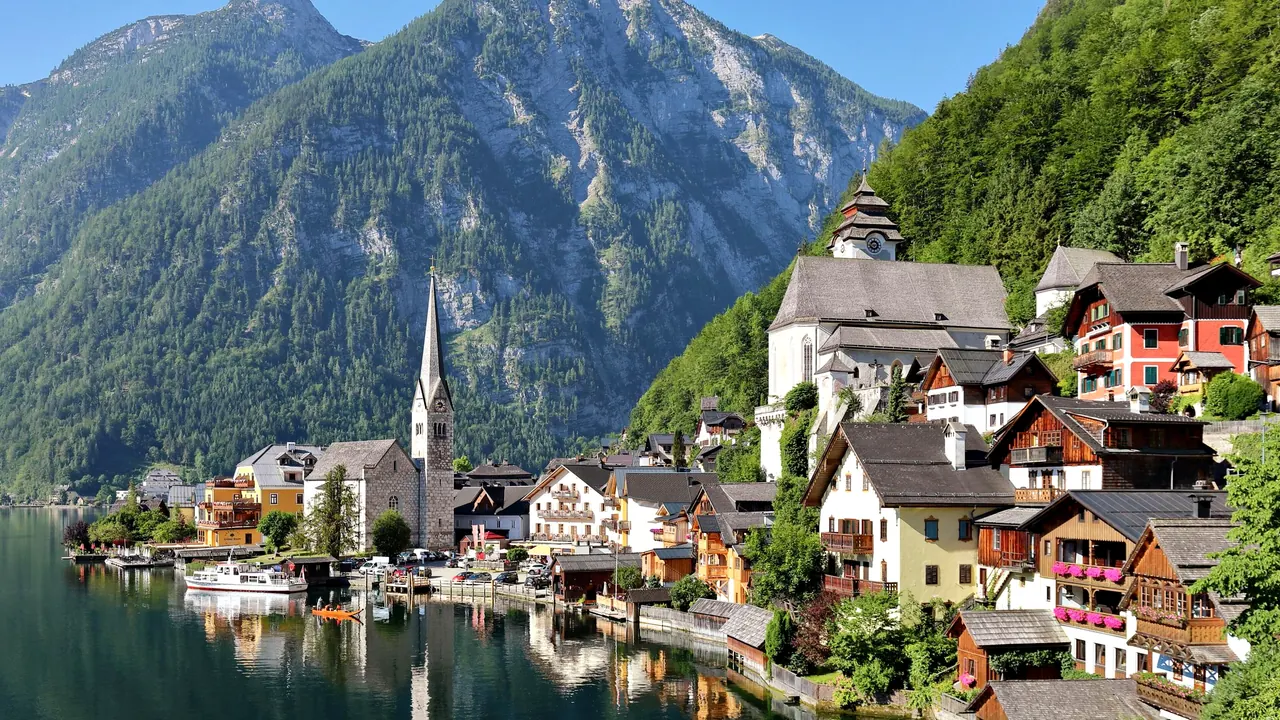
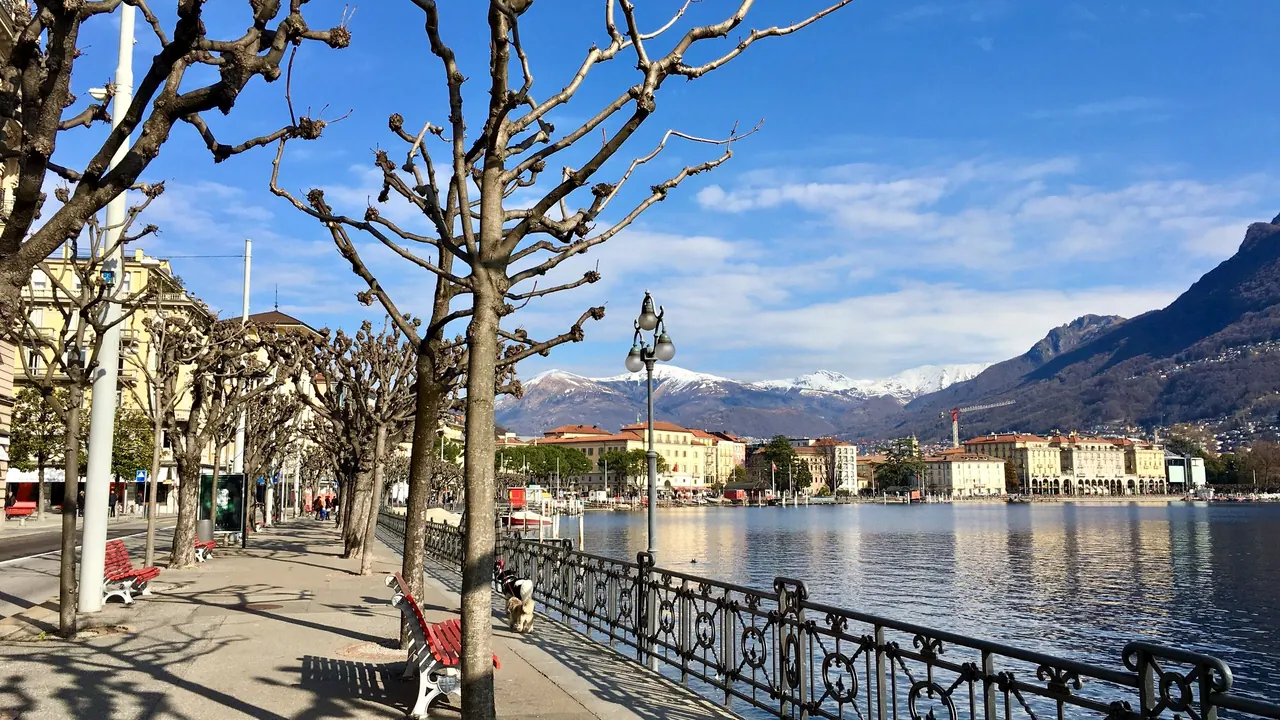
Photos: Hallstatt by C.Stadler/Bwag, CC BY-SA 4.0, cropped; Lugano by Thomas Woodtli from Zürich, Switzerland, CC BY-SA 2.0, cropped.
Hallstatt or Lugano?
Our verdict in twelve categories, each scored against the same fixed benchmark cities, and the climate month by month, so you can choose for your trip.
Choose Hallstatt for
- prices
- nature and the outdoors
Hallstatt is for travellers who come for the mountains and want the village as a base. The Dachstein starts at the edge of the lake, with ice caves, high plateau walks and the Gosausee within reach. Evenings are quiet and there is little to do indoors, so it suits a short, active stay of two or three nights, ideally with a car for the rest of the Salzkammergut.
Choose Lugano for
- live music and the arts
- shopping
- food and drink
Lugano gives you more to do once the walking boots come off. Its strengths are lake lidos, grotto lunches, concerts at LAC and a rail line that reaches Milan, Como and Bellinzona with ease. It costs even more than Hallstatt, but it works better as a longer lake stay, for families who want an easy town, and for anyone who likes a well-dressed aperitivo as much as a summit view.
Scoreboard
Twelve categories on one fixed scale from 0 to 100. The shaded stretch is the gap between the two.
Your match
Pick a travel style or drag the sliders, and both match scores follow your weighting.
Wins on prices and nature and the outdoors with your weighting.
Wins on live music and the arts and shopping with your weighting.
What matters to you?
Category by category
What the scores mean for a trip.
Beaches & swimming
Neither has a beach, but Lugano is the better place to swim. Its lake warms a few degrees more in high summer, and the Cassarate lido and the bathing decks towards Castagnola and Paradiso give you space, pools and a whole afternoon's lounging.
Hallstätter See is colder and darker, with steep shores, a small lawn at the northern end of the village and the larger lido at Obertraun. There, a swim is a bracing dip after a hike rather than a reason to plan the day.
Food & drink
Lugano eats far better. The grotto tradition of polenta, braised meats and local cheese at stone tables, along with Ticino Merlot, arcaded cafés and a weekly market, gives you real choice over several days, even if international cooking is thin.
Hallstatt has smoked or pan-fried char from the lake and Austrian staples, and not much else, and kitchens can close early. For pastries Bad Ischl is the better bet, much as Lugano's food lovers head over the Italian border.
Culture & sights
The two are roughly level, and both are seen in a day, but the interest differs. Hallstatt's draw is deep time: seven thousand years of salt mining, the Iron Age finds that named a European culture, the painted skulls of the Beinhaus and a village that is itself a UNESCO landscape.
Lugano offers art and architecture instead. You get Luini's Passion fresco, the Renaissance front of San Lorenzo, Lombard arcades around Piazza della Riforma and the collections at LAC and Palazzo Reali, plus the Hesse museum in the hills.
Nightlife
Hallstatt has no nightlife at all. The evening is dinner, a glass of wine by the water and a walk in the dark, and many overnight guests stay for exactly that.
Lugano offers more, though not much. There is aperitivo on the lakefront, a few cocktail and wine bars, a lounge or two and the odd club, and on summer weekends the promenade stays busy for a while. Anyone who wants a late night still ends up in Milan.
Nature & outdoors
Both are lake-and-mountain places, but Hallstatt sits in higher, wilder country. The Krippenstein cable car leads to the Five Fingers platform, the karst plateau and the Dachstein ice caves, the Echerntal climbs towards a glacier, and winter adds ski touring and freeride.
Lugano's landscape is softer and more southern. There are funiculars up Monte Brè and San Salvatore, chestnut woods, the shore path to Gandria and the Lema to Tamaro ridge walk, with the green rivers of Verzasca and Maggia about an hour away. It is lovely, but it has none of the true Alpine scale.
Day trips
Lugano has the wider reach because it sits on a border with fast trains. Milan's Last Supper and Brera, Lake Como, Bellinzona's castles, Lake Maggiore and Bergamo's upper town are all easy days out, and Morcote is a boat ride away.
Hallstatt's outings stay mostly within the Salzkammergut: imperial Bad Ischl, St Wolfgang's altarpiece, Gmunden's lake castle and the Aussee towns, with Salzburg as a longer day. They are charming, but they take more planning without a car.
Good for families
Lugano is the easier family base. It is calm and safe, with lido slides, boat hops, the playgrounds of Parco Ciani and the miniature Swiss landmarks at Melide to fill the days, though teenagers may find it tame.
Hallstatt has stronger single hits, especially the salt mine's wooden slides and underground lake and, for older children, the ice caves. But its single crowded lane is hard work with a pushchair, so many families stay in Obertraun and visit.
Getting around
Inside town both are walkable and both are steep, but Lugano connects far better. A funicular links the station to the old town, buses reach the hillside districts, and lake boats, mountain railways and the Swiss rail network make a car unnecessary.
In Hallstatt the village itself takes minutes to cross. Arriving means a boat from the station on the far shore, though, and buses to Obertraun, Gosau and Bad Ischl run thinly outside summer, so a car often earns its keep.
Shopping & style
Lugano gives shoppers something to do. Via Nassa's arcades hold Swiss watchmakers, jewellers and Italian fashion, the old-town lanes add delicatessens and wine shops, and there is a large designer outlet near Mendrisio.
Hallstatt's shopping is one lane of souvenirs, worth half an hour for local mine salt, carved wood and schnapps.
Affordability
Both are expensive, but Hallstatt is the less punishing of the two. Its high prices come from a few rooms and global demand, and you can largely sidestep them by sleeping in Obertraun, Bad Goisern or Bad Ischl.
Lugano charges Swiss prices for everything, from hotels and wine to boat trips and funiculars, with no cheaper base nearby on the Swiss side. Grotto lunches, set menus and the free regional transport that comes with a hotel stay soften the bill only slightly.
Live music & performing arts
Lugano has a real programme and Hallstatt barely has one. At LAC you can hear the Orchestra della Svizzera italiana and see touring soloists, drama and dance, and in summer the free Estival Jazz concerts fill Piazza della Riforma.
In Hallstatt the music is the village brass band at feast days and an occasional church concert. For an evening out you would drive to Bad Ischl's summer operetta or to Salzburg.
Wellness & relaxation
Neither has a bathing culture of its own, and both rely on calm, but the calm feels different. Hallstatt's stillness comes in the misty early mornings and empty evenings, between crowded middle hours, and the historic brine baths of Bad Ischl and Bad Aussee are close by.
Lugano's ease lasts all day, with palm-lined promenades, mild sunshine, lido afternoons and long grotto lunches. For pools and saunas you rely on the lakeside hotel spas or the indoor complex near Rivera.
When should you go?
Pick your month. The climate figures are measured averages, not a forecast.
Hallstatt in July
Lugano in July
Daytime high, °C
Rainfall in the month, mm
Where the figures come from
Hallstatt's temperatures are measured 56 km from the centre, at Salzburg.
Hallstatt has no rain gauge within 25 km of the centre, so its rainfall comes from a gridded climate dataset read at the city rather than from a gauge further away.
Temperature and rainfall are climate normals, averaged over the years shown. Hallstatt: 1991-2020 normals, Salzburg (55.5 km from centre). Lugano: 1991-2020 normals, Lugano (1.2 km from centre).
Both are at their warmest in July and August, but Lugano runs a couple of degrees ahead all year, reaching about 27°C against Hallstatt's 25°C. That makes its lidos more pleasant on a summer afternoon. Hallstatt's summer is also its wettest time, with July bringing about 178mm, so hikers there should expect showers and mist and plan around clear mornings. June and September are good months for walking in both, and Lugano also gets clearly more sunshine through the summer.
The rest of the year is where they part most. Hallstatt's winters are cold, with daytime highs near freezing, so they suit snow on the Krippenstein more than strolling. Lugano stays mild and is at its driest in winter, with about 61mm in February. Its rainy stretch runs from spring right through to November, which makes a bright January day by the lake a real possibility and a dry autumn walk less certain.
Which traveller are you?
On an outdoors trip, Hallstatt is the stronger choice. The Dachstein cable car, the ice caves, hut-to-hut routes and via ferratas start almost at the door, while Lugano's mountains are gentler wooded summits, and the high Alps are further away.
For a food and nightlife trip, Lugano wins clearly. Grotti with Merlot under chestnut trees, aperitivo under the arcades and a handful of lakeside bars beat Hallstatt's few guesthouse dining rooms, which go quiet once the day visitors leave.
On a trip on a tight budget, neither is cheap, but Hallstatt is the easier one to manage. Staying in Obertraun or Bad Goisern and visiting for the day keeps costs down, while Lugano has Swiss prices throughout and no cheap way to stay.
Before you go
| Measure | Hallstatt | Lugano |
|---|---|---|
| Official language | German, Austrian Sign Language | French, German, Italian, Romansh |
| Currency | Euro (EUR) | Swiss Franc (CHF) |
| Sockets | CF230 V, 50 Hz | CJ230 V, 50 Hz |
| Driving side | Right | Right |
| Time zone | UTC+1, UTC+2 in summer | UTC+1, UTC+2 in summer |
| Emergency number | 112 | 112 |
| Elevation | 511 m | 283 m |
| Main airport | Salzburg Airport (SZG)55 km from centre64 non-stop destinations | Milan Malpensa International Airport (MXP)46 km from centre208 non-stop destinations |
| Public holidays this year | 16 days | 15 days |
By the numbers
| Measure | Hallstatt | Lugano |
|---|---|---|
| City population | 741 | 63,495 |
| People per km² | 12 | 837 |
| Museums within 10 km | 3 | 17 |
| UNESCO World Heritage sites within 50 km | 2 | 5 |
Where else could you go?
Every comparison below shares a destination with this one, so you can follow Hallstatt or Lugano somewhere new.