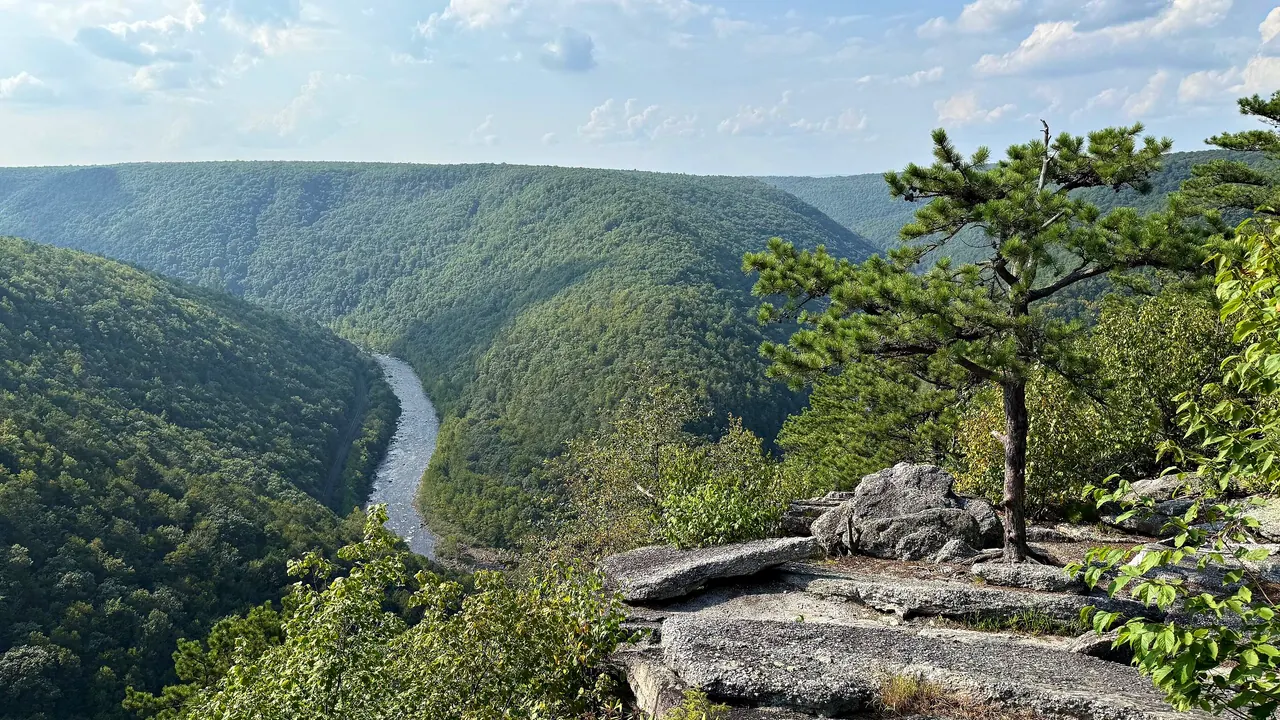
Photos: Poconos by Famartin, CC BY-SA 4.0, cropped.
The Hamptons or Poconos?
Our verdict in twelve categories, each scored against the same fixed benchmark cities, and the climate month by month, so you can choose for your trip.
Choose The Hamptons for
- beaches
- food and drink
- nightlife
The Hamptons suit a summer trip built around the ocean. You get long Atlantic sand from Westhampton to Montauk, seafood and farm-stand produce, polished village restaurants and a social summer season in Montauk and Southampton. Choose it if the beach is the point and the budget isn't. Come in July or August to swim, or in June and September for the same coast at a gentler pace.
Choose Poconos for
- prices
- families
- getting around
Families, walkers and anyone watching costs will get more from the Poconos. The forested plateau around the Delaware Water Gap has better hiking, waterfalls, rafting and winter skiing. Its resorts with indoor waterparks keep children busy in any weather, and a midweek cabin costs far less than a Hamptons rental. It is a woods-and-lakes escape for every season rather than a seaside one, with plain food and quiet evenings.
Scoreboard
Twelve categories on one fixed scale from 0 to 100. The shaded stretch is the gap between the two.
Your match
Pick a travel style or drag the sliders, and both match scores follow your weighting.
Wins on beaches and food and drink with your weighting.
Wins on prices and families with your weighting.
What matters to you?
Category by category
What the scores mean for a trip.
Beaches & swimming
This is the Hamptons' clearest advantage. Wide, pale ocean beaches run from Westhampton to Montauk, at Cooper's Beach, Main Beach and Amagansett. Ditch Plains has real surf, and the shallow bay beaches on Peconic Bay suit toddlers. Follow the rip-current warnings and check the parking permits.
The Poconos have no sea at all. You swim in lakes such as Wallenpaupack or at the guarded state-park beaches at Promised Land and Hickory Run. These are small grassy strips that warm nicely in high summer, and there is also tubing on the Delaware. They are pleasant to add to a stay but not worth planning a trip around.
Food & drink
You eat far better in the Hamptons. Peconic oysters, bay scallops, lobster rolls by Montauk harbour, farm-stand corn and strawberries, and South and North Fork wines feed both the beach picnic and the polished dining rooms of Sag Harbor and East Hampton. There is little in between, though, and much of it shuts after the autumn.
Poconos food is hearty rather than memorable: diners, taverns, pizza and resort dining rooms, with shoofly pie and whoopie pies as the Pennsylvania Dutch touch. The better meals are in a handful of bistros and brewpubs in Stroudsburg, Jim Thorpe and Milford.
Culture & sights
Neither is a culture destination, but the Hamptons give you more to see. There are Sag Harbor's whaling-era streets and museum, the windmills and saltbox houses of early English villages, and Montauk Point Lighthouse. Add the art of the Pollock-Krasner House, the Parrish and Guild Hall, and you have a couple of good afternoons.
The Poconos' story is coal and railway money. It is concentrated in Jim Thorpe's Victorian streets and the Asa Packer Mansion, with Eckley Miners' Village and Grey Towers further out. They make worthwhile half-days, best saved for a rainy one.
Nightlife
Neither place stays up late, but the Hamptons at least have a summer scene. Montauk's bars run loud with a young crowd, and Southampton has a few clubs with strict door policies. Much of the famous party life happens in private houses, and outside the season evenings end at dinner.
In the Poconos an evening means a hot tub, a fire and perhaps a brewpub in Stroudsburg or Jim Thorpe. The casino resort at Mount Pocono and the winter après-ski bars are the only places open late.
Nature & outdoors
The Hamptons give you gentle outdoor days, mostly on or beside the water. The best walking is at the eastern end, on the bluff trails of Montauk Point and Hither Hills, across the Walking Dunes, and through the woods and marshes of Mashomack on Shelter Island. Otherwise it is kayaking and sailing on the sheltered bays, sport fishing out of Montauk and easy cycling on the flat back roads.
The Poconos are the better choice if you want to be properly active outdoors. In the Delaware Water Gap the Appalachian Trail follows the crest of Kittatinny Ridge, and side valleys hold waterfalls such as Raymondskill and Dingmans, with Bushkill Falls the best known of all. The Lehigh Gorge adds whitewater rafting and a long riverside rail trail. October colour and winter skiing at Camelback and Blue Mountain give the woods seasons that the coast does not have.
Day trips
The Poconos have more within easy reach. Bethlehem's 1740s Moravian buildings and old steelworks furnaces are an hour south, and Scranton has railway and coal-mine museums. Jim Thorpe, Hawley and the Delaware river villages are short drives from any base.
From the Hamptons, the best outing is by small ferry via Shelter Island to the North Fork's tasting rooms and Greenport's working harbour. In summer a ferry runs from Montauk to Block Island. Beyond that the choice is short, and New York works better as the start or end of the trip than as a day out.
Good for families
The Poconos are built for children in a way the Hamptons are not. Resorts around Mount Pocono and Tannersville are wrapped around indoor waterparks that work in any weather. Camelback adds an outdoor waterpark and alpine coaster in summer and gentle learning slopes in winter, and the drives between attractions are short.
The Hamptons suit a slower family summer, with shallow bay beaches for toddlers, lifeguarded ocean beaches for older children, pick-your-own fields and the climb up the lighthouse. With no big attractions and slow traffic, families there tend to settle into a beach routine.
Getting around
You need a car in both, but the Poconos are easier to drive. Interstates 80 and 380 link the four counties, and most drives take twenty minutes to an hour. The jams come mainly on Friday evenings and Sunday afternoons.
The Hamptons squeeze everything onto Montauk Highway, where summer weekend traffic crawls and taxis are scarce. In return, there is a rail line from New York, and on the flat back lanes a bicycle will get you to the beach and the farm stands.
Shopping & style
The Hamptons are the place to shop if you want boutiques. There is high-end fashion and resortwear on Main Street and Newtown Lane in East Hampton and on Jobs Lane in Southampton, and Sag Harbor has bookshops and independent stores. The interiors shops and antiques dealers around Bridgehampton and Water Mill are the real local strength.
The Poconos offer bargains rather than style, at the premium outlet centre in Tannersville. Otherwise there are antiques, crafts and maple syrup to browse in Jim Thorpe and Milford.
Affordability
The gap here is wide. A summer in the Hamptons is one of the most expensive anywhere. Rentals are often by the week or the season, there is little cheap lodging, and even deli sandwiches are priced for the very wealthy. Going in June or September or staying on the North Fork softens the bill, but only somewhat.
The Poconos are far easier on the budget. Midweek cabins, older motels and shared rental houses are good value, and the hiking, state-park lakes and the national recreation area cost little. Waterpark resorts, lift tickets and peak-season weekends still add up.
Live music & performing arts
Both have small summer stages, and the Hamptons offer a little more range. Guild Hall and Bay Street Theater in Sag Harbor put on plays and concerts, and the Bridgehampton Chamber Music Festival fills churches with classical music. In autumn a film festival brings screenings to the villages.
The Poconos lean towards jazz and touring acts. Delaware Water Gap has its long-running late-summer jazz festival, the Mauch Chunk Opera House in Jim Thorpe hosts roots and folk acts, and summer-stock playhouses keep resort theatre going.
Wellness & relaxation
The Poconos have a slight edge for switching off. Secluded couples' resorts with hot tubs and fireplaces, and the large spa resorts around Lake Wallenpaupack, are designed for getting away. A cabin in autumn or after snow is hard to beat.
In the Hamptons the sea does the restoring. There are resort spas and seawater pools in Montauk and Southampton, and early walks on empty beaches. Midsummer weekends are crowded and social, so go in June or September if rest is the aim.
When should you go?
Pick your month. The climate figures are measured averages, not a forecast.
The Hamptons in July
Poconos in July
Daytime high, °C
Rainfall in the month, mm
Where the figures come from
The Hamptons has no rain gauge within 25 km of the centre, so its rainfall comes from a gridded climate dataset read at the destination rather than from a gauge further away.
Poconos's temperatures are measured 40 km from the centre, at Wilkes-Barre/Scranton International.
Poconos's station stands 162 m above the place it is measured for, so that place is likely a little warmer than the figures say.
Poconos has no rain gauge within 25 km of the centre, so its rainfall comes from a gridded climate dataset read at the destination rather than from a gauge further away.
Temperature and rainfall are climate normals, averaged over the years shown. The Hamptons: 2016-2025 (rainfall 1991-2020) normals, Easthampton / Midhampton (5.6 km from centre). Poconos: 1991-2020 (sunshine 1981-2010) normals, Wilkes-Barre/Scranton International (40 km from centre).
Both are warmest in July, at about 27°C on the Hamptons coast and 29°C in the Poconos. Neither has a dry season, and rain falls steadily all year at roughly 100mm a month in both. The Hamptons' ocean is properly swimmable only from July into September and peaks around 22°C in August, so the beach season is short. June is better for walking the sand than for swimming, and September is still warm, with the sea slow to cool.
The Poconos change more with the seasons. The lakes are for June to early September, May to August are the sunniest months, and October brings the autumn colour with mild days for walking. Winter is colder inland than on the coast, with January highs near 1°C. That is cold enough for the ski slopes but hard going for much else. The Hamptons winter is milder but grey, and many places close.
Which traveller are you?
For a beach and sun trip, the Hamptons win easily. Wide Atlantic sand runs the length of the South Fork, the ocean is warm enough to swim from July, and the bay beaches give calmer water. The Poconos have only small, grassy lake beaches.
On a family trip with children, the Poconos are the easier choice. Indoor waterpark resorts work in any weather, Camelback adds an alpine coaster and gentle ski slopes, and short drives link lakes, waterfalls and mini-golf. Families in the Hamptons mostly settle into a beach routine.
On a tight budget, the Poconos are the only realistic choice of the two. Midweek cabins and shared rental houses are good value, and the trails and state-park lakes cost little. A Hamptons summer is priced for the very wealthy.
Before you go
| Measure | The Hamptons | Poconos |
|---|---|---|
| Currency | US Dollar (USD) | US Dollar (USD) |
| Sockets | AB120 V, 60 Hz | AB120 V, 60 Hz |
| Driving side | Right | Right |
| Time zone | UTC-5, UTC-4 in summer | UTC-5, UTC-4 in summer |
| Emergency number | 911 | 911 |
| Main airport | John F. Kennedy International Airport (JFK)189 non-stop destinations | Lehigh Valley International Airport (ABE)14 non-stop destinations |
| Public holidays this year | 13 days | 12 days |
By the numbers
| Measure | The Hamptons | Poconos |
|---|---|---|
| Swim season, months above 21 °C | 1 month | - |
Where else could you go?
Every comparison below shares a destination with this one, so you can follow The Hamptons or Poconos somewhere new.
- Catskillsvs Poconos
- Martha's Vineyardvs The Hamptons
- Cape Codvs The Hamptons
- Nantucketvs The Hamptons
- Catskillsvs The Hamptons
- Adirondacksvs Poconos