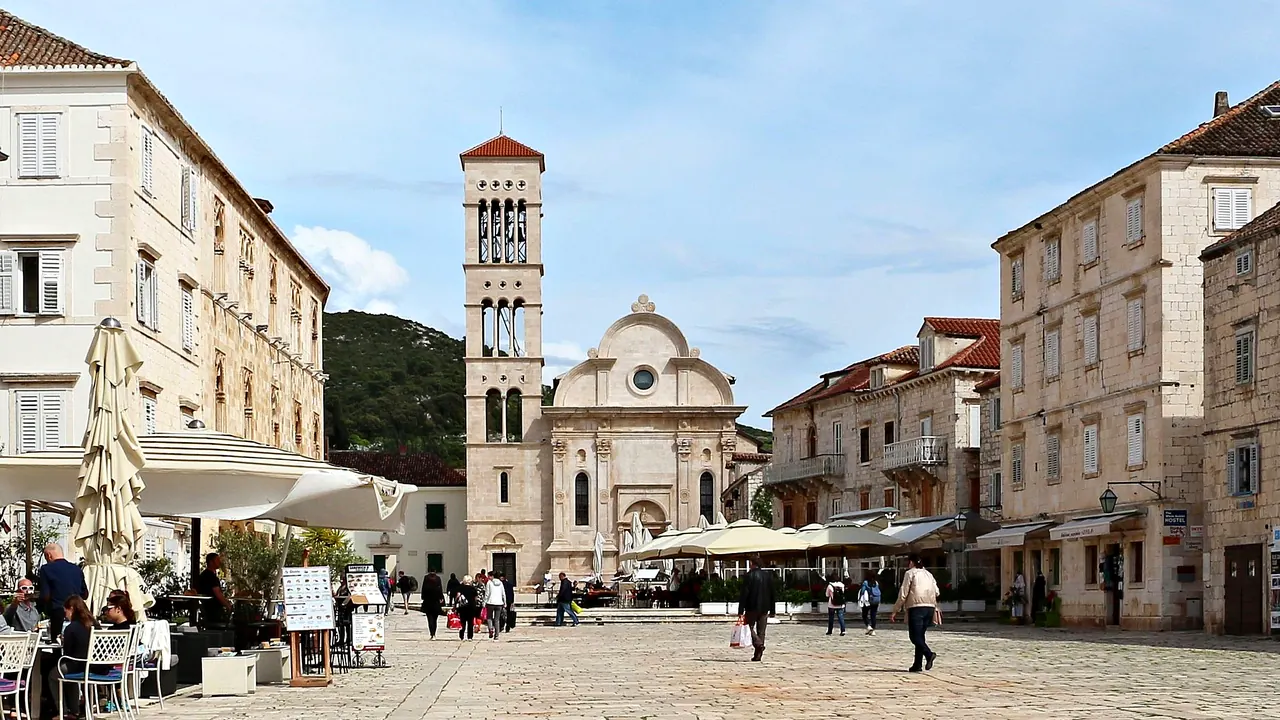
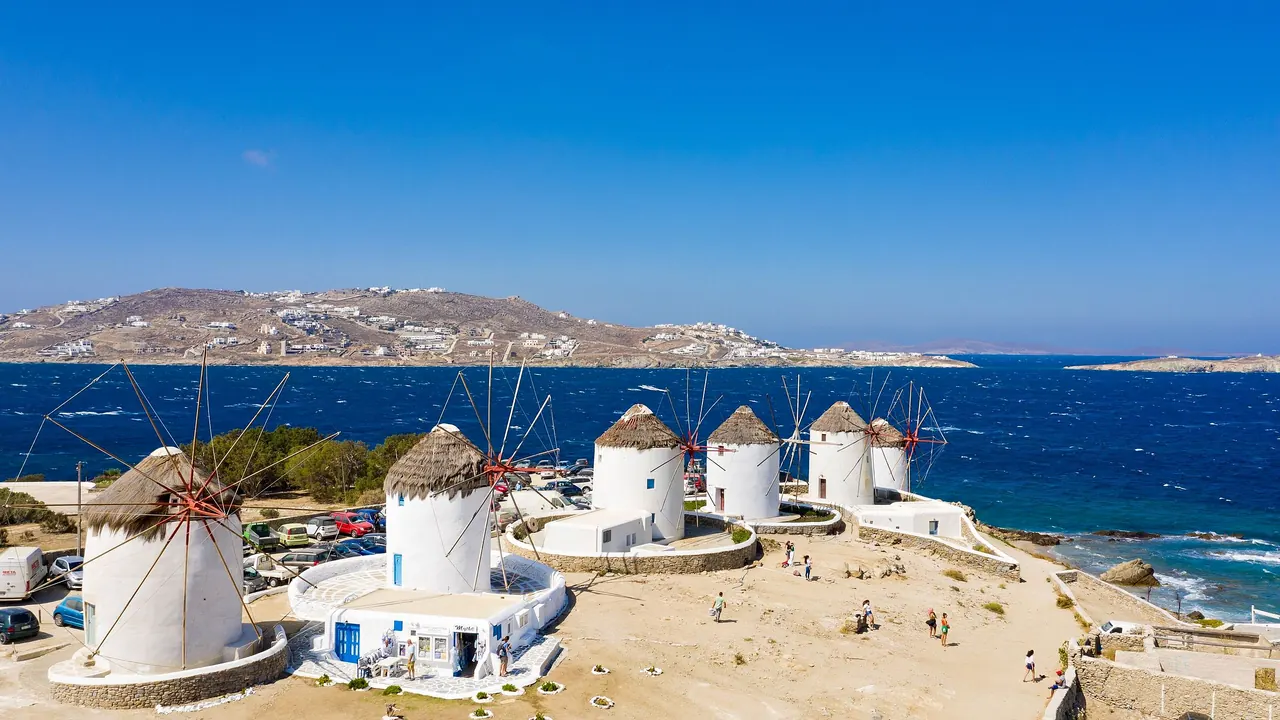
Photos: Hvar by Bernard Gagnon, CC BY-SA 4.0, cropped; Mykonos by dronepicr, CC BY 2.0, cropped.
Hvar or Mykonos?
Our verdict in twelve categories, each scored against the same fixed benchmark cities, and the climate month by month, so you can choose for your trip.
Choose Hvar for
- prices
- nature and the outdoors
- wellness
Hvar suits travellers who want an island with more to it than the beach and the bar. Away from the party harbour of Hvar Town there are hill villages, lavender terraces, family wine cellars and the old fields of the Stari Grad Plain. The quieter north-side towns of Jelsa, Stari Grad and Vrboska make an easier, calmer and cheaper base for couples, families and anyone who wants to slow down.
Choose Mykonos for
- shopping
- culture and sights
- nightlife
Mykonos is the choice when the nights and the sand are the whole point. Its south-coast bays are sandy where Hvar's are pebble, its club scene runs bigger and later, and Delos gives it one ancient site of real importance a short boat ride away. Chora's lanes add designer shopping. It asks a great deal of your budget in return, and it offers little for walkers or for anyone hoping for a quiet stay in high summer.
Scoreboard
Twelve categories on one fixed scale from 0 to 100. The shaded stretch is the gap between the two.
Your match
Pick a travel style or drag the sliders, and both match scores follow your weighting.
Too close to call, 1 point apart
Wins on prices and nature and the outdoors with your weighting.
Wins on shopping and culture and sights with your weighting.
What matters to you?
Category by category
What the scores mean for a trip.
Beaches & swimming
The beaches are equally good, but they are different underfoot. Hvar is pebble and flat rock almost everywhere. Its best swimming is in the pine-backed coves of the Pakleni Islands, reached by taxi boat, and in the south-coast bays at the end of steep tracks. The calm, shallow water is on the north side around Jelsa and Stari Grad.
Mykonos has the sand. Its south coast is a string of bays that each suit a different crowd, from sheltered Ornos and polished Psarou to the party beaches and the roomier stretches at Elia and Kalafatis. Most of them are lined with sunbeds and clubs, while the north coast is often too windy for a comfortable swim.
Food & drink
The cooking is about as good on both islands, but you eat for different reasons. Hvar is about the produce. Lamb and octopus come slow-cooked under the peka bell, Plavac Mali grows on the slopes at Ivan Dolac, and the best meals are in inland konobas at Pitve or Velo Grablje, where the food comes from the owners' own land.
On Mykonos you are paying more for the setting: grilled fish at tables over the water in Little Venice, and a large high-end scene of sushi and fusion cooking. Look for kopanisti and louza, and for the tavernas in Ano Mera, to taste the island itself.
Culture & sights
Mykonos has the stronger sightseeing, and almost all of the difference is Delos. The sacred island of Apollo, with its Terrace of the Lions and mosaic-floored houses, was one of the great religious centres of ancient Greece, and nothing on Hvar compares with it. On Mykonos itself, Chora's windmills and the Paraportiani church round out a couple of days.
Hvar's sights are spread more widely but are smaller in scale. There is the Venetian square and cathedral in Hvar Town, the 1612 theatre above the Arsenal, the poet's Tvrdalj in Stari Grad and the Greek field boundaries of the UNESCO-listed plain behind it.
Nightlife
Both are well-known summer party islands, but Mykonos plays in a bigger league. Its nights run from south-coast beach clubs to Chora's dance bars and on to large clubs that close at sunrise, with international DJs and a long-established gay scene at the heart of it.
Hvar's version is smaller and mostly confined to Hvar Town. People drink along the harbour and in the stepped lanes, and much of the dancing is out on the Pakleni Islands because of the town's noise limits. Stari Grad and the villages go quiet early, which some travellers will count as a point in Hvar's favour.
Nature & outdoors
Hvar is much the better island for being outdoors. A limestone ridge runs its length, with Sveti Nikola at 626m looking across to Korčula and Vis, and inland there are abandoned stone villages, pine woods and lavender fields that flower in early summer. The Pakleni Islands add kayaking and snorkelling, and the back roads are good for cycling in spring and autumn.
Mykonos is low, brown and almost bare, and its beauty lies in the light rather than the landscape. Its outdoor appeal is the wind and the water: kitesurfing at Korfos Bay and Kalafatis, and diving over reefs and wrecks.
Day trips
Both islands rely on boats for excursions. The difference is in how varied the destinations are. From Hvar, catamarans reach Split and Diocletian's Palace on the mainland in about an hour, as well as walled Korčula and the quiet harbours of Vis, so you can mix a Roman city with other islands.
From Mykonos, every outing is to another Cycladic island: pilgrim Tinos, neoclassical Ermoupoli on Syros, and Paros and Naxos. Each is rewarding, but they are closer in character to one another, and the meltemi can upset crossings.
Good for families
Hvar is the easier family choice, as long as the base is right. Jelsa, Stari Grad and Vrboska have shallow bays, gravel beaches in places, evening promenades and a relaxed, safe feel. You should avoid steep, noisy Hvar Town in midsummer.
Mykonos has a few gentle beaches at Agios Stefanos and Ornos, plus a water park near Elia, which Hvar lacks. But the island is built around adult nights out, the north coast can be rough for small swimmers, and the costs mount quickly with children in tow.
Getting around
Getting around is about as easy on either island, but the layouts differ. Hvar is long and narrow, and you reach it by car ferry to Stari Grad or by catamaran. Buses run infrequently between its several towns, and a single-lane tunnel road leads to the south coast.
Mykonos is compact around one hub. Nowhere is much more than half an hour from Chora, buses and sea taxis cover the south-coast beaches, and the town itself is car-free. On both islands the remote coves really need a scooter or car, and on Mykonos the shortage of taxis in summer is the usual complaint.
Shopping & style
Mykonos is a better place to shop, at least for clothes. Matoyianni Street and the lanes around it are lined with boutiques selling designer resort wear, along with Greek jewellery and art galleries, and they stay open late. It is a good place to put together a beach wardrobe, though there are no local crafts to speak of.
Hvar has the opposite strengths and fewer of them. What it offers is what the island makes, such as lavender oil, honey, olive oil, cellar wine and lace made by the Benedictine nuns, plus a handful of linen and swimwear shops in Hvar Town.
Affordability
Neither island is cheap in high summer, but Hvar gives you far more room to economise. Hvar Town's harbour is priced for the yacht crowd, but family apartments in Jelsa or Vrboska, village konobas and wine bought at the cellar door bring a stay down to a reasonable level.
Mykonos is among the most expensive places to vacation in Europe. Rooms, sunbeds, taxis and car hire all add up, and even staying in Ano Mera and eating gyros only softens the bill. On both islands, June and September cost noticeably less.
Live music & performing arts
Neither island is a place to plan around performances, but Hvar has a little more. In summer it holds classical and chamber concerts in churches and the Franciscan cloister, and you may hear klapa harmony singing at village feasts.
On Mykonos the music is the club DJ sets, and anything else is an occasional open-air concert or folk dancing at a village festival.
Wellness & relaxation
Hvar is the more restful island, and it gets that from its pace rather than from spas. In Vrboska, Stari Grad and the hill villages the day revolves around long lunches and an evening walk by the water, with pine and lavender in the air.
Mykonos offers sea-view treatments and yoga in its upmarket hotel spas, but its summer rhythm works against rest. For calm you have to go to Agios Sostis, Ftelia or the bays beyond Kalafatis. On both islands, the months either side of high summer are far quieter.
When should you go?
Pick your month. The climate figures are measured averages, not a forecast.
Hvar in July
Mykonos in July
Daytime high, °C
Rainfall in the month, mm
Where the figures come from
Hvar's temperatures are measured 38 km from the centre, at Split / Marjan.
Hvar has no rain gauge within 25 km of the centre, so its rainfall comes from a gridded climate dataset read at the destination rather than from a gauge further away.
Hvar's sunshine is measured 38 km from the centre, at Split / Marjan.
Mykonos has no weather station within reach, so its figures come from a gridded climate model rather than a measured record, and read a broad area rather than one spot.
Temperature and rainfall are climate normals, averaged over the years shown. Hvar: 1991-2020 (sunshine 1971-2000) normals, Split / Marjan (38.2 km from centre). Mykonos: 2001-2020 normals, NASA POWER reanalysis grid, no weather station within 90 km.
Both islands are summer places, with the sea warm enough to swim from June through September, and on Mykonos into early October. The real difference is heat. Hvar climbs to about 31°C in July and August, under long, very sunny days, so walking the stepped lanes or the inland tracks is best kept to early morning and evening. Mykonos stays nearer 25°C in the same months, and the meltemi wind takes the edge off. It is also almost completely dry from June to August. The sea peaks at about 25°C off Hvar in August, a degree warmer than off Mykonos.
For sightseeing in comfortable warmth, Hvar's best months are May, June and September, when the island has already warmed up but is not yet baking. Its rain returns in September and peaks in November at about 116mm. Mykonos warms more slowly in spring and gets its rain mainly from November to February. Its winter days stay a few degrees milder, but neither island has much reason to visit then.
Which traveller are you?
On a trip on a tight budget, Hvar is the island where saving actually works. Stay away from the party harbour and a week costs what most travellers can manage. On Mykonos, even the thriftiest choices only trim a bill set for luxury.
For an outdoors trip, Hvar gives you a whole island to explore on foot, by bike and by boat, with green hills, rocky shores and inland villages. Mykonos suits people who come for the wind and the water. There is little to do on land.
For a food and nightlife trip, Mykonos gives you more nights out. Its scene is larger, runs later and has more choice than the evenings in Hvar Town. The cooking is no better, though, so choose it for the dancing rather than the dining.
Before you go
| Measure | Hvar | Mykonos |
|---|---|---|
| Official language | Croatian | Greek |
| Currency | Euro (EUR) | Euro (EUR) |
| Sockets | CF230 V, 50 Hz | CF230 V, 50 Hz |
| Driving side | Right | Right |
| Time zone | UTC+1, UTC+2 in summer | UTC+2, UTC+3 in summer |
| Emergency number | 112 | 112 |
| Main airport | Split Saint Jerome Airport (SPU)69 non-stop destinations | Mykonos Island National Airport (JMK)44 non-stop destinations |
| Public holidays this year | 14 days | 15 days |
By the numbers
| Measure | Hvar | Mykonos |
|---|---|---|
| Population | - | 10,134 |
| People per km² | - | 96 |
| Swim season, months above 21 °C | 4 months | 5 months |
Where else could you go?
Every comparison below shares a destination with this one, so you can follow Hvar or Mykonos somewhere new.