Greece
Mykonos
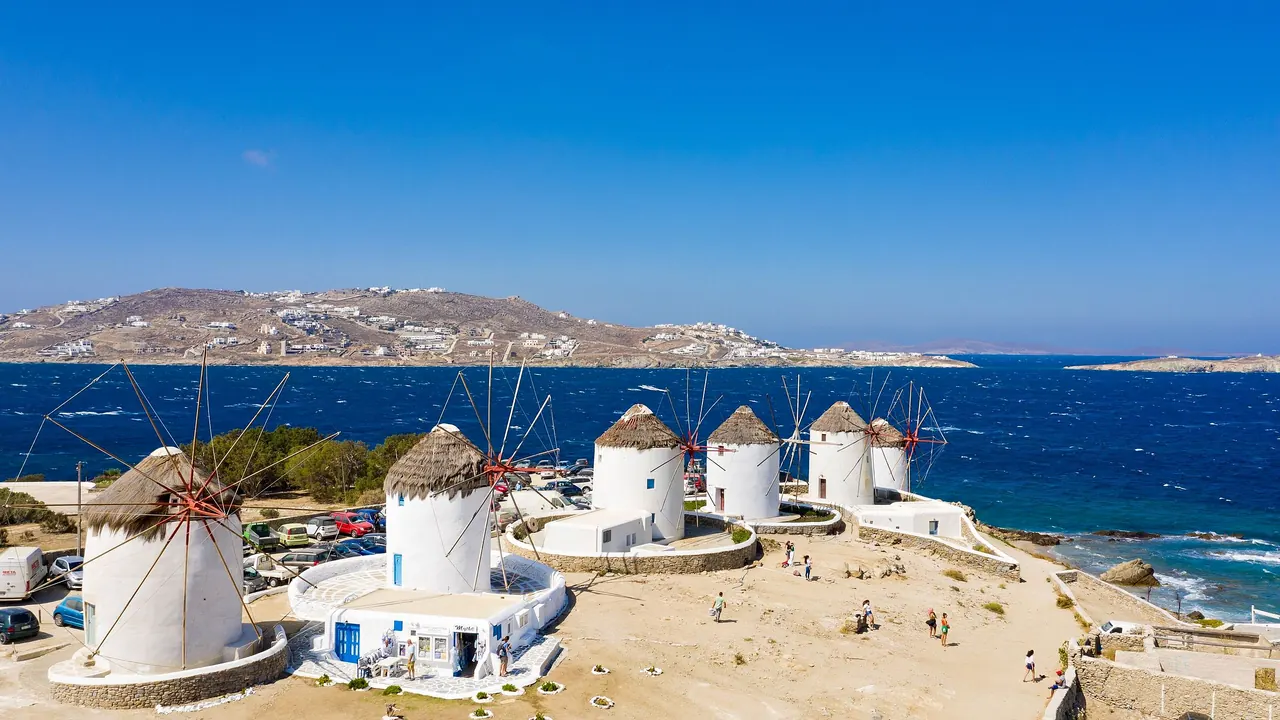
The Kato Mili windmills above Mykonos Town
- Nightlife88
- Beaches85
- Culture & sights65
Match
48
Every category weighted equally
- Beach & sun51
- Culture & arts47
- Food & nightlife52
- Family trip46
- Outdoors46
- Relax & unwind46
- Shopping & style49
- On a budget44
Mykonos in twelve categories
Our verdict on each, scored 0 to 100 against the same fixed benchmark cities, so a score means the same thing on every page.
Beaches & swimming. Scores 85 out of 100.
Food & drink. Scores 55 out of 100.
Culture & sights. Scores 65 out of 100.
Nightlife. Scores 88 out of 100.
Nature & outdoors. Scores 35 out of 100.
Day trips. Scores 58 out of 100.
Good for families. Scores 38 out of 100.
Getting around. Scores 50 out of 100.
Shopping & style. Scores 52 out of 100.
Affordability. Scores 12 out of 100.
Live music & performing arts. Scores 10 out of 100.
Wellness & relaxation. Scores 30 out of 100.
Mykonos category by category
Beaches & swimming
85Beach life is what most visitors come for. The south coast holds the main sandy bays, each with its own character. Ornos and Agios Ioannis are close to town and sheltered. Psarou and Platis Gialos are polished and full of sunbeds. Paradise and Super Paradise are known for their party crowds, while Elia, Agrari and Kalafatis are longer, with more space to spread out. The water is very clear and reaches about 24°C in late summer. It is warm enough to swim from June to early October.
The north coast faces the meltemi, the strong summer wind. Ftelia and Agios Sostis are wilder and less built up, good on still days and rough on windy ones, so most people swim on the south side when the wind is up. Many beaches are lined with organised sunbeds and beach clubs, and the quieter coves at the eastern end of the island take more effort to reach.
Food & drink
55Eating out here is mostly about setting: grilled fish and octopus at waterfront tables in Little Venice and on the old harbour, and seaside tavernas at the beaches with chairs almost in the water. The island's own flavours are worth looking for: kopanisti, a sharp, peppery cheese; louza, a cured pork; and the almond sweets sold in Chora's bakeries. Ano Mera, the inland village, has tavernas around its square that feel more local.
The island also has a large high-end scene of sushi, Mediterranean fusion and celebrity-chef dining built for the summer crowd. It is polished, but often more about being seen than about eating well. Cheap, everyday Greek food exists, in gyros counters and bakeries, but it is a smaller part of the picture.
Culture & sights
65The great sight is Delos, the sacred island of Apollo, a short boat ride from Chora's old harbour. Its ruins spread across almost the whole island: the Terrace of the Lions, mosaic-floored houses, theatres and sanctuaries. It was one of the major religious centres of the ancient Greek world and deserves a full morning.
On Mykonos itself, Chora is the sight: whitewashed lanes laid out to confuse the wind and pirates, the row of windmills at Kato Mili, the balconied houses of Little Venice over the water, and the many-sided Paraportiani church. The archaeological, folklore and maritime museums are small but worthwhile, and the Panagia Tourliani monastery in Ano Mera has a fine carved iconostasis. A visitor sees the full set within two or three days.
Nightlife
88From June to September, Mykonos is one of the Mediterranean's great party islands. The day starts at the beach clubs on the south coast, where Paradise and Super Paradise run loud afternoon sessions that go on into the night. In the evening the crowd moves into Chora: sunset drinks in Little Venice, then cocktail bars and dance bars in the lanes, where a long-established gay scene shapes much of the night. Larger clubs on the edge of town and by the beaches carry on until sunrise, and international DJs play through high summer.
It is glamorous, crowded and very late, with July and August at full pitch. The scene thins sharply in late spring and autumn, and in winter the island is almost silent.
Nature & outdoors
35The island is low, rocky and almost bare, with brown hills crossed by dry-stone walls, scattered chapels and the white cubes of farmhouses. Its beauty is in the light and the sea rather than in any dramatic landscape. Walking is limited to country lanes and coastal paths around the quieter north and east, such as the lighthouse at Armenistis.
The wind is the island's real outdoor asset. The meltemi makes Korfos Bay and Kalafatis good places for kitesurfing and windsurfing in summer. The clear water also suits diving and snorkelling around the reefs and wrecks, and boat trips go round the coast to Rhenia. Anyone wanting mountains or green hiking country will find little here.
Day trips
58Beyond Delos, day trips are by ferry to neighbouring islands, and the meltemi can disrupt crossings. Tinos is the closest, about half an hour away. It is a pilgrimage island with the great church of Panagia Evangelistria and inland villages famous for their marble carving. Syros, about an hour away, has Ermoupoli, a stately neoclassical port town that feels quite unlike the rest of the Cyclades.
Paros and Naxos are reachable in about an hour on fast boats. They offer Naoussa's fishing harbour, the old town of Parikia, and the Venetian kastro and great marble doorway of Naxos town. Santorini is possible but makes a long day. Every outing is island-hopping, so the variety is between Cycladic islands rather than between very different places.
Good for families
38Families can have a good beach vacation here if they choose carefully. Agios Stefanos, Ornos and Platis Gialos have gentle, shallow water, tavernas on the sand and a calmer crowd than the party beaches. There is a water park near Elia, and a boat trip to Delos can catch older children's imagination.
Beyond that, little is made for children, and much of the island's identity is built around adult nights out, so Chora gets loud and crowded late in high summer. Strong winds can make the north coast unsafe for small swimmers. Families do best staying at a quiet south-coast bay with a car, or visiting in June or September.
Getting around
50The island is small, with nowhere much more than half an hour's drive from Chora, and the town itself is entirely on foot, a maze of lanes closed to cars. Buses run from the Fabrika and old port stations to the main south-coast beaches and to Ano Mera. Small sea taxis shuttle along the south coast from Platis Gialos and Ornos to Paradise, Super Paradise, Elia and the bays in between.
The weak point is everything else. There are notoriously few taxis for the summer crowds, the roads are narrow and winding, and traffic and parking around Chora get difficult in July and August. Reaching the quieter north and east beaches really needs a hired car, scooter or quad bike.
Shopping & style
52Shopping is concentrated in the lanes of Chora, above all Matoyianni Street and the alleys around it. Summer-season boutiques there sell designer resort wear, linen, swimwear and sandals alongside fine Greek jewellery, art galleries and small design shops. It suits browsing in the evening, when most shops stay open late into the night.
The range is narrow, though: it is mostly fashion for a few summer months, mixed in with souvenir shops, with no markets or local crafts worth seeking out. Much of it closes outside the season. Visitors buy well for a beach wardrobe and not much else.
Affordability
12In season, Mykonos is one of the most expensive places to vacation in Europe. Hotel rooms are far above what the rest of Greece charges, and beach clubs, cocktails and waterfront restaurants are priced for a luxury crowd, so sunbeds at the fashionable beaches alone add up. Hiring a car or taking taxis is expensive too.
There are ways to spend less: rooms in the inland areas or at Ano Mera, gyros and bakeries in Chora, simple tavernas away from the harbour, public buses, and beaches without organised sunbeds. Visiting in June or late September also helps. Even so, it is never a budget destination in summer.
Live music & performing arts
10There is very little to attend. The island's music is the DJ sets of its clubs and beach bars, which belong to its nights out rather than to a performance scene. In summer, an occasional open-air concert, cultural evening or traditional music and dance at a village festival makes a pleasant find. There is no theatre, opera or concert season to plan a trip around.
Wellness & relaxation
30Wellness here means the spas of the upmarket hotels, which offer massages, treatments and yoga on terraces facing the sea. The island has no bathing tradition or public baths of its own, and its summer rhythm of beach clubs and late nights is anything but restorative.
Visitors wanting rest do better at the quieter ends of the island, around Agios Sostis, Ftelia or the bays beyond Kalafatis. Early June and late September are also calmer, when the crowds thin and the light and the sea do most of the work.
Where to stay in Mykonos
Mykonos is small enough for one base to cover the whole island, since nowhere is much more than half an hour's drive from Chora. So the real choice is how close to the nightlife you want to sleep. Chora suits night owls and anyone without a car. Its lanes are all on foot, sunset drinks in Little Venice lead straight into the bars, boats for Delos leave from the old harbour, and buses run out to the beaches. In high summer it stays loud and crowded until very late, so light sleepers should look elsewhere.
The south-coast bays near town are the easy middle ground. Ornos and Platis Gialos have shallow, sheltered water and tavernas on the sand. They also have buses into Chora and sea taxis to the beaches further east, which makes them the natural choice for families and beach days. Psarou next door is more polished. Staying near Paradise or Super Paradise only makes sense if you have come for the beach-club parties.
For a quiet stay, look east and north. Kalafatis suits windsurfers and anyone who wants a long beach with room to spread out. Agios Sostis and Ftelia are wilder and less built up. Inland, Ano Mera has a village square, tavernas with a local feel and cheaper rooms. All of these need a hired car or scooter.
When should you go?
Pick a month to see what it is like. The climate figures are measured averages, not a forecast.
Mykonos in July
Daytime high, °C
Rainfall in the month, mm
The whole year
Shaded against this city’s own year: the deepest cell is its best month for that figure and the palest its weakest.
Where the figures come from
Mykonos has no weather station within reach, so its figures come from a gridded climate model rather than a measured record, and read a broad area rather than one spot.
Temperature and rainfall are climate normals, averaged over the years shown. Mykonos: 2001-2020 normals, NASA POWER reanalysis grid, no weather station within 90 km.
Before you go
| Measure | Mykonos |
|---|---|
| Official language | Greek |
| Currency | Euro (EUR) |
| Sockets | CF230 V, 50 Hz |
| Driving side | Right |
| Time zone | UTC+2, UTC+3 in summer |
| Emergency number | 112 |
| Main airport | Mykonos Island National Airport (JMK)44 non-stop destinations |
| Public holidays this year | 15 days |
By the numbers
| Measure | Mykonos |
|---|---|
| Population | 10,134 |
| People per km² | 96 |
| Swim season, months above 21 °C | 5 months |
Compare Mykonos with
Every comparison with a written verdict behind it.