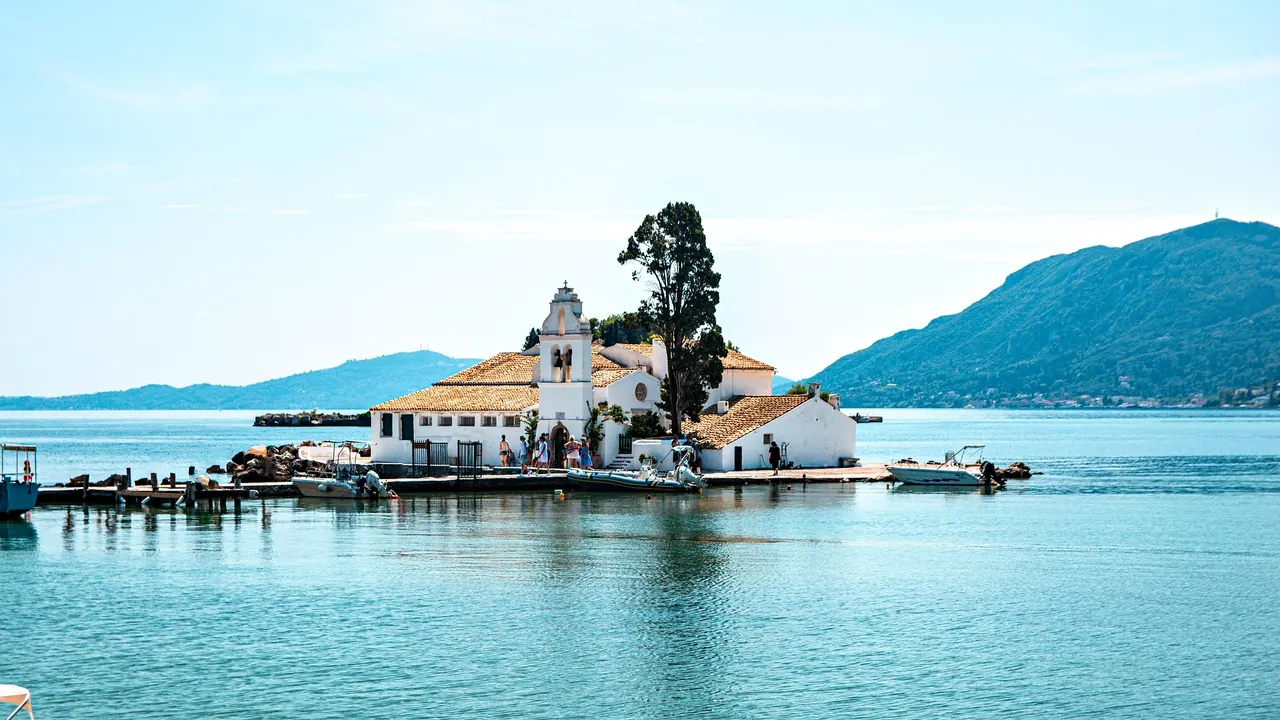
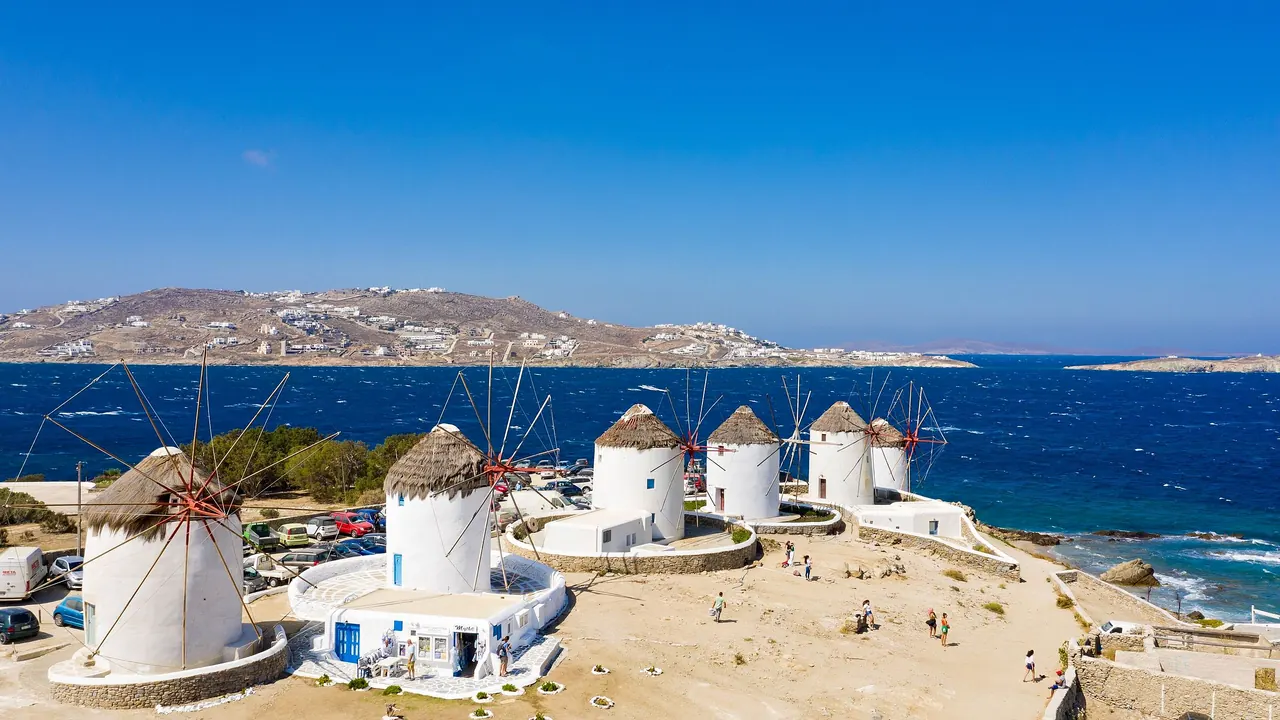
Photos: Corfu by Nico Hartnauer, Pexels License; Mykonos by dronepicr, CC BY 2.0, cropped.
Corfu or Mykonos?
Our verdict in twelve categories, each scored against the same fixed benchmark cities, and the climate month by month, so you can choose for your trip.
Choose Corfu for
- prices
- families
- live music and the arts
Corfu suits travellers who want a green, varied island to move around over a week or more. It has gentle sandy beaches for children, walking country on Pantokrator and along the Corfu Trail, a Venetian old town with real depth, and prices that stay sensible outside Corfu Town in high summer. You will want a hire car to get the most from the west coast and the hill villages, but the island repays the driving.
Choose Mykonos for
- nightlife
- shopping
- getting around
Mykonos is the pick for a short, sociable and expensive summer stay where the days are spent on the beach and the nights in Chora. It is compact, it has Delos a short boat ride away, and its run of beach clubs, bars and late dancing is something Corfu only matches in Kavos. In return you accept bare brown hills, few distractions for children and little real quiet in July and August.
Scoreboard
Twelve categories on one fixed scale from 0 to 100. The shaded stretch is the gap between the two.
Your match
Pick a travel style or drag the sliders, and both match scores follow your weighting.
Wins on prices and families with your weighting.
Wins on nightlife and shopping with your weighting.
What matters to you?
Category by category
What the scores mean for a trip.
Beaches & swimming
Both islands are first-rate beach destinations, but they offer different kinds of beach. Corfu has the more varied coastline: long sunset sands on the west coast at Glyfada and Halikounas, small cliff-backed coves at Paleokastritsa, shallow sandy water at Sidari and Roda, and pebble bays facing Albania around Kassiopi. Its sea is also a couple of degrees warmer in August.
Mykonos packs its beaches into a short south coast, which makes it easy to try several in a day, from sheltered Ornos to the sunbed rows of Psarou and the roomier sands of Elia. Many of them are organised around beach clubs. The wilder north coast is at the mercy of the meltemi.
Food & drink
On food the two are close, but they reward different meals. Corfu's cooking has its own Venetian-influenced character, with pastitsada, sofrito and fiery bourdeto, plus kumquat preserves and ginger beer, and you eat it best in Corfu Town's back lanes or in inland villages rather than in the resorts.
On Mykonos you are paying for the setting: grilled octopus in Little Venice and tables almost in the sea, alongside a polished high-end scene of fusion and sushi. Kopanisti cheese and the tavernas of Ano Mera are where the island's own flavours turn up.
Culture & sights
Both islands offer a few solid days of sightseeing, though of very different kinds. Corfu's strength is a whole UNESCO-listed town with Italian-looking lanes, two fortresses, the Liston arcades and several museums. Beyond the town you can add the Achilleion and the cliff-top ruin of Angelokastro.
Mykonos has one great ancient site, Delos, a full morning among the ruins of Apollo's sanctuary. Back on Mykonos itself, the sightseeing is mostly a matter of walking Chora's whitewashed maze and the windmills at Kato Mili.
Nightlife
This is where Mykonos pulls clearly ahead. Its nights start at the Paradise and Super Paradise beach clubs in the afternoon, move into Chora's cocktail and dance bars, shaped by a long-established gay scene, and finish in large clubs at sunrise, with international DJs through July and August.
Corfu's party scene is concentrated in Kavos, a young resort at the southern tip, with a smaller mixed run of bars in Ipsos and Dassia. For most visitors, an evening on Corfu means drinks under the Liston or a long taverna dinner in a village.
Nature & outdoors
Corfu is far better for anyone who wants landscape. Old olive groves and cypresses cover the island, Mount Pantokrator rises to about 900m above abandoned stone villages, the Corfu Trail runs the island's full length, and the Korission lagoon draws birdwatchers.
Mykonos is low, dry and rocky, beautiful for its light rather than its scenery, and walking there means country lanes out to spots such as the Armenistis lighthouse. Its real outdoor draw is the wind, which makes Korfos Bay and Kalafatis good for kitesurfing, and there is diving on its reefs and wrecks.
Day trips
Every day trip from either island goes by boat, and the options are broadly comparable. Corfu's go further afield in kind: olive-grove Paxos with the bays of Antipaxos, a crossing to Albania for the ruins of Butrint, or the mainland town of Parga under its castle.
From Mykonos you are island-hopping in the Cyclades: pilgrim Tinos, neoclassical Ermoupoli on Syros, and Paros and Naxos on fast boats. The meltemi can cancel these crossings.
Good for families
Corfu is much the better family choice. Its north coast and the southern sands of Issos and Agios Georgios slope gently into calm water, and resorts with pools and kids' clubs are common. The worry there is staying clear of Kavos and Ipsos.
On Mykonos, families can do well at Agios Stefanos, Ornos or Platis Gialos, and Delos can catch older children's interest. But Chora is loud and crowded late at night in high summer, the windy north coast is risky for small swimmers, and the cost of a family stay adds up fast.
Getting around
Mykonos is somewhat easier, mainly because it is small: nowhere is much more than half an hour from Chora. Buses reach the main south-coast beaches, and sea taxis hop between the bays. The weak point is the shortage of taxis in summer.
Corfu is about 60km long with sparse intercity buses and twisting roads in the north and west, so a car or scooter is close to essential for anything beyond one resort. On both islands the old town is best explored on foot.
Shopping & style
Mykonos is the better place to shop, as long as what you want is clothes. Matoyianni Street and the lanes around it are full of designer resort wear, linen, sandals, fine jewellery and galleries, and most stay open late into the evening, though much of it shuts outside the season.
Corfu Town's lanes off the Liston sell more local things, such as olive-wood boards, kumquat liqueur, olive oil and soaps, but there is little fashion beyond the ordinary chains.
Affordability
The cost gap is wide. Corfu is middling for a Mediterranean island, with fair taverna prices and reasonable package rooms on the north and east coasts. Only the villas around Kassiopi and peak-season Corfu Town are markedly expensive, and car hire is the main extra cost.
In season, Mykonos charges luxury rates for rooms, sunbeds, cocktails and taxis alike. Rooms at Ano Mera, gyros in Chora and the public buses help, but it never becomes cheap in summer.
Live music & performing arts
Corfu has a living musical tradition that is rare in Greece. Its philharmonic bands, some dating from the nineteenth century, play in the Spianada and in village squares through the summer and lead the Easter processions, and kantades serenades are still sung in tavernas. There are also classical evenings at the Old Fortress.
On Mykonos the music is essentially the DJ sets of its clubs, with only the odd open-air concert or village festival.
Wellness & relaxation
Neither island has a bathing tradition, and on both, wellness mostly means hotel spas. Corfu offers more ways to slow down, with yoga retreats among the olive groves and hill villages or the quiet northeast coast, where the days pass in long lunches.
On Mykonos, rest means choosing Agios Sostis, Ftelia or the bays beyond Kalafatis, or coming in early June or late September, because the high-summer rhythm of the island works against it.
When should you go?
Pick your month. The climate figures are measured averages, not a forecast.
Corfu in July
Mykonos in July
Daytime high, °C
Rainfall in the month, mm
Where the figures come from
Mykonos has no weather station within reach, so its figures come from a gridded climate model rather than a measured record, and read a broad area rather than one spot.
Temperature and rainfall are climate normals, averaged over the years shown. Corfu: 1991-2020 normals, Kerkyra Airport (0.9 km from centre). Mykonos: 2001-2020 normals, NASA POWER reanalysis grid, no weather station within 90 km.
Corfu runs hotter. July and August reach about 32°C, fine for the beach but heavy going for walking the old town at midday, and the sea is warm enough to swim from June to early October. Spring is the time for walking: April and May are warm, increasingly sunny and fairly dry. The rain comes back in September and turns heavy from October through to January, with November the wettest month at around 188mm. That wet season is what keeps the island so green.
Summer on Mykonos is milder, with highs of about 25°C, so Chora's lanes stay pleasant to walk even in August, and from June to August there is almost no rain. Its sea peaks at about 24°C, a little cooler than Corfu's, and the summer meltemi often decides which coast you can swim from. In winter both islands are cool, with daytime highs of about 14°C, but Mykonos is much drier and gets roughly half Corfu's rain from November to January.
Which traveller are you?
On a family trip with young children, Corfu is the easier choice. Tavernas welcome children at any hour, pirate-style and glass-bottom boat trips fill a morning, and older children can explore Corfu Town's fortresses. Mykonos, by contrast, is shaped around adult nights out.
For a trip on a tight budget, go to Corfu. Its tavernas, local wine and package resorts on the north and east coasts are fairly priced. In season Mykonos is one of Europe's most expensive places, and even careful spending there only softens the cost.
For a food and nightlife trip, Mykonos wins on the nights. Afternoon beach-club sessions, sunset drinks in Little Venice and clubs that run until sunrise go well with waterfront fish dinners. Corfu has better regional cooking, but its party scene is mostly confined to Kavos.
Before you go
| Measure | Corfu | Mykonos |
|---|---|---|
| Official language | Greek | Greek |
| Currency | Euro (EUR) | Euro (EUR) |
| Sockets | CF230 V, 50 Hz | CF230 V, 50 Hz |
| Driving side | Right | Right |
| Time zone | UTC+2, UTC+3 in summer | UTC+2, UTC+3 in summer |
| Emergency number | 112 | 112 |
| Main airport | Corfu Ioannis Kapodistrias International Airport (CFU)88 non-stop destinations | Mykonos Island National Airport (JMK)44 non-stop destinations |
| Public holidays this year | 15 days | 15 days |
By the numbers
| Measure | Corfu | Mykonos |
|---|---|---|
| Population | 100,854 | 10,134 |
| People per km² | 161 | 96 |
| Swim season, months above 21 °C | 5 months | 5 months |
Where else could you go?
Every comparison below shares a destination with this one, so you can follow Corfu or Mykonos somewhere new.