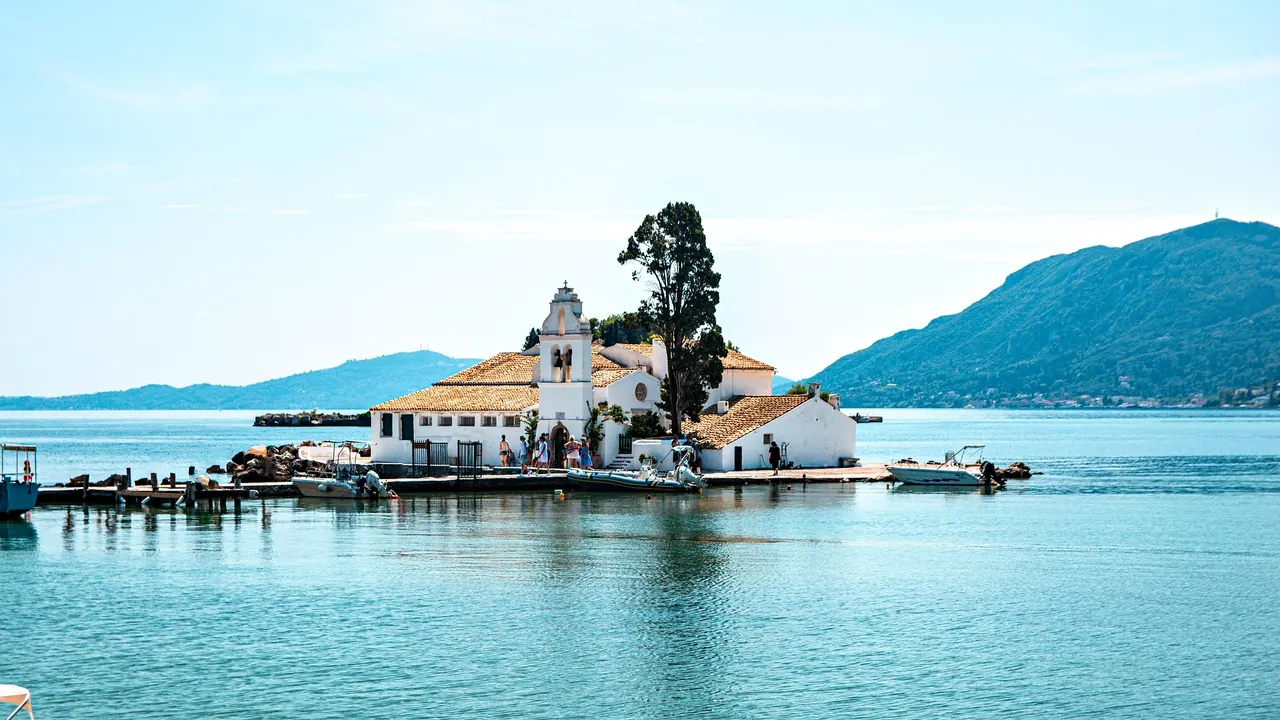
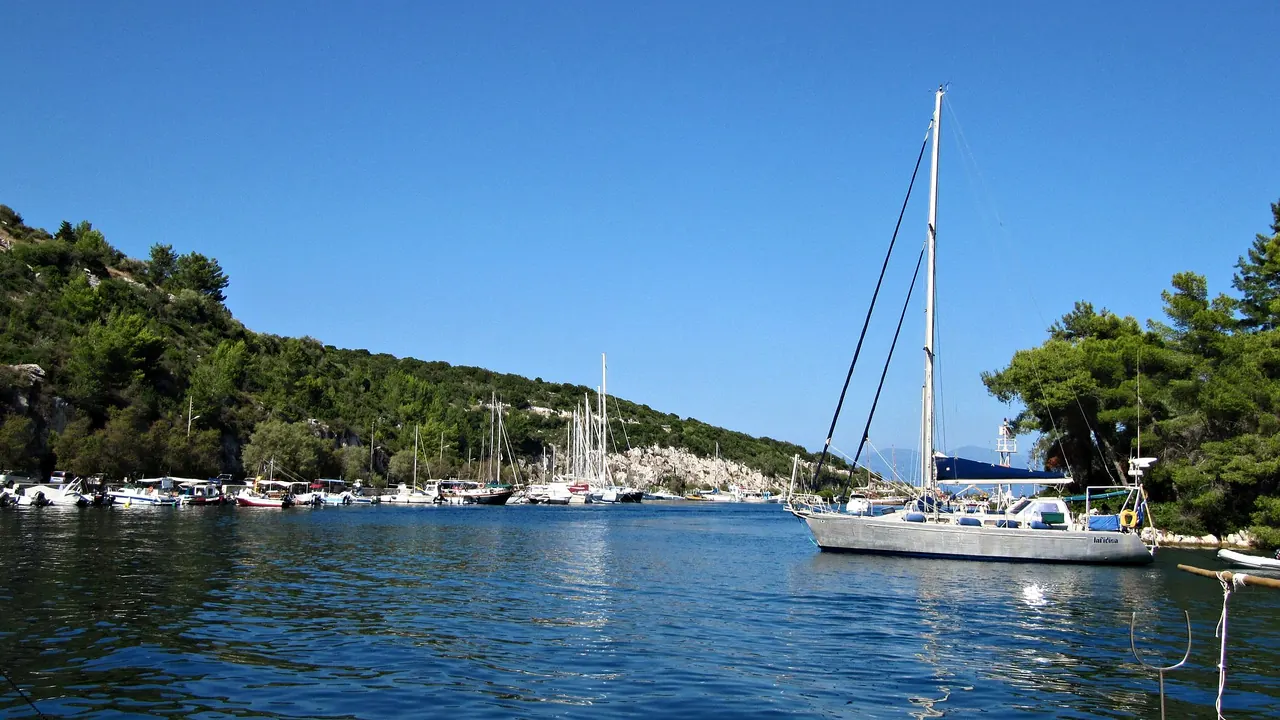
Photos: Corfu by Nico Hartnauer, Pexels License; Paxos by Poiesia, CC BY-SA 4.0, cropped.
Corfu or Paxos?
Our verdict in twelve categories, each scored against the same fixed benchmark cities, and the climate month by month, so you can choose for your trip.
Choose Corfu for
- culture and sights
- nightlife
- families
Corfu is the fuller island for a varied trip. It has a UNESCO-listed Venetian old town with two fortresses and the Liston, long sandy beaches on the west coast and gentle ones in the north, and evenings that run from cocktails in town to clubs in Kavos. Add family resorts, more day trips and lower costs, and it suits travellers who want plenty to choose from and don't mind hiring a car to reach it.
Choose Paxos for
- wellness
Paxos gives most of that up in return for quiet. It is a small island of olive groves and three harbour villages. You spend the days swimming in clear pebble coves or taking a little motorboat across to the sands of Antipaxos, and the evenings end with dinner beside the moored yachts. It suits couples and families with older children who want a slow villa stay. They should accept that it costs more and that sights, shops and late nights are a ferry ride away in Corfu.
Scoreboard
Twelve categories on one fixed scale from 0 to 100. The shaded stretch is the gap between the two.
Your match
Pick a travel style or drag the sliders, and both match scores follow your weighting.
Wins on culture and sights and nightlife with your weighting.
Wins on wellness with your weighting.
What matters to you?
Category by category
What the scores mean for a trip.
Beaches & swimming
Both islands are built for swimming, and both put you within a boat ride of Antipaxos and its turquoise bays at Voutoumi and Vrika. The difference is the shore at your door. Corfu has long sand: Glyfada, Issos and Halikounas on the west coast, with sunsets and some surf, the shallow north coast at Sidari and Roda, and small clear coves under the cliffs at Paleokastritsa.
Paxos is mostly small pebble coves along its sheltered east coast. The only real sand is in the round bay at Lakka, and the cliffs of the west coast have no beaches at all. In return, a small hired motorboat lets you treat the whole coastline as your beach, which suits people who like hopping between coves more than settling on one long strand.
Food & drink
Corfu has more to eat. Its Venetian past shows in pastitsada, sofrito and a fiery bourdeto, and there is kumquat liqueur and the island's own ginger beer to try. The back lanes of Corfu Town and the inland village tavernas give real choice, as long as you steer clear of the resort menus.
Paxos cooks the same Ionian dishes, often with care because so many of its visitors stay in villas, and its own olive oil is excellent. But the harbour tavernas of Gaios, Lakka and Loggos offer a small range that repeats from one menu to the next, and many kitchens close once summer ends.
Culture & sights
The two islands differ most here. Corfu Town alone is worth the trip: a UNESCO-listed old town of tall Venetian houses and narrow kantounia, the Liston beside the Spianada, the Old and New Fortresses, a museum of Asian art and the archaic Gorgon pediment. Out on the island are the Achilleion palace and the clifftop ruins of Angelokastro.
Paxos has a ruined Venetian fort on an islet off Gaios harbour, a small museum of island life and olive farming, and old presses and chapels along its inland lanes. They are pleasant to come across on a walk, but visitors who want history take the boat to Corfu Town.
Nightlife
Corfu offers real choice, as long as you pick the right place. Kavos, at the southern tip, is a party strip for young visitors that runs until dawn. Ipsos and Dassia are a milder mix of beach bars, and Corfu Town does the grown-up evening, with cocktails under the Liston arcades and bars in the old lanes.
On Paxos the evening is a long harbour dinner and then a drink by the moored yachts in Gaios or Lakka. Gaios stays up late in July and August and has one or two places to dance. The rest of the year the island goes quiet soon after dinner.
Nature & outdoors
Corfu has more varied ground. Mount Pantokrator rises to about 900m in the north, with abandoned stone villages and views across to Albania. The Corfu Trail runs the whole length of the island, and the Korission lagoon in the south draws birdwatchers.
Paxos is small and low, with a waymarked trail through its olive groves and mule tracks between stone walls. Its one dramatic stretch is the white limestone west coast, with the Erimitis cliffs and the Tripitos arch, best seen from a kayak or a boat. On both islands, walking is for spring and autumn.
Day trips
Both islands depend on boats, and they share several outings: Parga and the coves of Sivota on the mainland, and the beaches of Antipaxos. Corfu has the longer list. It adds Paxos itself, the quiet Diapontia islands and the short crossing to Saranda for the Greek, Roman and Venetian ruins of Butrint in Albania.
From Paxos the best day out is about an hour by fast ferry to Corfu Town and its fortresses. After that the choice is thin, and rough seas can cancel plans.
Good for families
Corfu is much easier with children. Gently shelving sand at Roda, Acharavi, Issos and Agios Georgios, resorts built around pools and kids' clubs, a water park inland and pirate-style boat trips cover most needs, provided you keep away from Kavos and Ipsos.
Paxos suits families with older children who love swimming and snorkelling. Lakka's shallow bay is the one really good spot for small children. Most other beaches are pebble with steep paths down, and there is little to do on a grey day.
Getting around
Getting about takes much the same effort on both islands: buses are infrequent, the roads are narrow and winding, and most visitors hire a car or scooter. On Corfu the distances are real, about 60km from end to end, and summer traffic is heavy around Corfu Town, though the old town itself is best on foot.
Paxos is only about 10km long, and footpaths through the olive groves link its villages. But it has no airport, so every arrival depends on a ferry that rough seas can cancel, and a small hired boat is often the most useful way to get around.
Shopping & style
Neither island is a shopping destination. Still, the lanes of Corfu Town around Nikiforou Theotoki and behind the Liston are good for browsing, with olive-wood bowls, kumquat sweets, soaps and jewellery, and there are Greek clothing chains in the newer part of town. Paxos has a few summer boutiques selling linen and beachwear in Gaios and Lakka, its olive oil and honey are the best things to take home, and anything practical means a trip to Corfu.
Affordability
Corfu is the cheaper of the two. Package resorts on the north and east coasts offer reasonable rooms, and taverna meals and buses are fairly priced. Only the villa coast around Kassiopi and Corfu Town in high summer push costs up.
Paxos is one of the dearer Greek islands. Most rooms are in villas and small guesthouses, the harbourside restaurants charge for their setting, and ferries plus boat or car hire add to the bill. On both islands, self-catering and the shoulder months bring costs down.
Live music & performing arts
Corfu has a musical life few Greek islands share. Its historic philharmonic bands play on the Spianada and in village squares through the summer and lead the Easter processions, and kantades are still sung in tavernas.
Paxos has a small chamber music festival at the end of summer and its saints' day festivals, above all the August feast of the Panagia in Gaios. Outside those dates there is little more than the odd taverna guitarist.
Wellness & relaxation
Neither island has a bathing tradition, and on both the treatments come down to hotel spa rooms and yoga retreats among the olive groves. What you really get is pace. Paxos offers it almost everywhere, with few cars, no high-rise building and harbours that wake slowly, especially in May, June and September.
On Corfu, calm depends on where you stay. A hill village or the northeast coast is deeply restful, while the busy resort strips in high summer are the opposite.
When should you go?
Pick your month. The climate figures are measured averages, not a forecast.
Corfu in July
Paxos in July
Daytime high, °C
Rainfall in the month, mm
Where the figures come from
Paxos's temperatures are measured 52 km from the centre, at Kerkyra Airport.
Paxos has no rain gauge within 25 km of the centre, so its rainfall comes from a gridded climate dataset read at the destination rather than from a gauge further away.
Temperature and rainfall are climate normals, averaged over the years shown. Corfu: 1991-2020 normals, Kerkyra Airport (0.9 km from centre). Paxos: 1991-2020 normals, Kerkyra Airport (52.1 km from centre).
The two islands share almost the same weather, so the month you pick hardly changes which island you pick. The sea is warm enough to swim from June into early October and peaks around 26°C in August. July and August reach about 32°C, too hot for long walks or a slow afternoon in the lanes of Corfu Town. That matters more on Corfu, where sightseeing is part of the trip. May, June and September bring long sunny days without the worst of the heat.
Rain returns in late September and is heavy from October through the winter. November is the wettest month, with around 188mm on Corfu and a little less on Paxos. Spring is the best time for walking on either island, when the olive groves are green and the wildflowers are out, but the sea is still cool for swimming until June.
Which traveller are you?
For a culture and arts trip, Corfu wins easily. Corfu Town's Venetian lanes, its two fortresses, Agios Spyridon and its museums fill several days, and Angelokastro and the Achilleion add more. Paxos has only a harbour fort and one small museum.
On a food and nightlife trip, Corfu is the clear choice. Its Venetian-rooted dishes are at their best in the back lanes of Corfu Town, and evenings range from the Liston arcades to all-night Kavos. On Paxos an evening means a harbour dinner and a drink.
For a relaxing and wellness trip, Paxos has the gentler mood. Neither island has a spa tradition. But Paxos has few cars, no high-rise building and villas among the olive trees, while on Corfu you have to choose your base carefully to find the same calm.
Before you go
| Measure | Corfu | Paxos |
|---|---|---|
| Official language | Greek | Greek |
| Currency | Euro (EUR) | Euro (EUR) |
| Sockets | CF230 V, 50 Hz | CF230 V, 50 Hz |
| Driving side | Right | Right |
| Time zone | UTC+2, UTC+3 in summer | UTC+2, UTC+3 in summer |
| Emergency number | 112 | 112 |
| Main airport | Corfu Ioannis Kapodistrias International Airport (CFU)88 non-stop destinations | Corfu Ioannis Kapodistrias International Airport (CFU)88 non-stop destinations |
| Public holidays this year | 15 days | 15 days |
By the numbers
| Measure | Corfu | Paxos |
|---|---|---|
| Population | 100,854 | 2,300 |
| People per km² | 161 | 91 |
| Swim season, months above 21 °C | 5 months | 5 months |
Where else could you go?
Every comparison below shares a destination with this one, so you can follow Corfu or Paxos somewhere new.