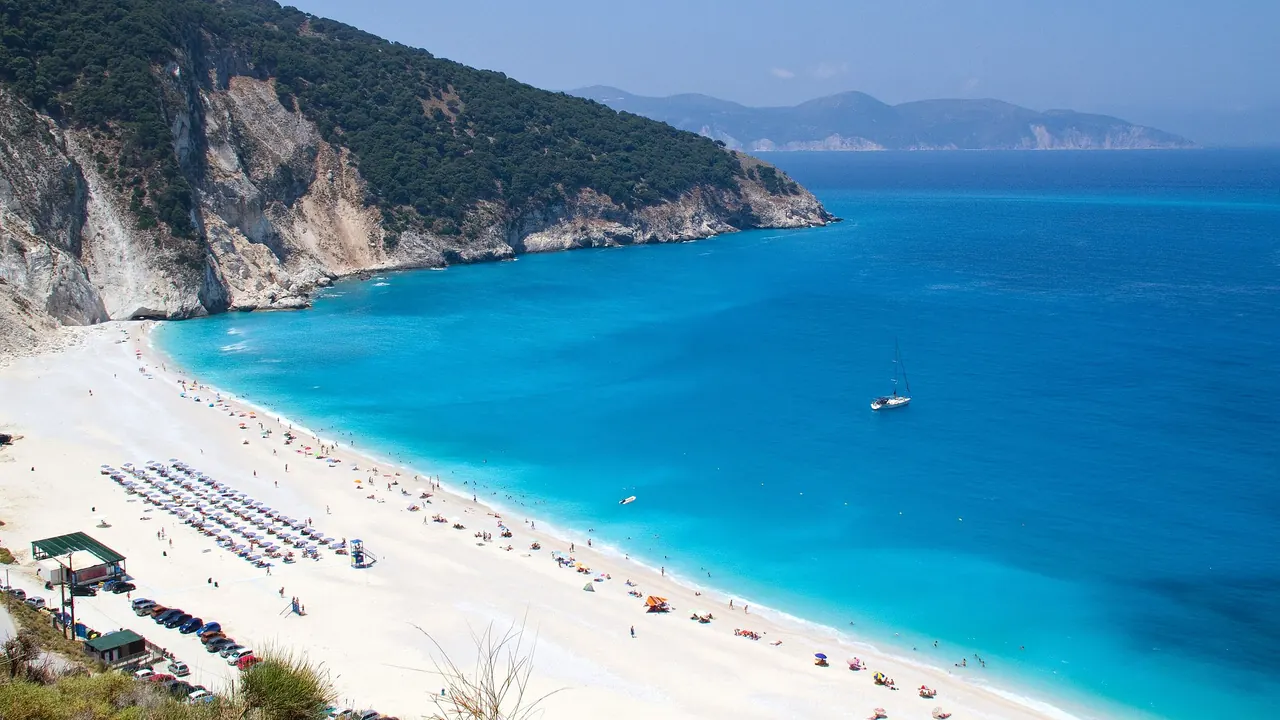
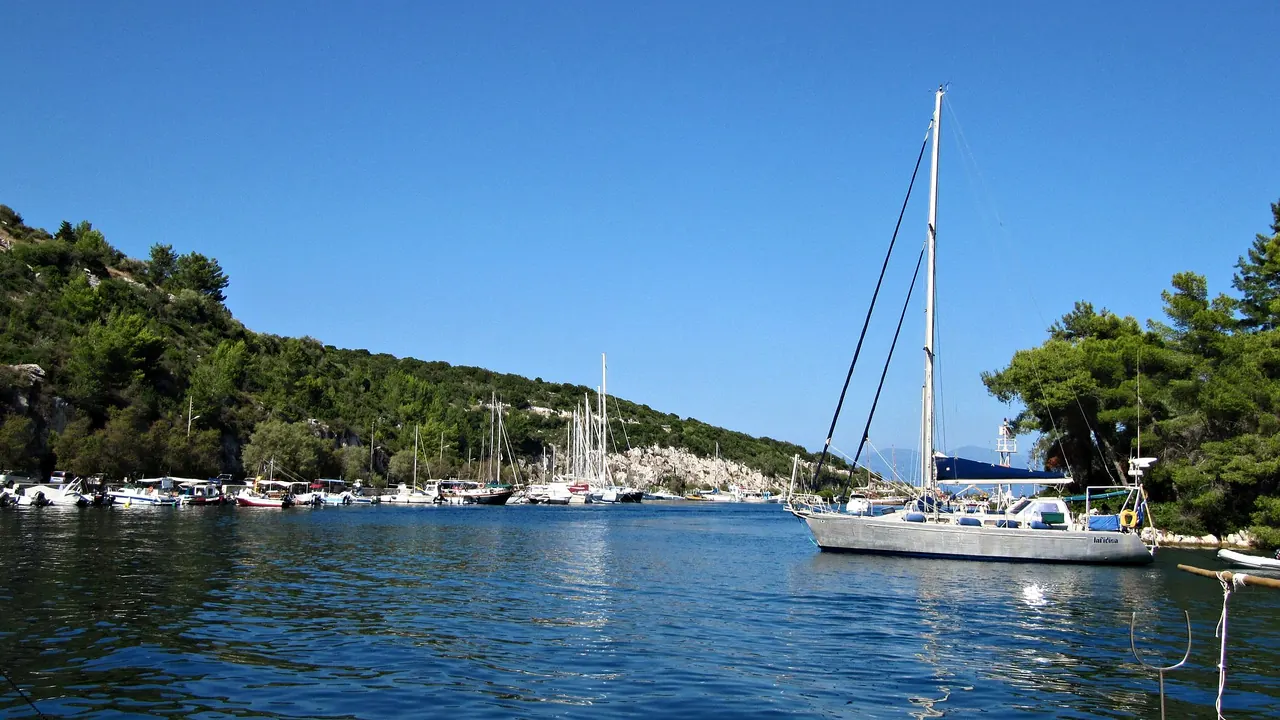
Photos: Kefalonia by Tony Hisgett from Birmingham, UK, CC BY 2.0, cropped; Paxos by Poiesia, CC BY-SA 4.0, cropped.
Kefalonia or Paxos?
Our verdict in twelve categories, each scored against the same fixed benchmark cities, and the climate month by month, so you can choose for your trip.
Choose Kefalonia for
- nature and the outdoors
- prices
- food and drink
Kefalonia suits travellers who want a large island to explore by car. It has mountains, a fir-forested national park, caves and beaches on several coasts, and in between there are wineries, island dishes and a few castles and monasteries. It is also the cheaper of the two and the easier choice with young children, as long as you base yourself near the sandy south. In return you spend long stretches on winding roads.
Choose Paxos for
- getting around
- wellness
Paxos is the choice for a small, slow island where most of the day happens on the water. You hire a boat, swim in coves the roads never reach, cross to the sand of Antipaxos and come back to dinner on a harbour full of yachts. You give up range and spend more for it, and there is less to do on land. What you get is a quieter, more compact stay among olive groves.
Scoreboard
Twelve categories on one fixed scale from 0 to 100. The shaded stretch is the gap between the two.
Your match
Pick a travel style or drag the sliders, and both match scores follow your weighting.
Wins on nature and the outdoors and prices with your weighting.
Wins on getting around and wellness with your weighting.
What matters to you?
Category by category
What the scores mean for a trip.
Beaches & swimming
Both islands have exceptionally clear water. Kefalonia's beaches are spread more widely and offer more variety: the white pebble arc of Myrtos under cliffs, quieter Petani on Paliki, reddish sand at Xi and long sandy stretches at Skala and Lourdas. Because they lie on different coasts, a beach day there usually means a drive.
Paxos works by boat rather than by road. Its own beaches are mostly small pebble coves along the east coast, with sandy shallows only in Lakka bay. The pale sand of Voutoumi and Vrika is across the water on Antipaxos, and those beaches crowd at midday in high summer.
Food & drink
Kefalonia gives you more to eat and drink. It has dishes of its own, such as meat pie, bourbourelia soup and aliada with salt cod, along with thyme honey and mandoles. Robola wineries in the Omala valley offer tastings, and Argostoli has a fish market and the widest choice of places to eat.
Paxos has fewer kitchens, many of which close out of season. Its harbour tavernas can be careful cooks thanks to the villa trade, serving bourdeto, sofrito and the island's olive oil. The choice is still too small to plan a trip around.
Culture & sights
Neither island is a culture trip, but Kefalonia has more to see. You can visit the Venetian-era harbour at Fiskardo, the fortress at Assos, the Castle of Agios Georgios, the Mycenaean tomb at Tzanata, a museum in Argostoli and the Agios Gerasimos monastery.
On Paxos the sights are the fort and monastery islets off Gaios, a small folk museum and the stone houses and olive presses you pass inland. For real history, visitors take the boat to Corfu Town.
Nightlife
Evenings on both islands mean dinner by the water and a drink afterwards, and neither has a real club scene. Kefalonia offers a little more choice: the cocktail and beach bars along Lassi and a late crowd on Argostoli's Lithostroto in summer. On Paxos the evening centres on the Gaios and Lakka waterfronts, among the moored yachts.
Nature & outdoors
Kefalonia's landscape is far bigger. Mount Ainos rises to about 1,628m in a national park of Greek fir. The west coast has tall cliffs, and under the karst lie the cave lake of Melissani and the Drogarati chamber. Loggerhead turtles feed in Argostoli harbour.
Paxos is low and covered in olive groves, with an end-to-end walking trail. Its best scenery is the cliffs of the west coast, the Erimitis cliffs and the Tripitos arch, which are best seen by boat or kayak, and the snorkelling is good.
Day trips
Both islands offer a few good outings by sea, and the choices differ. From Kefalonia, Ithaca is a short ferry ride, with Vathy, Kioni and the sites linked to Odysseus, and summer boats run to Zakynthos and Lefkada. Fiskardo and Paliki make outings on the island itself.
From Paxos the best day out is Corfu Town, with its UNESCO-listed old town, about an hour away by fast ferry. Boats also go to Parga on the mainland and to the beaches of Antipaxos. Weather and timetables decide what you can do.
Good for families
Kefalonia works better with small children, provided you stay in the south. Skala, Lourdas and Xi have sandy, gently shelving water, and the Melissani boat ride and the turtles in Argostoli harbour are easy wins. The drives can be long and hot.
Paxos suits older children who like to swim and snorkel. Lakka bay is the one easy spot for toddlers. Elsewhere the beaches are pebble coves with steep paths down to them, and on a bad-weather day there is little to do.
Getting around
Paxos is easier once you are there. The island is only about 10km long, so nothing is far, the villages are joined by footpaths and a small hired boat reaches the best coves. Getting there is the catch: there is no airport, and the ferries can be cancelled in rough seas.
Kefalonia has its own airport, but on the island a rented car is close to essential. Argostoli to Fiskardo takes about an hour and a half on winding roads, buses are rare and parking at Myrtos and Assos is tight in summer.
Shopping & style
Shopping is slight on both, and the best things to take home are food. Kefalonia has the Lithostroto in Argostoli for everyday clothes and gifts, plus Robola wine and mandoles. Paxos has linen and jewellery boutiques behind the Gaios and Lakka harbours, and its olive oil.
Affordability
On Kefalonia, what you pay depends mostly on where you stay. The yachting harbours of Fiskardo and Assos have few rooms and charge for them, while the resorts and villages of the south keep the island as a whole within reach. Waiting until June or September brings prices down while the sea is still warm.
Paxos has much less choice. Most beds are in private villas and small guesthouses, so there is little cheap option to fall back on, and July and August book up early. Cooking for yourself and choosing the plainer tavernas over the harbour fronts cut costs most, and the easier months start earlier, in May.
Live music & performing arts
Neither island has regular theatre or concerts, and each has its own seasonal music. On Kefalonia you might hear kantades serenades or Argostoli's philharmonic band at summer concerts and village festivals. Paxos has a small chamber music festival at the end of summer and the August feast of the Panagia in Gaios, with dancing late into the night.
Wellness & relaxation
Neither island has a spa tradition, so on both the rest comes from the pace, and the two kinds of slow life differ. On Kefalonia it means a long lunch in a hill village and an evening on the harbour at Assos or Fiskardo, with the Paliki peninsula and the north-east coast as the quieter corners. If you want treatments, the bigger resort hotels around Lassi, Skala and Fiskardo have spas.
On Paxos the calm covers the whole small island rather than a few chosen corners. Its harbours wake up slowly and there is little to pull you away from the water. Treatments come down to a few massage rooms in hotels and villas. On both islands the quiet comes either side of high summer: in May, June and September on Paxos, when the day boats from Corfu thin out, and in June and September on Kefalonia.
When should you go?
Pick your month. The climate figures are measured averages, not a forecast.
Kefalonia in July
Paxos in July
Daytime high, °C
Rainfall in the month, mm
Where the figures come from
Kefalonia's temperatures are measured 59 km from the centre, at Zakinthos / Agrilia.
Kefalonia has no rain gauge within 25 km of the centre, so its rainfall comes from a gridded climate dataset read at the destination rather than from a gauge further away.
Paxos's temperatures are measured 52 km from the centre, at Kerkyra Airport.
Paxos has no rain gauge within 25 km of the centre, so its rainfall comes from a gridded climate dataset read at the destination rather than from a gauge further away.
Temperature and rainfall are climate normals, averaged over the years shown. Kefalonia: 1991-2020 normals, Zakinthos / Agrilia (58.6 km from centre). Paxos: 1991-2020 normals, Kerkyra Airport (52.1 km from centre).
The two islands share almost the same climate. Both are warm enough for the beach from June to October, when the sea is pleasant for swimming and reaches about 26°C in August. July and August are hot on both, with afternoons around 33°C, so walking and sightseeing are best done early. May and late September are the better months for trails, villages and the hill roads of Kefalonia's Mount Ainos. Kefalonia, measured around the main resort area, gets a little more sun through the summer.
The rain comes back in autumn on both, a little sooner on Paxos, which has 91mm in September against Kefalonia's 65mm. From November to February both are wet and cool, with around 160mm of rain in the wettest months. That is weather for a quiet off-season stay rather than a beach trip.
Which traveller are you?
On an outdoors trip, Kefalonia is the clear pick. Mount Ainos has fir forest, trails and semi-wild horses, and there are the Melissani and Drogarati caves, the cliff roads above Myrtos and kayaking on the north-east coast. Paxos has olive-grove paths and sea caves but no high ground.
For a trip on a tight budget, Kefalonia goes further. Apartments around Skala, Lourdas and Lassi are fair value and taverna meals are reasonable. On Paxos, villas, ferry crossings and the boat or car hire most visitors need all push the cost of a stay up.
For a relaxing and wellness trip, Paxos has the edge. It has few cars, no high-rise building and villas among the olive trees, and some estates run yoga weeks. Kefalonia slows down too, but its size means more driving and busier resorts in high summer.
Before you go
| Measure | Kefalonia | Paxos |
|---|---|---|
| Official language | Greek | Greek |
| Currency | Euro (EUR) | Euro (EUR) |
| Sockets | CF230 V, 50 Hz | CF230 V, 50 Hz |
| Driving side | Right | Right |
| Time zone | UTC+2, UTC+3 in summer | UTC+2, UTC+3 in summer |
| Emergency number | 112 | 112 |
| Main airport | Kefalonia International Airport "Anna Pollatou" (EFL)41 non-stop destinations | Corfu Ioannis Kapodistrias International Airport (CFU)88 non-stop destinations |
| Public holidays this year | 15 days | 15 days |
By the numbers
| Measure | Kefalonia | Paxos |
|---|---|---|
| Population | 36,064 | 2,300 |
| People per km² | 49 | 91 |
| Swim season, months above 21 °C | 5 months | 5 months |
Where else could you go?
Every comparison below shares a destination with this one, so you can follow Kefalonia or Paxos somewhere new.
- Corfuvs Paxos
- Zakynthosvs Kefalonia
- Lefkadavs Paxos
- Lefkadavs Kefalonia
- Corfuvs Kefalonia
- Zakynthosvs Paxos