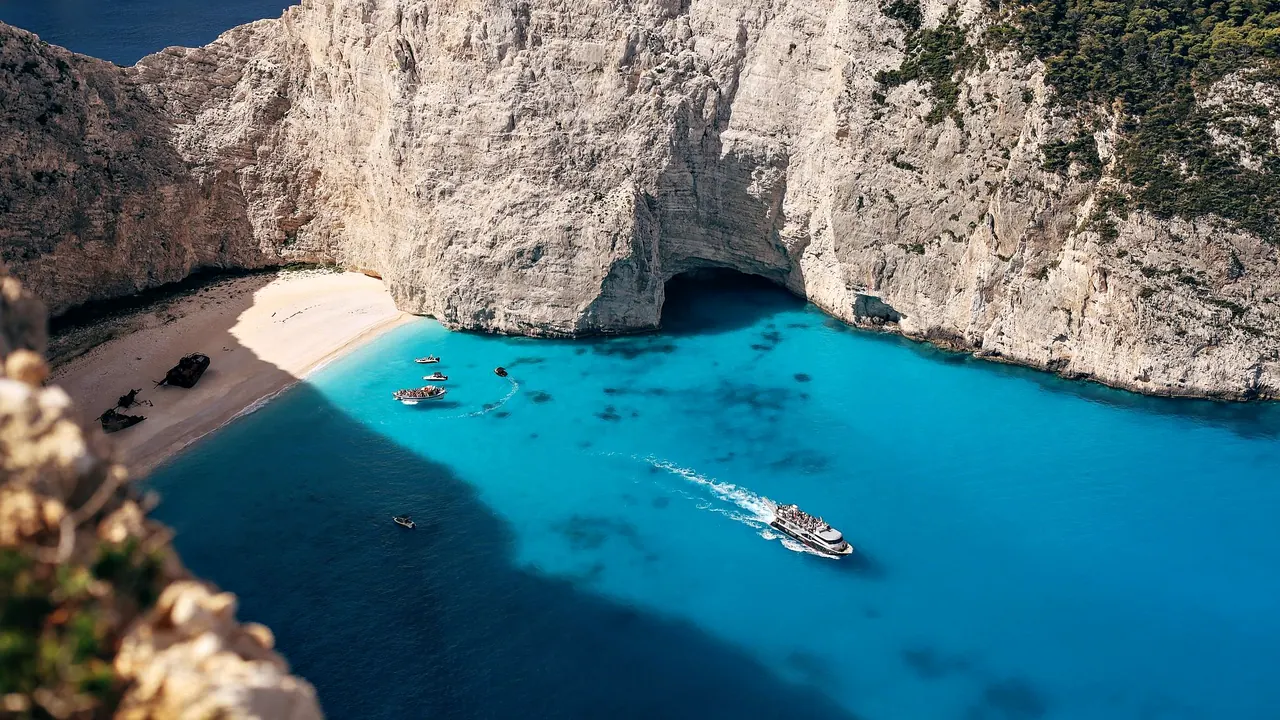
Photos: Zakynthos by Sadettin Dogan, Pexels License.
Kefalonia or Zakynthos?
Our verdict in twelve categories, each scored against the same fixed benchmark cities, and the climate month by month, so you can choose for your trip.
Choose Kefalonia for
- day trips
- nature and the outdoors
- food and drink
Kefalonia suits travellers who want an island to explore by car, with scenery as much as sand. It is bigger, greener and more mountainous, with the fir forest of Mount Ainos, the Melissani cave lake, Robola tastings in the Omala valley and the old harbour of Fiskardo. Ithaca is a short ferry ride away. Couples and independent travellers who like quiet evenings by the water will feel most at home here.
Choose Zakynthos for
- nightlife
- families
- prices
For a resort vacation, Zakynthos is the easier choice. The island is compact, so journeys stay short, and the north-east coast has calm, shallow beaches and hotels built for families. Package deals keep it a little cheaper. It also has Laganas, the one real party strip on either island, which draws young groups and is easy for everyone else to avoid. The wreck at Navagio can be seen from the clifftop above or from a boat, and boats from the northern tip take swimmers to the Blue Caves.
Scoreboard
Twelve categories on one fixed scale from 0 to 100. The shaded stretch is the gap between the two.
Your match
Pick a travel style or drag the sliders, and both match scores follow your weighting.
Wins on day trips and nature and the outdoors with your weighting.
Wins on nightlife and families with your weighting.
What matters to you?
Category by category
What the scores mean for a trip.
Beaches & swimming
Both islands have outstanding beaches and equally clear water, but the beaches are of different kinds. Kefalonia's best-known beaches are pebble beaches below cliffs: Myrtos and Petani on the north-west and Paliki shores, and Antisamos near Sami. For sand you head to Skala, Lourdas or Xi, and because these beaches lie on different coasts, a beach vacation here involves a fair amount of driving.
Zakynthos has more sand close together. Laganas Bay, the Vasilikos coves and the shallow north-east coast are all within easy reach, and Gerakas and Dafni are kept undeveloped for nesting turtles. Its most famous view, the wreck at Navagio, is a sight to look at from above or from a boat, and resort sunbeds fill up in high summer.
Food & drink
Both islands eat in Greek tavernas, and each has its own dishes. Kefalonia has a slight edge because of its wine: the Omala valley wineries offer Robola tastings, and Argostoli has a waterfront fish market alongside the meat pie and garlicky aliada. Harbour tavernas at Fiskardo and Assos make dinner the main event of the evening.
On Zakynthos, look for skordostoumbi, ladotyri cheese and Verdea wine in the villages around Keri, because Laganas and Tsilivi lean towards English breakfasts and international menus. Neither island has much fine dining.
Culture & sights
The 1953 earthquake left both islands with plain rebuilt towns, so sightseeing is a sideline on either. Kefalonia's sights are spread out: Fiskardo, which survived the earthquake, the Venetian fortress at Assos, the Mycenaean tomb at Tzanata and the deserted village of Old Vlachata.
Zakynthos keeps most of its sights in its capital. The Byzantine Museum on Solomos Square, with its Ionian school icons, the Solomos museum and the castle on Bochali hill make a neat half day in one place.
Nightlife
Zakynthos is far stronger for a night out, though almost all of it is in one place. Laganas in summer is a strip of clubs, promoters and foam parties that goes on until dawn, aimed at young British groups, while the rest of the island is quiet by comparison.
Kefalonia has nothing similar. A late evening there means the Lithostroto in Argostoli, cocktail bars at Lassi or a harbour bar in Skala or Fiskardo. Clubs are few and small, which is exactly why couples who want to avoid the party crowd choose it.
Nature & outdoors
Kefalonia has the richer landscape inland. Mount Ainos rises to about 1,628m and is a national park, with forests of Greek fir and semi-wild horses. Below ground are the Melissani cave lake and the Drogarati chamber, so there is more to do on foot than on Zakynthos.
Zakynthos's scenery is mostly coastal: the cliffs at Keri and above Navagio, the sea caves at Cape Skinari and the Laganas Bay marine park, where turtle-spotting boats go out early. It also has the better diving and snorkelling of the two.
Day trips
Kefalonia is better placed for trips off the island. Ithaca is a short ferry ride from Sami, with Vathy, Kioni and the sites linked to Odysseus, and in summer boats run from Pessada to Zakynthos and from Fiskardo to Lefkada.
Zakynthos's options are fewer and longer. There is a summer ferry to southern Kefalonia, and a crossing of about an hour to Kyllini on the mainland, from which Chlemoutsi castle is close and ancient Olympia makes a long day.
Good for families
Zakynthos is the easier island for families. The north-east coast around Tsilivi, Planos and Alykes has calm, shallow water and resort hotels with pools and kids' clubs. There is a water park inland, and because the island is small, no drive is long.
Kefalonia works for families who stay on the south coast at Skala or Lourdas, or at Xi, and children enjoy the boat ride through Melissani. But it has no attractions built for children, and the long, winding drives in summer heat make each day out harder.
Getting around
On both islands you really need a car, but Zakynthos makes it a little easier. It is only about 40km long, buses reach the main resorts, taxis are easy to find, and boat excursions cover many of the beaches and caves.
Kefalonia is larger and more mountainous. Argostoli to Fiskardo takes about an hour and a half on ridge and cliff roads, buses run too rarely to plan a day around, and the summer ferry across the bay to Lixouri is a useful short cut.
Shopping & style
Neither island is a place to shop. On both, the best things to take home are honey, olive oil, local wine and almond sweets, mandoles on Kefalonia and mantolato nougat on Zakynthos. Kefalonia adds the small boutiques around Fiskardo's harbour, while Zakynthos has village lace and weaving around Volimes.
Affordability
Zakynthos is the cheaper of the two, mainly because package tourism keeps room prices in its big resorts moderate even in summer. Boat trips and sunbeds still add up over a week.
Kefalonia costs a little more. Apartments around Skala, Lourdas and Lassi are fair value, but Fiskardo and Assos, with their yachting crowd, are expensive, and car hire is close to unavoidable. On both islands June and September are cheaper than high summer.
Live music & performing arts
The two islands are alike here: both share the kantades serenade tradition and an old philharmonic band, and neither has a theatre or concert season. On Kefalonia you are most likely to hear music at summer open-air concerts in Argostoli's squares. On Zakynthos the songs turn up informally in town and village tavernas, and at carnival villagers perform omilies, a traditional folk street theatre.
Wellness & relaxation
Neither island has a spa culture beyond the hotels, so rest on both comes from a slower pace. Kefalonia makes that a little easier, because it has no party zone to steer around, and the Paliki peninsula, the north-east coast and evenings in Assos are quiet by default.
On Zakynthos, calm depends on where you stay: the hill villages around Keri, the Vasilikos peninsula or the small northern harbours, well away from Laganas. In return it has the cool sulphur springs that bubble into the sea at Xigia.
When should you go?
Pick your month. The climate figures are measured averages, not a forecast.
Kefalonia in July
Zakynthos in July
Daytime high, °C
Rainfall in the month, mm
Where the figures come from
Kefalonia's temperatures are measured 59 km from the centre, at Zakinthos / Agrilia.
Kefalonia has no rain gauge within 25 km of the centre, so its rainfall comes from a gridded climate dataset read at the destination rather than from a gauge further away.
Temperature and rainfall are climate normals, averaged over the years shown. Kefalonia: 1991-2020 normals, Zakinthos / Agrilia (58.6 km from centre). Zakynthos: 1991-2020 normals, Zakinthos / Agrilia (4.3 km from centre).
The two islands have almost the same temperatures and sunshine, so the month you travel hardly affects which island to choose. Both are warm enough for the beach from June to October, with daytime highs around 33°C in July and August and the sea reaching about 26°C in August. The midsummer heat makes walking hard after mid-morning, so late September and early October are the best months for combining swimming with time on foot. May is pleasant for walking too, though the sea is still cool. From November to February both islands are cool and wet, with close to 150mm of rain in the wettest months.
The difference is in the rain either side of summer. Kefalonia is a little wetter in spring and in autumn. In September it gets about 65mm against roughly 50mm on Zakynthos, and the gap continues into October. Neither difference is large enough to spoil an early autumn trip to either island.
Which traveller are you?
On a family trip with young children, Zakynthos is the easier choice. Tsilivi, Planos and Alykes have shallow sand and hotels with kids' clubs, there is a water park, and short drives mean less time spent in a hot car.
For an outdoors trip, choose Kefalonia. Mount Ainos has forest trails and a summit with views, Melissani and Drogarati add caves, and sea kayaking and sailing towards Ithaca fill the days. Zakynthos's landscape is mostly coast seen from a boat.
On a food and nightlife trip, Zakynthos wins if going out matters, because Laganas runs until dawn all summer. Kefalonia eats slightly better, with Robola wine and harbour tavernas, but its evenings end over dinner.
Before you go
| Measure | Kefalonia | Zakynthos |
|---|---|---|
| Official language | Greek | Greek |
| Currency | Euro (EUR) | Euro (EUR) |
| Sockets | CF230 V, 50 Hz | CF230 V, 50 Hz |
| Driving side | Right | Right |
| Time zone | UTC+2, UTC+3 in summer | UTC+2, UTC+3 in summer |
| Emergency number | 112 | 112 |
| Main airport | Kefalonia International Airport "Anna Pollatou" (EFL)41 non-stop destinations | Zakynthos International Airport "Dionysios Solomos" (ZTH)69 non-stop destinations |
| Public holidays this year | 15 days | 15 days |
By the numbers
| Measure | Kefalonia | Zakynthos |
|---|---|---|
| Population | 36,064 | 41,180 |
| People per km² | 49 | 102 |
| Swim season, months above 21 °C | 5 months | 5 months |
Where else could you go?
Every comparison below shares a destination with this one, so you can follow Kefalonia or Zakynthos somewhere new.
- Lefkadavs Kefalonia
- Lefkadavs Zakynthos
- Corfuvs Kefalonia
- Peloponnesevs Zakynthos
- Peloponnesevs Kefalonia
- Corfuvs Zakynthos