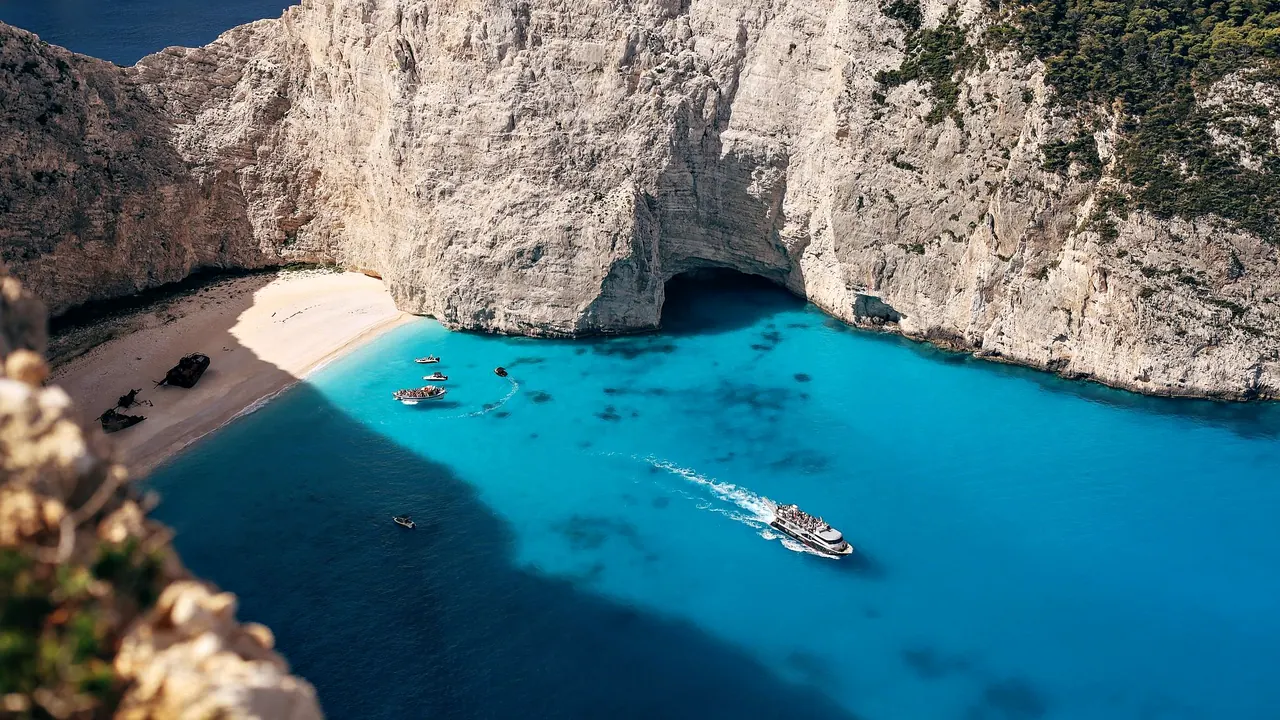
Photos: Zakynthos by Sadettin Dogan, Pexels License.
Peloponnese or Zakynthos?
Our verdict in twelve categories, each scored against the same fixed benchmark cities, and the climate month by month, so you can choose for your trip.
Choose Peloponnese for
- culture and sights
- day trips
- live music and the arts
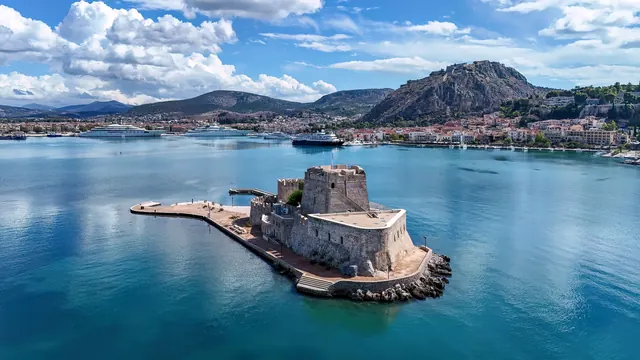
Choose the Peloponnese for a touring trip with a hire car, where the beach shares the days with history and hills. From Nafplio, Mycenae and Epidaurus are an easy morning's drive, with the sheltered bays of Tolo for the afternoon. Olympia, Messene and the long Messinian beaches make a second base in the west, and Mystras and Monemvasia a third in the south. The mountain villages, wineries and old harbour towns make each base feel different. In return you give up the easy rhythm of one hotel, because the drives are real and the region is big.
Choose Zakynthos for
- nightlife
- families
- beaches
Zakynthos suits a week in one place, with the sea as the main event. Sandy bays, turtle-watching boats and cliff-top views are all a short drive apart. Families with young children will find calm water and resort pools, and young groups after a party will find Laganas. There is little to see beyond the coast, and leaving the island means a ferry.
Scoreboard
Twelve categories on one fixed scale from 0 to 100. The shaded stretch is the gap between the two.
Your match
Pick a travel style or drag the sliders, and both match scores follow your weighting.
Wins on culture and sights and day trips with your weighting.
Wins on nightlife and families with your weighting.
What matters to you?
Category by category
What the scores mean for a trip.
Beaches & swimming
Both coasts are excellent, so the choice comes down to kind and scale. The Peloponnese spreads its beaches across a large region: the horseshoe of Voidokilia and the long sands of Messinia, the tropical-looking water of Elafonisos, pebble coves under the Mani villages and the easy, sheltered bays near Nafplio. Choosing one means committing to that corner of the region, and the reward is beaches that empty out quickly beyond July and August.
Zakynthos packs its variety into a small island. Laganas Bay gives long sand and protected turtle beaches, the north-east has shallow water, and the west has rocky swimming at inlets such as Porto Limnionas. Its most famous sights, Navagio and the Blue Caves, are boat outings rather than beaches. Resort sands are busier in summer than most of the mainland coast.
Food & drink
The Peloponnese is the better place to eat and drink. It is a working farm region, with olives and oil from the Kalamata groves, the Mani's cured pork, Nemea's Agiorgitiko reds and Moschofilero from the Arcadian plateau, and you can drink these wines at the source. Kalamata and Nafplio add a real choice of places to eat and a covered market.
Zakynthos has a few distinctive dishes of its own, such as skordostoumbi, ladotyri cheese and Verdea wine. The good cooking, though, is found in the inland villages, while the main resorts lean towards international menus.
Culture & sights
Here the gap is widest. The Peloponnese holds the Bronze Age citadels of Mycenae and Tiryns, the theatre at Epidaurus, Olympia, Messene and Bassae, followed by a medieval layer at Mystras, Monemvasia and the Venetian castles of Methoni and Koroni. A culture trip could easily fill two weeks there, with Nafplio as a handsome base.
Zakynthos lost most of its old capital in the 1953 earthquake. What remains, the Byzantine Museum with its Ionian icons, the Solomos museum and the castle on Bochali hill, makes a pleasant morning. Its best link to antiquity is the long day trip by ferry to Olympia, on the mainland.
Nightlife
Zakynthos has more going out, but almost all of it is in one place. The Laganas strip runs through the summer as a loud, cheap party zone of clubs and late bars, mostly for young British groups. Elsewhere on the island evenings are quiet, and there is little in between for anyone wanting good cocktail bars.
The Peloponnese favours long dinners and a drink by the harbour in Nafplio or Kalamata. Its one real scene of bars and clubs is in the university city of Patras, which is far from the main beach areas.
Nature & outdoors
The Peloponnese offers the bigger and wilder outdoors. Taygetos climbs to about 2,400m, the Lousios gorge links cliff monasteries with stone villages, the Menalon Trail crosses Arcadia, and the bare Mani runs down to Cape Tainaron. Add birdwatching at Gialova and winter skiing on Chelmos, and the mainland has a great deal to offer hikers.
Zakynthos keeps its best scenery at the edge. You see its white limestone cliffs from Keri or above Navagio, or from a kayak or boat, and the Laganas Bay marine park brings loggerhead turtles and good snorkelling and diving. The olive-covered interior suits gentle walks rather than serious hiking.
Day trips
The Peloponnese gives far more choice. From Nafplio you can take a ferry to car-free Hydra or Spetses, drive to the Nemea wineries or go on to Athens. From the south, Monemvasia, Elafonisos and the Mani villages each make a full day out. Almost every outing needs a car.
On Zakynthos, every trip off the island depends on a ferry. Southern Kefalonia is a long summer day out, and the crossing to Kyllini leads to the castle of Chlemoutsi and, with an early start, Olympia. Most visitors settle for a round-the-island tour.
Good for families
Zakynthos works a little better with children, mainly because everything is close. The north-east resorts of Tsilivi, Planos and Alykes have calm, shallow water and hotel kids' clubs. Turtle and sea-cave boat trips and the inland water park fill the days away from the beach.
The Peloponnese has fine family beaches at Tolo, in Messinia and on Elafonisos. Ancient sites like Mycenae and Olympia can thrill older children, but they have little shade and the region involves long hours in the car.
Getting around
Both are places where you need your own wheels, and neither does well by bus. The difference is distance. The Peloponnese has fast motorways between its main towns, but mountain and Mani roads are slow, and moving between Nafplio, Olympia and the far south amounts to separate legs of a trip.
Zakynthos is only about 40km long, so a scooter or small car covers it easily, even though the western roads twist. Many of its beaches and caves are reached by boat rather than by road.
Shopping & style
Neither is a shopping destination, but the Peloponnese gives a little more to browse. Nafplio's old lanes mix jewellery, worry beads and ceramics with the souvenirs. Wine can be bought straight from Nemea wineries, and the weekly markets in Kalamata and Tripoli are worth a look. Zakynthos comes down to Alexandrou Roma street in town, mantolato nougat, thyme honey and lace from around Volimes.
Affordability
The Peloponnese is slightly cheaper, especially if you stay in family-run rooms in the Mani or Arcadian villages and eat in local tavernas. The extra costs are a hire car, fuel and entry fees at the big sites. Zakynthos keeps resort rooms at moderate prices thanks to package tourism, but boat trips, sunbeds and car hire add up over a week. On both, June and September offer the best value.
Live music & performing arts
The Peloponnese has one experience of real stature: ancient drama on summer weekend nights in the theatre of Epidaurus, where the acoustics need no amplification. Kalamata's July dance festival adds to it. Zakynthos has nothing comparable to book. What it offers is local tradition, the kantades serenades sung in town and village tavernas and the omilies folk theatre at carnival, which you will find by luck rather than by ticket.
Wellness & relaxation
For rest with some bathing culture, the Peloponnese has more. It has the old spa towns of Loutraki and Methana, the warm sulphur-fed lake at Kaiafas and full spas at the Messinian resorts, with stone villages and empty spring coves to slow the pace further.
Zakynthos relies mostly on the quiet of the Keri hills, Vasilikos and the northern harbours. Its one natural curiosity is the cool sulphur springs entering the sea at Xigia, and calm there means keeping well away from Laganas.
When should you go?
Pick your month. The climate figures are measured averages, not a forecast.
Peloponnese in July
Zakynthos in July
Daytime high, °C
Rainfall in the month, mm
Where the figures come from
Peloponnese's temperatures are measured 89 km from the centre, at Kalamata Airport.
Peloponnese has no rain gauge within 25 km of the centre, so its rainfall comes from a gridded climate dataset read at the destination rather than from a gauge further away.
Temperature and rainfall are climate normals, averaged over the years shown. Peloponnese: 1991-2020 normals, Kalamata Airport (89 km from centre). Zakynthos: 1991-2020 normals, Zakinthos / Agrilia (4.3 km from centre).
From May to September the two are hard to tell apart. Both are hot, sunny and almost dry through the summer, and the sea is warm enough to swim from June into October, reaching about 26°C in August. July and August climb to around 32°C. That is fine on a sunbed but heavy going at midday on the Peloponnese's ancient sites or on village walks. The weather in spring is much the same in both. The Peloponnese simply has more to do with a mild April or May, when its gorges, mountain trails and ruins are at their best, while on Zakynthos those months are mostly a quiet run-up to beach season.
The difference comes from October. Around the main coastal bases of the Peloponnese, October stays fairly dry at about 47mm, with warm sea and comfortable days for sightseeing. Around the Zakynthos resorts it is already wetter, at about 88mm, and November and December are very rainy at roughly 150mm a month. For an autumn trip the mainland is the safer choice. Zakynthos is really a destination for May to September.
Which traveller are you?
On a culture and arts trip, the Peloponnese wins easily. Mycenae, Epidaurus, Olympia, Messene, Mystras and Monemvasia make one of the richest historic landscapes in Greece, with summer drama at Epidaurus, whereas Zakynthos offers half a day of museums.
On a family trip with young children, Zakynthos is easier. Distances on the island are short, the north-east coast has shallow sand and resort pools, and turtle-spotting boats and the water park keep children busy, without the long drives the mainland demands.
For an outdoors trip, the Peloponnese has far more ground to cover: Taygetos, the Lousios gorge, the Menalon Trail and the birdlife of Gialova lagoon. Zakynthos is better for snorkelling, diving and kayaking along its sea cliffs.
Before you go
| Measure | Peloponnese | Zakynthos |
|---|---|---|
| Official language | Greek | Greek |
| Currency | Euro (EUR) | Euro (EUR) |
| Sockets | CF230 V, 50 Hz | CF230 V, 50 Hz |
| Driving side | Right | Right |
| Time zone | UTC+2, UTC+3 in summer | UTC+2, UTC+3 in summer |
| Emergency number | 112 | 112 |
| Main airport | Athens Eleftherios Venizelos International Airport (ATH)176 non-stop destinations | Zakynthos International Airport "Dionysios Solomos" (ZTH)69 non-stop destinations |
| Public holidays this year | 15 days | 15 days |
By the numbers
| Measure | Peloponnese | Zakynthos |
|---|---|---|
| Population | - | 41,180 |
| People per km² | - | 102 |
| Swim season, months above 21 °C | 5 months | 5 months |
Where else could you go?
Every comparison below shares a destination with this one, so you can follow Peloponnese or Zakynthos somewhere new.
- Kefaloniavs Zakynthos
- Lefkadavs Zakynthos
- Milosvs Peloponnese
- Kefaloniavs Peloponnese
- Parosvs Peloponnese
- Corfuvs Zakynthos