Milos or Peloponnese?
Our verdict in twelve categories, each scored against the same fixed benchmark cities, and the climate month by month, so you can choose for your trip.
Choose Milos for
- beaches
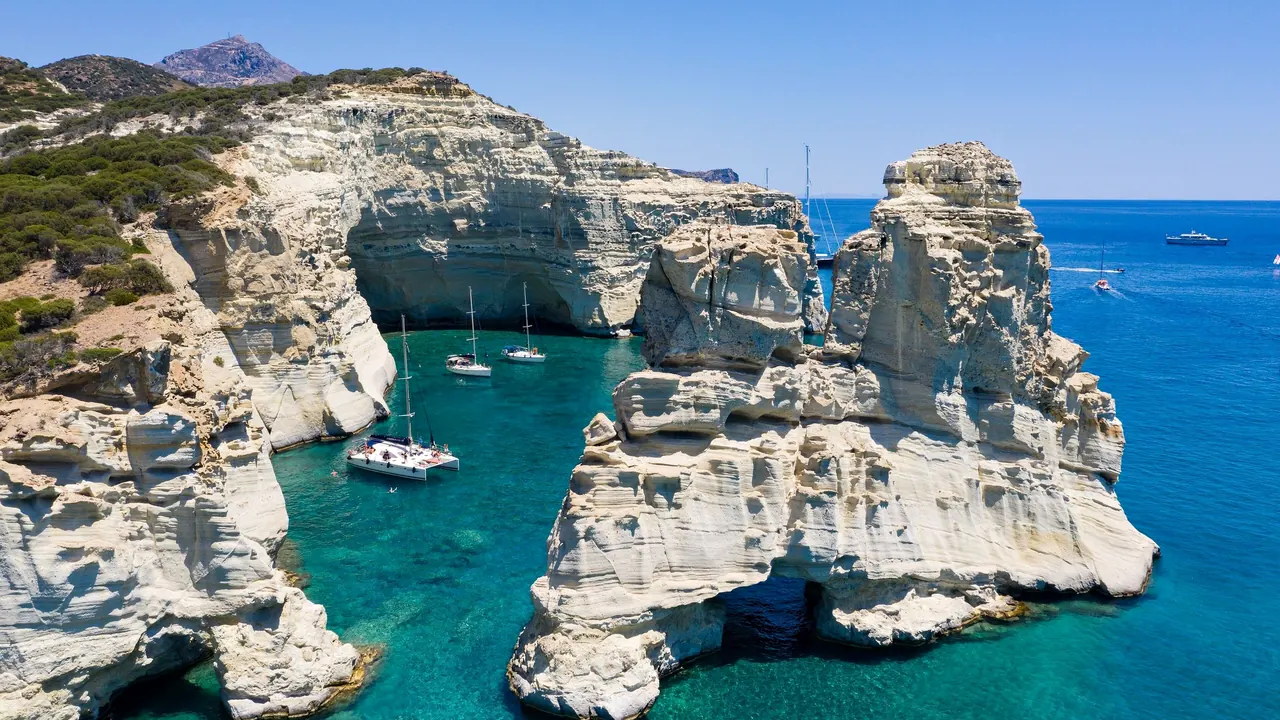
Milos suits a traveller whose whole idea of a trip is the sea. The volcanic coast gives white, red and grey rock, very clear water and beaches you reach by boat, all within a short drive of one base. Evenings are quiet and the sights are modest, so it works best as a slow island stay of swimming, boat trips and long dinners. It also helps if you don't mind summer prices or the effort of getting there.
Choose Peloponnese for
- culture and sights
- day trips
- prices
The Peloponnese is the better choice for anyone who wants more than a beach. It has Olympia, Mycenae, Epidaurus and Mystras, mountain gorges for walking, wine country around Nemea and a coastline that can stand up to Milos. It also costs noticeably less. The price is time in a hire car and bases chosen with care, because the region is large and its best places are spread out.
Scoreboard
Twelve categories on one fixed scale from 0 to 100. The shaded stretch is the gap between the two.
Your match
Pick a travel style or drag the sliders, and both match scores follow your weighting.
Wins on beaches with your weighting.
Wins on culture and sights and day trips with your weighting.
What matters to you?
Category by category
What the scores mean for a trip.
Beaches & swimming
Both coasts are excellent, so the difference is in kind. Milos packs extraordinary variety into a small island. You get Sarakiniko's white pumice inlets, the long sandy south-coast beaches such as Firiplaka and Tsigrado, and coves that can only be reached by boat. The north wind decides each day which side to swim on. Many beaches have no sunbeds or shade.
The Peloponnese spreads its beaches across a whole region, so you choose a coast. Messinia has Voidokilia's horseshoe and Navarino Bay, and Elafonisos has white sand and turquoise water in the far south. The Mani has pebble coves below stone villages, and Tolo near Nafplio has easy, sheltered beaches.
Food & drink
The Peloponnese eats better, mainly because of its produce and its wine. Kalamata olives and oil, slow-cooked goat and the Mani's cured pork fill village menus. Nemea's Agiorgitiko reds and the crisp Moschofilero whites from around Tripoli are made close by. Kalamata and Nafplio offer the widest choice, and Kalamata's covered market is worth a morning.
Milos has pleasant island cooking: waterfront fish tavernas in Pollonia and Adamas, grilled octopus in Klima, and local pitarakia cheese pies and ladenia flatbread. The range is narrow, though, and few people would plan a trip around it.
Culture & sights
There is a wide gap here. The Peloponnese holds a large share of ancient and medieval Greece: Olympia, Mycenae's Lion Gate, Tiryns, Epidaurus, Ancient Corinth and Messene. It also has the Byzantine town of Mystras, the rock of Monemvasia and Venetian castles at Methoni and Koroni. With Nafplio as an elegant base, a week of sightseeing would still not cover it all.
Milos has more than most small islands, including the early Christian catacombs, the field where the Venus de Milo was found before it went to the Louvre, a Roman theatre and Bronze Age Phylakopi. Two days covers it all.
Nightlife
Neither place is a party destination, but the Peloponnese has more going on after dinner. Nafplio's old town and waterfront stay busy late in summer, and Kalamata's seafront fills with locals. Patras, the university city on the north coast, has the only real club streets, though it is far from most beach bases.
On Milos, the evening's main event is the sunset from Plaka's castle hill, followed by dinner and a drink in Adamas or Pollonia. A few bars stay open late in high summer and nothing more.
Nature & outdoors
Milos's beauty is coastal and best seen from the water. Visitors take sailing or kayak trips past the coloured cliffs of Papafragas and Firopotamos and the rock towers of Kleftiko. Inland the island is dry and marked by quarries, and its trails are pleasant rather than memorable.
The Peloponnese offers far more for walkers. Taygetos rises to about 2,400m above the Mani. The Lousios gorge links cliffside monasteries and stone villages, and the Menalon Trail crosses Arcadia. There are also the Vouraikos gorge with its rack railway, the bird lagoon at Gialova, and skiing on Chelmos in winter.
Day trips
From Milos, outings mean ferries. Quiet Kimolos is a short crossing from Pollonia, and in summer Sifnos can be done in a day. Everything depends on the timetable and the wind.
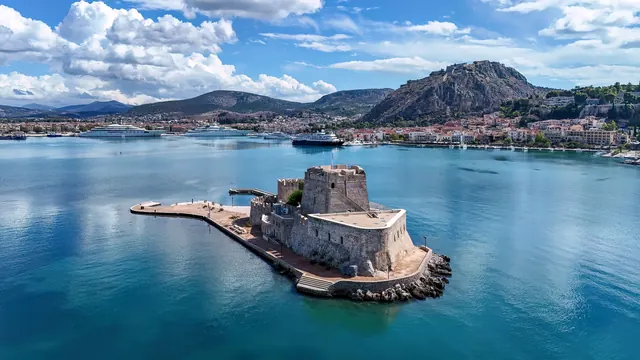
The Peloponnese gives far more choice by car. From Nafplio you can visit the Nemea wine villages, take a ferry to car-free Hydra and Spetses, or reach Athens in about two hours. From the south and west you can see Monemvasia, Elafonisos, Pylos, Methoni and the Mani villages.
Good for families
Neither place has attractions made for children, and in both a beach vacation works best. The Peloponnese makes it a little easier. There are shallow sandy bays at Tolo and in Messinia, resort hotels with kids' clubs and pools, and Nafplio is easy to stroll with a pushchair. Older children can also climb around Mycenae or Olympia early in the morning.
Milos has gentle south-coast beaches and a sheltered beach in the village at Pollonia. However, many of the best spots involve dirt tracks or boats, shade is scarce, and the ferry crossing can be rough for children.
Getting around
Both need a car once you arrive, but the problems are different. Milos is small, and nowhere is more than about forty minutes from Adamas. The hard part is reaching the island at all, by a long ferry or a short flight from Athens. Once there, rough dirt roads in the west and boat-only beaches complicate things.
The Peloponnese can be reached by road from Athens, and motorways link the main towns quickly. The distances are real, though, and winding mountain and Mani roads make short-looking journeys slow. Buses rarely reach the sites or beaches.
Shopping & style
Shopping on Milos is something you do on the way to the sunset: a stroll past Plaka's small boutiques with linen, jewellery and ceramics, then capers, honey and sweets to take home.
The Peloponnese offers a little more, though nobody comes for it. Nafplio's old lanes have jewellery, worry beads and ceramics, Nemea's wineries sell their bottles directly, and Kalamata and Tripoli hold lively weekly markets. Patras and Kalamata cover ordinary high-street needs.
Affordability
The Peloponnese is clearly cheaper. Village rooms in the Mani and Arcadia and everyday taverna meals are good value, and costs rise mainly in Nafplio, the Messinian resorts and the coast in high summer. The hire car, fuel and site entry fees are the main costs.
Milos is expensive in July and August because of its rooms, which book out early in Pollonia, Plaka and Adamas. Car hire and boat trips to Kleftiko add to the bill. In both places, June and September are noticeably kinder to the budget.
Live music & performing arts
The Peloponnese has one great reason to book tickets: ancient drama under the stars at Epidaurus on summer weekends, where the acoustics need no amplification. Add Kalamata's dance festival in July and concerts at the Little Theatre nearby.
Milos has almost no formal stage. Its live music comes from the village panigyria, saints'-day feasts with violin, lute and dancing late into the night. They are a delight if you happen upon one, but you cannot plan a programme around them.
Wellness & relaxation
In both places the slow pace restores people more than any spa does, and the difference lies in how you bathe. Milos's volcano still warms the ground, so you soak in rustic springs at Lakkos in Adamas and near Provatas, or feel the warm sand and seabed at Paliochori. A few hotels around Pollonia and Plaka add treatment rooms.
The Peloponnese has more formal bathing. There are old spa towns at Loutraki and on the volcanic Methana peninsula, sulphur springs feeding the lake at Kaiafas, and the region's most complete hotel spas on the Messinian coast.
When should you go?
Pick your month. The climate figures are measured averages, not a forecast.
Milos in July
Peloponnese in July
Daytime high, °C
Rainfall in the month, mm
Where the figures come from
Milos has no weather station within reach, so its figures come from a gridded climate model rather than a measured record, and read a broad area rather than one spot.
Peloponnese's temperatures are measured 89 km from the centre, at Kalamata Airport.
Peloponnese has no rain gauge within 25 km of the centre, so its rainfall comes from a gridded climate dataset read at the destination rather than from a gauge further away.
Temperature and rainfall are climate normals, averaged over the years shown. Milos: 2001-2020 normals, NASA POWER reanalysis grid, no weather station within 90 km. Peloponnese: 1991-2020 normals, Kalamata Airport (89 km from centre).
Both are dry from June to August and both seas are warm enough to swim from June to October. They differ most in high summer. Milos stays milder, with highs around 27°C, while the Peloponnese coast where most visitors stay reaches about 32°C in July and August, with long, cloudless days. That is fine for the beach but hard going at shadeless ancient sites at midday. The Peloponnese sea is slightly warmer at its peak, about 26°C.
For combining sightseeing or walking with swimming, May, June and September suit the Peloponnese best. On Milos, spring and autumn are the walking seasons, and June and September give warm water without the August heat. Rain sets in from October on both, and Milos has the wetter winter, with around 100mm a month from December to January. Neither is a winter beach destination.
Which traveller are you?
For a beach and sun trip built around swimming, Milos has the edge in kind. Sarakiniko's pumice inlets, coloured cliffs and boat-only south-coast beaches all lie within a short drive of one base, whereas the Peloponnese makes you choose a coast.
On a culture and arts trip, choose the Peloponnese. Milos's catacombs and small museums fill a couple of days. Mycenae, Epidaurus, Olympia, Messene, Mystras and Monemvasia share one region, and summer weekends bring drama to the ancient theatre at Epidaurus.
On a tight budget, the Peloponnese goes further. On Milos the main cost is summer rooms, which are expensive and book out early. In the Peloponnese it is the hire car, while family-run rooms in Mani and Arcadian villages and taverna meals stay cheap.
Before you go
| Measure | Milos | Peloponnese |
|---|---|---|
| Official language | Greek | Greek |
| Currency | Euro (EUR) | Euro (EUR) |
| Sockets | CF230 V, 50 Hz | CF230 V, 50 Hz |
| Driving side | Right | Right |
| Time zone | UTC+2, UTC+3 in summer | UTC+2, UTC+3 in summer |
| Emergency number | 112 | 112 |
| Main airport | Milos Airport (MLO)2 non-stop destinations | Athens Eleftherios Venizelos International Airport (ATH)176 non-stop destinations |
| Public holidays this year | 15 days | 15 days |
By the numbers
| Measure | Milos | Peloponnese |
|---|---|---|
| Swim season, months above 21 °C | 5 months | 5 months |
Where else could you go?
Every comparison below shares a destination with this one, so you can follow Milos or Peloponnese somewhere new.