Ios or Milos?
Our verdict in twelve categories, each scored against the same fixed benchmark cities, and the climate month by month, so you can choose for your trip.
Choose Ios for
- nightlife
- prices
- day trips
Ios is the island for a young crowd that wants golden sand by day and bar-hopping through the lanes of Chora until dawn, with Mylopotas serving as both the beach and the afternoon party. It is also the easier of the two on a modest budget, still keeps its hostels and campsites, and sits well placed for a day on Santorini or Naxos when the summer boats are running.
Choose Milos for
- wellness
- families
- nature and the outdoors
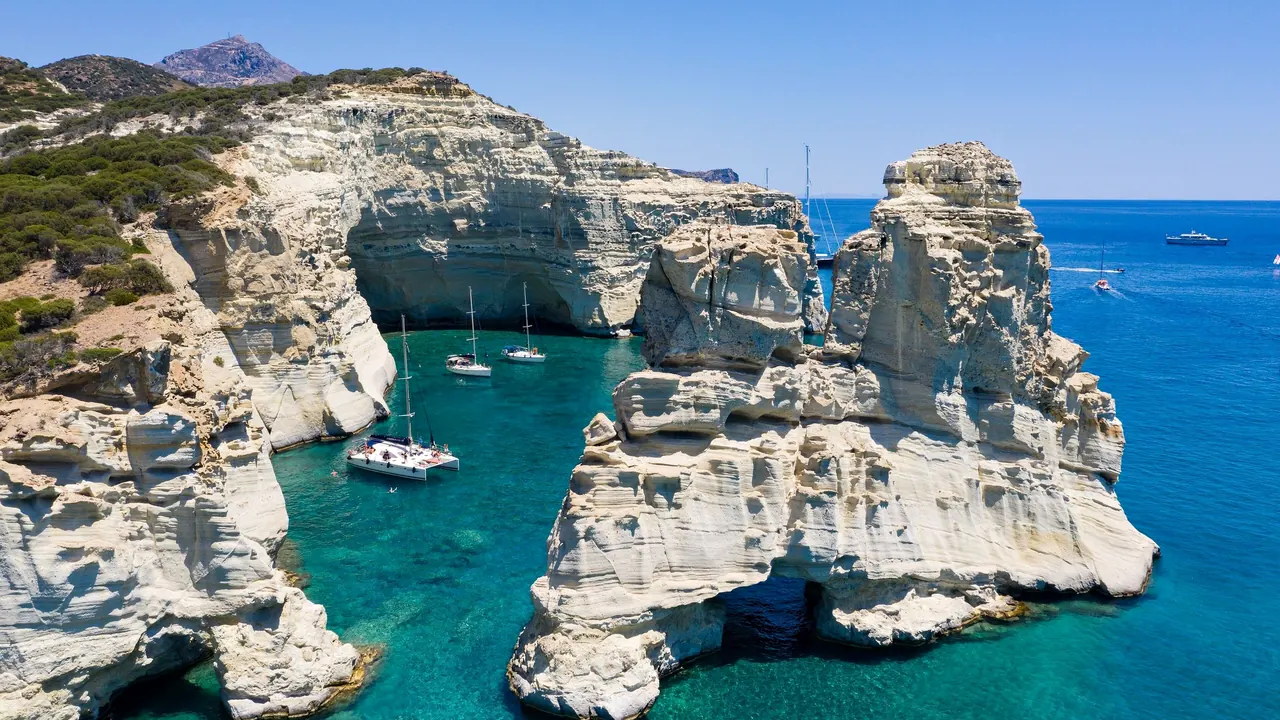
Milos suits a slower, more grown-up beach trip built around the coastline itself: the white pumice of Sarakiniko, the coloured cliffs, the sea caves of Kleftiko seen from a boat, and warm springs to soak in afterwards. It costs more and you need a hired car, but in return you get better island cooking, more history and quiet evenings. In high summer it is a far easier choice for families than Ios.
Scoreboard
Twelve categories on one fixed scale from 0 to 100. The shaded stretch is the gap between the two.
Your match
Pick a travel style or drag the sliders, and both match scores follow your weighting.
Too close to call, 2 points apart
Wins on nightlife and prices with your weighting.
Wins on wellness and families with your weighting.
What matters to you?
Category by category
What the scores mean for a trip.
Beaches & swimming
These are two of the stronger beach islands in the Cyclades, and both are sandy and clear-watered. They differ in character. On Ios the beaches are golden and often social: Mylopotas has sunbeds, water sports and a crowd from late morning, and the quiet alternative is the sheltered, shallow coves of Manganari in the south.
Milos is more varied and wilder. Its volcanic coast gives white pumice inlets at Sarakiniko and long south-coast beaches such as Firiplaka and Tsigrado, some reachable only by boat, and many have no sunbeds or shade at all. On both islands the summer north wind sends swimmers to the south coast.
Food & drink
Neither island is a food destination, but Milos gives you more to discover. It has its own dishes, small pitarakia cheese pies, ladenia flatbread and a watermelon pie, as well as fish tavernas on the waterfront at Pollonia and Klima and honest cooking in the inland villages.
Ios has its soft skotyri cheese and some careful kitchens in Chora and Yialos. In high summer, though, many places switch to gyros and pizza for the late crowd, so a good meal takes more searching than it does on Milos.
Culture & sights
Milos holds noticeably more history. It has early Christian catacombs, the field where the Venus de Milo was found, a marble Roman theatre above the bay, the Bronze Age site at Phylakopi and a mining museum. Add the painted boathouses at Klima and you have enough for a couple of days.
On Ios the sights fill a few hours: the whitewashed lanes and windmills of Chora itself, the Early Cycladic walls at Skarkos and the hilltop at Plakotos that tradition calls Homer's tomb.
Nightlife
This is where the two islands part company most sharply. Ios has long been a party island, and from June to September Chora's old lanes fill with small bars and a few larger clubs that stay open until dawn, while Mylopotas adds beach parties that roll into the evening. The scene is young, loud and built on cheap drinks.
Evenings on Milos are a sunset from Plaka's castle hill, a long dinner and a drink on the harbour at Adamas or Pollonia. A few bars stay open late in high summer, but nobody comes here to dance.
Nature & outdoors
Milos has the more remarkable landscape, because its volcano shaped it. You can see white pumice ravines, red and yellow cliffs at Firopotamos and Papafragas, sea arches, and the rock towers and caves of Kleftiko, all best seen from a sailing boat or a kayak, and the island has a small snorkelling scene.
Ios is barer and more terraced. Old mule tracks there climb past chapels towards Profitis Ilias, and windsurfers make use of the summer wind at Mylopotas. It is pleasant walking country, but its coast does not match the drama of Milos.
Day trips
Ios sits better for island-hopping by day. Santorini is about an hour or less by fast boat, with the caldera villages and the Bronze Age town of Akrotiri, and Naxos, Sikinos and Folegandros are all within reach in summer.
From Milos the reliable outing is the short crossing from Pollonia to quiet Kimolos, with Sifnos possible on the summer fast boats. On both islands a day away depends on ferry times and the wind.
Good for families
Milos is the better family base. Pollonia has a sheltered beach in the village, the south-coast beaches at Provatas and Paliochori shelve gently, and the nights are quiet. The catch is that a car is needed for almost everything, and shade is scarce in midsummer.
Ios has good shallow bays at Manganari, but in July and August the island belongs to the party crowd, and Chora's steep steps defeat a pushchair. Families there do best in June or September, staying near the southern beaches.
Getting around
Ios is easier once you have arrived. The harbour at Yialos, Chora and Mylopotas form a compact triangle linked by frequent summer buses and an old stepped path, so a stay built on beach and bars needs no car. Getting there always means a ferry, since Ios has no airport.
Milos can also be reached by a short flight from Athens, but once there the buses reach only a few villages and beaches. A hired car or quad is close to essential, though some rental agreements exclude the rough dirt roads of the western half, so check yours. Separately, Kleftiko and several beaches are easiest reached by boat.
Shopping & style
Neither island is a shopping trip, and the offer on both is small. On Ios the shops in Chora sell beachwear, sandals and jewellery late into the night for the evening crowd. On Milos the boutiques in Plaka lean towards linen and ceramics, and its capers, honey and sweets make more distinctive things to take home.
Affordability
Ios is the gentler island on the wallet. Its backpacker past survives in hostels, campsites, simple rooms near Mylopotas and cheap grill food, even if comfortable rooms in high season still cost a good deal.
On Milos the rooms in Pollonia, Plaka and Adamas are expensive in July and August and book out early, and car hire and boat trips push the bill up further. On both islands June and September give the same warm sea for noticeably less.
Live music & performing arts
There is hardly any stage life on either island, so the real difference is in the kind of music you hear. On Ios the music is mostly in the bars, with occasional summer concerts at the open-air theatre by the windmills. On Milos the summer panigyria, village saints'-day feasts with violin, lute and dancing late into the night, are the more memorable way to hear live music.
Wellness & relaxation
Milos is by far the more restful island, and it has something Ios lacks entirely: volcanic heat. You can soak in the rustic baths at Lakkos and the springs near Provatas or lie on the warm sand at Paliochori, and the slow pace of the island does the rest.
Ios has no bathing tradition, and its summer rhythm is late nights rather than rest. A few boutique hotels offer massage and yoga, but calm there means coming in June or September and staying near Manganari.
When should you go?
Pick your month. The climate figures are measured averages, not a forecast.
Ios in July
Milos in July
Daytime high, °C
Rainfall in the month, mm
Where the figures come from
Ios's temperatures are measured 41 km from the centre, at Santorini Island / Monólithos.
Ios has no rain gauge within 25 km of the centre, so its rainfall comes from a gridded climate dataset read at the destination rather than from a gauge further away.
Milos has no weather station within reach, so its figures come from a gridded climate model rather than a measured record, and read a broad area rather than one spot.
Temperature and rainfall are climate normals, averaged over the years shown. Ios: 2000-2025, 12 years observed (rainfall 1991-2020) normals, Santorini Island / Monólithos (40.9 km from centre). Milos: 2001-2020 normals, NASA POWER reanalysis grid, no weather station within 90 km.
Both islands are dry from June to September, and both have a sea warm enough for comfortable swimming from June into early October, at about 24°C in August. The difference is the heat. Around Chora on Ios, July and August afternoons reach about 30°C, which leaves walking the stepped lanes and mule tracks to the early morning and evening. Milos stays several degrees cooler at about 27°C, so midsummer days there are kinder for getting out of the water and exploring.
Spring and autumn are the walking seasons on both. April and May are dry and mild, though the sea is still cool for swimming. September is the best month on either island, with warm water and gentler heat. The rain arrives in October and settles in through winter, and Milos is the wetter of the two, with over 100mm in December and January.
Which traveller are you?
On a food and nightlife trip, Ios wins on the nights, when the island stays up until dawn and moving from one bar to the next is the whole point. Milos eats a little better but goes to bed after dinner.
For a relaxing and wellness trip, Ios only really works outside the peak weeks, when the party crowd has gone. Milos is the natural choice: its volcano gives it warm water to soak in, which Ios lacks, and evenings end early.
On a trip on a tight budget, Ios is the easier island. It still caters for young travellers counting their money, and its main stretch can be done without a car. Milos costs more in summer, above all for a bed.
Before you go
| Measure | Ios | Milos |
|---|---|---|
| Official language | Greek | Greek |
| Currency | Euro (EUR) | Euro (EUR) |
| Sockets | CF230 V, 50 Hz | CF230 V, 50 Hz |
| Driving side | Right | Right |
| Time zone | UTC+2, UTC+3 in summer | UTC+2, UTC+3 in summer |
| Emergency number | 112 | 112 |
| Main airport | Santorini International Airport (JTR)60 non-stop destinations | Milos Airport (MLO)2 non-stop destinations |
| Public holidays this year | 15 days | 15 days |
By the numbers
| Measure | Ios | Milos |
|---|---|---|
| Swim season, months above 21 °C | 5 months | 5 months |
Where else could you go?
Every comparison below shares a destination with this one, so you can follow Ios or Milos somewhere new.